


TL;DR
This guide assists travel agencies from retail OTAs to niche tour operators in making the choice between SaaS or custom booking engine software. It includes total cost of ownership, supplier integration realities, and a step-based expansion strategy designed for travel operations. If you are assessing your booking platform in 2026, this is your decision framework
Why Your Booking Engine Software Decision Is the Most Important Tech Choice Your Agency Will Make
Your agency is growing. Bookings are increasing. But your existing system is holding you back from manual vouchers, missed reconfirmations, to supplier errors and a checkout flow that drops customers before they even convert.
All of those were a strategic point every growing agency comes to: invest in a SaaS booking platform, or assign custom travel booking engine software development? Both paths carry real trade-offs. Neither is universally right.
Hilton’s 2024 Trends Global Survey, reveals that the ability to book completely online is a key consideration for eight out of ten travelers. Moreover, 48% of consumers recently reported that they switched energy providers due to a bad booking experience (Salesforce’s State of the Connected Customer (2024)). Your booking engine means your storefront, your operations hub, and your revenue engine all in one system.
Key Terms You Will Encounter in This Guide
Booking Engine Software: The technology system that connects a traveler’s search query to live supplier inventory, pricing rules, and payment processing in real time and manages all post-booking operational workflows.
Mid-Office: The operational layer of a travel booking system that manages post-booking workflows, including voucher generation, supplier reconfirmation, task queues, and change or cancellation handling.
White-Label Booking Platform: A SaaS booking engine that can be rebranded and deployed under an agency’s own brand identity, without the agency building the underlying technology infrastructure.
SaaS (Software as a Service): A cloud-based software delivery model where the vendor hosts, maintains, and updates the platform. The agency pays a recurring subscription or per-booking fee, rather than owning the software outright.
What Is Booking Engine Software and Why Should Travel Agencies Think About It Differently?
Booking engine software is the underlying technology layer that fuels how a traveler searches, prices and pays for a trip as well as how your agency manages each operational step that comes next. For travel agencies, this decision has more operational implications than most other businesses because the technology impacts suppliers, finances, compliance and customer experience all at once.
What Does a Travel Booking Engine Actually Do?
A travel booking engine operates on multiple interlinked layers at the same time:
Search layer: GDS networks, bed banks and direct supplier APIs queried for live inventory
Pricing and rules engine: Applies markups, commissions and net vs. gross rate logic
Payment layer: PCI-compliant transaction and multi-currency processing
Mid-office layer: Voucher, reconfirmation workflows and operational task queue management
Back-office layer: Invoicing, supplier reconciliation, financial reporting
Each layer of the Pyramids represents a different build-or-buy decision. An argument for the entire flow and handling of your process, a bad decision at any one level creates bottlenecks not just in technology but when your team works day to day.
Why Does This Choice Carry More Operational Weight for Agencies Than for Most Other Businesses?
The majority of companies weighing the SaaS versus custom software decision are picking how to manage one workflow with an e-commerce checkout, a customer relationship management (CRM) system or a scheduling tool. The booking engine of a travel agency is separate. Simultaneously, it has to manage real-time supplier inventory over various GDS networks and bed banks, enforce complex pricing and commission rules, process PCI-compliant payments, produce legally required travel documentation and support post-booking workflows such as reconfirmations and changes.
A retailer that chooses the wrong e-commerce platform can transition in months. But when an agency chooses the wrong booking engine, it breaks supplier relationships, financial reconciliation, and customer-facing operations all at the same time. The stakes are simply higher.
According to Gartner’s Software Market Report, by 2025–2026, SaaS solutions are responsible for 70% of new business software deployments worldwide. Moreover, according to Phocuswright research, agencies utilizing online booking systems had an average of 27 percent more revenue. But most agencies are still making this call without a travel-specific framework, and that is the gap this guide addresses.
" This is not a software decision for travel agencies; booking platform choice is an operational strategy decision.”
SaaS vs. Custom Travel Booking Engine Software: A Clear Comparison for Agencies
SaaS booking engine software delivers agility, out-of-the-box supplier connectivity and reduced upfront investment. Custom travel booking engine software development gives you complete control over your platform and provides better long-term return on investment (ROI) but comes with a high level of execution risk. Whether this is the right choice or not, it depends entirely on your agency’s type and growth stage.
How Does SaaS Online Booking Engine Software Work for Agencies?
A SaaS booking platform is a multi-tenant system that is hosted and maintained by the vendor on a subscription basis. You do not build it , you configure it as an agency.
Significant benefits for travel agencies are:
- Connectivity to GDS systems, low-cost carriers and hotel wholesalers
- PCI compliance is managed at the vendor level, eliminating a significant operational burden
- Automatic Software updates and infrastructure maintained by the provider
- Deployment speed: Average time-to-go live for SaaS platforms is 4 to 6 weeks vs. 36 to 54 weeks for a custom build (McKinsey Digital)
There are different types of SaaS applications for Travel Agency. Subscription-based platforms take a set monthly payment. Revenue-share models are charged per completed booking. Total customization of the brand is done on white-label platforms. API-first headless providers hand the agencies the booking logic and omit the front-end, enabling a custom interface to build on top.
That trade-off is the reliance of fellow roadmaps. Your product capabilities evolve in line with the vendor’s development priorities not yours.
What Does Custom Travel Booking Engine Software Development Actually Involve?
Custom development refers to building your booking platform from scratch. Every layer is owned by your team or an external development partner: the supplier API integrations, pricing logic, mid office workflows and branded portals.
This model offers agencies their own rules of pricing, the configuration of commission structures, and operational workflows that cannot be duplicated on an out-of-the-box platform. But the execution risk is high. According to the Standish Group CHAOS Report (2024), 66% of custom enterprise software projects do not fulfil time, cost or scope expectation
In addition, custom systems impose a heavy continuous cost penalty. In fact, Forrester Research indicates that maintenance and personnel costs are 50% to 85% of the total lifetime cost of a custom system. It is a figure that most agencies dread to calculate at the planning stage.
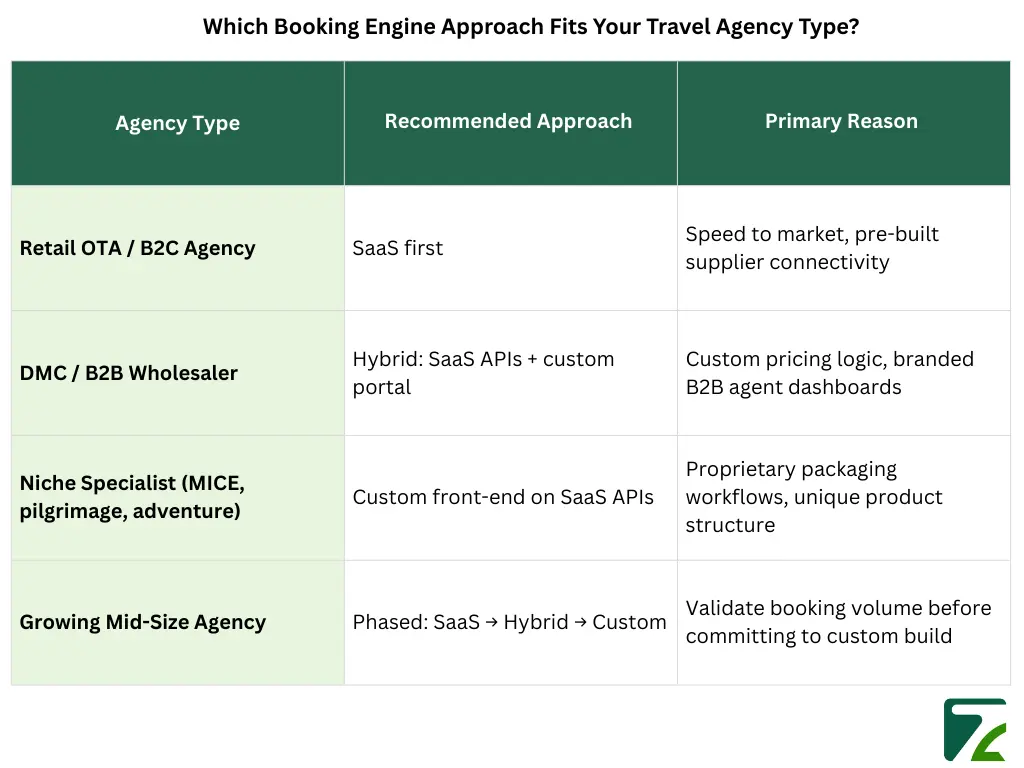
Which Type of Agency Should Choose Which Option?
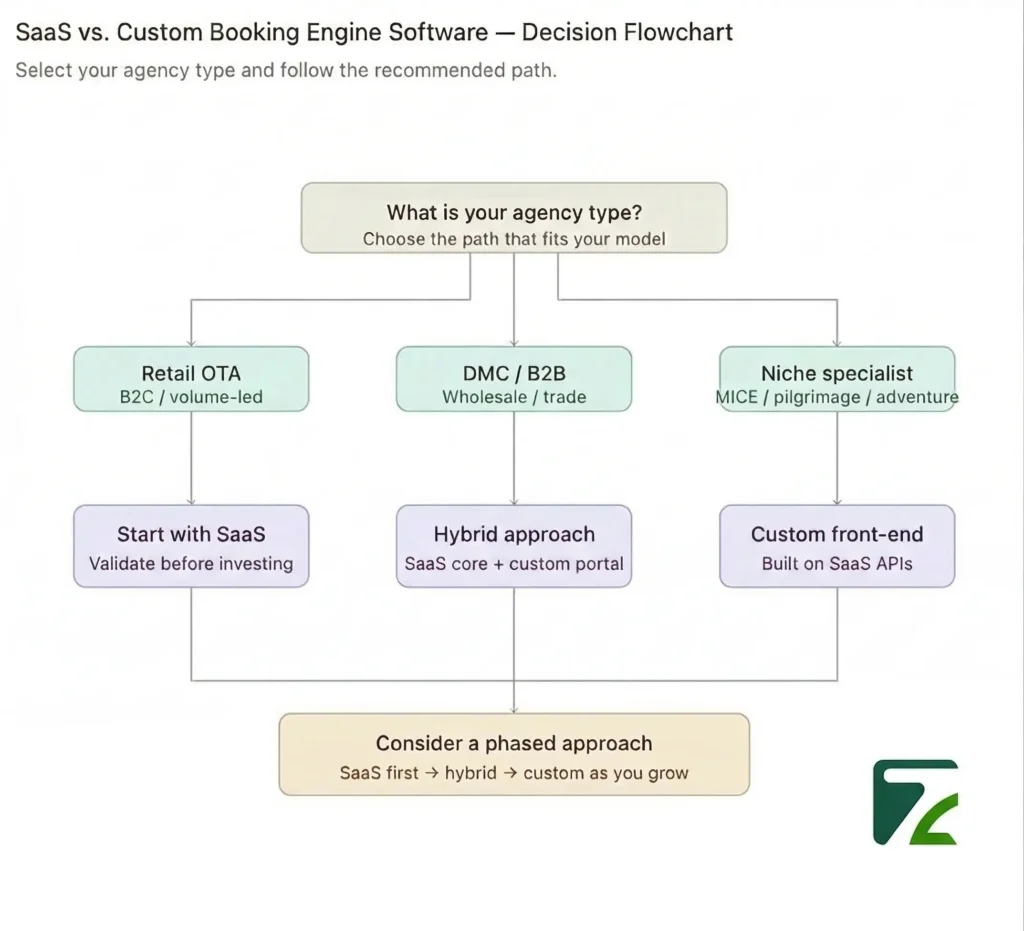
The right approach differs significantly by agency type, booking volume, and product complexity. The table below maps these clearly:
What Are the Real Supplier Integration Trade Offs?
With a SaaS platform, you inherit the vendor’s supplier connections. This translates to quicker product growth and less internal resources needed. But when you onboard new suppliers or bed banks, you also rely on the vendor’s integration roadmap.
With bespoke development you own every supplier API connection. Including integrations with GDS networks, bed banks and direct hotel APIs. It also requires dealing with schema changes when suppliers alter their API structures which they do frequently, and often with
It is fair to say that knowing your supplier mix before you select a platform is not up for debate. Agencies with a small number of deeply integrated direct supplier relationships may find custom development worthwhile. Most agencies that have multiple suppliers they need to connect in the cloud will find SaaS far more cost-effective.
“The agency that knows its supplier mix before even choosing a booking platform will always make a better decision than the one that leads with budget alone.”
How Should a Travel Agency Implement Its Booking Platform Without Getting It Wrong?
For an agency that is continuing to grow, a phased evolution approach is the best strategy. It gives agencies the opportunity to validate their model ahead of investing real capital in a bespoke build and reduces the chances of an expensive failed build outcome.
What Does a Realistic Phased Evolution Path Look Like?
Instead of attempting to build this as a forever, one-time decision, embrace this as a three-phase technology roadmap:
Phase 1 – SaaS Foundation: Launch a SaaS booking system with default supplier connectivity. Validate booking volume, product market fit, and customer demand first. Do not scale before this.
Phase 2 – Custom Layer: Create a custom branded front-end or B2B agent portal through the APIs provided by the SaaS platform. Inject intelligent/powerful pricing logic, markup rules, and white-labeled travel documents. This allows you to provide a differentiated customer experience without having to reinvent the booking core.
Phase 3 – Custom Mid and Back Office: As booking volume scales and operational complexity increases, build custom mid-office and back-office capabilities including automated reconfirmation workflows, dynamic packaging, supplier reconciliation while continuing to leverage where the SaaS booking core still shines.
This approach reduces risk significantly. It creates a proven platform onto which agencies can validate their product and distribution model before deploying capital to custom development. Most importantly, it prevents the classic trap of engineering an expensive custom solution before validating that the business model can actually support it.
"A booking engine that looks impressive in a sales demo on a desktop can still fail your customers during mobile checkout."
What Operational Factors Do Most Agencies Overlook During Platform Selection?
In addition to cost and the time it takes to deploy, there are three operational factors that always surprise agencies:
Reconfirmation and mid-office workflows: Who tracks down suppliers to confirm bookings prior to departure? That is an ongoing operating expense that differs even more widely between platforms. Many SaaS platforms come equipped with automated reconfirmation workflow. Agencies can encode their precise internal SOPs through custom builds. Neither is inherently better but the cost of getting this wrong, in missed reconfirmations and supplier disputes, is significant.
Mobile performance: 70.5% of worldwide online travel website visitors by mobile device (Statista, 2025). Research from Google and SOASTA shows that 53% of users abandon a booking if the page load takes longer than 3 seconds. In 2026, a platform that works great on desktop and dismal on mobile is not an option.
Compliance obligations: Whether using a hosted solution or building your own, some compliance obligations always remain: PCI-DSS for card data storage, Package Travel Directive in Europe, regional tax compliance, and so on. PCI compliance is generally a vendor-level concern with SaaS platforms. For custom builds, this is fully the agency’s responsibility.
"The agency that phases its technology investment reduces risk without sacrificing long-term competitive advantage."
What Are the Measurable Outcomes of Choosing the Right Booking Engine Software?
These results have an important and quantifiable financial and operational impact. But numbers are more nuanced than a straight cost comparison might indicate.
For the custom booking system, the 5-year total cost of ownership for a mid-sized operation has reached almost $3,375,000, according to Forrester Research. By comparison, a modern SaaS platform costs around $1,020,000 for 10 years this represents a 70% cost reduction. On the other hand, Nucleus Research (2024) states that businesses with custom solutions boast an average five-year ROI of 55%, whereas ROI for SaaS only reaches 42%. So cost alone should be a poor motivation for this decision.
According to GetApp Research, online booking systems save 8 hours per week in administrative time for businesses. Adobe Digital Insights also reported that mobile-optimised booking forms convert 31% better than non-optimised versions.
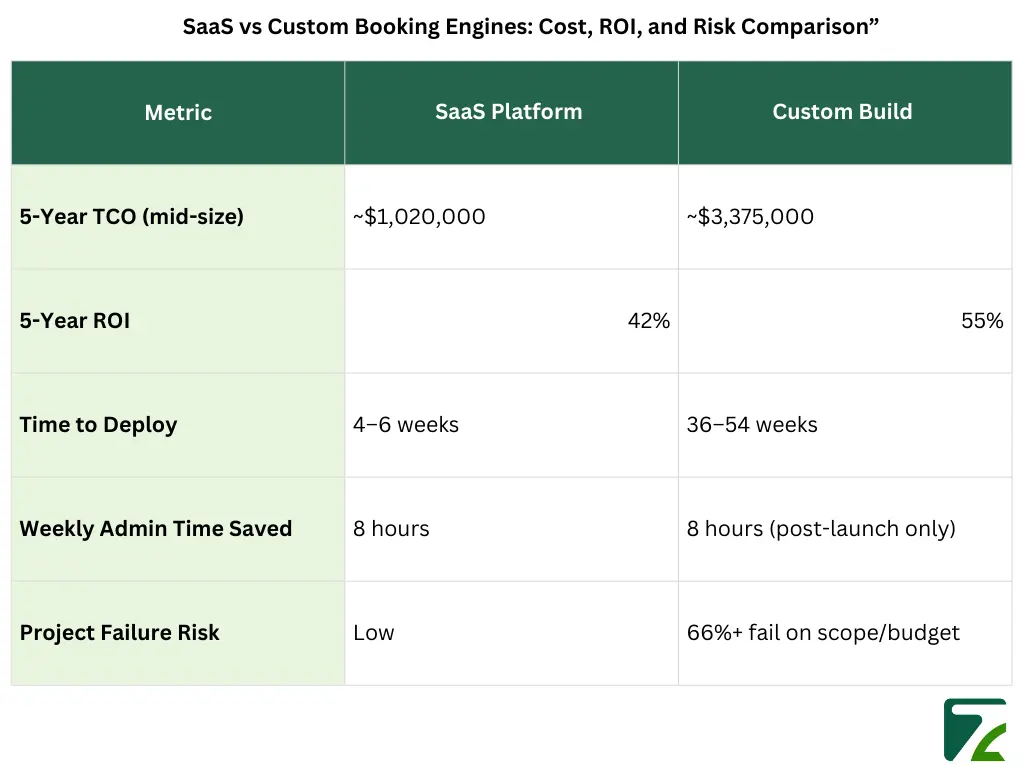
These numbers raise some questions that every agency should reason through prior to pursuing either path. Most of them are answered directly in the FAQ section below.
"For most growing agencies, SaaS wins on cost efficiency today , but custom wins on competitive differentiation tomorrow, provided the build succeeds."
Conclusion:
Between SaaS and custom travel booking engine software, there is no absolute answer. Which one is right for you depends on the type of your agency, your booking volumes, your supplier mix and how long you have until your next peak season.
But for most growing agencies all the evidence across the industry points to one thing: begin with a known SaaS booking platform, validate your model, and build bespoke capabilities only where they add real competitive advantage incrementally.
Those agencies that either pour too much into custom development before validating their model or remain on an inflexible SaaS platform long after they have outgrown it, seem to be the ones that continue to struggle the most. The best thing that may result from this decision stage is simply knowing which stage your agency is really in along with a realistic guiding light for what steps you should be taking next.
Be honest about your supplier mix, your team’s technical ability, and your growth timeline. And that evaluation more than any price comparison or feature list will direct you to the booking engine software that is right for your agency in 2026.