


TLD;R
This guide is for travel agencies and TMCs not corporate IT buyers. It covers what a corporate booking tool must deliver from an agency perspective: multi-client policy control, approval workflows, and real-time spend visibility. If your agency is still managing corporate clients through emails and spreadsheets in 2026, this article shows what is costing you and how to fix it.
Why Travel Agencies Are Losing Corporate Accounts Without the Right Corporate Booking Tool
Corporate travel is a booming market and discerning.
According to Fortune Business Insights, the global business travel market is expected to grow from USD 1.48 trillion in 2025 to USD 2.77 trillion by 2034 at a CAGR of 8.10%. The speed in India is much faster still. India Business Travel and Payments Study 2025 from GBTA shows that in 2024, the travel spends for business purposes in India stood at USD 37.2 billion with a projection of 15.5% growth in India on an average business travel spend per corporation per annum basis (compared to global average of exceeding more than double this at only around 6.6%).
Corporate customers are not only traveling more. They are demanding more from agencies that handle their travel. According to the 2025 Deloitte Corporate Travel Study, 60% of travel managers are actually working toward increasing compliant behavior with recommended booking activities in an effort to bring costs under control. That means corporate clients are now rating their agency by compliance rates, spend visibility and booking efficiency, not simply service relationships.
When an agency is unable to provide those things, the account shifts. It segues to a big TMC or one of the direct SaaS platforms that can.
What Is a Travel Booking Engine?
A travel booking engine is an online reservation system that connects a travel agency to its inventory suppliers and gives customers direct consumers or B2B agents the ability to search, compare, and book travel with real-time pricing and instant confirmation.
At the front end, it is the search-and-book interface your customers use. At the back end, it connects your platform to airlines via GDS or NDC, to hotels via bed bank APIs, and to tour operators, transfer providers, and activity suppliers through their own integrations. It handles the full transaction search, pricing, payment, and confirmation automatically, without manual intervention.
Every booking that bypasses this infrastructure and routes through a third-party OTA instead costs your agency 15–25% in commission per booking (Hotelogix, 2025). The booking engine is what allows you to sell directly and keep that margin.
Key Terms Worth Knowing
Corporate Booking Tool (CBT): A policy-enforcing online booking platform configured for corporate clients. It enables employees to self-book within pre-set rules ,unlike a B2C booking engine, which has no compliance or approval layer.
NDC (New Distribution Capability): An IATA-developed standard that allows airlines to distribute richer, more customised fare content directly to agencies and booking platforms going beyond traditional GDS limitations. As of April 2025, 905 travel agencies globally were reporting NDC transactions, up significantly year-on-year.
Multi-Tenancy : A software architecture that allows one platform instance to serve multiple separate clients each with their own isolated data, policy rules, and branding. This is the most important feature for any agency operating a CBT across multiple corporate accounts.
Maverick Booking / Booking Leakage:Travel spend that happens outside the approved booking channel. Fox World Travel’s industry data shows that traditionally, 37% of hotel bookings and 15% of flight bookings fall into this category eroding negotiated savings and making traveler tracking nearly impossible.
What Is a Corporate Booking Tool And How Is It Different from a Standard Booking Engine?
A corporate booking tool is more than a booking engine with a company logo on it.
When a traveler logs into a CBT, they see only those options that meet their company’s travel policy. Fares over the approved cap are either blocked or flagged. Hotels outside the chosen programme initiate a request for approval. Multi-level sign-offs chains automatically activate according to the trip budget, destination or traveler class. The agency views all of that across each corporate client from one dashboard.
None of this happens in a standard B2C booking engine. All it does is allow users to search and buy. No policy layer, no approvals, logic and no reporting trail.
What Does Managing Corporate Travel Without a CBT Actually Cost?
The cost is real and measurable.
According to APQC benchmarks referenced by Rhocash (2025) the average time taken for processing each expense report manually is 18 minutes, month-end close cycles take from 10–15 days and error rates are in the range of 15–25%. With automation, processing falls to just 2–3 minutes per report, and close cycles shrink to 3–5 days.
On the booking side, Booking.com for Business research discovered that companies process on average 51,000 expense reports a year at about 20 minutes per report manually, and that nearly 19% of the reports contain errors or missing information.
For an agency that’s working with multiple corporate clients through inboxes and spreadsheets, each booking is a coordination exercise: request received, manual search, options emailed, response awaited, booking confirmed, record updated. That is not a corporate travel program. That is a reactive booking service and corporate clients in 2026 can tell the difference.
A corporation without a TMC is fulfilling travel requests, not managing any travel program.
What Core Capabilities Should a Corporate Booking Tool Offer Travel Agencies?
How Does Multi-Client Policy Configuration Work for Agencies?
Multi-tenancy is the non-negotiable requirement for agencies, and it’s also the most common functionality overlooked when assessing vendors.
This means different corporate clients running in a single instance of the platform; one client’s data, policies, approval chains, and branding are completely separated from each other. Client A has an ₹8,000-per-night cap for domestic hotels and three levels of approval. Client B– any international trip above ₹1 lakh needs CFO approval. Client C uses self-booking for junior staff, and agent-assisted booking for senior leaders. All of this is set up and managed via one agency console, but each client only sees their own portal.
A single-company deployment tool forces agencies to manage standalone instances for each client. That wipes out the whole efficiency improvement.
What Does an Effective Approval Workflow Look Like in a Business Travel Booking System?
A good business travel booking system will not rely on an inflexible, one-size-fits-all approval process. It allows agencies to set up approval logic that mirrors how each client’s organization operates.
The key elements to look for:
- Threshold-style triggers are approved for any booking that exceeds a cost threshold or is made less than 72 hours from departure
- Role-based routing line manager approves first, and finance approves second, for high-value trips
- Exception escalation: out-of-policy bookings automatically routed to the right approver, with policy context and compliant alternatives attached
- Auto-approval, low-risk trips: domestic, in-policy, preferred-carrier bookings by frequent travelers gets approved automatically to avoid slowing down the workflow
Each approval action be it approved or rejected or escalated or overridden must be time-stamped and stored. That log serves as the audit trail for client reporting and account renewals.
How Does Spend Visibility Help Agencies Serve Corporate Clients Better?
Spend visibility becomes a differentiator between booking vendors and a travel partner with strategic importance.
Real-time dashboards enable agencies to monitor clients from 4 angles: total spend by category, policy compliance rate, leakage volume, and supplier performance. If a client is heading toward a budget overrun, the agency sees it and takes action before the client does. When the quarterly review comes, the agency arrives with validated data: savings delivered, compliance improved, supplier performance tracked
A recent GBTA India study indicates that 76% of Indian corporate buyers use a self-service Online Booking Engine, but only 38% rate their program management maturity at the highest level. And that gap is where agencies executing proper CBT programs which have substantial reporting behind them can provide value that no email-based operation will ever be able to deliver.
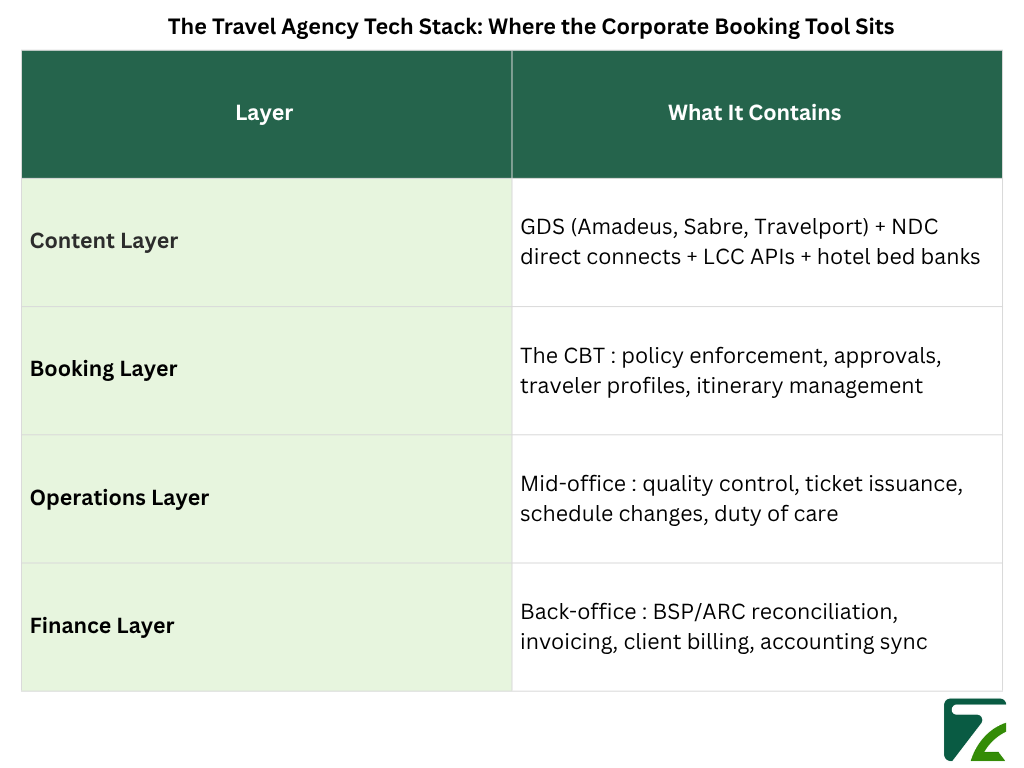
Where Does a Corporate Booking Tool Sit in an Agency's Tech Stack?
How Can Travel Agencies Implement a Corporate Booking Tool Without Disrupting Operations?
What Internal Readiness Does an Agency Need Before Going Live?
Getting this right before going live saves a lot of pain later. Three things to complete first.
Start with mapping the current workflow end-to-end where requests come in, how consultants work through them, how approvals are gathered, and how tickets get issued. A baseline that the CBT must be configured against.
Redefine consultant roles explicitly. Once a CBT is established, consultants stop processing bookings and start to address exceptions and provide clients with advice. Set new performance indicators before go-live, including client-by-client CBT adoption rate, exception intervention rate per 100 bookings, and policy compliance score.
Confirm the technical foundation: GDS credentials, mid-office API available and back-office data mapping. Try not to sign a vendor contract until you have done this.
How Should Agencies Phase the Rollout Across Corporate Clients?
Rolling out to all corporate clients simultaneously is a risky strategy. What works much better is a phased structure.
Phase 1 – Weeks 1-8: Pilot with three to five clients with clean, documented travel policy Run dual operations the CBT and the old workflow in parallel for four weeks, then move to full adoption.
Phase 2 – Weeks 9 to 16: Build configuration templates by client segment (SME domestic-only, mid-market mixed travel, enterprise international approvals) using learnings from the pilot. These templates reduce onboarding time for each subsequent client by a significant amount.
Phase 3 – Week 17 onward: Scale with templates. For each client, define a well-structured SLA document that outlines CBT uptime, supports response times, exception handling, and reporting delivery.
What ROI Can Travel Agencies Realistically Expect from a Corporate Travel Management Software?
The return on investment of a corporate travel management software investment can come from three sources.
The most immediate is operational efficiency. According to Rhocash’s benchmarks for 2025, automating booking and expense workflows reduce the processing time by transaction from 18 minutes to 2–3 minutes. For a mid-size agency with 500 corporate bookings a month, that’s a huge reduction in consultant hours and hours that are reallocated to account growth instead.
Revenue restructuring is the medium-term gain. CBT-enabled services can either be a per-booking tech (only) fee for SME self-service clients or delivered as a managed program retainer for enterprise accounts with CBT access, quarterly reporting and dedicated support. This moves agency revenue from reliance on transactional commission to predictable re-occurring revenue.
Client retention is a long-term payoff. According to Deloitte’s 2025 study, 49% of frequent business travelers now exclusively use corporate booking channels a jump from 43% in 2024. Agencies that can demonstrate compliance improvements, cost savings, and program data as part of a renewal conversation are in an inherently better position than those who cannot.
Agencies with a CBT retain corporate accounts. Agencies without one are left explaining why those accounts left.
Conclusion
In 2026, travel agencies winning and retaining corporate accounts are not competing on price. They are winning on program capability policy control, approval structure, spend visibility and the data to prove it.
This is only possible through the infrastructure of a corporate booking tool. Choosing the right one and properly configuring it to each client and reporting it generates to hit measurable value that’s how a booking agency turns into a travel program partner.
The market is growing. The client expectations are rising. Those agencies which invest now in the correct technology will lead the corporate segment in years to come.
Frequently Asked Questions
Can one corporate booking tool manage multiple corporate clients for a single agency?
Lorem ipsum dolor sit amet, consectetur adipiscing elit. Ut elit tellus, luctus nec ullamcorper mattis, pulvinar dapibus leo.
How does a corporate booking tool connect with GDS and non-GDS content?
A well-built CBT connects to GDS platforms for full-service airline and hotel content, NDC direct connects for richer fare options, LCC APIs for budget carriers, and hotel bed banks for accommodation. The wider the content connectivity, the more likely travelers will stay on-platform rather than booking outside the system.
What approval workflow works best for SME corporate clients?
A two-tier structure suits most SMEs: line manager approval for standard trips, finance or director approval above a defined cost threshold. Auto-approval for domestic, in-policy, preferred-carrier bookings by frequent travelers keeps things moving without losing control.
How do travel agencies generate revenue from a corporate booking tool?
Three main models: per-transaction technology fees charged to the corporate client, monthly managed program retainers bundling CBT access with reporting and support, and one-time implementation fees for onboarding new clients. Agencies can also use consolidated spend data across their client portfolio to negotiate better supplier rates benefiting both the agency and its clients.
What KPIs should a travel agency track when running a corporate booking program?
Track: CBT adoption rate versus offline bookings per client, policy compliance rate, average consultant intervention rate per 100 bookings, leakage volume, savings delivered against baseline, and revenue per corporate account versus cost to serve.