





TL;DR
The global online travel market is growing from $523 billion in 2024 to a projected $1.3 trillion by 2030. For travel agencies, that growth runs on API connectivity. This guide explains what a travel booking API is, which integrations your booking engine genuinely needs, how to evaluate providers, and the architecture mistakes that cost agencies clients and revenue.
The APIs Behind Your Booking Engine Shape Everything Your Agency Can Offer
The right travel booking API stack is not a technology decision it is a business decision.
Key Terms Worth Knowing
NDC (New Distribution Capability):An IATA-developed standard that allows airlines to distribute their full product content ancillaries, bundled fares, seat upgrades directly to travel agencies, outside the traditional GDS channel. NDC APIs give access to richer airline content that GDS does not always carry.
Bed Bank: A wholesale accommodation supplier that negotiates net rates directly with hotels and redistributes that inventory to travel agencies via API. Agencies apply their margin on top. Examples include Hotelbeds and RateHawk..
API Aggregator: A platform that connects to multiple travel suppliers and presents their combined inventory through a single API integration point. Aggregators reduce development complexity but add a cost layer and can introduce latency compared to direct connections.
Mid-Office: The operational layer between a booking engine and an agency’s financial back-office. It handles booking quality control, documentation (e-tickets, vouchers), queue management, and reconfirmation workflows.
Rate Limit: A restriction set by an API provider on how many requests a system can make within a given time window. Booking engines that exceed rate limits get throttled, which slows or breaks the search experience during busy periods.
What Are the Core API Integrations Every Travel Booking Engine Needs?
No single travel booking API covers everything. A modern travel agency booking engine usually comprises four to six separate integrations, each handling a different inventory/operation function. Below is a breakdown of each.
GDS APIs: Still Central, But the Ground Is Shifting
For agencies still relying on Amadeus Self-Service APIs, July 2026 is not a deadline to plan around it is one to have already acted on.
NDC APIs: What Airlines Are Offering Outside the GDS
New Distribution Capability (NDC) is a standard developed by IATA that enables airlines to distribute their complete product content ancillaries, bundled fares, seat upgrades and exclusive offers directly to travel agencies rather than through the traditional GDS channel.
The practical difference is significant. Agencies usually get standard fares and limited ancillary content via a GDS API. NDC enables airlines to deliver dynamic pricing, personalized bundles and content that just doesn’t show in GDS channels. British Airways, Lufthansa, Air France-KLM and Emirates among others have made NDC a strategic priority for their distribution.
That said, NDC implementation is not a linear or straight line each airline has its own way of deploying it. As such, connecting to multiple airlines over NDC will require either an aggregator layer or considerable development resource. Agencies need to determine if integrating directly with an NDC is appropriate for their technical competency and client type, or if an NDC aggregator better fits that bill.
NDC is not replacing GDS it sits alongside it, and agencies that ignore it risk losing access to competitive airline content.
Hotel and Accommodation APIs: What Goes Beyond GDS Hotel Inventory?
GDS hotel inventory covers major chains adequately. But to provide competitive rates and a wide range of accommodations, travel agencies require bed bank and wholesaler API connections outside the GDS.
What hotel API Sources Agencies Should Consider
- Hotelbeds : a leading B2B bed bank in the world with over 180,000+ properties
- RateHawk (Emerging Travel Group) : rich stock in the Eastern Europe, Middle East and Asia
- Juniper : some mid-size agencies are using this for hotel and package content aggregation
- Direct hotel chain APIs: for agencies with volume relationships with specific chains
The importance of multi-source hotel APIs is that they are more competitive in prices. The same hotel can negotiate different net rates with different wholesalers. An agency with a single hotel API source can never compete on price against agencies that aggregate across multiple sources. For most agencies this is a good starting architecture: a primary bed bank for breadth, and then one or two regional wholesaler connections.
For hotel inventory, one source is never enough agencies that aggregate across multiple bed bank APIs consistently offer better rates to their clients.
Payment Gateway APIs: The Integration That Breaks Operations When It Goes Wrong
A payment API that cannot handle multi-currency, refunds, and virtual cards cleanly will cost an agency more in operational overhead than it saves in transaction fees.
A Practical Look at the Major Travel API Providers
Choosing the most suitable travel booking API partner is one of the key decisions when building a booking engine. You need to choose what’s right for you, based on the size of your agency, the type of clients you are working with, technical capacity, or geographic focus. And on top of that, the commercial terms differ widely from provider to provider, so it’s worth doing a direct comparison before signing up. Here is a practical summary of the most frequently evaluated options.
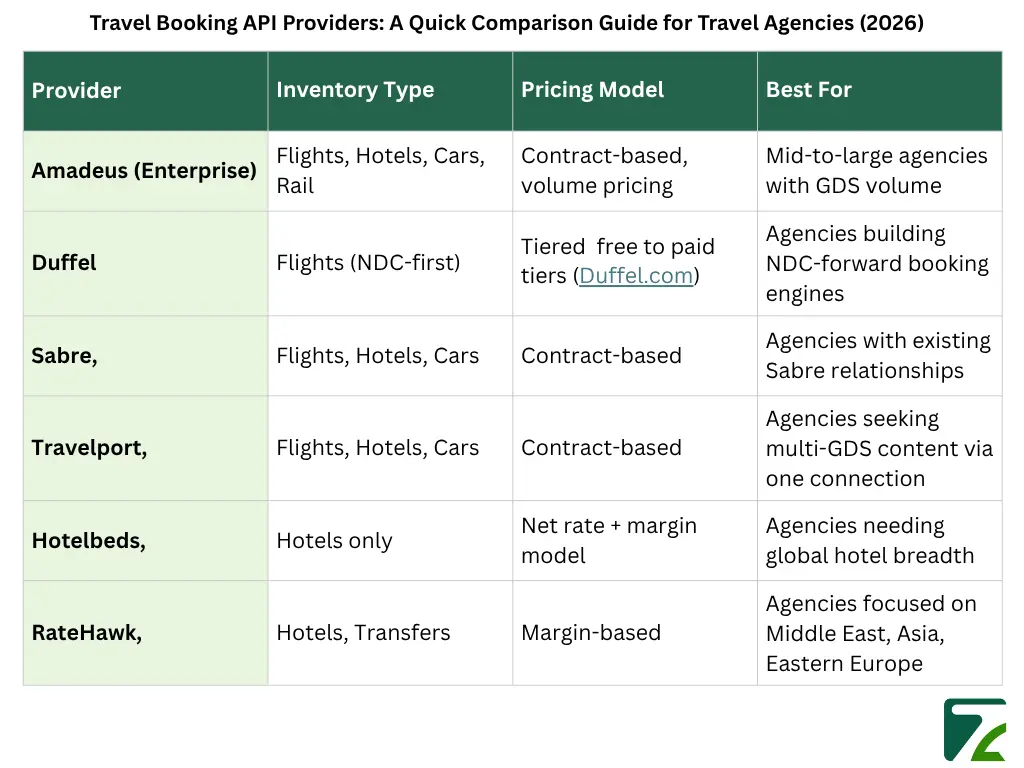
One important note:
With Amadeus phasing out its Self-Service portal in July 2026, agencies on that tier must decide soon whether to migrate to Amadeus Enterprise or pivot to alternatives such as Duffel for NDC-first flight content.
Choosing a travel API provider is not a one-time decision it should be reviewed annually as inventory access, pricing, and market conditions evolve.
How the Layers of a Travel Booking Engine Actually Connect
A booking engine is not a single system; it is a layered architecture that connects content sources through to the agency’s operational and financial back-end. Understanding how those layers are pieced together gives agencies insight into where any performance breakdowns happen and where they can deploy investment for the maximum operational return.
Content Sources → API Integration Layer → Booking Engine → Mid-Office → Back-Office and Payments
- Content Sources: GDS (Amadeus, Sabre, Travelport), NDC airline connections, bed banks (Hotelbeds, RateHawk), car rental APIs and transfer APIs. This is where the breadth of your inventory is determined: an agency with fewer source connections will always show you a smaller amount of options and worse rates than one with more diverse access.
- API Integration Layer: The middleware that combines, simplifies and speeds up API responses to make them reliable; When a search takes five seconds to show results this is typically the layer where delay originates either from poor caching, unoptimized API calls or no rate-limit handling.
- Booking Engine: The front-end and logic layer of the booking system where searches, pricing, and transactions are performed. This is what your clients touch directly and where a sluggish or error-prone API layer shows up right away as a bad booking experience.
- Mid-Office: Quality control, booking documentation, queue management, and reconfirmation workflows. Agencies lacking proper mid-office integration end up doing this work manually a straight bandwidth tax on staff time, not to mention an error source at scale.
- Back-Office and Payments: Invoicing, BSP/ARC reconciliation, payment gateway settlement & reporting. Weak integration here means reconciliation gaps, settlement delays and finance teams spending hours on end matching bookings to transactions that should (but don’t) reconcile automatically.
Architecture matters because reliability at the API layer determines everything downstream. API downtime increased 60% worldwide in 2025. For travel agencies, one API outage without a backup connection translates into broken reservations, pissed off customers, and lost income. Redundancy and fallback logic aren’t optional extras; they are operational requirements.
A booking engine is only as reliable as its weakest API integration building in redundancy from the start costs less than fixing failures later.
What Are the Most Common Travel API Integration Mistakes?
The most common mistakes when integrating a travel booking API are not technical errors they are planning failures that turn into costly operational issues once in production.
- Relying on a single content source.A single GDS connection is a single point of failure. If a connection is down or does not havean specific airline’s content, the booking engine returns nothing.
- Ignoring API rate limits.Each provider applies limits on how many search requests per second or minute you can make. Agencies that ignore rate limits while in development get throttled in high traffic times, slowing downor completely breaking the booking experience.
- No fallback or redundancy planning. As API downtime is up 60% in 2025 , agencies without fallback logic suffer complete outages when their primary connection goes down. Consequently, just one unplanned downtime can cost an agency client trust that takes months to reestablish.
- Treating payment API as an afterthought.Average agencies that include payment integration as their last scope item and race through it, give you flimsy multi-currency support, reconciliation data too weak to do any proper reconciliations on and refund workflows that requires a lot of manual touch.
- Not accounting for mobile performance.70.5% of travel browsing is mobile but only converts at 0.7% versus 2.4% on desktop. Much of that gap can be traced back to travel booking API response latency. Slow API responses lead to slow search results, and slow search results lead to abandoned bookings.
The most costly API integration mistake is assuming the work is complete when an integration goes live not when it performs reliably at scale.
Conclusion:
The international online travel industry is only picking up speed. Booking engines are processing $523 billion in travel commerce in 2024 and projected to grow to $1.3 trillion by 2030. Volume of this type is only increasing every transaction runs on API connectivity.
No one travel booking API does it all. And when it comes to a modern, competitive booking engine, that means an intentional mix GDS for wide flight coverage, NDC for deeper airline content, multi-source hotel APIs to maintain rate competitiveness, and a payment gateway engineered holistically around the complexity of travel’s multi-currency, multi-organization world. The mid-office connection that ultimately integrates it all is the layer agencies underinvest in until it breaks.
Architecture is just as important as the integrations themselves. The 2025 global API downtime up to 60% means that agencies who implemented redundancy and fallback logic into their booking engine are operationally resilient. And those who haven’t will endure avoidable outages and the resulting client losses.
The Amadeus Self-Service API shutdown in July 2026 is another clear sign that the travel API landscape is dynamic, not static. Provider strategies shift, pricing models change, and new distribution standards reorient where the high-quality content resides. Agencies that treat their API stack as a live and evolving decision subject to review on an annual basis remain competitive. Those that regard it as infrastructure, simply existing, cease to grow.
The agencies that win in this market are not the ones with the most integrations they are the ones that chose the right ones, built them properly, and never stopped treating connectivity as a competitive advantage.