


TL;DR
A B2B travel booking engine is the infrastructure that connects travel agencies, OTAs, and DMCs to wholesale inventory and distributes it through tiered agent networks with pricing, credit, and commission rules applied automatically at every level. Without one, wholesale distribution becomes a manual operation that leaks margin, creates pricing inconsistencies, and cannot grow beyond a handful of partners. This guide explains how the engine works, how it connects to wholesale inventory, and why the shift to API-first distribution makes the platform decision more consequential than ever.
What Is a B2B Travel Booking Engine?
A B2B travel booking engine is a platform that connects travel businesses :OTAs, agencies, and DMCs to live inventory sources and distributes that inventory through a managed network of agents and sub-agents. Unlike B2C platforms built for end consumers, it operates on wholesale rates, enforces per-agent pricing rules, and processes bookings on behalf of business clients rather than individual travellers.
The distinction matters commercially. A B2C engine shows every visitor the same retail price. A B2B travel booking engine applies a different commercial logic to every tier in the network automatically, at the point of search, based on rules the principal configured once. That difference in architecture is the difference between a booking interface and a wholesale distribution business.
The engine has three interdependent layers: the agent network it structures, the pricing logic it enforces across that network, and the inventory it connects to. Each layer depends on the others. Understanding how they fit together is the starting point for understanding why the platform choice is a strategic one, not just a technical one.
How Does a B2B Travel Booking Engine Power Tiered Agent Networks?
A B2B travel booking engine powers tiered agent networks by creating a structured hierarchy of principals, agents, and sub-agents and automatically applying the correct pricing, credit, and commission rules to every booking at every level, without the principal managing individual transactions.
According to Phocuswright’s Global Travel Market Report 2025, the global travel industry reached $1.6 trillion in gross bookings in 2024 and is on course to approach $1.8 trillion by 2027. Behind that volume is a distribution structure most travellers never see a tiered chain of principals, agents, and sub-agents, each accessing inventory from the tier above and reselling it to the tier below.
This structure is the commercial engine of wholesale travel. It allows a single agency to multiply its booking output far beyond what its own team can produce. But it only functions when the rules governing every relationship are enforced consistently.
Key Terms Worth Knowing
B2B Travel Booking Engine: A distribution platform connecting travel businesses to wholesale inventory and managing the flow of bookings through a tiered agent network, with pricing, credit, and settlement rules enforced automatically.
Travel Distribution Platform : The technology layer connecting inventory suppliers with travel sellers, managing rates, availability, booking confirmations, pricing rules, and financial settlement across the distribution chain
Markup : The percentage a travel agent adds to a wholesale net rate before presenting the final price to the client, representing the agent’s margin on the transaction.
Bedbank: wholesale accommodation supplier that negotiates hotel room inventory at net rates and redistributes it to OTAs, travel agencies, and tour operators via API.
What Agent Hierarchy Does a B2B Travel Booking Engine Create?
At the top sits the principal, the agency owner or OTA operator who holds supplier contracts and controls inventory access. Beneath them sit agents: partners who book on behalf of their own clients using the principal’s inventory, within the pricing the principal has defined. Below those agents are sub-agents: smaller operators, regional resellers, or independent advisors who access inventory through the agent above them.
When a principal configures a B2B travel booking engine, they build this architecture directly from the admin panel. They create agent accounts. They set access levels. They assign credit limits; the maximum outstanding balance an agent can carry before settlement is required. They define markup rules per agent group, per product type, per season.
The agent logs in and books within those parameters. Pricing is pre-applied. The inventory is live. Confirmation arrives instantly. Five agents, each managing three sub-agents, each making ten bookings per month; the engine is processing 150 bookings without a single additional staff member. That is the compounding revenue logic of agent network depth, and it comes entirely from infrastructure.
What Breaks When an Agent Network Runs Without a B2B Travel Booking Engine?
Without a B2B travel booking engine, agent networks default to manual distribution: rates negotiated over WhatsApp, pricing adjusted per inquiry, different agents receiving different prices for the same product. Invoices are created outside the booking record. Credit exposure accumulates faster than it can be tracked. Month-end reconciliation consumes days.
The commercial cost is measurable. Phocuswire reported in February 2025 says that Expedia’s B2B revenue grew 21% in 2024, reaching $4.1 billion making it the company’s fastest-growing segment, against total group gross bookings of $111 billion. That growth does not happen through manual distribution workflows. It happens through infrastructure that removes every friction point between an agent’s decision to book and a confirmation landing in their inbox.
How Does a B2B Travel Booking Engine Handle Wholesale Pricing and Net Rates?
The agent network creates the structure. But structure without pricing rules is just an org chart. What makes the network commercially valuable is the pricing logic the engine enforces automatically across every tier so that the principal’s margin is protected whether there are five agents or five hundred.
A B2B travel booking engine handles wholesale pricing by applying different markup rules to different agent tiers automatically at the point of search, so every agent sees the correct price for their commercial relationship, and the principal’s margin is protected at every level without manual intervention.
Net Rates vs Rack Rates: How a B2B Travel Booking Engine Applies Wholesale Pricing
A rack rate is the publicly available price a consumer sees on a B2C platform. A net rate is a confidential wholesale price lower than the rack rate offered to trade partners who apply their own markup before presenting a final price to the client. The markup is the agent’s margin. The net rate is what the agent pays the supplier.
According to DMCquote’s agent commission rates guide, hotels typically offer 15–25% on net rates with luxury products supporting 25–40% wholesale margins compared to 10–15% on standard commissionable rack-rate pricing. The arithmetic consistently favours the agent controlling their own markup over one waiting for a supplier commission to clear.
A B2B travel booking engine enforces the net rate model structurally: the principal sets the wholesale rate and the markup band; the engine applies them at search, and the agent never sees the underlying cost.
How a B2B Travel Booking Engine Enforces Commission Tiers Across the Distribution Chain
The pricing layer of a B2B travel booking engine governs an entire commercial chain, not just a single relationship. Arival’s guide on setting wholesale net rates describes how an inbound tour operator or DMC typically retains 7–10% of the retail rate, while the retail travel agent earns a further 7–10% commission on the booking. Each tier earns from the markup applied by the tier above it.
Without a B2B travel booking engine enforcing those rules, each tier sets its own pricing in isolation creating rate disparity, inconsistent agent behavior, and margin leakage that only surfaces at month-end. The engine closes that gap by applying the principal’s pricing rules at every booking, every tier, in real time.
How Does a B2B Travel Booking Engine Connect to GDS and API Inventory?
With the agent hierarchy built and the pricing rules defined, the third question is where the inventory comes from. A network with enforced commercial rules is only as competitive as the inventory it can access and most agencies are drawing from multiple sources that, without a unified integration layer, create more friction than they resolve.
A B2B travel booking engine connects to inventory through a unified integration layer , aggregating GDS content, bedbank APIs, and direct supplier connections into a single real-time search interface presented to every agent in the network.
Most agencies do not have a single clean inventory source. They have a GDS contract for flights. A bedbank API for hotels. Direct contracts with preferred suppliers. Each source speaks a different technical language, returns data in a different format, and carries its own confirmation workflow. Managing those connections separately adds operational cost before a single booking is made agents searching across multiple systems, finding inconsistent availability, quoting prices they cannot immediately confirm.
How Does GDS Connectivity Work Inside a B2B Travel Booking Engine?
A Global Distribution System, Amadeus, Sabre, or Travelport aggregates airline and hotel inventory from thousands of suppliers and makes it accessible through a standardised interface. A B2B travel booking engine connects to GDS to surface this content for agents without requiring individual supplier relationships. For airline content especially, GDS remains a primary access point.
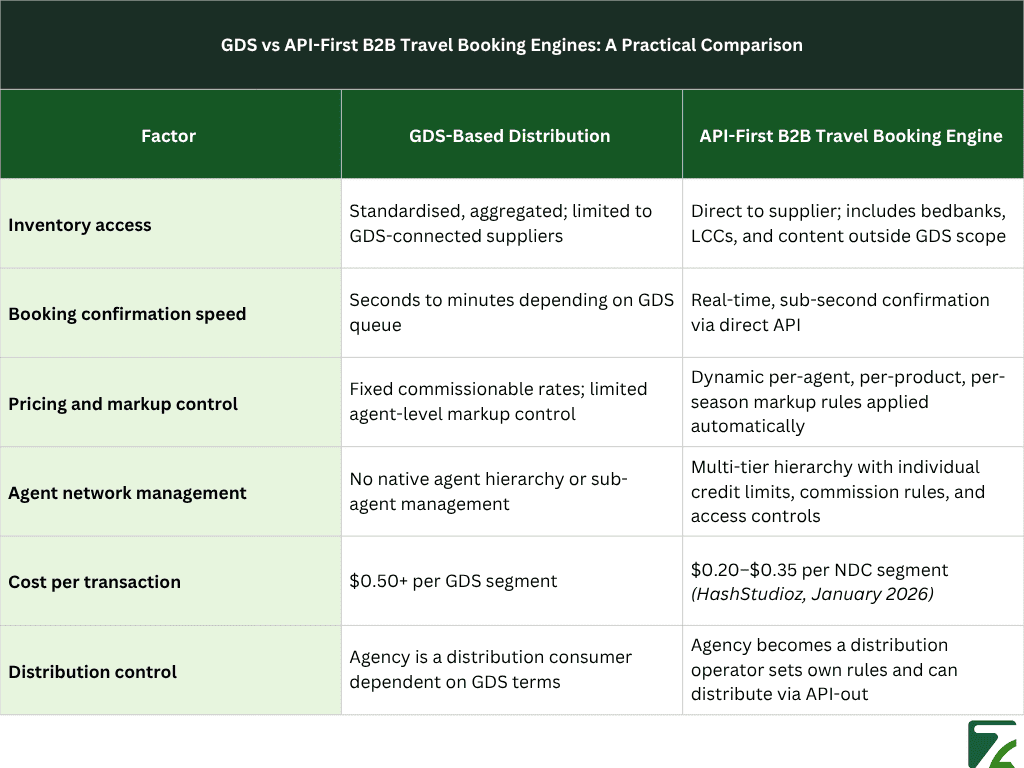
The trade-off is cost and coverage. GDS bookings carry a per-segment fee of $0.50 or more, and the content available is sometimes narrower than what direct API connections deliver. API-based NDC transactions cost $0.20–$0.35 per segment, according to HashStudioz (January 2026) , a meaningful margin advantage at volume.
How Do Bedbanks Integrate With a B2B Travel Booking Engine?
Bedbanks are wholesale accommodation suppliers that negotiate room inventory directly with hotels at net rates prices; the hotel will not publish publicly and redistribute that inventory to travel agencies via API. When a B2B travel booking engine connects to a bedbank, every agent in the network gains access to thousands of hotels at below-public pricing, marked up automatically, confirmed in real time.
As Altexsoft explains in its guide to bed banks, these platforms provide a critical distribution layer for agencies that need competitive hotel pricing without the overhead of direct contracting. Connecting to multiple bedbanks through a single B2B travel booking engine eliminates the need to manage supplier relationships at the property level.
GDS-Based vs API-First B2B Travel Booking Engine: Full Comparison
The difference between GDS-based and API-first connectivity is not just technical, it determines what inventory the agency can access, at what cost, and how much commercial control it retains over every booking.
Why API-First Distribution Is Redefining the B2B Travel Booking Engine
The comparison above makes the cost and control case for API-first connectivity. But the shift is not just about saving $0.30 per segment, it is about which agencies retain access to competitive inventory as the distribution landscape restructures beneath them.
API-first distribution is redefining the B2B travel booking engine because the structural shift away from indirect channels which hoteliers are actively targeting to fall from 53% to 34% of supply by 2030 means agencies reliant on intermediaries will lose both inventory access and margin to those connecting directly.
According to a Skift Research survey of hotel owners and operators (Hotel Distribution Outlook, November 2024), hoteliers are targeting a reduction of indirect channel share from 53% in 2024 to 34% by 2030 a 19-point contraction driven by a deliberate push toward direct digital booking. For agencies that access inventory through third-party OTAs, this means less comprehensive inventory and no reduction in the platform fees and OTA commissions charged for accessing it.
That shift is already visible in transaction data. API bookings on Travelport’s platform grew from 43% of all transactions in 2022 to 63% by early 2026 a 20-point shift in under four years, driven by agencies choosing direct connectivity over legacy aggregation. (Travelport, March 2026)
For agencies that own their B2B travel booking engine infrastructure direct supplier APIs, proprietary tiered agent networks, controlled pricing rules, this shift is an accelerating structural advantage.
What the Indirect Channel Contraction Means for B2B Travel Booking Engine Users
The global B2B travel market reached $32.2 billion in 2024 and is projected to reach $55.8 billion by 2030 at a CAGR of 9.6%, according to ResearchAndMarkets via GlobeNewswire (January 2025). That growth will not be shared equally.
Agencies using a B2B travel booking engine with direct API connectivity are positioned as distribution operators setting their own margins, distributing inventory outward to their own partner networks, and accessing content that intermediary-dependent competitors cannot match. Agencies accessing inventory through platforms they do not control will pay increasing costs for decreasing coverage.
How to Evaluate a B2B Travel Booking Engine for Your Agency
The B2B travel booking engine evaluation is not a technology procurement exercise, it is a strategic position. The questions that matter are not about feature lists.
Does the platform support multi-supplier API connectivity, or only GDS? Does it enforce tiered pricing rules across agent hierarchies without manual intervention? Does it provide real-time visibility across the full network credit balances, booking volumes, margin by agent tier? Does it offer API-out capability to distribute inventory to downstream partners? And does its architecture support the pace at which wholesale distribution continues to evolve?
A B2B travel booking engine that answers yes to all five turns the principal from a distribution consumer into a distribution operator.
Conclusion
A B2B travel booking engine is not a back-office tool, it is the infrastructure that determines how a travel business scales, what inventory it can access, and how much of its own margin it controls. The three layers work together: the agent hierarchy creates the distribution network, the pricing engine protects the margin across it, and the inventory connections determine how competitive that margin actually is.
As indirect channels contract and API-first connectivity becomes the operational standard, the agencies that own this infrastructure will compound their advantage. Those renting access through third-party platforms will pay more, for less, over time. The platform decision is not a technology choice, it is a commercial position, and the time to make it deliberately is before the shift forces it.