



TL;DR
Most OTAs evaluate booking engine software the wrong way letting vendors lead the demo and checking features off a list. The platform that looks best in a 90-minute presentation is rarely the one that performs best at production volume. This guide gives OTA managers and travel agency owners a seven-dimension vendor scorecard to evaluate platforms on the criteria that actually predict revenue and operational performance.
The Vendor Demo Looked Great. So Why Did the Platform Fail?
Every OTA manager has a version of this story.
The demo ran smoothly. Clean interface, fast checkout, and a B2B portal with tier management. Compelling case studies. The contract got signed.
Three months after go-live, the gaps appeared. Inventory revalidation failed at peak hours. B2B tier setup required a support ticket and a five-day wait. API documentation referenced deprecated endpoints. Support responded to critical failures with a form email.
None of this showed up in the demo. It never does.
OTAs evaluate platforms on the vendor’s terms, watching a curated presentation rather than probing operational reality. A vendor-led demo is a marketing exercise. A structured scorecard is an evaluation tool. Same platform. Very different outcomes.
The OTAs that make strong platform decisions are the ones that walk into a demo already knowing exactly what they are measuring.
According to Phocuswright’s Global Travel Market Report 2025, global travel gross bookings reached $1.6 trillion in 2024 and are projected to approach $1.8 trillion by 2027, with online bookings growing 9% that year (PhocusWire, 2025). The infrastructure powering that volume is not a background function. It is the business.
Booking engine software for an OTA is the platform that searches live supplier inventory, applies dynamic pricing and markup rules, processes customer payments, and manages the full post-booking workflow reconfirmation, voucher delivery, and modification handling , without manual intervention.
For a hotel, the scope is narrow: capture direct reservations. For an OTA, the platform is the entire distribution operation.
Key Terms Worth Knowing
Booking engine software: The distribution platform enables an OTA or travel agency to search supplier inventory, apply dynamic pricing and markup, process bookings, and manage post-booking workflows in one connected system.
Inventory revalidation: The process of confirming in real time that a rate and room shown to a traveler during search is still available and correctly priced at the moment of booking confirmation.
API documentation: The full technical reference describing a platform’s programming interfaces including endpoint specifications, request formats, authentication methods, response structures, and versioning policy.
Support SLA: A contractual commitment from a software vendor defining specific response and resolution time targets for platform issues, categorized by severity; not a stated policy, a signed obligation.
Why Are Feature Lists the Wrong Way to Evaluate Booking Engine Software?
Where most OTA software selection decisions break down is the gap between a feature existing and a feature performing.
A platform may support dynamic pricing not that markup recalculates live during peak traffic, or updates without a developer ticket. It may support B2B portals not that an OTA can onboard a new tier and set credit limits without a consulting engagement.
The feature list confirms the presence. The vendor scorecard probes performance.
What Does Poor OTA Software Selection Actually Cost?
The Amadeus Travel Technology Investment Trends 2024, a survey of 150 senior OTA leaders found that 72% of OTAs are investing in new booking capabilities, with the sector planning an average 13% increase in technology spend (Amadeus, 2024). When the sector is moving at that pace, choosing the wrong platform does not just waste the budget it sets the OTA back while competitors who chose correctly are pulling further ahead.
Switching after a failed go-live costs in three places: the sunk contract investment, the cost of running a broken system during replacement, and lost revenue during a degraded transition.
Buying the wrong booking engine software is not a technology mistake. It is a revenue mistake that surfaces slowly and compounds before anyone names it.
Which Seven Dimensions Actually Predict Booking Engine Software Performance?
The OTA Vendor Evaluation Scorecard measures what vendors can demonstrate live, under conditions that reflect how an OTA actually operates.
Score each vendor 1–10 per dimension:
- 1–3: Missing, broken, or underdeveloped for OTA-scale operations.
- 4–6: Exists with gaps: limited conditions, workarounds, or professional services required
- .7–9: Solid and demonstrated with minor limitations.
- 10: Fully demonstrated live, no caveats.
Maximum total: 70.
- Below 45: Critical gaps that will surface as failures post-go live. Remove from shortlist.
- 45–59: Strength’s present but unproven at your scale. Request a proof of concept before signing.
- 60 and above: Performs well across all dimensions. Proceed commercial negotiation.
Does the Platform Query Inventory in Real Time or Serve Cached Data?
Real-time inventory means the platform queries supplier APIs at the moment of search. Cached inventory means it queries in batches and serves pre-stored data. The gap surfaces at checkout a traveler sees a cached rate, payment processes, and the room is gone, or the price has changed.
“Inventory discrepancies between search and confirmation are the leading cause of post-booking operational failure for OTAs. The damage is invisible in a demo and immediate in production.”
Ask every vendor: what is the cache refresh interval? Request a live API call during the demo. A vendor who will not run one already knows the answer.
Can the OTA Build a Full B2B Sub-Agent Layer Without Developer Involvement?
A booking engine platform’s B2B module determines whether the OTA can onboard sub-agents with independent credentials, assign tiered markup controls per tier, and enforce credit limits at booking level all without involving a developer.
Platforms that offer this convert the OTA into a distribution hub where every agent’s tier generates revenue without additional marketing spend. Platforms that require professional services to configure agent tiers are not built for OTA-scale distribution.
“An OTA that cannot activate its B2B layer is leaving a second revenue engine switched off. Every week without it is distribution volume that goes to a competitor who built that infrastructure.”
The B2B sub-agent architecture is not a feature. It is the structural difference between a travel agency and a distribution business.
Test it: can an operations manager onboard a new tier, configure markup, and set credit limits without a developer ticket?
Does the Checkout Flow Hold Conversion at the Final Step?
Checkout is where traffic becomes revenue or abandonment. Test it live in every demo.
The Hilton and Ipsos 2024 Trends Report found that 80% of global travelers say it is important to book entirely online, and 76% value apps that reduce friction (Hilton, 2024). Travelport’s 2024 Modern Retailing Report found travelers visit up to 277 web pages before completing a booking (Travelport, 2024). That traveler is at maximum intent when they reach checkout, and the booking engine platform is either removing friction or creating it.
What the platform controls at checkout: the number of required form fields, whether guest checkout is available without account creation, how fast availability search responds, whether the payment flow supports the traveler’s preferred method, and how the flow renders on mobile.
According to Credence Research, 72% of mobile travel bookings happen within 48 hours of travel (Credence Research, 2024) the highest-intent moment happens on a mobile screen.
A checkout that fails on mobile is not a UX problem. It is a revenue problem and no inventory depth recovers a conversion lost at the final step.
Are Pricing and Markup Rules Fully Operator-Controlled?
A booking engine platform’s pricing module controls how markup rules are applied by supplier, by route, by date range, by customer segment. The question is not whether that module exists, but whether an operations manager can configure and update rules without raising a development request.
In travel, demand signals shift daily. A pricing rule locked behind an engineering ticket will always lag the market. Ask specifically: what is the rule configuration interface, who has access to it, and what is the typical turnaround when a rule needs to change?
Is the API Integration Documentation Available Before Signing?
Poor API documentation is one of the most common causes of failed platform integrations and entirely verifiable before signing a contract.
The API connects the platform to payment gateways, back-office systems, and supplier feeds. Request the full endpoint documentation before the demo. If a vendor cannot produce its pre-signature, it is incomplete or being rewritten. The integration will be harder than represented.
What Happens to a Booking After Confirmation?
This dimension evaluates a specific capability within the booking engine platform: whether it automates the post-confirmation workflow or pushes it to a manual operations queue.
When a customer books, the platform must do three things without human involvement: send a reconfirmation request to the supplier API, generate and deliver the voucher to the traveler, and expose a structured workflow for modifications so downstream changes do not require manual supplier contact.
Platforms with this built-in handle all three via API. Platforms without it create a manual queue. At low volume, this is workable. At scale it becomes a staffing and error risk the platform price never reflects.
“The post-booking workflow is where platforms that looked equal in the demo start to diverge in real operations. One automates. The other invoices you for the headcount.”
Post-booking automation is the hidden cost dimension in every booking engine software evaluation and the one most vendors never raise during the sales process.
Ask: does your platform send reconfirmation requests to suppliers automatically after confirmation, without operations involvement? And: what percentage of confirmed bookings at your current OTA customers require manual post-confirmation intervention? Anything above single digits is a staffing overhead that will not appear in the contract pricing.
Is the Vendor's SLA a Contract or a Promise?
The Travel Tech Show 2024 research found that 62% of travel businesses are increasing their technology budgets, with booking systems topping the agenda (TravelTech Show, 2024). Rising budgets attract new vendors, and not all of them have the operational depth to support a growing OTA customer base for the long term. A vendor’s SLA is the contractual evidence of that depth, or its absence.
One question cut through every sales pitch: is the SLA contractual with defined escalation paths and financial consequences for breach, or a stated policy in the sales deck no one can enforce?
The OTA Vendor Evaluation Scorecard
Run this simultaneously across a minimum of three vendors not sequentially. Sequential evaluation introduces recency bias. Assign a score of 1–10 per dimension using the guidance above, then total each column. This booking engine scorecard works for any OTA manager or travel agency software procurement team evaluating platforms at any scale.
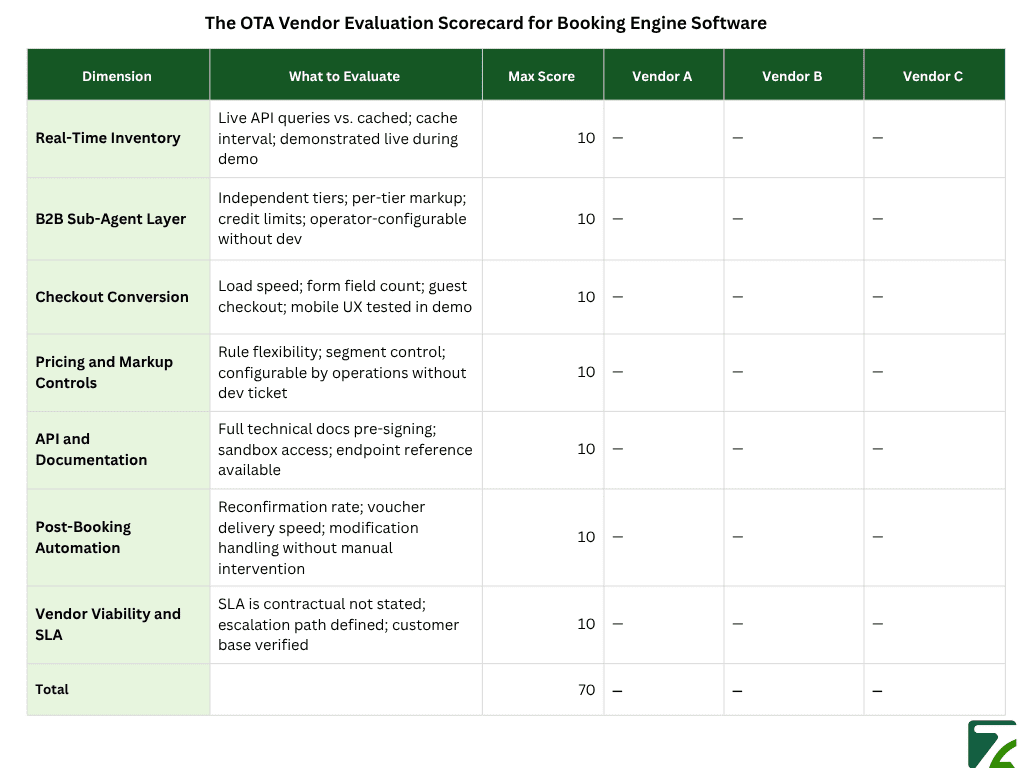
Below 45: Critical gaps. Remove from shortlist. 45–59: Strengths present, gaps unproven. Request proof of concept before signing. 60 and above: Proceed to commercial negotiation.
What Red Flags in a Demo Tell an OTA About Operational Reality?
The scorecard structures the evaluation. The demo provides the evidence ; but only if the right questions are asked.
The demo runs on pre-loaded test data. A vendor unwilling to run a live search knows the live environment behaves differently. Insist on real route, real supplier connections.
Support escalation is described but not contractual. Ask for the response time on a P1 failure at 2 AM on a peak weekend. Vague answers are the answers.
API documentation is offered post-signing. Hard disqualifier. Full technical documentation must exist before any contract conversation.
The B2B demo requires a pre-configured environment. Ask whether an operations manager can replicate that setup independently. Usually, they cannot.
What Should Every OTA Ask Before Signing a Booking Engine Contract?
What is the average time between confirmation and voucher delivery? What is the reconfirmation failure rate? Can you provide two references at comparable volumes to discuss post-go-live performance? What does the contractual SLA specifically exclude? Has any customer left your platform in the past 12 months and why?
These are standard questions for any high-value software procurement.
How Should OTAs Apply the Booking Engine Software Scorecard to Shortlist Vendors?
Weight the dimensions before the first vendor conversation, not during it.
An OTA with a growing sub-agent network weights B2B architecture and post-booking automation higher. An OTA rebuilding its direct channel weights checkout conversion and pricing higher. Adjust before any vendor enters the room.
McKinsey research finds that companies comprehensively addressing digital and analytics opportunities can see earnings improvements of up to 25% (McKinsey, 2024).
Platform selection is an earnings decision. The OTA that chooses with a scorecard beats the OTA that chooses with instinct , not because the scorecard is clever, but because it forces the right questions before the contract is signed.
The GBTA Business Travel Industry Outlook Poll found that 86% of global business travel buyers said 2024 met or exceeded expectations yet only 14% are using automation meaningfully (GBTA, 2024). That gap is where disciplined platform evaluation pays back.
Use the scorecard to eliminate vendors below the threshold. Use references, commercial terms, and implementation timelines to choose between those who clear it.
Map your seven scorecard dimensions before the first vendor conversation. Set your thresholds. Then walk into every demo already knowing what you are measuring and hold every vendor to the same standard.
Conclusion
Imagine running the opening scenario again. The vendor sits down. They load the demo. This time, before they show a single feature, you ask about cache refresh frequency. You request the API documentation before scheduling a second call. You run a live API query during the session. You score the platform against seven dimensions rather than watching a presentation.
The platform that gets signed is the one that earned the score not the one that ran the best demo