



TL;DR
A travel booking engine is not one system it is five architectural decisions stacked on each other, where a flaw in any single layer cascades into all the others. For OTA and travel agency leaders, the cost of an under-engineered engine shows up in checkout abandonment, supplier confirmation failures, and operations costs that compound silently. This guide maps each layer, names the failure points, and frames what a platform built for 2026 actually needs.
What Is a Travel Booking Engine Architecture and Why Does Every Platform Decision Start Here?
Most booking platform failures do not announce themselves. A rate that will not confirm at checkout. A guest at check-in with a booking reference the hotel has never seen. A checkout that loses nine in ten users before payment clears. These look like isolated incidents. They are not. They are architectural symptoms each one traceable to a specific layer of the platform.
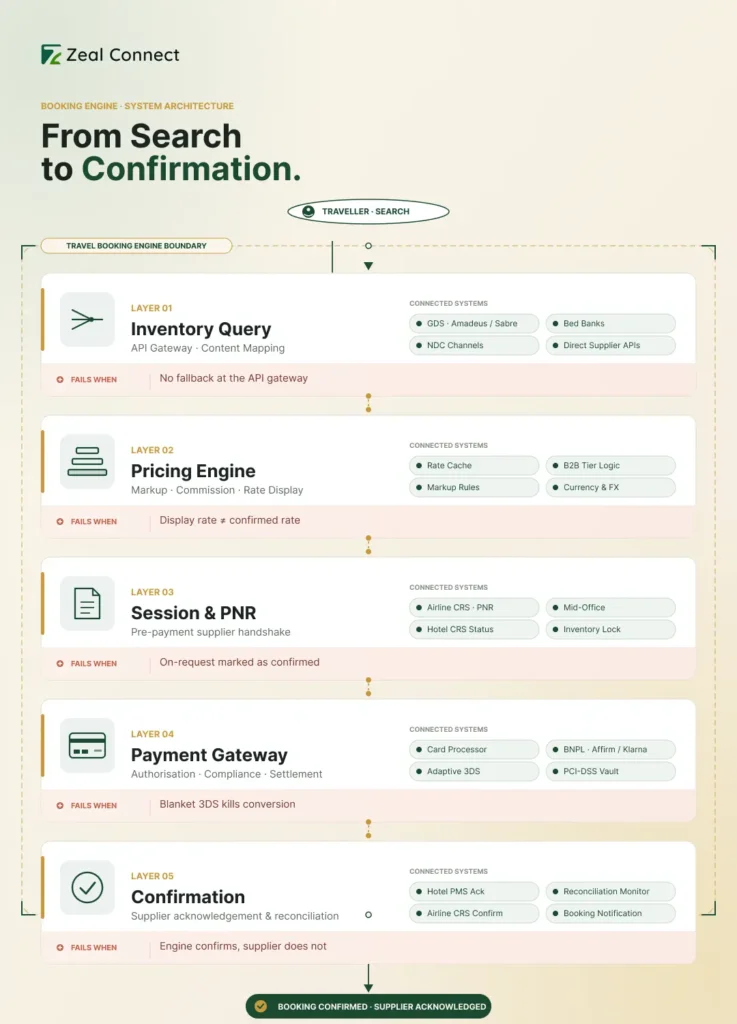
A travel booking engine is the software infrastructure that manages the full transaction lifecycle querying live inventory across supplier connections, applying pricing and business rules, managing the booking session, processing payment, and reconciling supplier-side confirmation. It is five interdependent layers operating in sequence, where a failure at any one layer does not stay contained.
Every commercial decision your OTA makes is only as executable as the architecture beneath it allows. You cannot enforce per-agent markup logic if the pricing layer was not designed to support it. You cannot expand into cross-border markets if the payment layer cannot handle local payment methods.
The architecture of a travel booking engine is the infrastructure of every revenue decision your business makes, and every operational cost your team absorbs.
Layer 1 is where the architecture either begins building a complete, accurate inventory picture or starts accumulating gaps that no downstream layer can correct.
Layer 1 : How Does a Travel Booking Engine Query Supplier Inventory in Real Time?
The moment a traveler hits search, the architecture either delivers, or it does not. What happens in the next four seconds determines whether they see accurate, complete, priced results or something that costs you the booking.
Key Terms Worth Knowing
NDC (New Distribution Capability) : An IATA XML-based standard enabling airlines to distribute richer content including ancillaries, dynamic pricing, and personalised fare bundles directly to OTAs and travel agencies, independent of legacy GDS fare-filing constraints.
API Gateway : The connectivity layer inside a travel booking engine that manages simultaneous outbound API calls to multiple supplier systems, aggregates responses, and applies fallback logic when any connected source fails or times out.
Adaptive 3DS (Three-Domain Secure): A payment authentication architecture that applies challenge flows proportionally to transaction risk profile rather than universally preserving conversion on low-risk sessions while protecting high-risk ones.
Reconciliation Layer :The architectural component that monitors supplier-side confirmation receipt against engine-side booking references, automatically flagging discrepancies when a supplier’s acknowledgement has not arrived within a defined window.
Why Does a Single GDS Connection Put the Entire Booking Engine at Risk?
The engine fires parallel API calls simultaneously across every connected supplier GDS providers, bed bank feeds, NDC connections, and direct APIs. A platform built on a single GDS connection has one point of failure. If that feed goes down, the engine returns nothing, not a partial result; nothing. Redundancy and fallback logic at the API gateway is the minimum viable design for a platform that cannot afford silence during peak windows, as noted by Onix Systems, Mar 2026.
The same hotel appears across multiple supplier feeds simultaneously with different property IDs, different rate formats, and different content schemas. Content mapping logic must resolve all inconsistencies before results reach the display layer. When it fails, travelers see duplicate listings and rates the supplier will reject at checkout.
What Does NDC Connectivity Change at the Data Layer and What Are OTAs Missing Without It?
NDC is not a distribution update. Adding NDC connectivity changes the data payload at the query layer itself.
Where a GDS response returns EDIFACT-structured fare data, an NDC response delivers a richer offer fare plus ancillaries, seat options, and dynamic pricing constructed by the airline in real time. The engine’s content mapping layer must be built to parse this format, or the content is discarded silently.
NDC now accounts for 21.2% of total ARC-settled transactions as of December 2025, according to Travel Weekly, Jan 2026. OTAs without NDC connectivity are operating with a structurally incomplete inventory picture against competitors who are not.
Once inventory has been queried and results returned, the architecture hands the problem to Layer 2 turning raw supplier data into a priced, ranked, and margin-aware display. This is where commercial strategy meets system design.
Layer 2 : How Does Pricing Logic Inside a Travel Booking Engine Determine Margin?
Before a single result reaches the traveler’s screen, the pricing engine has already applied markup rules, commission logic, supplier rankings, and in a B2B context agent tier and credit checks. This is where revenue strategy is encoded in the architecture. Get this layer wrong and the consequences show up in conversion rates, not error logs.
Why Is the Caching vs. Live Pricing Trade-Off a Revenue Decision, Not a Technical One?
Cached pricing returns results faster. Live pricing returns them accurately. A rate cached 15 minutes ago may not reflect what the supplier will confirm at checkout. The gap between displayed price and confirmed price is one of the most consistent drivers of booking abandonment after payment initiation.
Rate discrepancies are an architectural symptom. They originate in the pricing layer and are delivered downstream to the customer as a broken experience.
Why Can B2B and B2C Travel Booking Engines Not Share the Same Pricing Architecture?
A B2B pricing engine must simultaneously manage net fare display per sub-agent tier, individual markup rules per agent profile, credit limit enforcement across concurrent sessions, and wallet-based settlement. These are business rules encoded inside the engine not configuration options.
A B2C engine retrofitted with B2B modules cannot enforce session-level credit limits reliably at volume. DMCs and wholesale operators running sub-agent networks encounter this failure in production with direct financial consequence. B2B pricing architecture must be designed in not bolted on as confirmed by HFTP / Hospitalitynet, Dec 2025.
Pricing logic can be excellent, and the query layer is perfectly redundant, but if Layer 3 is poorly engineered, neither advantage reaches the guest at checkout.
Layer 3 : What Happens Between Product Selection and Payment in a Travel Booking Engine?
Most booking failures that surface at check-in were created at Layer 3. Not at the hotel. Not at the airline. Inside the session and PNR layer of the booking engine before the guest ever reached payment.
Where Do PNR Failures Begin and Why Do They Surface Three Steps Later?
The selected fare or room must be held at the supplier level during passenger data entry. Timeout windows set too short expire the session mid-form. Set too long, they distort live availability for other concurrent users.
For flights, the engine sends a booking request to the airline’s CRS, which returns HK (holding confirmed) or UN (unable to satisfy). The PNR created here is the reservation’s identity across mid-office, back-office, and airline servicing systems. Incomplete PNR data at this stage surfaces at every subsequent touchpoint ticketing, modification, and cancellation as noted by Coaxsoft, Mar 2026.
What Is On-Request Confirmation and Why Does It Create Phantom Bookings?
When a hotel CRS responds as on request, the reservation has not been accepted. It is a pending supplier review.
Platforms that treat an on-request response as confirmed issuing a guest confirmation email before the hotel accepts the booking are creating a confirmation gap before payment has even cleared. This is a common architectural shortcut that ops teams discover at check-in, not at booking.
A correctly held session and a clean PNR bring the architecture to its highest-pressure point: payment. This is where every layer of upstream friction is converted into a single outcome completed booking or abandoned session.
Layer 4 : How Does Payment Architecture Inside a Travel Booking Engine Affect Conversion?
The payment layer is where the highest-intent abandonment occurs. Users who selected a product, entered their details, and stopped at the final step are not a pricing problem; they are a friction problem built into the architecture.
When Does 3DS Authentication Become an Abandonment Driver Instead of a Security Tool?
The transaction sequence is authorization request from engine to gateway; gateway to card network; response returned; reservation record created. If any step times out, the booking collapses regardless of whether the card was charged.
OTAs carry an average cart abandonment rate of 93.96%, according to Mize, Dec 2025. A material portion of that is payment-layer friction. Blanket 3DS authentication applied to every transaction forces challenge flows on low-risk sessions where no friction is warranted. Adaptive 3DS which applies authentication proportionally to risk is an architecture-level decision, not a checkout setting.
The gap between a 93.96% abandonment rate and what a well-architected payment layer can recover is not a marketing problem. It is a specific set of architectural decisions about friction, fallback, and failure handling.
Why Do BNPL and Multi-Currency Support Require Architecture Changes, Not Checkout Updates?
Localised payment method support, transparent dynamic currency conversion, and multi-entity settlement are requirements for any booking engine operating across geographies.
Affirm reported its travel and ticketing BNPL volume rose 38% year-on-year in Q4 2024, crossing $1 billion, according to NBC News, Apr 2025. Adding BNPL support requires changes to the payment layer’s transaction model and settlement architecture ; it is not a front-end addition.
Payment of completion is not the end of the architecture’s responsibility. It is the beginning of a second, less visible process one that most platforms have not engineered, and most operators discover only when it fails in front of a guest.
Layer 5 : What Does "Confirmation" Actually Mean in Travel Booking Engine Architecture?
When payment clears, the engine generates a confirmation reference and sends the guest an email. This records that a transaction completed in the engine’s own database. It is not confirmation that the supplier received the booking. These are two distinct events and the gap between them is where the most expensive operational failures in travel live.
What Is the Difference Between an Engine Confirmation and a Supplier-Side Acknowledgement?
The handshake between the engine and the hotel’s PMS or airline’s CRS is a separate, asynchronous process. In a well-designed architecture, the engine monitors for the supplier acknowledgement and flags the gap if it does not arrive. In the majority of platforms in production today, that monitoring layer does not exist.
Onyx Insights data, published by Skift Research, May 2024, shows that hotel-confirmed revenue (total transaction value) was 12% lower than booked figures in 2023 and approximately 10% of all bookings undergo modifications that create data discrepancies across systems. At OTA transaction volumes, that gap represents millions of dollars in unreconciled bookings every month.
Every platform without an automated reconciliation layer is discovering this gap through operations. The question is only what it is currently costing.
What Does the Look-to-Book Ratio Reveal About Every Layer of Booking Engine Performance?
The look-to-book ratio searches per completed booking is a diagnostic instrument that runs across all five layers simultaneously. High query latency degrades it at Layer 1. Rate discrepancies erode it at Layer 2. Session timeouts interrupt it at Layer 3. Payment friction drops it at Layer 4. Unresolved confirmation failures suppress repeat bookings at Layer 5.
The 78.3% hotel booking abandonment rate reported by Hotel Speak, Jan 2025 rising to 85.6% on mobile is the aggregate cost of unresolved architectural friction across every stage. No demand generation strategy offsets an architecture that loses nearly eight in ten users before conversion.
Understanding each layer’s failure mode is step one. The strategic question for leaders is what a well-designed architecture across all five layers actually looks like in 2026.
What Should a Well-Architected Online Reservation System Deliver in 2026?
Comparison Table: Monolithic vs. Modular Travel Booking Engine Architecture
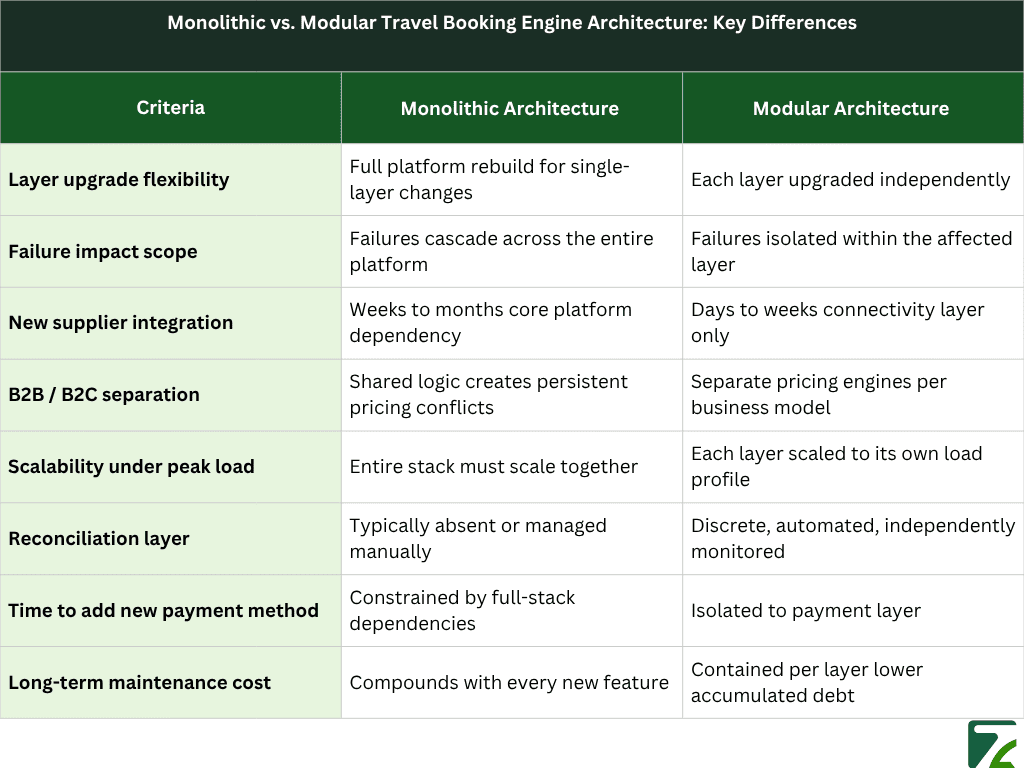
If your platform sends guest confirmation emails without an automated check that the supplier received the reservation map that gap today. The number of unacknowledged bookings in your last 30 days is the most direct measure of what your reconciliation architecture is currently costing.
Conclusion
The architecture of a travel booking engine is a set of compounding decisions, each with a revenue consequence and an operational cost attached. The platforms performing in 2026 are not the ones with the broadest supplier networks they are the ones whose five layers work as a resilient, failure-aware system. Leaders who treat the engine as commodity infrastructure will continue paying for that assumption in abandonment rates, ops headcount, and supplier disputes that no commercial initiative can reverse.