
![The Role of an Online Booking Engine in the Travel Industry [2026 Guide for Travel Agencies]-Zeal Connect](https://www.zealconnect.com/wp-content/uploads/2026/04/The-Role-of-an-Online-Booking-Engine-in-the-Travel-Industry-2026-Guide-for-Travel-Agencies-1024x536.webp)
TLD;R
- An online booking engine plays the role of connecting a travel agency’s sales channels to live supplier inventory, automating every step from search to confirmation and back-office settlement.
- This guide is written for travel agencies about leisure retail, OTA, corporate TMC, and DMC who want to understand the strategic and operational role a booking engine plays in their business.
- Online bookings are on track to account for 65% of all global travel gross bookings by 2026 (Phocuswright). The engine’s role in capturing that share is not optional it is structural.
- Includes: distribution role, sales workflow, agency-type breakdown, revenue impact, KPIs, glossary, and FAQ.
Why the Role of an Online Booking Engine Has Never Been More Critical
The travel industry’s shift to digital is no longer a trend it is the operating reality. Global travel gross bookings reached nearly $1.6 trillion in 2024 and are projected to climb to $1.8 trillion by 2027. Of that, online bookings are forecast to represent 65% of all global gross bookings by 2026. (Phocuswire / Phocuswright, 2025; Phocuswright, 2025)
Meanwhile, offline travel bookings have been in steady decline falling from $729 billion in 2019 to $610.5 billion in 2024. Travellers are not disappearing. They are moving to digital platforms, and agencies that cannot meet them there are losing share to OTAs and direct supplier channels. (Travel and Tour World, 2024)
In this environment, the online booking engine is not a feature; it is the infrastructure through which a travel agency competes. Understanding its role precisely is the starting point for using it well.
The Role of an Online Booking Engine in Travel Distribution
The travel industry’s distribution chain connects supplier airlines, hotels, car rental companies, tour operators to travellers through a series of intermediaries. An online booking engine is the technology layer that sits at the centre of that chain for travel agencies. It is the access point through which an agency reaches supplier inventory, prices it, and sells it in real time, across multiple sources simultaneously, with pricing logic applied automatically on every transaction. In a modern travel booking platform, this process is fully automated from search to settlement.
The Online Booking Engine as the Bridge Between Agency and Supplier
On one side of the engine sits the agency’s distribution channels: the public website, the agent desktop, the B2B sub-agent portal, or any combination of these. On the other side sit the suppliers: GDS platforms such as Amadeus, Sabre, and Travelport; bed banks; direct hotel and airline APIs; and any contracted rates the agency holds. The engine connects both sides in real time, applying markup rules, commission structures, and preferred supplier rankings automatically without manual agent involvement on every transaction. The GDS market alone is valued at $6.78 billion in 2024 and projected to reach $16.44 billion by 2032, a scale that reflects how central this infrastructure remains to global travel distribution. (Fingent, 2025)
The online booking engine is the infrastructure layer that turns supplier inventory into agency revenue automatically, at scale.
The Role of an Online Booking Engine in an Agency's Sales Operations
The most direct role an online booking engine plays for a travel agency is inside its sales workflow. Every stage of a booking from first search to confirmed, settled transaction either runs through the engine or around it. Through the engine: fast, consistent, scalable. Around it: slow, error-prone, and impossible to measure at scale.
How an Online Booking Engine Drives the End-to-End Booking Workflow
A well-integrated booking engine handles five connected stages of every transaction:
- Search and live availability: The engine queries all connected suppliers simultaneously, returning real-time inventory and pricing in a single interface eliminating the need to log into separate portals for each product.
- Quote and pricing: Markup rules, commission structures, and preferred supplier rankings are applied automatically. The agent or customer receives a priced result with no manual calculation.
- Booking and payment: The selected option is confirmed; payment is processed through the integrated gateway, and a PNR or reservation reference is created directly in the supplier system.
- Confirmation and documentation: Booking vouchers, itinerary documents, and confirmation emails are generated and dispatched automatically no manual data entry.
- Back-office settlement: Transaction data feeds into accounting and reporting, driving reconciliation, commission tracking, and supplier settlement without additional manual work.
Key Terms Worth Knowing
Online Booking Engine The software layer connecting a travel agency’s front-end channels to live supplier inventory automating search, pricing, payment, and confirmation in real time.
Look-to-Book Ratio The number of booking engine availability searches made for every confirmed reservation the clearest measure of engine conversion performance.
B2B Booking Engine An engine serving sub-agents or franchise partners with net fares, per-agent markup controls, and credit limit management not visible to the end traveller.
B2C Booking Engine A public-facing engine through which end customers search, compare, and book travel directly via an agency website or OTA portal.
The Role of an Online Booking Engine in Removing Manual Effort from Agency Operations
Without an online booking engine, each stage demands manual effort across multiple systems re-entering PNR data, calling hotels to verify availability, reconciling commissions manually at month end. The engine eliminates that friction at every step, redirecting agent time toward complex itineraries and client relationships that generate real value.
Automation through cloud-based booking platforms improves booking accuracy by up to 30% and reduces processing time by 25%. Over 72% of travel agencies globally adopted cloud-based booking and distribution platforms in 2024.
The Role of an Online Booking Engine Across Different Types of Travel Agencies
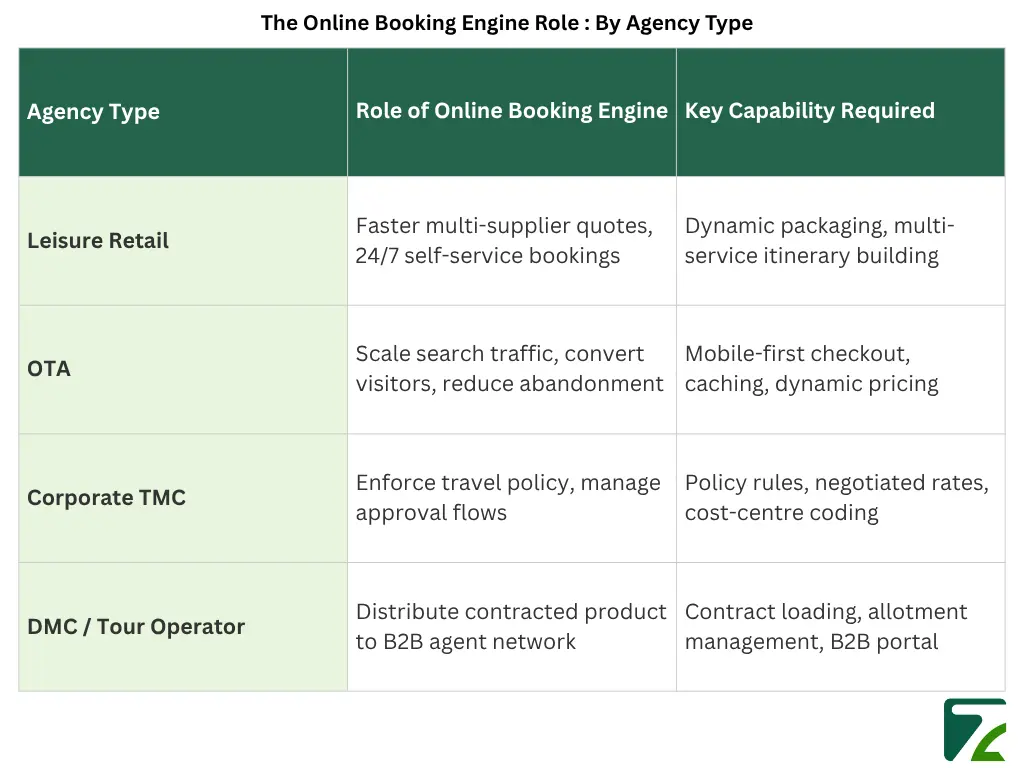
The online booking engine does not play the same role in every agency. What it must do for a leisure retail agency is fundamentally different from what it must do for a corporate TMC or a DMC. Understanding this distinction is critical when selecting, configuring, or evaluating an engine and it is a dimension that most content on this topic ignores entirely.
The Role of an Online Booking Engine for Leisure Retail Agencies
For a leisure retail agency, the engine’s primary role is speed and product breadth. Agents build complex, multi-component itineraries flights, hotels, transfers, tours from multiple suppliers. Without an engine, every quote requires logging into separate portals, cross-checking availability manually, and assembling the result by hand. The engine replaces that with a single search interface, dynamic packaging capability, and automated documentation. It also enables 24/7 self-service booking for clients, capturing enquiries outside office hours that would otherwise convert nowhere.
The Role of an Online Booking Engine for OTAs
For an online travel agency, the engine plays a dual role: operational infrastructure and conversion tool. The operational side manages search scalability, content caching, and supplier connectivity at volume. The conversion side determines how much of that traffic actually becomes revenue. Travel is one of the highest cart abandonment sectors online an average of 81% of bookings on OTA platforms are abandoned before payment is completed. (Condor Ferries) The engine’s checkout design, mobile optimisation, and payment flexibility are not cosmetic decisions they are the primary lever on that 81% figure.
The Role of an Online Booking Engine for Corporate TMCs
For a corporate travel management company, the engine’s role is policy enforcement and compliance not just transaction processing. Travel policies, approval workflows, preferred vendor hierarchies, and cost-centre coding must be embedded in the booking logic itself. The gap that exists without this is measurable: only 18% of business travellers book all their travel through their company’s designated platform, and policy non-compliance affects 42% of corporate travellers. (Navan, 2025; Prostay, 2026) An engine that makes the compliant option the easiest option closes that gap more effectively than any policy document.
The Role of an Online Booking Engine for DMCs and Tour Operators
For a destination management company or tour operator, the engine’s role is product distribution and contract management. This means loading directly-contracted hotel allotments, ground services, and series departures into the engine, then distributing that product to a B2B agent network through a portal that applies each sub-agent’s specific pricing tier, credit limit, and booking permissions. This is a structurally different use case from a retail B2C engine, and the architecture must reflect it.
For DMCs and tour operators, the online booking engine is the product distribution layer the mechanism through which contracted inventory reaches the agent network that sells it.
The Role of an Online Booking Engine in Revenue Growth and Competitiveness
Beyond operations, the online booking engine plays a direct role in an agency’s commercial performance. The most immediate impact is availability an engine allows an agency to take bookings at any hour, through any channel. For agencies that previously only converted enquiries during office hours, 24/7 availability through the engine is a structural expansion of the sales window.
The second impact is conversion. Agencies that adopt online reservation systems see an average 20% increase in bookings. (Hotelagio, 2025) That uplift comes from faster response to enquiries, reduced friction at checkout, and the ability to offer real-time pricing and availability rather than estimates pending manual confirmation.
The third commercial role is margin management. An engine that loads directly contracted rates alongside aggregated GDS content gives an agency genuine pricing control across three dimensions:
- Per product set different margins on flights, hotels, transfers, and packages
- Per market apply different markup rules for domestic vs international itineraries
- Per sub-agent control pricing tiers and credit limits for each B2B partner
An online booking engine does not just process transactions it is the revenue infrastructure that determines how competitive your agency can be in a digital-first market.
The Role of an Online Booking Engine in GDS and Supplier Network Access
An online booking engine’s value to a travel agency is inseparable from the supplier connections it enables. The depth and quality of those connections determine the content the agency can sell, the rates it can access, and the speed at which it can confirm bookings. This is why supplier connectivity is one of the most critical criteria when evaluating any travel booking platform.
GDS connectivity Amadeus, Sabre, Travelport gives the engine access to global air, hotel, and car rental inventory with real-time availability and pricing. Direct hotel API connections add contracted rates and bed bank content that may not be on the GDS. Where an agency holds its own supplier contracts, the engine’s contracting module allows those rates to be loaded and sold alongside aggregated content, with the agency controlling the margin on each component.
The distribution infrastructure supporting this is growing. The GDS market was valued at $6.78 billion in 2024 and projected to reach $16.44 billion by 2032. AI integration among major GDS providers has reached 65% in 2025, bringing predictive analytics and real-time fare optimisation directly into the engine’s supplier connectivity layer. An engine that is not built mobile-first also limits reach: the mobile travel booking market was valued at $228 billion in 2024 and is growing rapidly. (Fingent, 2025; Perk / Credence Research)
The Role of an Online Booking Engine in Measuring Agency Performance
An online booking engine is not just a transactional tool it is also the primary source of performance data for a travel agency. Every search, every quote, every completed or abandoned booking generates a data point that agencies can act on.
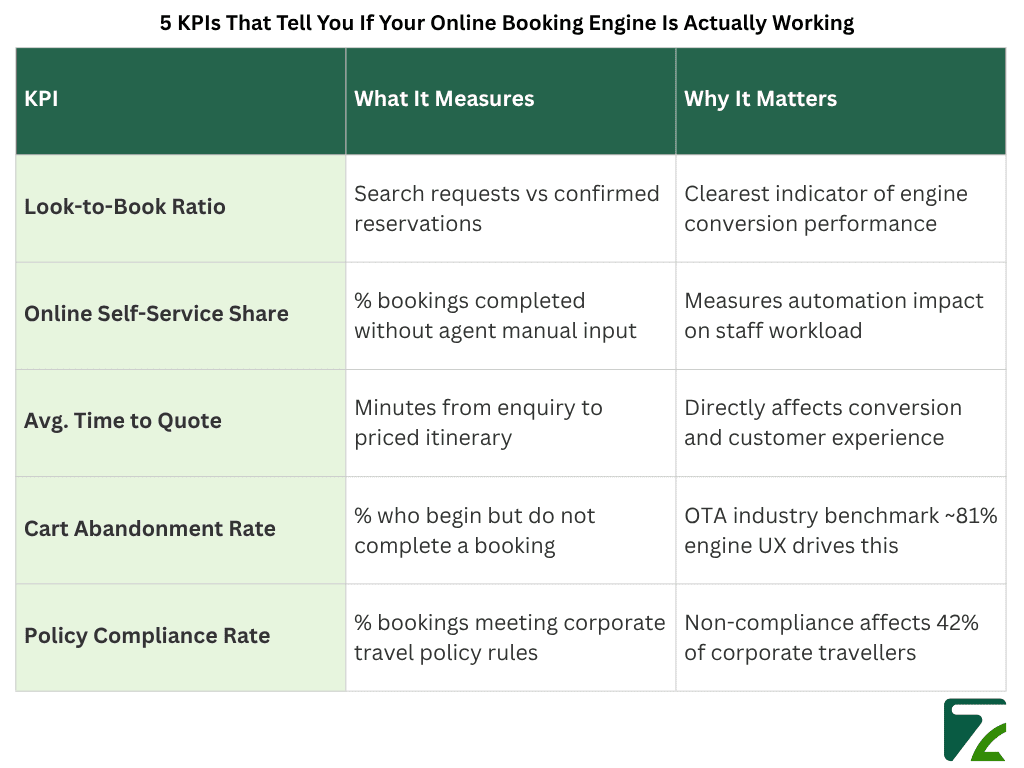
The look-to-book ratio is the most important metric to track the number of availability searches versus confirmed reservations. A declining ratio signals pricing gaps, content unavailability, or checkout friction. Monitoring it weekly gives agencies an early warning before problems affect revenue. Agencies adopting online reservation systems see an average 20% increase in bookings when those systems are properly configured and monitored. (Hotelagio, 2025)
Conclusion
The online booking engine’s role in the travel industry goes well beyond processing transactions. It is the infrastructure through which a travel agency connects to the global supply chain, serves customers at scale, enforces its commercial model, and measures operational performance. For leisure retail agencies, OTAs, corporate TMCs, and DMCs alike, the engine is not one technology decision among many it is the foundational one.
Online bookings will account for 65% of all global travel gross bookings by 2026. Agencies that understand the engine’s role precisely and choose, configure, and monitor it accordingly are the ones positioned to capture that growth.
Frequently Asked Questions
An online booking engine connects a travel agency's sales channels to live supplier inventory automating every step from search and pricing through to payment, confirmation, and back-office settlement. It also generates the performance data look-to-book ratios, abandonment rates, and conversion by channel that agencies need to measure and improve commercial operations.
A GDS (Global Distribution System) is the network infrastructure holding and distributing real-time inventory from airlines, hotels, and car rental companies. An online booking engine is the software layer a travel agency uses to query that inventory, apply pricing rules, and process transactions. The GDS is the data network; the booking engine is the transaction and logic layer built on top of it.
For a corporate TMC, the engine's primary role is policy enforcement embedding travel policies, approval workflows, preferred vendor rules, and cost-centre coding directly into the booking process. This makes the compliant option the default, rather than relying on traveller behaviour to enforce rules that data shows are consistently broken.
It improves revenue in three ways: extending the sales window to 24/7 availability; reducing checkout friction to improve conversion from search to confirmed booking; and enabling configurable margin control across products, markets, and sub-agents. Agencies adopting online reservation systems see an average 20% increase in bookings as a direct result.