How a Travel Booking Engine Delivers the Connected Trip Experience in 2026
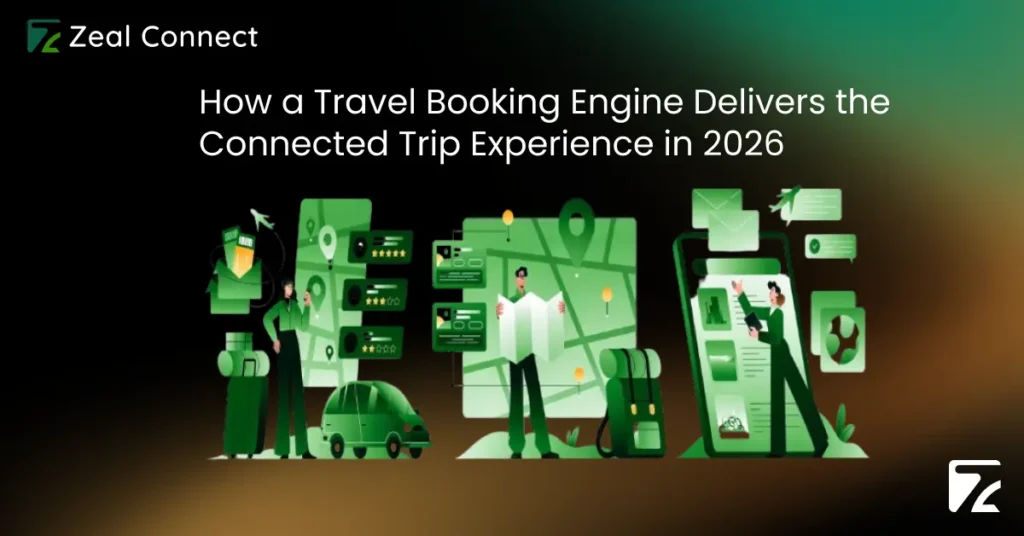
TLD;R Travellers in 2026 arrive at agencies with AI-built itineraries and expect everything flights, hotel, transfers, activities to work as one connected experience. Most agencies cannot deliver this because their systems are fragmented. A travel booking engine fixes this by bringing all supplier inventory into one workflow, enabling custom trip packaging, and automating post-booking operations. The agencies building this infrastructure are gaining market share. Every agency still routing bookings through OTAs is paying 15–30% commission, carrying ~50% cancellation exposure, and handing the client relationship to a platform that will remarket to their customer without them. A client messages your agency on WhatsApp. They have attached a screenshot a complete itinerary built in ChatGPT. Flights from Dubai to Tokyo, four nights at a Shinjuku hotel, a bullet train to Kyoto, a ryokan stay, and a day trip to Nara. Priced roughly. Sequenced correctly. And they want you to confirm it, book it, and manage it as one thing. That is the 2026 version of the connected trip problem. Not a lost PDF. Not a transfer arranged over email. The problem is that a traveller just used a free AI tool to show themselves what a fully connected itinerary looks like, and now they are sitting in front of your agency expecting you to make it real. Bookable. Confirmed by a team who will pick up the phone if something goes wrong at 11pm in Kyoto. Most agencies cannot do this in one system. The flights go into the GDS. The hotels go into three different supplier portals. The ryokan is an email chain. The bullet train booking is handled separately. By the time the itinerary is confirmed, it lives in six different places, and no one’s system holds the whole thing. That is a connectivity gap. And there are four of them sitting inside most agency operations right now, quietly costing revenue, eroding client confidence, and handing market share to platforms that at least feel more connected, even when they are not. This article is about those four gaps and about how a travel booking engine closes them. It is written for everyone inside a travel agency who owns a piece of this problem: the CEO deciding where to put the technology budget, the operations director who watches manual reconciliation eat up half the team’s day, the product manager evaluating platforms, and the sales lead trying to justify agency value against a tool that costs the client nothing. What Is the Connected Trip Experience and Why Does It Demand a Travel Booking Engine? The connected trip experience is simpler to define than it is to deliver. It is a journey where every component outbounds and returns flights, accommodation, airport transfers, in-destination of transport, and activities is booked, managed, and visible through a single workflow. One itinerary. One confirmation. One team is accountable for all of it. Travel agencies have been promising this for decades. The honest truth is that most of them deliver the components and hope the connection between them holds. It usually does, right up until it does not until the hotel has no record of the booking, or the transfer is timed to a flight that changed three days ago, or the activity confirmation sits in an email thread that only one agent can find. Key Terms Worth Knowing Connected Trip Experience: A journey where every component: flights, hotel, transfers, activities is booked and managed in one workflow, with one itinerary document and one point of contact for any change. Agentic AI (Travel): AI systems that autonomously search, compare, and complete bookings on a traveller’s behalf. As of spring 2025, a quarter to a third of US and European travellers expressed interest in agent-led booking (Phocuswright, 2025). API (Application Programming Interface): A protocol enabling two software systems to exchange data in real time. In travel, APIs connect a booking engine to supplier systems for live availability, pricing, and booking confirmation. Dynamic Packaging: Combining individual components from different suppliers into a single quoted price, with one margin applied at the agency level. The traveller sees a package. The agency controls every element of it. Why the Connected Trip Experience Is a 2026 Problem, Not a 2019 One 2024 global survey by TTS found that 77% of travelers say the quality of the travel experience now matters more to them than the price of the trip. That is a significant shift. Five years ago, the price was the primary lever. Today, experience is. And experience, in this context, means connectivity the sense that the whole trip was planned and managed as one thing, not assembled from parts. The Hilton 2024 Trends Global Survey found that 80% of global travelers consider digital booking important, rising to 86% among Millennials and 83% among Gen Z. But here is the part that most agencies are underreacting to: travelers now build itineraries in AI tools before they call an agency. They have already seen what a connected trip looks like when assembled in one place. They arrive with a reference point. And your system either clears that bar or it does not. The travel booking engine is the infrastructure that determines whether it does. The traveller is not comparing your agency to another agency anymore. They are comparing you to what their AI assistant built them in twenty minutes for free. That is a different kind of competition, and a spreadsheet quote process cannot win it. Where Does the Connected Trip Experience Break Down Without a Travel Booking Engine? Call it what it is: a connectivity gap. Not a process inefficiency, not a technology shortfall a gap between what the traveller expects to experience and what most agency infrastructure is actually capable of delivering. There are four of them. Together, we call this the Four Connectivity Gaps framework. Connectivity Gap 1 : Travel Booking Engine vs. Fragmented Inventory When flights sit in a GDS terminal, hotels in a separate extranet, activities in an email chain, and transfers in a WhatsApp thread. Nobody, not the agent, not the client, nor the operations team holds a complete picture of the trip in one place. The agent holds it mentally. Which means the trip’s connectivity depends entirely on that agent being available, alert, and at their desk. One handover, one sick day, one system outage, and the connection breaks. The client does not know this is happening. They find out at the airport. Connectivity Gap 2 : Travel Booking