


TL;DR
Written for travel agencies and OTA professionals across leadership, product, marketing, and operations functions globally.
Covers what AI travel booking and personalisation mean inside a modern booking platform search ranking, dynamic pricing, AI travel assistants, recommendation engines, and post-booking flows. Introduces the TAP Framework (Track → Activate → Predict) and a Static vs AI Platform comparison table.
Key takeaway: AI travel booking personalisation is not a platform upgrade. It is the primary lever for conversion growth and margin improvement for travel agencies in 2026 and the data to begin already exists inside your systems.
Why AI Travel Booking Is Now the Competitive Divide for Travel Agencies
AI travel booking uses machine learning, natural language processing, and real-time data to personalise every stage of the booking journey. In 2026, it is the primary driver of conversion rate, customer retention, and margin for travel businesses of every size globally.
For most of the last decade, travel agencies competed on access who had the best hotel rates, the widest airline coverage, the most competitive package pricing. That era is over. The competitive divide in travel today is about relevance: showing each traveller exactly what they need, at the moment they need it, before they have to ask.
Travel platforms without personalisation see bounce rates regularly exceeding 67% ( Kody Technolab, 2025). At the same time, 71% of guests are more likely to make higher-value purchases when the experience feels tailored ( HFTP / Sabre Hospitality, 2025). The gap between what most platforms deliver and what travellers now expect is where AI travel booking creates commercial advantage.
What Does AI Travel Booking Actually Mean Inside a Modern Platform?
AI travel booking operates across four platform layers : personalised search ranking, dynamic pricing, AI travel assistant interactions, and post-booking engagement. Each layer uses real-time and historical data to change what a traveller sees and when, creating a compounding effect on conversion and revenue.
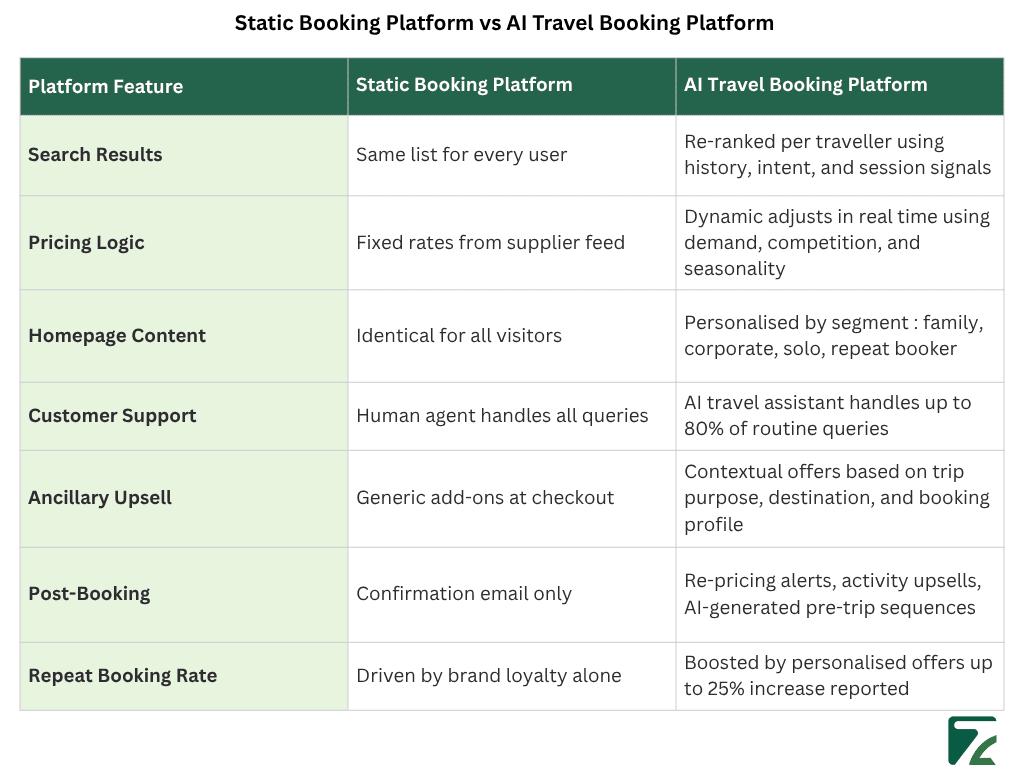
It is not a single feature. It is a set of intelligent systems that continuously change what a traveller sees and why based on data signals the platform collects and acts on at every step of the journey. The table below shows the difference in practice.
Key Terms Worth Knowing
Travel Recommendation Engine: An AI module that analyses a traveller’s behavioural data, booking history, and contextual signals (trip purpose, party size, budget band) to surface a ranked, personalised set of results hotels, packages, flights, or ancillaries in real time.
TAP Framework:A three-phase AI adoption model for travel agencies: Track (instrument the platform and build a behavioural data foundation), Activate (deploy off-the-shelf AI tools including recommender APIs and AI travel assistants), and Predict (build custom ML models and deep dynamic pricing integration). Each phase creates the infrastructure the next one depends on.
AI Travel Assistant: A conversational AI layer embedded within a booking platform that handles multi-turn traveller queries, accesses live inventory, and guides users from initial search intent to confirmed booking without requiring human agent intervention for routine interactions.
Personalised Search Ranking and Results Display
A static platform ranks results identically for every user. An AI travel booking platform re-ranks dynamically based on each traveller’s search history, previously booked destinations, travel party composition, preferred hotel tier, and real-time session behavior. Booking.com applies this logic across every property card not just which hotels appear first, but which photos, review snippets, and room rate options are shown. The inventory is identical for every user. The presentation is not.
The AI Travel Assistant: Where AI Travel Booking Becomes Conversational
An AI travel assistant is not a FAQ bot. It is a conversational layer that handles multi-turn queries, accesses live inventory, surfaces relevant alternatives, and guides a traveller from initial intent to confirmed booking without requiring human agent intervention for routine requests.
Expedia’s AI service agent handles over 143 million conversations annually, with more than 50% of travellers self-serving without speaking to a human agent ( Expedia Group, 2025 via Adamo Software). Travel agencies deploying AI chat layers report chatbots handling up to 80% of routine customer inquiries ( MindfulEcotourism AI Chatbot Statistics, 2026).
Post-Booking Personalisation : The Revenue Window Most Agencies Miss
Most platforms treat the confirmation screen as the end of the commercial journey. AI changes that. Post-booking personalisation covers re-pricing alerts when fares drop, activity and transfer upsell nudges based on destination and trip duration, AI-generated pre-trip content sequences, and proactive disruption notifications. The traveller is already committed. The cost of converting ancillary products at this stage is a fraction of what it costs during the initial booking search.
Post-booking is where most travel businesses leave money on the table. AI-driven communication after confirmation delivers some of the highest ROI available to any agency marketing or product team.
What Is a Travel Recommendation Engine and Why Should Agency Leaders Care?
A travel recommendation engine is the AI module that decides which results, packages, or products to surface to a specific traveller at a specific moment. It processes behavioural data, booking history, and contextual signals to return a ranked, personalised set of options and it is the single highest-impact investment a travel agency product team can make in 2026.
AI-driven recommendations improve booking conversion rates by up to 22% ( Adamo Software, 2026). Personalised AI offers increase repeat bookings by approximately 25% ( Mize / Gitnux, updated December 2025).
Leading OTAs globally have moved decisively here. Multiple major platforms launched multilingual AI trip-planning assistants through 2025, delivering personalised recommendations through conversational search to diverse, mobile-first traveller bases. The lesson for agency product and leadership teams is not to replicate those builds directly , it is to identify which signals the existing booking platform is currently ignoring and begin building the data infrastructure that makes a recommendation engine viable within 6 to 12 months.
How to Build an AI Travel Booking Strategy: The TAP Framework
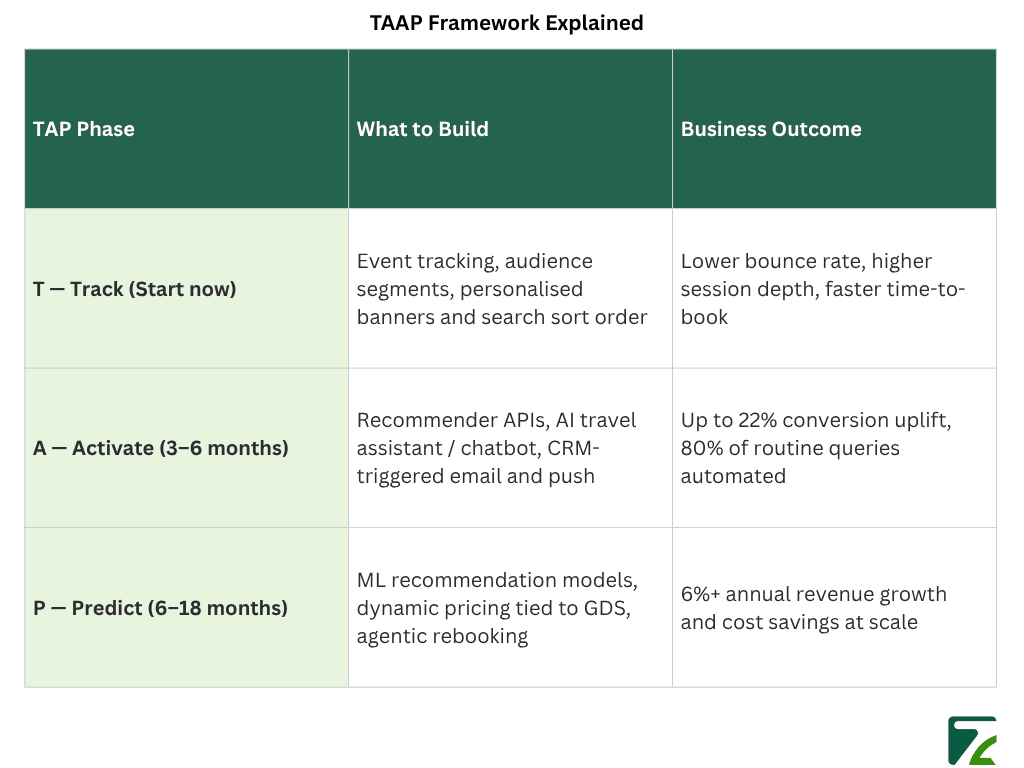
The TAP Framework: Track, Activate, Predict , is a three-phase AI adoption model designed for travel agencies and OTAs of any size. Each phase builds on the last, with measurable commercial outcomes at every stage, and none requires a full platform rebuild to begin.
One of the most persistent barriers to AI adoption in travel agencies is the assumption that it requires a large engineering team or an enterprise budget. Neither is true. The TAP Framework offers a realistic progression from traditional agencies going digital to mid-sized OTAs managing fragmented GDS and supplier feeds.
TAP: T = Track (build the data foundation) → A = Activate (deploy off-the-shelf AI) → P = Predict (build custom ML models and dynamic pricing). Each phase creates the infrastructure the next one depends on.
T Track: Start This Quarter, No ML Required
Track requires proper instrumentation of the booking platform , capturing what users search, which filters they apply, how long they spend on specific pages, and where they exit the funnel. With that event data, teams build meaningful audience segments and change homepage content blocks, default search sort orders, and featured package selections for logged-in users. Deployable using existing CRM and booking platform data live within weeks
A Activate: Plug-In AI Tools in Three to Six Months
Activate layers AI capabilities on top of the Track infrastructure. Off-the-shelf recommender APIs integrate into search results flows without platform rebuilds. AI chat tools deploy on the portal. CRM data connects to email and push workflows triggered by user behavior abandoned searches, viewed destinations, previously booked tiers.
52% of hospitality and travel marketers planned to invest in AI-driven personalisation tools by end of 2025 ( Sendbird / AIMultiple, 2025). For those who have not yet moved, that represents a widening competitive gap.
P Predict: Custom AI and Deep Integration in Six to Eighteen Months
Predict is where returns become substantial and durable, ML recommendation models trained on first-party data, dynamic pricing integrated directly with GDS or supplier feeds, and agentic AI systems handling rebooking and disruption management autonomously.
Travel companies that deployed AI across operations report more than 6% annual revenue growth and 6% annual cost savings simultaneously (source: McKinsey / Skift Remapping Travel with Agentic AI, 2025).
AI Travel Booking and Traveller Trust: How to Personalise Without Overstepping
Travellers globally accept AI travel booking personalisation when it feels useful and transparent. Three implementation principles visible reasoning, meaningful user control, and recency-weighted inference determine whether personalisation builds trust or erodes it.
First, make the reasoning visible. A recommendation with a brief contextual label ‘Based on your last booking, you might like this’ builds confidence. Second, give users meaningful control. A preference toggle allowing travellers to enable or disable personalised recommendations increases overall platform trust. Third, weight recency over history. Current session signals should consistently outweigh older historical data.
Only 2% of travellers are currently willing to let AI book completely on their behalf the human layer remains critical (McKinsey / Skift State of Travel 2025). However, 48% are willing to share personal data for genuinely personalised experiences provided they trust the platform ( MindfulEcotourism / Gitnux, 2026).
The Real Business Impact of AI Travel Booking and Personalisation
AI travel booking personalisation delivers measurable improvement across four metrics simultaneously : booking conversion rate, average order value, repeat booking rate, and operational cost per query. These are reported outcomes from live deployments, not projections.
- AI-driven recommendations improve booking conversion rates by up to 22%
- Hyper-personalisation through AI increases tourism bookings by up to 25% via better audience segmentation
- 83% of travellers are more likely to book when AI-enhanced services are part of the platform experience .
- Althoff Hotels achieved a +13% booking conversion uplift in a one-month A/B test after deploying personalised on-site messaging , geotargeted content, social proof, and exit-intent nudges
- AI travel startup funding grew from 10% of total travel VC in 2023 to 45% by mid-2025 , the clearest market signal that the commercial case for AI travel booking is no longer speculative
The travel agencies that will hold margin and grow share over the next three years are not necessarily those with the deepest inventory. They are those whose platforms make every traveller feel understood every single time.
Conclusion:
The question travel agency leadership teams should be asking in 2026 is not whether to invest in AI travel booking personalisation. That decision is made by market trajectory. The question is how to sequence the investment and the TAP Framework gives every travel business a clear path: Track the data already being generated, Activate off-the-shelf AI tools once the foundation is in place, then Predict at scale once the commercial evidence is established.
Every function has a stake. Product teams own platform architecture. Marketing owns personalisation programmes and communication workflows. Operations owns the efficiency gains from AI-assisted query handling. Revenue teams own pricing and ancillary uplift. Leadership owns the sequencing and the investment case.
The traveller readiness is already there. 90% of travellers globally are aware that AI can help plan and book travel, and those who have used it continue using it for almost every subsequent trip ( TakeUp / Pollfish Research, January 2026). The only remaining variable is whether your platform meets them where they already are.