


TL;DR
In every travel business, tickets arise daily, shaped entirely by the nature of that operation. A chargeback at a payment company, a denied boarding at an airline, a rooming error at a DMC, and a duty of care alert at a TMC are all tickets. A help desk for travel companies is the software platform through which every ticket gets classified, assigned, tracked against SLA, escalated when needed, and resolved with full documentation. This blog explains the concept, how it applies across travel segments, and what to look for when choosing one.
Why Does Every Travel Business Need a Help Desk?
On a Tuesday morning, a travel payment company’s operations team faces three simultaneous situations. A major OTA client has disputed 47 transactions; a chargeback response to the card network is due in 72 hours. An overnight reconciliation error has created discrepancies across 12 merchant accounts. A fraud alert has fired on a cluster of transactions from a single IP across multiple cards.
Three situations. Three teams needed. Three different SLAs.
Without help desk software, the analyst who took the first call manages all three informally. The fraud alert goes by email. The reconciliation error sits in an inbox. By Wednesday, the card network deadline is 24 hours away, and no one owns the chargeback response.
With a help desk, three tickets are raised within the first fifteen minutes the chargeback at P1 with a hard 72-hour deadline, the reconciliation error at P2 with an 8-hour SLA, the fraud alert at P1 with immediate escalation. Each has an owner. Each has a clock. Each moves through a defined resolution process.
This is what a help desk does regardless of which travel segment the company operates in. It ensures every ticket is classified, owned, and resolved within a structured process.
Why Travel Agencies Are Moving to White Label Travel Portal Solutions
According to PIRG’s Plane Truth 2025, U.S. airline complaints rose nearly 9% in 2024 the fourth year in the last five that complaints reached new highs while passenger volumes grew only 4%.
Those are unmanaged tickets. They existed as real operational issues. No one classified, assigned, or tracked them against an SLA, and, as a result, they escalated to formal complaints.
Moreover, travel tickets carry hard deadlines most industries do not share. A chargeback has a card network response window. A pre-departure document error has a departure time. A duty of care incident has a traveller currently in the field. Missing these deadlines does not mean a delayed resolution; it means a financial penalty, a stranded passenger, or a lost corporate account.
Key Terms Worth Knowing
Help Desk : A software platform through which travel companies receive, classify, prioritise, assign, track, escalate, and resolve every ticket their operation generates, with SLA compliance and full documentation from creation to close.
Ticketing System: Base-level support software that records incoming tickets, stores them, and tracks their status. A ticketing system is the foundation of a help desk but does not include classification logic, SLA management, or automated escalation.
Ticket Escalation: The automated or manual process within help desk software of moving a ticket to a higher-tier owner when it breaches an SLA threshold or requires expertise beyond the first-tier assignee.
CAOS Model : Zeal Connect’s ticket origin framework identifying the four sources from which tickets arise in travel operations: Consumer (direct customers), Agent (trade partners), Operations (internal teams), and Supplier (ground operators and accommodation partners).
What Happens When a Travel Business Has No Help Desk Software?
Without a help desk, tickets arrive through email, phone, WhatsApp, and direct calls picked up by whoever notices first. In practice, no classification happens. No ownership is assigned. No SLA runs. When the same ticket returns the following week, the next agent handles it from scratch because the resolution was never documented.
Every unmanaged ticket in a travel business carries a direct cost a penalty, a lost account, a formal complaint, or a customer who does not return. Help desk software exists to stop tickets from reaching those outcomes.
Understanding what help desk software is and how it differs from simpler tools shapes every evaluation decision that follows.
What Is a Help Desk for Travel Companies?
A help desk for travel companies is a software platform through which every ticket the operation generates from customer complaints and partner issues to internal operational failures is received, classified, prioritised, assigned, tracked against SLA, escalated when thresholds are breached, and resolved with full documentation.
What Is the Difference Between a Help Desk, a Ticketing System, and a Service Desk?
All three are software. However, they differ significantly in scope and capability.
The ticketing system is the base layer. It records incoming tickets, stores them, and tracks their status. It is the foundation, but it does little beyond logging.
A help desk is more capable. It builds on ticket tracking and adds classification logic, SLA management, automated escalation rules, assignment workflows, a knowledge base, and self-service capabilities. It does not just record tickets it manages them through their full lifecycle; from the moment they are raised to the moment they are closed with a documented resolution.
A service desk goes further still. It incorporates proactive IT governance alongside ticket management system monitoring, change management, platform stability, and infrastructure oversight. All three are software. In practice, most travel companies need help desk software. Larger operations with dedicated IT teams need service desk software incorporating help desk capability. Confusing them leads to buying a platform with functionality the team cannot staff, or insufficient capability for the ticket volume the business generates.
According to LanguageIO, only 32% of travel brands respond to customer emails within the first 60 minutes, while 85% respond within 24 hours a response window far too wide for tickets with hard departure-date deadlines.
Forrester’s 2024 CX Index found only 3% of companies qualify as genuinely customer obsessed. In travel, how a company manages its tickets through its help desk software is the most measurable expression of which side of that gap it occupies.
Understanding what the software is leads directly to understanding what tickets it must manage and in travel, those differ completely by company type.
What Tickets Does a Travel Company's Helpdesk Support Function Actually Manage?
A ticket is not a generic unit. It is the specific operational issue arising from the business a company runs. Ticket types differ entirely across travel segments and any help desk software that treats them as equivalent will classify them incorrectly, assign them to the wrong team, and track them against the wrong SLA.
How Do Ticket Types Differ Across Travel Segments?
Travel payment companies generate chargeback dispute tickets, settlement reconciliation error tickets, fraud alert tickets, and merchant payment failure tickets. Each carries different SLA logic a card network response deadline is a hard cutoff; a reconciliation error is a financial SLA; a fraud alert is immediate.
Hotel chains and hospitality groups generate guest complaint tickets, corporate billing dispute tickets, housekeeping escalation tickets, maintenance request tickets, and loyalty programme query tickets. Specifically, a corporate billing dispute carries commercial urgency that a maintenance ticket does not share.
Airlines generate denied boarding tickets, baggage claim tickets, special service request failure tickets, seat assignment error tickets, and delay compensation tickets. Many are time-critical; a passenger at the gate has fundamentally different urgency than a miles dispute raised a week after the flight.
TMCs generate duty of care incident tickets, travel policy violation tickets, missed pre-approval tickets, and traveller safety alert tickets. In fact, a duty of care tickets with a traveller currently in the field is always P1. A policy exception request three weeks before departure is P3.
Visa and documentation services generate application status tickets, document rejection appeal tickets, missing document notifications, and urgent processing requests. Every ticket here has a hard deadline the travel date.
Pilgrimage operators generate accommodation substitution tickets when authorities change group housing, transport manifest error tickets, Mahram documentation tickets, and group visa delay tickets.
The common thread is not what the ticket contains. It is that every ticket needs correct classification for that specific business, the right assigned owner, and resolution before its specific deadline.
What Internal Tickets Does a Travel Help Desk Manage?
Beyond customer and partner tickets, every travel business generates internal tickets when teams identify failures before they become external problems.
A hotel revenue team notices a rate loading error affecting all distribution channels until an internal ticket is raised before an incorrect booking confirms. An OTA finance team identifies a payment reconciliation failure across 80 overnight bookings; an internal ticket resolves it before agents arrive. A cruise line shore excursion team finds a capacity error three days before embarkation an internal ticket corrects it before passengers board.
Internal ticket management is the early warning system that turns potential external complaints into resolved internal incidents before they become penalties, chargebacks, or lost accounts.
Understanding what tickets arise shows why travel ticket management requires more capable software than most industries.
Why Is Travel Ticket Management More Complex Than Other Industries?
Why Do Travel Tickets Have a Time Dimension Other Industries Don't?
In most industries, a billing dispute raised this week is managed this week. In travel, however, the same billing dispute carries completely different urgency depending on when it arrives relative to the travel date.
A document error reported six weeks before departure is P3. The same error reported 48 hours before the flight is P1. A visa application query three weeks before travel is routine. Consequently, the same query at the airport is a critical incident.
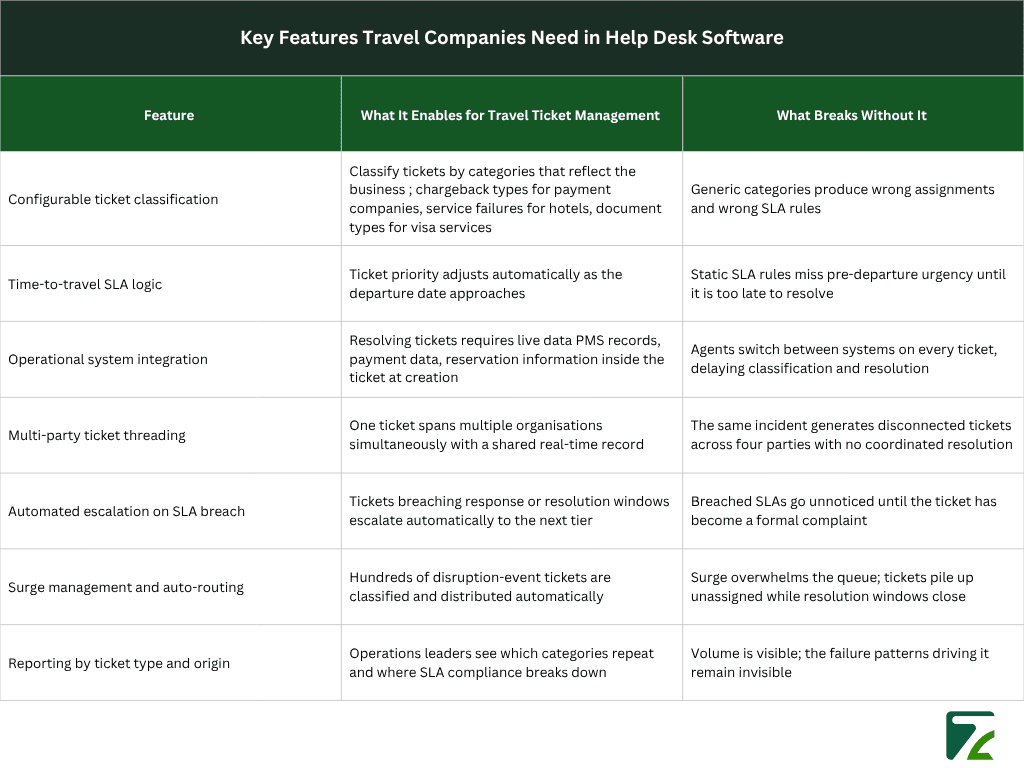
Travel help desk software therefore needs SLA logic that accounts for time-to-travel. A ticket’s priority must adjust automatically as the departure date approaches not remain static at the classification assigned weeks earlier. Generic SLA rules applying uniform response windows will systematically misclassify pre-departure ticket urgency.
How Does the Multi-Party Structure of Travel Complicate Ticket Management?
The global OTA market reached $253.2 billion in 2024 and is growing at 7.9% CAGR through 2034. That scale reflects a distribution chain where a single ticket frequently involves a retail agent, wholesale operator, DMC, ground supplier, and accommodation provider none in the same organisation.
According to HubSpot’s State of Customer Service, 75% of customer service professionals reported the highest-ever ticket volumes in 2024. In travel, furthermore, those tickets often require coordination across parties the company does not directly control.
A rooming list error ticket at a DMC must be owned by operations, coordinated with the hotel, updated with the retail agent, and confirmed with the passenger all on the same ticket, all with a shared record, all within SLA. Help desk software assuming one ticket equals one party cannot support this chain.
One practical framework for understanding where tickets originate is the CAOS Model Consumer tickets from direct customers, Agent tickets from trade partners, Operations tickets from internal teams, and Supplier tickets from ground partners. Most travel businesses formally manage Consumer tickets only. The other three origins generate tickets without classification rules or SLA ownership, which is why the same failures recur on every peak period.
A travel help desk is only complete when all four ticket origins are classified, owned, and resolved within defined SLA.
Understanding ticket complexity determines which software features genuinely matter.
What Does Help Desk Software for Travel Companies Need?
What Should You Prioritise When Choosing Help Desk Software for Travel?
Configurability for the specific ticket taxonomy the business generates. Always.
A hotel group needs maintenance workflows, loyalty dispute workflows, and corporate billing workflows. A travel payment company needs chargeback workflows, fraud investigation workflows, and reconciliation error workflows. These are not the same configuration. Additionally, any help desk software shipping with fixed generic categories forces teams to map tickets into the closest available label creating wrong assignments, wrong SLAs, and wrong escalation paths from the start.
The right help desk software for travel companies is configured for the tickets the business actually generates not built for a generic operation and marketed to the travel industry.
According to Kaizo, AI-driven tools reduce customer service costs by as much as 30% but only when classification logic reflects actual ticket types, not generic approximations. Zeal Desk applies this for travel specifically classifying tickets by origin and category against the operational context of the travel business, pulling live data directly into each ticket, and running custom workflows that teams configure for the specific operational tasks their business repeats daily
Knowing what the software must do leads directly to the questions that reveal whether it actually delivers it.
How Should a Travel Company Evaluate Help Desk Software?
Most vendor demos show a single clean ticket from a single customer resolved by a single agent in a single channel. Instead, the evaluation must test whether the platform can manage the specific ticket types, urgency logic, and multi-party structures the business generates, not a simplified demo scenario.
Which Questions Reveal Whether a Platform Can Manage Travel Tickets?
Can the classification system be fully configured for the exact ticket taxonomy the business generates chargeback types for a payment company, service failure categories for a hotel, document types for a visa service rather than forced into generic labels?
Does the software apply time-to-travel SLA logic automatically raising ticket priority as the departure date approaches, rather than applying a uniform SLA to all tickets regardless of travel date?
Does the operational system PMS, payment platform, reservation system, application tracker push live data directly into tickets at creation, so agents resolve with full context rather than switching platforms?
Does one ticket thread across all parties involved retail agent, ground supplier, internal ops, client with every stakeholder seeing the same record and every action logged in one place?
Do escalation rules trigger automatically when SLA thresholds are breached, not when a manager manually notices?
Help desk software that cannot demonstrate all five in the context of the specific tickets a business generates is not built for that operation. It is built for a simpler problem and marketed to the travel industry.
According to LiveChat AI, structured automated triage reduces median first-response time by 35 to 45 percent within the first month when the triage logic reflects actual ticket categories and SLA rules, not generic defaults applied without configuration.
A help desk for travel companies is not a support add-on. It is the software that determines whether every ticket the business generates whatever type, whatever origin, whatever deadline reaches a documented resolution before it becomes a complaint, a penalty, or a lost account.
If you are evaluating help desk software for your travel business, Zeal Desk enables custom ticket classification, custom SLA rules, and custom workflows built around what your travel operation actually generates, not a generic template. Use the evaluation questions above to assess any platform, including this one.”
Conclusion
A help desk for travel companies is the software that turns every ticket however it arises, whatever type it is, whoever raised it into a classified, owned, and resolved case with a documented outcome. The ticket types differ entirely across airlines, hotels, payment companies, DMCs, visa services, and pilgrimage operators. The need to classify them correctly, assign them to the right owner, and resolve them within SLA is identical across every one of them.