


TL;DR
A travel help desk is the operating layer that triages, routes, escalates, and resolves operational tickets for a travel business. Unlike a generic service desk, every ticket carries a departure date and a supplier dependency that ITIL request types never model. This blog defines what the desk does, walks through its six-stage daily ticket workflow, and shows how responsibilities split across customer-facing, supplier-facing, and back-of-house work.
Why a Travel Help Desk Needs Its Own Playbook
A travel help desk is not the IT service desk that ITIL textbooks describe. On a normal Tuesday, it absorbs pre-departure itinerary changes, chases a supplier for a missing confirmation, reissues a flight through the GDS, and resolves a payment dispute. None of this is work a generic definition accounts for.
The spectrum of travel businesses running one is also wider than most content admits. OTAs, tour operators, DMCs, travel tech platforms, bedbanks, consolidators, travel insurance providers, travel payments companies, and any travel company handling bookings all run some version of this function and each runs it slightly differently.
This blog therefore defines the desk as an operating layer. It walks one ticket through its six-stage lifecycle and separates the customer-facing work from the supplier-facing half.
What Is a Travel Help Desk and Why Does It Matter?
A travel help desk is a service function that resolves operational tickets for a travel business. It combines the people, processes, and software that handle customer queries, supplier coordination, and ticket follow-through. Unlike a ticketing system, which only manages tickets in a queue, a help desk emphasizes the full chain of direct support and escalation. Modern teams use ticketing tools, but they also layer AI, automation, and self-service on top.
The travel-specific difference is what the ticket carries. Every ticket has operational variables that generic frameworks ignore: a departure date and, often, a supplier dependency. For instance, a change request 14 days out behaves nothing like the same request three hours before check-in.
According to AltexSoft’s analysis of mid-office and back-office systems in travel, travel businesses run distinct front, mid, and back-office layers each handling different parts of a booking’s lifecycle. As a result, a desk built on generic ITSM assumptions misroutes the work because it cannot see across those layers.
A travel help desk’s workload scales with departure dates and supplier dependencies, not with internal request types.
That layered architecture also explains why the desk’s responsibilities split three ways, not one.
Key Terms Worth Knowing
Travel Help Desk : The service functions that triages, routes, escalates, and resolves operational tickets for a travel business.
GDS Reissue : A fare or itinerary modification routed through a Global Distribution System such as Amadeus, Sabre, or Travelport.
Supplier Escalation : The operator-to-vendor ticket spawned when resolving a customer issue requires action from a third party
Reconciliation : Matching a resolved money-related ticket against payments, refunds, chargebacks, or supplier settlements to close the financial record.
What Are the Core Responsibilities of a Travel Help Desk?
The desk owns three distinct responsibility sets, not one. Generic content collapses everything into “support,” which hides where the work actually lives. Specifically, it runs customer-facing duties, a supplier-facing half pointing at hotels, airlines, bedbanks, insurers, and payment partners, and a back-of-house layer that keeps the financial record clean.
Customer-Facing Travel Help Desk Responsibilities
Supplier-Facing Travel Help Desk Responsibilities
The supplier-facing half rarely shows up in generic content, yet it carries real weight. When a customer ticket needs a hotel, airline, bedbank, DMC, insurer, or payment processor to resolve, the desk opens a parallel B2B ticket. For instance, AltexSoft’s review of NDC airline capabilities found post-booking servicing remains the weakest area across most carriers and every gap becomes a supplier ticket.
For a tour operator, bedbank, or DMC, supplier coordination is structural workload, not an occasional exception.
Back-of-House Travel Help Desk Responsibilities
The third set runs after the customer goes quiet. It covers classification, tagging, data hygiene, and for tickets that involve money reconciliation against payments, refunds, chargebacks, or supplier settlements. Although this work is unglamorous and routinely under-staffed, it carries the highest financial exposure per ticket. Notably, Mastercard’s 2025 chargeback research found travel and hospitality has the highest average chargeback value across all industries at $120. For instance, a refund logged but never reconciled becomes a leak that surfaces weeks later.
These three responsibility layers map onto a single repeatable lifecycle that every ticket travels through.
What Does a Travel Help Desk's Daily Workflow Look Like?
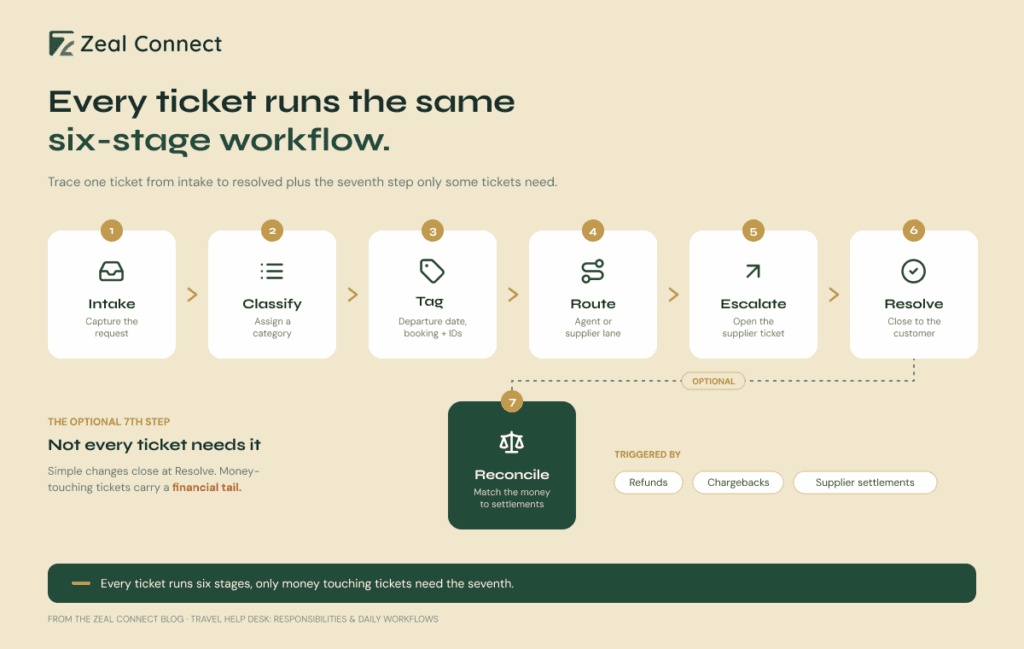
The desk runs a repeatable six-stage workflow: intake, classify, tag, route, escalate, and resolve. Tracing one ticket through all six stages shows where time leaks and where automation pays. Money-related tickets refunds, payment disputes, supplier settlements then pass through a seventh, optional step: reconciliation.
Workflow Stages 1–3: Intake, Classify, Tag
The first three stages structure the ticket. First, intake captures the request from email, chat, voice, WhatsApp, or a channel partner. Next, classification assigns a category booking change, refund, supplier issue, disruption, payment exception, or insurance claim. Finally, tagging attaches the operational fields that travel work depends on, especially the departure date, booking ID, and supplier reference.
Above all, the departure-date tag drives everything downstream. Because urgency in travel keys off hours-to-departure rather than severity alone, a ticket 18 hours out behaves differently from one two weeks away.
Workflow Stages 4–6: Route, Escalate, Resolve
The middle stages move the ticket toward a resolver. Routing sends customer-facing work to an agent and supplier-dependent work to the escalation lane. Meanwhile, departure timing shapes the order near-departure tickets jump the queue. Escalation opens the parallel supplier ticket when a third party must act. Finally, resolution closes to the customer-facing side.
However, resolution is not always the end. A closed customer ticket with an open supplier thread is only half done.
A travel ticket that touches money is not fully closed until its financial record reconciles.
The Optional Seventh Step: Reconciliation
Not every ticket needs reconciliation. A meal-preference change or a simple itinerary question closes at resolution. But any ticket that moves money a refund, a chargeback, a supplier settlement carries a financial tail. For those tickets, reconciliation matches the resolved record against payments and settlements, then closes the loop. According to Salesforce’s 2025 State of Service report, AI is projected to handle 50% of service cases by 2027, up from 30% today and rule-based steps like reconciliation are among the first to benefit.
Worked Example: One Refund Ticket Through the Workflow
To make the stages concrete, follow a single ticket. A traveler emails an OTA at 9:00 a.m.: their hotel cancelled a prepaid booking with check-in 20 hours away, and they want a refund.
- Intake : the email lands in the queue and becomes a ticket.
- Classify : it is logged as a refund with a supplier-cancellation cause.
- Tag : the desk attaches the booking ID, the supplier reference, and the 20-hour departure window. That last tag flags it as urgent.
- Route : because departure is under 24 hours, the ticket jumps into the queue to a senior agent.
- Escalate : the agent opens a parallel B2B ticket to the bedbank to confirm the cancellation and trigger the supplier-side refund.
- Resolve : the agent confirms the refund to the traveler and closes the customer-facing side.
- Reconcile : because money moved; the ticket carries a tail: the desk matches the customer’s refund against the bedbank settlement before the record fully closes.
A meal-preference change would have stopped at stage six. This refund ticket did not, because it touched money which is exactly why reconciliation is a step some tickets need and others skip.
How Does a Travel Help Desk Vary Across Sub-Verticals?
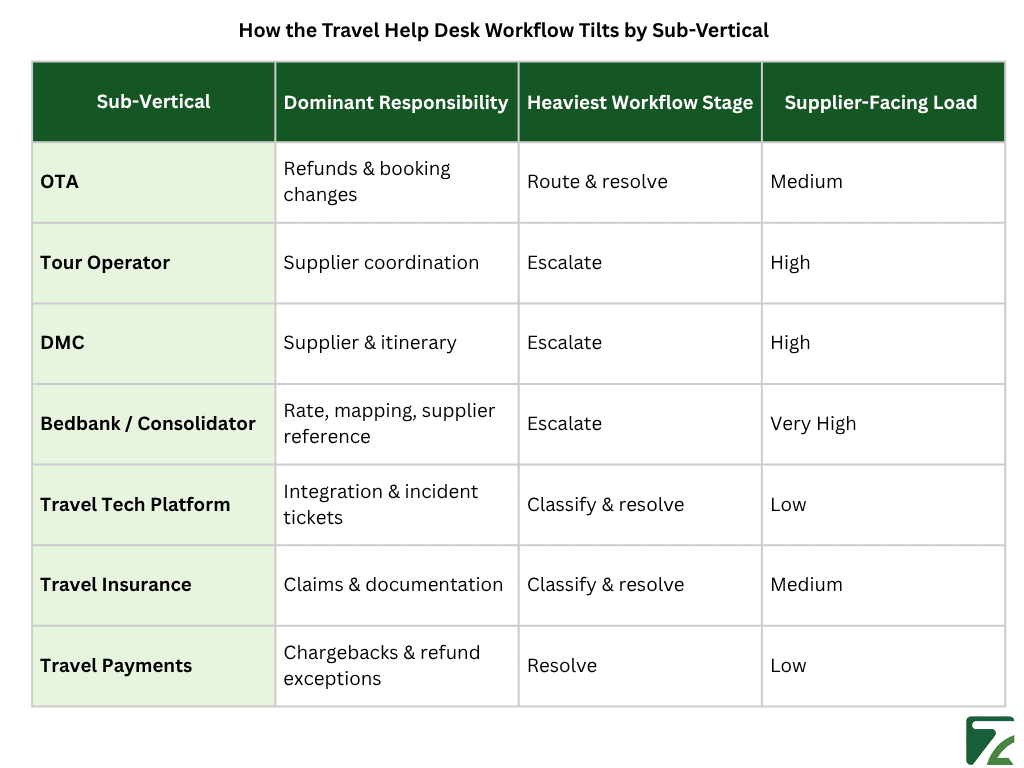
The six-stage workflow is stable, but its weighting shifts by segment. Understanding where your own desk sits helps you staff and automate the right stages rather than copying a generic template.
For example, an OTA leans refund-heavy, while a tour operator leans supplier-heavy. Similarly, a DMC carries both supplier and itinerary load, whereas a bedbank or consolidator lives in supplier reference work. Insurance providers, meanwhile, lean claims-heavy Squaremouth’s 2024 travel insurance recap reported over 40% of paid claims came from cancelled or cut-short trips. Payments companies live in chargebacks. Finally, travel tech platforms field integration and incident tickets from B2B clients.
What to Automate and What to Keep Human
Automation pays where stages are repetitive and rule based. Specifically, classification, tagging, supplier follow-ups, and reconciliation lead the list. By contrast, the stages that need humans are escalation negotiation with suppliers and the judgment-heavy customer conversations where tone and discretion matter. The payoff is real: McKinsey and Skift’s research on agentic AI in travel reports Cathay Pacific rebuilt schedules in two hours during a typhoon response using AI, against eight to ten hours manually. Notably, Phocuswright research from 2026 found 61% of travel businesses are experimenting with or scaling agentic AI but the gains come from automating the right stages, not all of them.
This is where a purpose-built travel ticketing system earns its place.
How Does Zeal Desk Automate the Help Desk Workflow?
Zeal Desk is an AI-powered ticketing system built specifically for travel operations. It automates ticket summarization, smart classification, and data tagging including travel-specific fields like check-in and check-out dates, booking IDs, and supplier references. Beyond tagging, it also runs a workflow automation engine that lets teams design custom rules across the lifecycle.
The builder uses a simple four-part structure any operations lead can configure without code:
- Trigger: the event that starts the workflow. For example: a new ticket created, a supplier email received, or a check-in date approaching.
- Conditions: the filters that decide whether the workflow runs. For instance, ticket category equals “HCN request,” or hours-to-departure is less than 24.
- Actions: what the workflow does next: auto-assigning to a group, sending a templated supplier email, or escalating to L2.
- Output: the resolved state the workflow leaves behind: ticket closed, supplier ticket opened, or customer notified.
In workflow terms, Zeal Desk slots into the stages where rule-based work compounds classification and tagging at the front, supplier follow-ups in the middle, and structured handoffs at the back. Consequently, agents focus on judgment-heavy stages like escalation and complex customer conversations.
To see how Zeal Desk maps to your sub-vertical, visit the Zeal Desk product page.
Conclusion
A travel help desk is an operating layer with a named responsibility set, and a six-stage workflow is not a generic inbox. The work splits cleanly into three layers: customer-facing duties, a supplier-facing half of most teams under-count, and a back-of-house layer where money-touching tickets reconcile. Although the workflow is stable across OTAs, tour operators, DMCs, bedbanks, consolidators, insurance providers, payments companies, and any travel business handling bookings, its weighting shifts by segment.
The practical move is straightforward. First, map the existing queue onto the six stages. Next, separate customer-facing work from the supplier-facing lane. Then, decide which stages to automate. With that operating model in place, the desk becomes something a lead can measure and improve.