



TLD;R
Real-time pricing is a strategic priority for every travel agency across flights, hotel bookings, and packages. This guide covers what it means, how it affects fare accuracy and booking engine performance, and how to implement it using The Selective Pricing Stack. Written for leadership and management at OTAs, DMCs, and tour operators.
Are Your Fares and Rates Accurate? The Real-Time Pricing Gap Costing Travel Agencies Bookings
Travel agencies deal with this daily. A customer asks for a flight and hotel package to Dubai. Your team puts together a quote of ₹58,000 for the flight, ₹9,500 a night for the hotel. The customer says they will confirm tomorrow. By morning, the airline adjusted the fare. The hotel has filled up for those dates and raised its rate. Your quote is now ₹6,200 short of what it will actually cost to confirm. You either absorb the gap or go back to the customer with a higher price. Neither outcome is good.
This is the real-time pricing problem. It affects flights and hotel bookings equally, because both are priced dynamically by the supplier. OAG’s 2025 airline pricing analysis found that only around 25% of all air ticket offers sold in 2024 were dynamically generated meaning 75% of fares customers see are still based on static, pre-filed rules. The same gap exists on the hotel side: rates loaded into an agency booking engine via a bedbank or channel manager are typically batch-updated, not live.
NerdWallet’s Travel Price Index (April 2026) shows U.S. airfares up 14.9% year-over-year as of March 2026. On the hotel side, average daily rates reached $162.16 in 2025, with weekends running 15–20% higher than weekdays shifts that happen within a single day based on occupancy, local events, and competitor moves on OTA platforms. An agency quoting from a cache that is six hours old is quoting from a different market.
The scale of intraday price movement is real. pAiback’s January 2026 platform data shows 50–60% of flights see at least one price drop after booking, with average savings of $250 per ticket. The same volatility that creates post-booking drops also creates pre-booking mismatches prices moving between the moment a customer searches and the moment they confirm, on flights and rooms alike.
Real-time pricing is not a flights-only problem. Every time a travel agency quotes a hotel room from a batch-updated cache, it faces the same mismatch risk as it does with a stale airfare.
What Real-Time Pricing Actually Means for a Travel Agency
Real-time pricing means the price shown to a customer at the moment of search; whether for a flight seat, a hotel room, or a package combining both is fetched live from the supplier’s current inventory system at that exact moment. Not from a database of prices loaded yesterday. Not from a batch that ran four hours ago. For hotel sellers, this means live hotel rates via API are fetched directly from the supplier’s current inventory system.
Key Terms Worth Knowing
Airfare Pricing: How airlines continuously update fares based on demand, booking pace, time to departure, and competition. Prices change multiple times daily, making live access essential.
Re-Shopping: A real-time price check at checkout that confirms both flight and hotel rates before payment, preventing last-minute price changes.
Selective Pricing Stack: A 4-layer framework combining cached and live pricing ,from stable searches (cache) to high-value bookings (always live) with a final re-check at checkout.
Rate Discrepancy Rate: The percentage of bookings where the final price differs from the searched price the key metric for pricing accuracy.
Look-to-Book Ratio: The number of searches needed for one booking. Improves when pricing is accurate and checkout drop-offs reduce.
Static Pricing vs Dynamic Pricing vs Real-Time Pricing : What Is the Difference?
These three terms are used interchangeably across the industry. They describe meaningfully different systems, and the distinction matters for agencies evaluating platform upgrades or vendor capabilities.
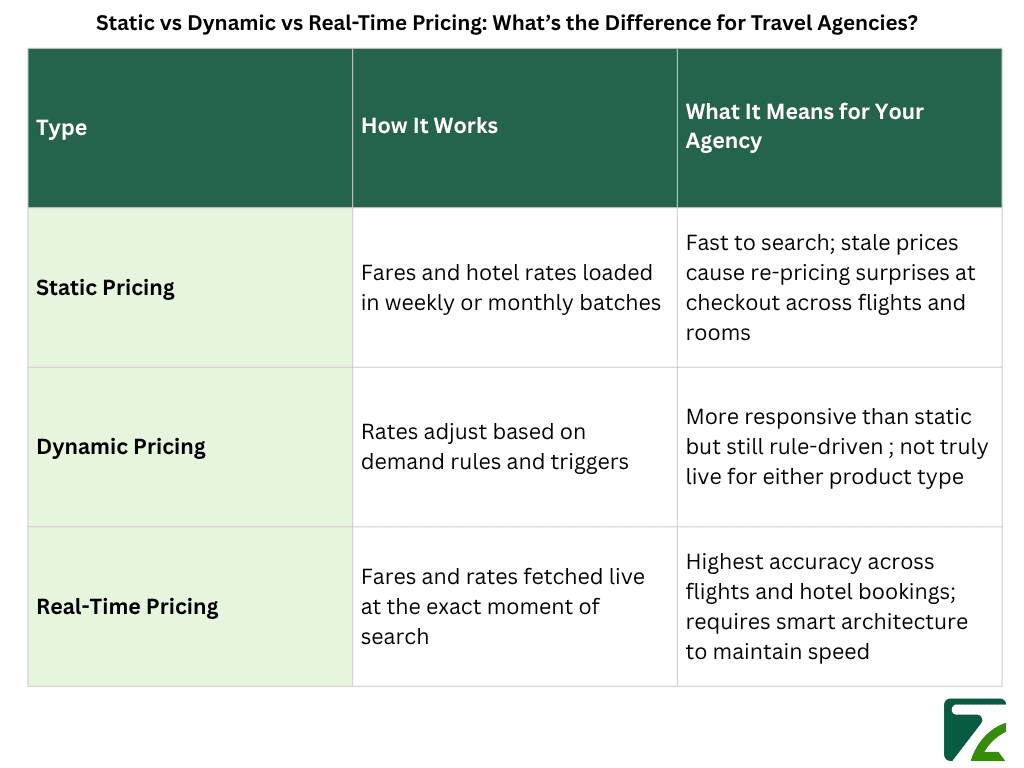
Static pricing is where most B2B travel still operates. Fares and hotel rates are negotiated with airlines, bedbanks, and hotel wholesalers, then loaded into the booking engine in scheduled batches. It is fast and predictable, but the prices shown are rarely the prices the supplier is selling at this moment for either product.
Dynamic pricing is more sophisticated. Airline fares and hotel rates adjust based on rules demand levels, booking pace, event calendars, competitor benchmarks. More responsive than static, but still rule-driven. A well-configured dynamic pricing setup narrows the mismatch between displayed and actual prices for both flights and hotel rooms. It does not eliminate it.
Real-time pricing closes the remaining gap. The fare or room rate is retrieved from the supplier’s live system at the moment of search, the airline’s current inventory, and the hotel’s current channel manager output. What the customer sees is what the supplier is charging right now, for both the flight seat and the hotel room.
For agencies selling packages, the problem compounds: stale pricing at either the flight or hotel layer makes the total wrong. Real-time pricing at both layers is what makes a package quote hold at confirmation.
For a travel agency, real-time pricing is not a feature ; it is the foundation of a price your customer can trust when they go to book.
How Real-Time Pricing Affects Your Agency's Revenue, Conversions, and Operations
Real-time pricing affects three operational metrics simultaneously the accuracy of the price shown at search, the speed at which your booking engine returns results, and the rate at which searches convert to confirmed bookings. Getting it right improves all three.
How Real-Time Pricing Creates or Kills Price Accuracy at Search
When the price a customer sees at search for a flight, a hotel room, or a combined package, matches what they pay at confirmation, the booking completes. When it does not, the booking fails. SiteMinder’s Changing Traveller Report 2025, based on 12,000 travellers across 14 countries, found that 52% of travellers have abandoned an online booking because of a bad digital experience. Price mismatch at checkout, arriving because a cached fare or room rate changed before the customer confirmed is one of the most direct and avoidable causes of that abandonment.
Data compiled by Navan (2025) puts the average OTA cart abandonment rate at approximately 89%. A meaningful share happens at the payment step, when the expected price no longer matches what the booking engine is charging across flights and hotel nights equally.
What Real-Time Pricing Does to Your Booking Engine's Speed and Load
When a booking engine moves from cached prices to live supplier calls, every search becomes a set of simultaneous outbound requests to the GDS for flight availability, to the airline’s NDC channel for current fares, to the bedbank or hotel channel manager for live room rates all running in parallel before results display.
Research cited by Abbacus Technologies (2025) shows a single additional second of page load time reduces booking conversions by 7% or more. For a platform handling thousand of flights and hotel searches daily, that is a direct revenue cost.
At enterprise scale, a 2025 analysis in the World Journal of Advanced Research and Reviews estimates major OTAs process 100–150 billion search queries annually, each triggering 15–20 downstream data calls. Adding live hotel channel manager calls alongside live airfare connections compounds this load which is why architecture matters as much as the pricing decision.
Dynamic Pricing vs Real-Time Pricing: The Look-to-Book Difference
The look-to-book ratio the number of searches required to generate one confirmed booking is among the most closely watched metrics in agency operations. Real-time pricing improves it not by generating more searches, but by reducing the drop-offs at checkout that happen when cached flight prices or hotel rates have moved since the search was run.
Dynamic pricing narrows the gap fares and room rates responding to demand signals diverge less from competitor prices. But because it is still rule-based, a gap remains. Real-time pricing eliminates it. The cost trade-off is real live calls cost more than cached results which is why pricing should be applied in layers, starting where accuracy has the greatest commercial impact.
Real-time pricing improves look-to-book ratios by eliminating the checkout drop-offs that stale flight fares and cached hotel rates create not by increasing search volume.
What the Data Says About Real-Time Pricing and Booking Engine Performance
- 22% increase in revenue compared to the previous static pricing system
- 17% improvement in pricing response time the live pricing architecture was faster than the batch system it replaced
- 30% reduction in peak-load resource consumption through component-level scaling in the microservices model
- 15% improvement in customer satisfaction scores attributed directly to more accurate, contextually relevant pricing
A 2–10% revenue uplift from real-time and dynamic pricing is documented across airline, hotel, and OTA contexts. The mechanism is the same in every case: accurate pricing at search converts more bookings.
How Travel Agencies Should Implement Real-Time Pricing
The Selective Pricing Stack is a four-layer framework that matches the pricing method to the booking type across flights and hotel inventory, so agencies get live accuracy where it matters most without the latency and cost of live calls everywhere.
The Selective Pricing Stack : Four Layers for Flights and Hotel Bookings
Layer 1 : Cache: Stable, high-volume searches popular domestic routes and standard hotel rooms on low-demand dates. Cached prices with 4–6-hour refresh windows. Price movement here is slow enough that freshness is not the priority.
Layer 2 : Selective Live: Volatile searches long-haul airfare corridors and hotel bookings around events, weekends, or peak dates where rates move by the hour. Reduce cache expiry to 30–60 minutes or trigger live calls when demand crosses a threshold.
Layer 3 : Always Live: High-value bookings corporate travel, premium cabin airfare, group hotel reservations, and packages where both a flight and a room must price correctly together. Live suppliers call on every search.
Layer 4 : Re-Shop Gate: A live re-validation of both the airfare and the hotel rate at the moment a customer moves to the payment step for every booking, regardless of which layer triggered the search. This eliminates checkout re-pricing surprises before the customer pays.
The Re-Shop Gate is the single highest-return change a travel agency can make to its booking platform removing the primary cause of payment-step abandonment across flights and hotel bookings alike.
KPIs to Track After Enabling Real-Time Pricing
- Rate discrepancy rate: how often the confirmed price on a flight, room, or package differs from the searched price. Primary accuracy metrics.
- Pricing response time at P95/P99: captures tail latency spikes from live airlines and hotel channel manager calls that averages hide.
- Look-to-book ratio: improving conversion from search to confirmed booking as checkout drop-offs fall.
- Cart abandonment at payment step: track weekly for the first three months after the Re-Shop Gate goes live.
The Selective Pricing Stack treats airfare and hotel bookings as equal parts of the same problem and solves both through the same layered architecture rather than building separate solutions for each product type.
The Business Case for Real-Time Pricing That Leadership Cannot Ignore
Revenue. A 2–10% uplift is documented across airline and hotel contexts. Hotels spend 15.5–23.8% of room revenue on distribution costs (WJARR Journal, 2025 industry estimate). Any pricing improvement that reduces rate leakage on hotel bookings, eliminates fare mismatch on flights, and increases confirmed bookings on the same search volume is a direct margin improvement.
Customer retention. The 15% improvement in customer satisfaction scores from the arXiv microservices study is not abstract. It reflects what happens when customers stop being surprised at the payment step on flights and hotel rooms both. Customers who are not re-priced at checkout come back.
Competitive positioning. With only 25% of air ticket offers dynamically generated in 2024, and hotel rate accuracy inconsistent across most agency platforms, the agency that presents live prices at search and confirms them without surprises wins the booking when all else is equal. That advantage compounds: accurate pricing becomes the reason customers choose you over the platform that re-prices them.
Conclusion
Real-time pricing is not a technology decision that sits with the product team. It is a commercial decision about what your agency promises customers a price they can trust when they go to confirm a flight, a hotel room, or a package that combines both.
The agencies getting this right are not necessarily the largest. They are the ones that understood the pricing gap in their airfare feeds and in their hotel rate connections and started closing it systematically. Auditing which suppliers update in real time and which still run in batches. Applying The Selective Pricing Stack layer by layer rather than all at once. Adding the Re-Shop Gate before ticketing. Measuring rate discrepancy and look-to-book alongside each other.
The starting point is the same for every agency. Know where your fares and room rates come from. Know how stale they are. Know which bookings, flights, hotels, packages are most damaged when the price shifts between search and confirm. Start closing that gap there first.