


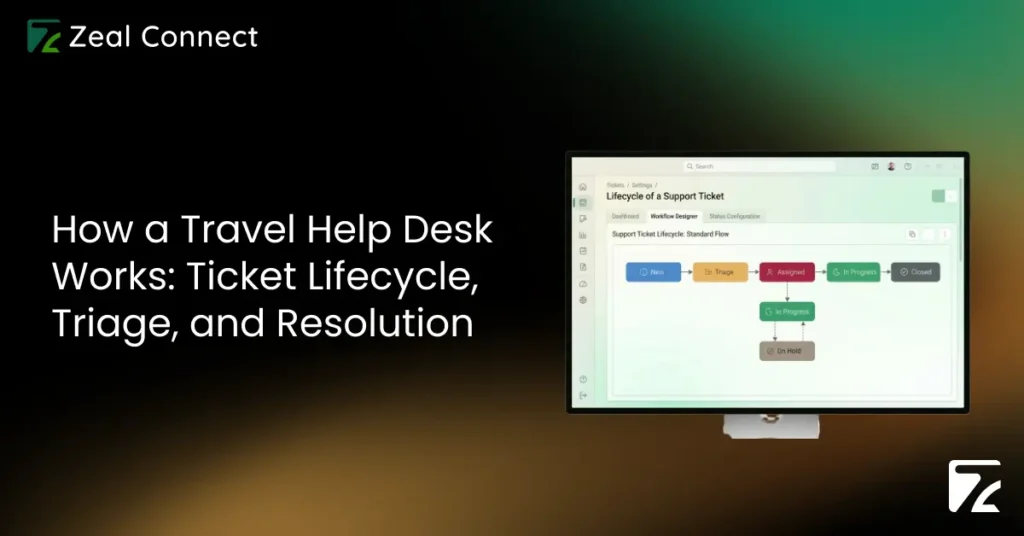
TL;DR
A travel help desk is software that manages the full lifecycle of support tickets from first contact to documented closure across every channel and requestor type a travel company serves. In travel, those tickets span denied boarding claims, safety incidents on remote routes, visa rejections, and API-generated booking failures. This guide introduces the Travel Ticket Lifecycle Framework and explains how help desk software processes each stage for OTAs, airlines, DMCs, TMCs, and every other travel company type that handles structured support at scale.
A travel help desk is software. Not a department. Not a workflow. Software that receives every support request a travel company handles from customers, trade partners, and internal teams classifies each one, assigns it to the right owner, tracks it against a deadline, and closes it with a documented resolution.
That definition applies to any industry. What makes travel operationally distinct is the nature of the requests. A denied boarding claim at a gate. A visa rejection 60 hours before departure. A safety incident on a remote trekking route. A payment gateway failure generating hundreds of system-triggered tickets before a single agent has logged in.
This guide explains how travel help desk software processes requests like these from the moment they arrive to the moment they genuinely close.
What Is a Travel Help Desk?
A travel help desk is software through which travel companies manage the full lifecycle of support tickets from first contact to documented closure across every inbound channel and requestor type the operation serves.
Every request is received, classified, prioritized, assigned, tracked against an SLA, escalated when thresholds are breached, resolved, and documented. Widely deployed standard service desk software includes Freshdesk, Zendesk, Zoho Desk, HappyFox, and Jira Service Management. Each requires a deliberate travel-specific configuration to function correctly in an operational travel context.
Key Terms Worth Knowing
Travel Ticket Lifecycle Framework : The four-stage model: Capture and Enrichment, Classification and Prioritization, Resolution, Genuine Closure through which travel help desk software processes every support request from creation to confirmed closure across all requestor and company types.
Ticket Classification : The process of assigning an incoming ticket to a defined category booking issue, supplier failure, safety incident, technical error before urgency is assessed; classification determines which team owns the ticket and which resolution workflow applies.
Ticket Enrichment: For channel-based and sheet-uploaded tickets: the automated process of attaching the relevant source record PNR, reservation, group manifest, or transaction reference after ticket creation. For API-generated tickets: contextual data passed by the source system at the moment the trigger fires, making enrichment simultaneous with capture.
SLA (Service Level Agreement): A defined commitment within help desk software specifying maximum response and resolution times per priority tier; in travel, SLA design must reflect the urgency of each requestor type and ticket category, with prioritization factors configured per company type.
How Does a Travel Help Desk Differ from a Standard Help Desk?
In most industries, a support team resolves issues using internal systems. In travel, resolution almost always requires an external party a supplier, a GDS operator, an embassy, or a ground handler to act first. Consequently, the agent is rarely the constraint. The external party’s response time is.
Additionally, travel support operates inside closing time windows. A billing dispute in SaaS can wait 24 hours without consequence. A stranded traveller at midnight cannot. According to AmplifAI, 85% of CX leaders report that customers will leave a brand over a single unresolved issue. In travel, that issue often has a departure time attached.
Generic service desk software fails to travel operations not because features are missing, but because its resolution logic assumes an internal path. In travel, it rarely does.
What Is the Travel Ticket Lifecycle Framework?
The Travel Ticket Lifecycle Framework is the four-stage model through which travel help desk software processes every ticket:
- Capture and Enrichment : Ticket created via any method and connected to the relevant record
- Classification and Prioritization : Category assigned, urgency determined, SLA clock started
- Resolution : Issue worked through the correct support tier, including external parties
- Genuine Closure : Outcome confirmed with requester, source record updated, all parties documented
Each section below maps to one of these four stages.
What Types of Tickets Does a Travel Help Desk Handle?
Tickets in a travel help desk arrive from three distinct requestor types. Requestor type determines the resolution path before the ticket category is considered.
What Do Customer and Traveller Tickets Look Like?
Customer tickets span the widest operational range. Airlines receive denied boarding claims, baggage loss reports, delay compensation requests, and special service request failures.Cruise lines field shore excursion overbookings and port substitution queries. Adventure travel operators manage safety incidents, equipment failures, and medical emergencies on route the most time-critical category in the industry. Each requires a different resolution path, a different responsible team, and a different external contact.
What Do Trade Partner and B2B Tickets Look Like?
B2B tickets come from agents, corporate clients, and distribution partners. OTAs receive API connectivity failures, supplier discrepancy reports, and agent commission queries. DMCs field rooming list errors, guide cancellations, and excursion amendments from incoming tour operators. TMCs manage corporate billing disputes, travel policy violations, and expense reconciliation failures. These tickets carry commercial consequences. Poor resolution directly affects contract renewal, not just satisfaction scores.
What Do Internal Operations Tickets Look Like?
Internal tickets represent significant volume that most implementations overlook. Travel payment companies raise multi-currency reconciliation errors and fraud alerts as internal cases for finance teams. TMCs manage duty of care incidents internally before any outbound traveller communication is made. Visa service companies track missing document notifications as internal cases before updating the client.
Requestor type customer, trade partner, or internal is the first classification input in the Travel Ticket Lifecycle Framework. It determines the SLA expectation, resolution team, and the consequence of failure before the ticket topic is assessed.
How Is a Travel Help Desk Ticket Captured and Enriched?
Stage 1 of the Travel Ticket Lifecycle Framework is Capture and Enrichment. The capture method determines whether enrichment is a downstream step applied after the ticket is created or whether it is already embedded in the ticket at the moment of creation.
How Are Travel Help Desk Tickets Captured?
Tickets enter help desk software through three distinct methods, each with a different relationship to enrichment.
Channel-based capture covers the most familiar inbound paths: email, phone, live chat, WhatsApp, social media, OTA messaging platforms, and in-app forms. A requestor contacts support and a ticket is created. Enrichment attaching the relevant booking record, PNR, customer profile, or transaction data is a downstream automated step applied after the ticket exists.
Bulk sheet upload handles volume submissions. A DMC uploading a rooming list error manifest, a TMC batch-submitting corporate traveller queries, or an airline processing bulk baggage claims after a disruption event each submits a structured file from which the help desk creates multiple tickets simultaneously. Enrichment quality here depends on how complete and structured the uploaded data is.
API-generated capture works fundamentally differently. A booking engine failure, payment gateway error, or GDS sync failure does not just trigger a ticket; it simultaneously passes structured contextual data from the source system directly into it. Booking references, error codes, affected records, transaction values, and timestamps all arrive as part of the trigger event itself. Capture and enrichment happen in a single step. The ticket is actionable the moment it is created.
What Does Enrichment Mean and When Does It Apply?
A booking reference completed manually by an agent after opening a ticket is not enrichment. For channel-based tickets, enrichment must be automated. For API tickets, it is already embedded in the capture event.
How Are Tickets Classified and Prioritized in a Travel Help Desk System?
Stage 2 of the Travel Ticket Lifecycle Framework is Classification and Prioritization. These are two distinct, sequential steps and conflating them is one of the most common configuration errors in travel help desk implementations.
How Are Travel Help Desk Tickets Classified?
Classification assigns the ticket to a category. It answers one question: what type of issue is this?
Common travel classification categories include booking and reservation issues, payment and billing disputes, supplier failures, documentation and visa issues, safety and emergency incidents, technical and system errors, service quality complaints, loyalty and rewards queries, group operations issues, and duty of care incidents.
Classification determines which team owns the ticket, and which resolution workflow applies. A safety incident and a billing dispute may carry identical urgency. However, they route to entirely different teams and follow entirely different paths.
How Are Tickets Prioritized and What Factors Drive It?
Prioritization assigns urgency to the classified ticket. The factors that drive priority differ by company type. There is no single universal model.
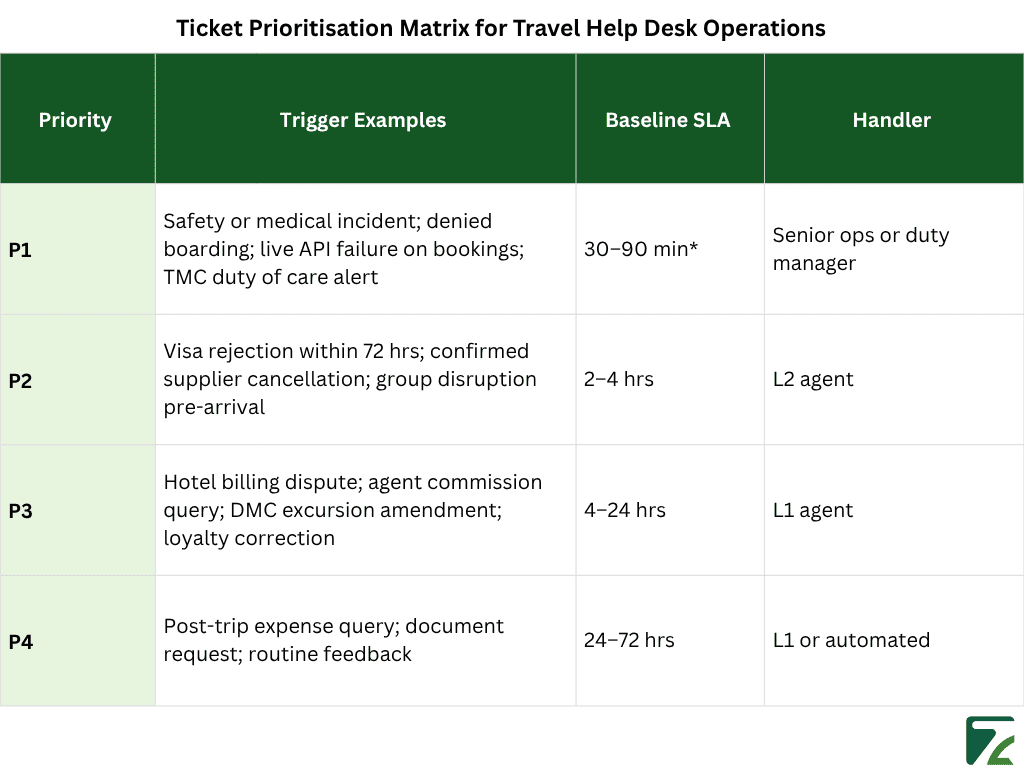
P1 of 30 minutes requires 24/7 staffing. For smaller operations, 90 minutes with a documented on-call protocol is realistic.
An OTA weights API failure scope, booking value, and time to departure. A TMC weights corporate client tier and traveller safety risk. A DMC weights group size and days to arrival. An adventure operator weights whether the incident is active in the field. Each operation should configure its own weighting model; the table above is a baseline, not a universal standard.
How Does Routing Follow Prioritization?
Routing assigns the classified, prioritized ticket to the correct team. An OTA API failure routes to an integration team, not customer service. A settlement error routes to finance operations. A visa rejection routes to a documentation specialist or embassy liaison.
Skill-based routing requires a maintained taxonomy updated as team structures and product scope evolve.
What Happens When a Travel Help Desk Ticket Goes to Resolution?
Stage 3 of the Travel Ticket Lifecycle Framework is a Resolution. It is the most complex stage because most travel tickets require an external party to act before the ticket can close.
What Do L1, L2, and L3 Mean in a Travel Support Operation?
L1 handles cases resolvable against existing records and standard policy. A hotel loyalty correction, a standard airline rebooking within fare rules, a coach luggage acknowledgement, all L1-resolvable when the agent holds source record access and policy authority.
L2 is where travel diverges from every other industry. In most contexts, L2 means a more experienced internal agent. In travel, L2 means external action:
- At an airline: GDS access through Amadeus, Sabre, or Travelport to rebook and issue compensation
- At a visa service company: direct contact with an embassy liaison
- At a DMC: a call to the hotel’s group reservations manager to confirm the correction on their side
- At a TMC: a duty of care protocol involving emergency services, corporate HR, and local ground support
The SLA clock runs while the external party is being reached. The agent is not the constraint. The supplier’s response time is.
L3 covers supplier disputes with financial exposure, refunds outside standard policy, and group-level failures requiring commercial authority.
Why Do L2 Tickets Consistently Stall?
Analysis of over 200 organizations by Moveworks found average MTTR (Mean Time to Resolution) without automation exceeds 30 hours across help desk operations. Travel’s external dependencies compound that baseline at every L2 ticket.
The highest-performing travel operations pre-build supplier directories, system credentials, authorization thresholds, and escalation scripts into their help desk configuration before tickets arrive not after they stall.
How Is a Travel Help Desk Ticket Genuinely Closed?
Stage 4 of the Travel Ticket Lifecycle Framework is Genuine Closure.The stage help desk software must enforce through workflow, not leave to agent discretion.
What Does Genuine Closure Actually Require?
A ticket closes genuinely when three conditions hold simultaneously: the requester has received written confirmation of the specific outcome; the source record reflects the change, and any external party involved has confirmed their side within the ticket.
A ticket marked resolved after a response is sent without external confirmation is a deferred escalation. The traveller arrives. The hotel has no record of the amendment. The ticket reopens as a P1.
Operations tracking “response sent” and “confirmed resolved” as two distinct workflow states consistently report lower repeat-contact rates and escalation volumes.
What Do Recurring Ticket Patterns Reveal?
What Does Purpose-Built Travel Help Desk Software Do Differently?
Generic service desk software can be configured for travel. However, travel-native ticketing tools are built around the operational requirements the previous sections describe enrichment at capture, classification before prioritization, supplier-aware escalation, and genuine closure enforcement.
Zeal Desk is an AI-powered ticketing system built specifically for travel operations. It automates ticket summarization at capture, so agents open a ticket and see the issue immediately, not a chain of forwarded emails. Smart classification routes tickets by type and urgency without agents manually assigning categories on each case.
Automated data tagging applies structured information check-in dates, check-out dates, booking references, and destination details to every ticket from the first interaction. Custom workflows handle repetitive operational tasks: standard acknowledgements, supplier update notifications, and SLA escalation triggers without agent involvement. This preserves agent capacity for L2 and L3 cases where human judgement is required.
According to Gartner 2024 research, cited by Pylon, AI-first platforms achieve 60% higher ticket deflection and 40% faster response times versus traditional deployments. Purpose-built tools like Zeal Desk apply those gains specifically within travel operations for any travel company from mid-market to enterprise scale.
The Travel Ticket Lifecycle Framework covers how help desk software processes requests once they arrive. The posts in this series on booking engine architecture, travel CRM analytics, and B2B distribution explain the upstream systems that determine what your ticket queue generates and what recurring patterns reveal about each one.
If you are evaluating help desk software for your travel business, Zeal Desk enables custom ticket classification, custom SLA rules, and custom workflows built around what your travel operation actually generates, not a generic template. Use the evaluation questions above to assess any platform, including this one.”
Conclusion
A travel help desk is software managing the full lifecycle of support requests from the moment a customer, trade partner, or internal team raises a ticket, to the moment it closes with a confirmed outcome on every side. What makes travel distinct is that tickets arrive through multiple capture methods with different enrichment paths, require classification before prioritization, and almost always involve external parties whose response time sits inside an SLA clock the agent cannot control. The operations that close tickets consistently have configured their help desk software around that reality not discovered it after the queue started stalling.