


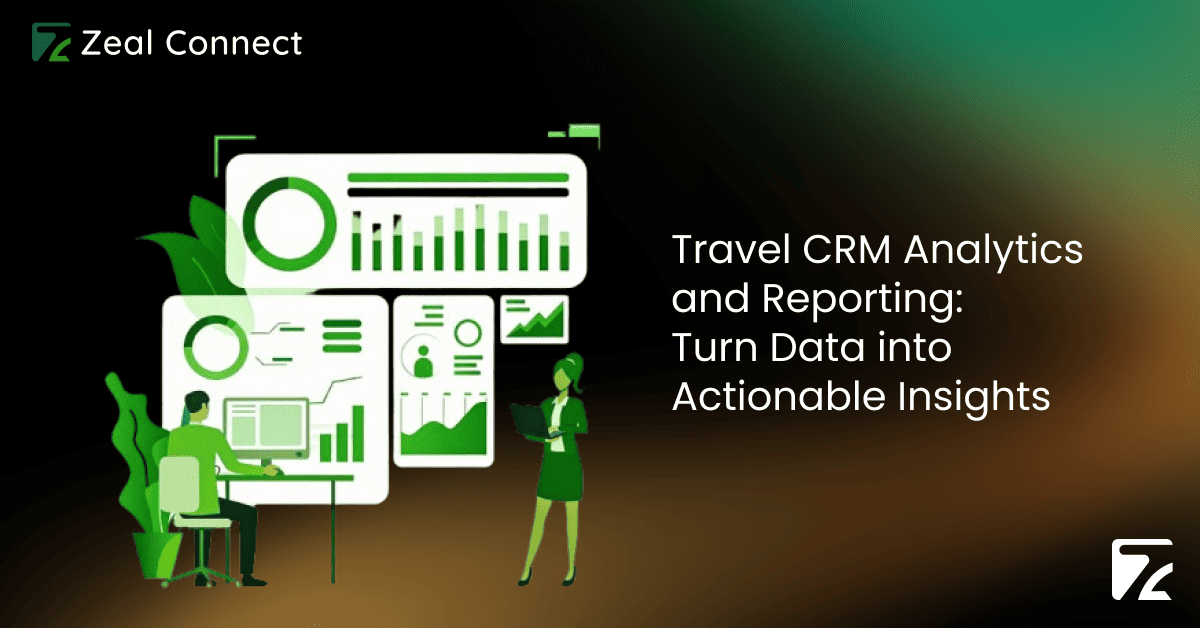
Travel CRM Analytics and Reporting: Turn Data into Actionable Insights

Travel CRM Analytics and Reporting: Turn Data into Actionable Insights TL; DR Summary Travel CRM analytics turn booking data into useable business intelligence. This guide helps travel agencies, OTAs, and DMCs track those metrics that matter the most conversion rates, customer lifetime value, seasonal trends, destination performance, and agent productivity and learn how to make the best of them in terms of no-shows, average booking value, and revenue forecasting. Agencies that are making data-driven decisions in 2026 rely on real-time CRM analytics. As a matter of fact, the majority of travel industry players collect billions of data points yearly without knowing what really counts or how to make the most profitable business decisions based on numbers. What Is Travel CRM Analytics and Why Does It Matter? The Travel CRM analytics is nothing but ensuring, analyzing, and interpreting customer and booking data to discover patterns, optimize the process, and drive business strategy. For travel organizations, CRM analytics uncover what marketing channels generate desirable bookings, what destinations attract the most bookings, and even what sales agents best convert inquiries. Analytics capability-assisted travel agencies have increased the conversion rate by 30% or higher in the first year itself. How Do You Get Started with Travel CRM Analytics? Step 1: What are your goals: Business problems that you are solving. Improve conversion? Reduce cancellations? Optimize marketing spend? Step 2: Set your baseline metrics: In this step you will record your current conversion rate, average booking value, CAC, monthly volume and inquiry to booking time. Step 3: Implement Proper Tracking: Make sure your CRM is tracking the full customer journey from initial CTR to booking to payment data, and post-booking feedback Step 4: Create Regular Reporting : Daily (volume, critical matters), Weekly (conversion, pipeline), Monthly (trends, performance), Quarterly (strategy, forecasting) Step 5: Test and Iterate : A/B test when to send the email, the pricing, the channels, and revise training for agents based on data. Track results and scale winners. What Are the Seven Essential Metrics Every Travel Business Should Track? Today, seven critical metrics define success-booking conversion rate, average booking value, customer lifetime value, inquiry-to-booking time, customer acquisition cost, seasonal demand patterns, and agent performance metrics. 1. Booking Conversion Rate: Your Sales Effectiveness Scorecard The percentage of qualified inquiries that convert into confirmed, paid bookings. Formula: (Total Confirmed Bookings / Total Qualified Inquiries) × 100 Industry benchmarks: According to Promodo’s Travel Industry Benchmarks Report: OTA (overall traffic): 2-6% Travel agencies (qualified leads): 25-40% High-performing agencies: 40%+ Typically, a lead means someone who filled out a detailed inquiry form, requested a custom itinerary or had a consultation call, not an average website visitor. What the data reveals: If your conversion rate is below 25%, there are issues with your sales process, timing, or pricing. Sudden decreases can point to problems at certain destinations, or activity at the competition. The difference between leads by source indicates which marketing channels generate the most high-intent customers. Actionable insight: If you convert 20% of your visitors, increasing it to 30% can mean 50% more revenue without having to spend more on your marketing efforts. Improve speed of responsiveness; leads who are contacted after 5 minutes convert 9x better than after 30 minutes. 2. Average Booking Value: Maximizing Revenue Per Transaction What it measures: Average revenue per booking that’s confirmed. Disruption Handling and Restoration Total Booking Revenue / Total Number of Bookings The average booking value can also create huge differences between the turnover of two agencies with the same number of bookings. Knowing what attributes prompt higher ABV specifically facilitates upselling and package design. Strategies to increase ABV: Package together related services (accommodations + transportation + activities) Provide upselling opportunities during the booking process (e.g., room upgrades, travel insurance, premium experiences) Dynamic packaging tailored to individual customer preference based on historic behaviors Market with purpose towards destinations that attract a higher average booking value Real example: A luxury travel agency monitored ABV by destination and found that tours to Europe had an average value of $8,500 per booking, and travel within the United States averaged $2,200. Wiser moved 30% of the budget for marketing to European tours and saw revenue grow 41% with no increase to volume of bookings. 3. Customer Lifetime Value: Beyond the First Booking What it measures: The overall net profit generated by a customer during their entire relationship with your agency. Formula: (Average Booking Value × Number of Repeat Bookings × Average Retention Time) – Customer Acquisition Cost Intending to obtain new customers takes 5x more than retaining existing ones. Tracking high CLV provides the foundation and basis for loyalty programs and tailored communication, that drives a customer to keep coming back. Healthy benchmarks: CLV three times higher than CAC = Sustainable | CLV five times = Great | CLV beneath two = Unsustainable How to improve CLV: Provide personalized trip anniversary emails, establish loyalty programs with tiers based on spending, create reminders based on preference to offer relevant packages, and finally, reach out after the trip. 4. Inquiry-to-Booking Time: Speed Wins Business What it measures: Average time between initial inquiry and confirmed booking. Benchmarks: High performers: 24-48 hours | Average: 3-5 days | Underperforming: 7+ days Long inquiry-to-booking times indicate bottlenecks. Leads who are contacted within 5 minutes convert 9x more than leads who are contacted after 30 minutes. 5. Customer Acquisition Cost: Marketing ROI Reality Check What it measures: The total cost of acquiring each new customer through marketing and sales efforts. Formula: Total Marketing & Sales Expenses / Number of New Customers Acquired When your customer acquisition cost is higher than average booking value, you lose money on each new customer. Channel-wise CAC explains where the marketing investments yield a more profitable return. Example breakdown: Google Ads: $150 CAC, 8% conversion Facebook Ads: $95 CAC, 12% conversion Referral program: $35 CAC, 45% conversion Email marketing: $20 CAC, 22% conversion This data shows referrals and email deliver best ROI, suggesting budget reallocation could significantly improve profitability. 6. Seasonal Trends: Predict and Prepare What it measures: The difference in demand and booking patterns and consumer behavior from one season to another. Once you know the peak times, you can use that information to properly manage staffing levels, marketing spends and negotiations with your suppliers. Key metrics: Month-over-month volume, year-over-year comparisons, advance booking windows, and cancellation patterns. Actionable insight: A tour operator found that packages to Europe, which were booked as early as 6-9 months in advance, were seeing Caribbean tours booked within 2–4 months all the while. They adjusted marketing timing accordingly. Outcome: 28% more people booked early. 7. Agent Performance Metrics: Identifying Top
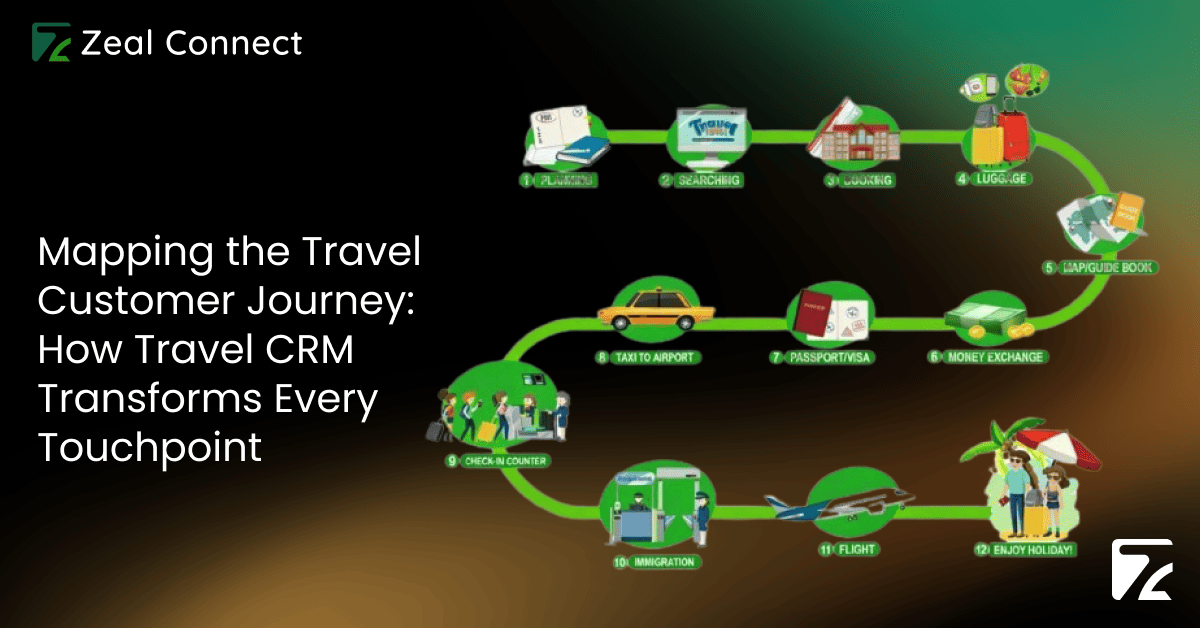
Mapping the Travel Customer Journey: How Travel CRM Transforms Every Touchpoint

Mapping the Travel Customer Journey: How Travel CRM Transforms Every Touchpoint There is no travel agency in the world that does not cringe at losing a hot lead. You get all excited when someone ask for an itinerary, you create this beautiful itinerary for them, send the quote, and… silence. Days pass. You reach out once, maybe twice, and then boom; that train has left the station. In the meantime, the competitor who replied quicker or followed up more consistently just got the booking. This happens thousands of times every day inside travel agencies around the globe, and not because of lack of specialties or offering poor products. It’s about navigating a complex landscape of interactions that create modern travel customer journeys. That initial “I want to know more about Bali” message through to the follow up letter once they are home. Every touchpoint between you either reinforces your relationship or gives your competitors an opportunity. Travel CRMs that are built for the travel industry change the way agencies process these important milestones. Where generic business software might address day-to-day operations, a Travel CRM gets the unique cadence of how travel sells: long consideration periods, the emotional burden of vacation planning, and the potential to turn one-off customers into repeat clients for life. Why the Travel Customer Journey Demands Specialized Attention The expectations for modern travelers have completely changed. Google’s Travel Trends report shows that 57% of travelers want brands to offer them personalized recommendations based on their past interactions with the brand. Before they reach out to any agency, they will do research on Instagram, TripAdvisor and Google reviews. When they do reach out, they want to be treated in a way that matches how they say they want to be treated instantly, direct answers. The challenge is scattered communication. At 9 AM, someone submits an inquiry through your website form. Then during lunch, the same customer sends additional questions via Instagram DMs. They’ll have emailed me by the evening asking about payment methods. But with no central hub, your team is trying to put context together from 3 different systems, and the important pieces of information are falling through. According to research from Skift, travel agencies lose an estimated 35-40% of potential bookings due to slow response times or not following up. Out of every ten opportunities that die due to price or product issues, four die due to communication breakdowns. Platforms like Salesforce or HubSpot are built for straightforward B2B sales cycles, but they don’t understand travel’s unique workflow. A Travel CRM knows that your “deal” isn’t closed when the booking is confirmed. The journey continues through ticketing, documentation, pre-trip preparation, on-trip support, and post-trip relationship building. Salesforce or HubSpot are platforms created for simple B2B sales cycles, not travel workflow. A Travel CRM understands that your “deal” is not sealed when the booking is done. The journey flows through ticketing, documentation, pre-trip preparation, on-trip support, and post-trip relationship establishment. What Travel CRM Actually Does for Your Agency Essentially, your Travel CRM is your agency’s single source of truth: the centralized home base for all customer information, tracking of individual interactions, management of a booking process, and the intelligent automation of your communications throughout your traveler’s journey. Here is the practical part of it: A couple asks about a Mediterranean cruise for their 25th anniversary. Instantly, Your Travel CRM records their purchases, logs that they wrote “luxury” and “anniversary celebration,” and send the lead directly to your cruise specialist. An acknowledgment email is immediately dispatched within minutes of the actual submission, and a follow up reminder is triggered 24 hours later by the automated system. Every quote that your agent makes gets stored in the Travel CRM with a timestamp. Their bookings are responded to with a series of pre-programmed touchpoints set off by the booking itself: reminders to pay, requests for documents, preparation emails for their trip sent on specific dates before departure and a series of touchpoints scheduled for their return home. As reported by Zendesk’s Customer Experience Trends Report, 42% of customers expect a business to respond within one hour of contacting them. A travel agency managing multiple channels with dozens of active inquiries will find it near-impossible to meet this expectation without systematic support. The Six Stages of the Travel Customer Journey The travel customer journey flows through six distinct phases: initial inquiry, quote creation, booking confirmation, pre-trip communication, on-trip support, and post-trip follow-up. Let’s explore how Travel CRM transforms each phase. Stage 1: Capturing Every Inquiry Before It Disappears A query is a very high-intent moment, and then the next 24 hours are crucial. This is the timeframe during which how you handle this lead creates a difference between getting a booking or losing them to a competitor. People face issues such as queries coming from different platforms (website, WhatsApp, Instagram, email), and getting lost, no clear ownership where multiple agents can handle the request, delayed responses where messages go unnoticed in personal accounts, etc. Inquiries from all channels are routed to one platform, which a travel CRM solves. With website forms, email parsing, and channel integrations, all contact points are recorded. The system automatically distributes inbound inquiries according to the rules you define round-robin distribution, geographic specialization, or product expertise, etc. Response tracking becomes built-in accountability. The CRM indicates the wait times for each inquiry and flags those which are about to breach your service level. But most importantly, it tracks source attribution and allows you to finally answer: which channels get you bookings and not just questions? Stage 2: Converting Interest Through Strategic Quoting Quoting is your most value-added stage with customer touchpoint. The traveler has interacted sufficiently to ask for specific details, but your proposal immediately impacts their decision making. The reasons quotes don’t convert: 3-5 days to reply while 24-hour responses from competitors, long email threads with multiple versions sent leading to confusion, one size fits all proposals with no mention of customer context, no systematic follow-up after sending quote According to research carried out by Phocuswright, agencies that convert over 25% of quotes into bookings always respond within 24 hours and tailor proposals to the customer preferences stated. Follow-up sequences are automated (no more guesswork): 48 after sending is “Any questions on the Italy itinerary?”. 5 days no reply: “I thought would send you the article about favorite hidden gems in Tuscany” 10 days no reply “I have your choice dates on hold, but I will need to release them soon” Within 30-40% of quotes booked, we see
10 Benefits of Travel CRM That Directly Impact Your Bottom Line

10 Benefits of Travel CRM That Directly Impact Your Bottom Line Travel CRM (Customer Relationship Management) is industry-specific software that organizes the way travel agencies, tour operators and OTAs manage customer interactions, bookings and relationships from the first inquiry all the way to post-trip follow-up. Unlike regular CRMs, Travel CRMs address industry-specific requirements such as multi-destination itineraries, supplier management commissions received and payable, payment schedules, seasonal trend analysis while they consolidate customer information from several communication channels. Operating a travel agency without using a CRM will lose those sales to competitors who act faster, personalize better, and function based on greater efficiency. A fact from several industry sources: CRM business applications can boost sales per representative by up to 41 percent. This guide takes a look at 10 such proven benefits, each supported by verified data from IBM, Salesforce, Nucleus Research and Aberdeen Group demonstrating Travel CRM’s direct impact to your bottom line. What is Travel CRM and Why Travel Businesses Need It According to Grand View Research, the global CRM market size was valued at USD 73.40 billion in 2024, registering a CAGR of 14.6% from 2025 to 2030. Travel CRM for cloud deployment achieved 56.1% market share in travel CRM in 2022 and is projected to expand at an impressive 16.1% CAGR by 2030. This phenomenal growth is indicative of how travel businesses are leveraging technology to cater to the demands of the new-age traveler. Instant replies over WhatsApp and email, personalized suggestions, and seamless booking journeys. Travel businesses have unique challenges that generic business software doesn’t do a good job of: managing complex itineraries between several suppliers, keeping commission records from multiple sources, dealing with bookings where deposits/final payments come due at different times , navigating high seasonality demands, maintaining relationships with both B2B partners and B2C travelers in real time. Benefit 1: Dramatically Increased Conversion Rates CRM can increase your conversion rate by as much as 300%, according to a number of industry sources. For travel agencies, that means converting a substantially higher percentage of inquiries into bookings by being more precise in lead management and scoring. Travel CRM collects leads from all source’s website forms, social media messages, calls, trade show contacts and prioritizes them based on engagement signals. High-intent leads that have opened significantly more than one email and/or viewed route pages are immediately handed off to sales, while others go into automated nurture campaigns. Actionable Step: Focus on leads with a score of over 70 for same day follow-up to get the most out of your conversion opportunities. Benefit 2: Shortened Sales Cycles Through Better Data Access Data accessibility for salespeople shortens their sales cycles by 8-14%, according to Nucleus Research. When customers inquire about destinations, they’re typically comparing multiple agencies simultaneously. Speed matters. Multi-channel inbox unification means when inquiries arrive via WhatsApp, Instagram, or email after hours, your CRM sends instant acknowledgment, assigns to the appropriate agent, and provides complete customer history immediately. Actionable Step: Set up auto-replies acknowledging inquiries within 60 seconds with reference numbers and realistic response timeframes. During peak seasons (January-March wave season, June-August summer bookings), automation prevents lost opportunities to faster competitors. Benefit 3: Improved Customer Retention Rates According to research from Aberdeen Group, those companies that utilize CRM tools to properly engage with customers see a 27% increase in customer retention rates. According to Capterra polls, 47% of CRM users reported that their CRM affected customer retention significantly. It is more expensive to acquire new customers compared to retaining existing customers about 5-7x more, so retention translates into higher profits more directly. Travel CRM streamlines post-trip follow-up, keeps track of preferences, and helps you orchestrate timely re-engagement campaigns, so your agency remains their first thought. Actionable Step: Send automated surveys 48 hours after they get home from a trip, then set up a re-engagement campaigns 4 – 5 months later, suggesting destinations based on their preferred travel style, budget tier, and previous history. Benefit 4: Massive Gains in Sales Productivity Analysis of business data from Zippia found that using CRM, companies saw an increase in sales productivity of 50%. Companies using CRM platforms achieved 41% higher productivity in sales per employee, Nucleus Research data shows. This productivity gain comes from automation. Agents spend more time consulting and selling instead of updating spreadsheets, seeking customer information or manually making quotes. Automation is not only incontrovertibly efficient it’s also convenient: You can set it up to work for your schedule and monitor its output with your smartphone from any app-enabled device. Actionable Step: Audit weekly time allocation to identify automation opportunities. Target shifting 60%+ agent time revenue-generating activities by automating confirmations, payment reminders, and document collection. Benefit 5: Enhanced Sales Forecasting and Reporting CRM apps can increase sales by 29%, sales productivity up by 34%, and, according to our research here at Salesforce, sales forecast accuracy increases 42%. Accurate forecasting helps travel agencies make smarter inventory decisions, pricing strategies, and marketing investments. Your CRM dashboard can tell you which destinations generate highest margins, what lead times book with fewer cancellations and even the marketing channel that drives more conversion Actionable Step: Run weekly automated reports to monitor conversion funnel drop-offs (inquiry→quote→booking→payment). Systematically identify bottlenecks and resolve friction points in your sales process. Benefit 6: Exceptional Return on Investment According to Nucleus Research, when the software is properly implemented to focus on its real objectives, the average return on investment for CRM can be as high as $8.71. Instead, an IBM study indicates that if correctly implemented over the long term, the ROI (Return on Investment) of a CRM software system is more than 245%. This return on investment arises from rising conversion rates, strategic up-sellings leading to higher average bookings (AUP), lower operational costs deriving from automation, and increased customer retention cutting acquisition spending. Actionable Step: Use this formula to calculate what your potential return will be: (Expected gain in revenue – One-time Costs to Implementation) / Implementation Costs × 100. After proper implementation, most agencies realize a positive ROI is within 12-18 months. Benefit 7: Significant Labor Cost Reductions According to several industry studies, companies can save 20 to 40 per cent in labor costs through automation and increased productivity. Ironically, just travel agencies must stand this benefit because there are some immediate gains in terms of reduced costs which can be translated into increased profits. Automated re-confirmation of booking, payment reminders, and document collection will save hours per week of manual work. This free time can then be used for revenue-generating activities such as proactive upselling and handling more orders
What is a Travel CRM? Complete Guide for Travel Businesses in 2026

What is a Travel CRM? Complete Guide for Travel Businesses in 2026 2026 is a make-or-break moment for the travel industry. OTAs are working on sharply reduced traditional (5-10%) commissions, and customer acquisition costs are also increasing. Meanwhile, travel agencies and online travel agencies are losing control over their most valuable assets: customer data. Without the customer relationship, businesses rent their entire operation from OTA platforms. Travel CRM is a software that brings customer’s details, automate booking workflows and allows for personalized communication under the same hood for travel companies. Unlike generic contact management software, it’s designed for the unique needs of travel agencies, tour operators, and destination management companies. And timing couldn’t be more crucial. In 2025, 64% of organizations consider CRM business critical, not just helpful. The cloud-based CRM market is increasing at 16.1% per year and will amount to $80 billion in 2025. For travel agencies in particular, the numbers do not lie: Travel CRM users see 47% increase in customer satisfaction and a 41% lift to revenue per consultant. The travel industry’s seasonal fluctuations, intricate supplier networks, and multi-leg booking processes present challenges which can’t be solved by generic business software. That alone is the reason why travel-specific CRM systems have become survival and growth tools. What is a Travel CRM? How It Differs from Generic CRM Software Travel CRM Definition: Core Components Explained A travel CRM is a specialized management system created for unique workflows in the business specific to the travel industry. Here’s what a full travel CRM would include: Centralized customer database houses every interaction, preference and booking history in one location. This encompasses contact details, travel history and preferences, communication records, and special needs. When a customer calls after six months since their last trip, you can immediately see their entire history. Booking management deals with the intricacies of travel operations like multi-vendor coordination, itinerary generation for complex journeys, monitoring payments to multiple vendors in a single transaction, and confirmation status management. It’s made for the reality that a single “booking” likely involves hotels, flights, activities and ground transportation. Automation engine automatically leverages reminder workflows, payment follow-ups, reconfirmation sequences and post-trip feedback requests without any manual interference so that your team can spend more time on high-value customer interactions. Communication hub consolidates email, SMS, and WhatsApp messaging into one place for all customer communication to happen from one platform. Your team has a full conversation history no matter which channel the customer uses. The Analytics dashboard allows you to report in real time on booking trends, patterns of revenue, demand by season, agent performance and customer lifetime value. You receive real-time responses to questions like “Which destinations are trending?” and “Which customers are likely to book with us again?” Mobile availability offers travel agents full access via smartphones and tablets to manage bookings, communicate with customers, and check data whenever, wherever. Why Travel CRM ≠ Generic CRM Software Generic CRM (Salesforce) is for B2B sales (contacts → leads → deals). Travel CRM manages complicated journey booking → payment → confirmation → reconfirmation→ post-trip. Travel-specific issues that generalist CRM systems cannot address seasonal patterns, multiple suppliers per booking, multi-destination itineraries and how the risk associated with no-shows and supplier payment reconciliation.20% of travel companies had to transfer from a generic CRM solution to one that was specifically dedicated to travel. Travel CRM vs. Spreadsheets: Why Modern Travel Businesses Have Made the Switch Spreadsheet headaches: manual data entries, version control nightmare, lost information, time-consuming finding and searching the right one, no automation, impossible change tracking. CRM software: automation, up-to-date details of customers stored in a single place, workflow compliance, and audit trails. Travel agencies are saving 10+ hours a week moving from spreadsheets to CRM, and that’s 520 hours a year. Travel CRM for OTAs: Why Online Travel Agencies Need Different Solutions Travel CRM Definition: Core Components Explained The OTA Commission Crisis: Why Customer Data Recovery is Essential If you’re an OTA, your business model is living on the edge. Supplier commission rates are decreasing, but marketing costs are on the increase. The math can be harsh: Paying $50 per head to acquire a customer when you earn only $30 in commission on their first booking makes you underwater unless they come back. The problem? OTA platforms like Booking. com, Expedia and Airbnb own customer relationships. You can’t communicate directly with customers who book through these platforms. You can’t market to them. You can’t exactly nudge them to book direct next time. This is where travel CRM comes as a savior for OTA’s. A robust CRM system should collect customer information from your own booking channels, create e-mail and SMS lists for direct marketing, track customer preferences and booking trends, pinpoint your best repeat customers and automate re-engagement campaigns. It’s a no brainer ROI: Direct bookings provide 3-5 times a margin than OTA platform booking. There is a 23–35% increase on direct bookings booked in travel agencies that use CRM, which is directly to the bottom of profitability and also makes your business more sustainable. 5 Travel CRM Challenges Unique to OTAs Multi-Vendor Coordination: Inventory tracking and management amongst hoteliers, airlines, packagers, and activity providers. Booking Fragmentation: Customer information spread across OTAs, your own website and phone calls. No-Show Forecast: High-risk bookings are detected by CRM using analysis of patterns. Reconciliation of Payment: Overview of customer payment, OTA commission, supplier payment, and refunds. Seasonal Volatility: Data analytics track booking trends that managers use to predict demand. How Travel CRM Solves OTA-Specific Problems Automatic reconfirmation decreases no-shows 15-20% via SMS and email series at 7 days, 2 days, and 1 day before travel. Supplier management: This feature centralizes contacts, rates, and monitoring of performance. Direct booking incentives leverage customer desires to book directly at a better price than can be found on any OTA. Key Features of a Travel Business Management Software: What You Need to Know Contact & Customer Data Management At the core of every travel CRM are detailed customer profiles. Today’s systems store travel preferences (from beaches vs. city, luxury vs. Budget) past booking history with specific dates and destinations special requests, dietary restrictions and allergies, accessibility needs, room and seat preferences (for air or rail) the entire communication history across all channels. Smart segmentation allows you to segment your customers based on their travel destination preferences, travel style (adventure,luxury, family orientated or solo), booking frequency (first-time customers vs. repeat customers). Average spend per booking and the time of year they typically book. This enables targeted marketing that really works. Preference tracking logs the kind of information that enables personalization: such as, those are favorite hotels and airlines; type of seat or room one prefers, other meal requirements; dates of celebration like anniversaries and birthdays; and family composition for appropriate trip planning. Why this matters: 80% of consumers are more likely to buy when brands offer personalized experiences. In travel, that personalization is the difference between
What is Customer Churn and Why Travel Companies Should Care

What is Customer Churn and Why Travel Companies Should Care In the competitive travel environment, with increasing costs to acquire customers and market becoming increasingly crowded, recognizing and dealing with customer churn has never been more of a key business attribute for travel agencies. Customer churn is essentially the percentage of people who no longer do business with your travel agency over a given period. By companies in the travel space where they are already working on thin margins with seasonality pressure, any incremental rise in churn rate can really nail them and affect not only their short-term P&L but also long-term survival. Unlike subscription services where churn is directly observed through canceled memberships, it is a challenge to identify and measure customer loss in the travel agency business. There is a difference between voluntary churn (where costumers decide to leave because they choose competitors) and involuntary churn (in which the customers have a passive disconnection that is a consequence of altering travel patterns), and this area needs its own insights and strategies, in coherence with travel industry’s booking cycles & customer journey . Why Customer Churn Matters for Travel Agencies The Financial Impact: Acquisition vs. Retention Economics The math of customer churn in travel agencies has an interesting story. Studies from Harvard Business Review indicate that the cost of acquiring a new customer can be 5 to 25 times more than to keep an existing one. This is especially challenging for travel businesses, who even in the best of cases would be competing with some category of paid advertising where cost-per-click can run between $5-10 or more and conversion rates might peak at 2-3%. Think about lifetime value: A loyal guest who books twice a year, at $2,500 per transaction on average, brings in $5,000 in revenue each year. That’s so in an industry where the common commission rate is 10-15%, which can mean $500-750 in gross profit per customer per year. Only 20 of these customers slipping away costs $10,000-$15,000 loss in commission revenue, and that too before you count the downstream impact they have on your business with lost referrals and reduced brand advocacy. Seasonal Fluctuations and Booking Pattern Disruptions Travel companies have their own churn characteristics associated with seasonal booking behavior. Compared to on-going relationship types of service purchase, travel purchase is episodic and thus it is hard to differentiate the dormant with churned. The average American goes on 1.5 leisure trips a year, leaving long stretches of time in between purchase occasions for competitors to win mindshare and wallet share. Real-World Impact: A Case Study in Customer Attrition For example, think of a mid-sized OTA catering to business travel. They looked at their customer database and learned that repeat business was down 20% year over year, meaning they were leaving $2.3 million in revenue on the table. The root cause? Poor post-booking interaction and limited if not zero proactive communication in event of travel disruptions. What they found was those competitors providing up-to-the-minute flight status and customized rebooking capabilities had been picking off their highest-value customers, a clear case where operational deficiencies are the root cause of customer churn. Key Metrics and Industry Benchmarks for Customer Churn Key Churn Rate Formulas for Travel Agencies Knowing your churn rate starts with tracking it correctly. A general formula for calculating the monthly churn rate in travel agencies: Monthly Churn Rate = (Customers Lost in Month / Total Customers at Month Start) × 100 But because travel is purchased episodically, these types of annual cohort-based retention measures are often more informative: Annual Retention Rate = (Customers Who Booked in Year 2 / Customers Who Booked in Year 1) × 100 Cohort Analysis: The Hidden Pattern Revealer Cohort analysis indicates that customer retention strongly depends on the acquisition channel and type of initial booking.According to Skift Research, loyalty program-acquired customers have 25% greater retention than those acquired directly through paid search that’s a valuable piece of insight about the acquisition strategy and how it is key in managing long term churn. Root Causes of Customer Churn in Travel Poor Post-Booking Engagement The time between booking and travel is a retention hotspot that many agencies are wasting. Studies show that 67% of customers want more proactive communication on their upcoming trip, yet many agencies only communicate transactional confirmations. This gap in engagement opens the door to competitors poaching it, and also limits the emotional connection needed for repeat purchases. Lack of Personalized Communication Strategies Mass market, one-size-fits-all marketing messages no longer connect with today’s travelers who demand personalization. Travel companies that are suffering from a high customer churn often don’t have the necessary data infrastructure to track preferences, previous destinations, and booking history. Without this intelligence, the cross-sell and upsell disappear, and customers see no distinguishing value over other companies who have similar inventory at a similar price. Technical Friction Points Technical challenges exacerbate churn risk in our mobile-first world. Google’s findings indicate that 53% of mobile users leave a site if it takes longer than three seconds to load. For travel companies, lagging booking engines, complex check-out flows and non-optimized mobile shopping all offer a straight line to the higher churn rate. Missed payments, mistakes in booking, and slow responses to customer inquiries serve to reduce trust and also business for competitors. Proven Strategies to Reduce Customer Churn Automated Reconfirmation and Proactive Messaging The use of automatic communication processes significantly increases customer retention. The successful agencies run multi-touch campaigns that featured: Destination guide with booking confirmation (right after purchase) Pre-travel reminders with weather information and packing advice (7 days prior to trip) Day-of-travel notifications with real time alerts about flight status (boarding day) Ask for feedback and incentives on booking again (3 days after return) This strategy of systematized customer journey ensures customers rebook with you by preventing low season churn. Building Effective Loyalty Frameworks Point-based systems have worked well for airlines and hotels, but travel agencies require different strategies. The best OTA loyalty programs emphasize experiences over transactions.
What is Ticket Backlog and How It Affects Customer Satisfaction for Travel Agencies

What is Ticket Backlog and How It Affects Customer Satisfaction for Travel Agencies In the fast-paced travel industry, in which customer demands are higher than ever before, travel agencies struggle with an issue that can significantly impact their success: ticket backlog. As 86% of the travelers demand an online, end-to-end experience and 60% are willing to switch after one bad or two support experiences, knowing and handling of backlogs in support is your life devising strategy. Understanding Ticket Backlog in the Travel Industry Context Ticket backlog refers to the collection of outstanding customer support requests; a.k.a. tickets that are open for longer than you planned as it would be. For travel companies, this becomes a concrete mathematical formula: Sum of unresolved tickets open longer than X days = Ticket Backlog Travel agency ticket backlogs differs from general customer service ones. These outstanding tickets usually relate to time critical support issues like booking confirmations, flight changes, visa documentation issues and last minute travel adjustments. Every ticket left unresolved means not only a technical issue, but also a traveler’s journey hanging in the balance. Ticket management becomes complicated in a travel industry setting. Imagine a scenario in which a family with young children books a vacation package through your agency. Their confirmation email doesn’t come, leading to a support ticket. Meanwhile, they generate more tickets for seat assignments, transfer details, and activity reservations. IF this initial confirmation issue is challenging for your crew it causes the whole cascading chain of associated requests to fail, leaving your team’s travel experience in tatters long before they’ve even got there. The Real Impact of Ticket Backlog on Customer Satisfaction Immediate Customer Experience Degradation As support backlogs increase, customer satisfaction falls dramatically. 60% of people consider customer services quality when opting for booking platforms, suggests a research. Every hour that customer travel issues go unresolved causes their frustration to increase exponentially, especially since travel is time sensitive. Those travel agencies that are faced with the huge backlog of tickets are already seeing several immediate repercussions on customer satisfaction. Response times are ranging in hours or even days, leaving travelers stranded and desperate for help. At the other end of these unqualified responses, those overburdened agents skim through tickets so quickly, with such poor solution details that they only provoke further complaints. More importantly, the SLA breaches are then frequent affecting reputation of the agency and opening its doors for possible compensation claims. Financial Consequences The cost of poor customer satisfaction because tickets are piling up is more than just a short-term problem. Industry research shows that 60% of travelers change suppliers after just one or two bad experiences with customer service. For a mid-size travel agency with 1k bookings per month and an average booking value of $2.5k, losing as little as 10% of their customers due to service failures means losing upwards of $3 million in annual revenue. In addition to direct revenue hits, agencies experience higher costs of operations. Tackling escalated cases means more Senior-level staff involved, driving up costs by as much as 30-40% per ticket. Compensation and reimbursement for service failures can add 2-3% to total revenue for those agencies that have a chronic backlog problem. Bad reviews online are even worse, particularly when they stem from bad service; those can result in a loss of 22 percent for new customer acquisition, travel studies show. Common Causes of Ticket Backlog in Travel Agencies Seasonal Volume Surges Travel companies have seasonal spikes that are not hard to predict, but often impossible to keep up with. During the summer vacation (Mar-May) / holiday booking season (Sep-Nov), ticket volumes can increase by 150-200%. These surges create cascading backlogs that remain after peak periods due to the absence of preparation. Travel being a seasonal industry; agencies are forced to manage staffing costs during downtimes while ensuring there is sufficient coverage at peak times. The reality is that many agencies undershoot the support they need during shoulder periods as travel starts to get planned, and those avoidable backlogs end up cascading into major customer satisfaction nightmares. Manual Reconfirmation Processes Manual booking reconfirmation is one of the biggest factors contributing to high ticket backlogs in travel agencies. According to industry figures, 25% of properties face overbooking challenges in their inaugural year or so of business because booking systems fail to communicate with one another. With these repetitive tasks done manually (to verify each booking, check availability or simply to confirm the exact details for a reservation) across multiple supplier systems, everything involves lots of time. Manual workflows also raise error rates, resulting in more support tickets. A single itinerary may involve checking between the hotel, carrier, transfer company and activity provider. When something needs manual action, the whole process of confirming a booking freezes and starts to backlog with unhappy customers who do not see their reservation as confirmed yet. Communication System Failures Today’s travel agencies are trying to manage many communication channels like email, phone, chat, social media, and booking platform messages. Without this integration, tickets become splintered across systems and silos, leading to an invisible pileup that only erupts when customers take their complaints to the next level. Research has shown that 35% of travel agencies don’t have a single system for booking tickets, which results in duplicate work and missed client notifications. Inadequate Staffing and Training The travel industry’s staffing problems are particularly acute and are helping to add ticket backlogs. High levels in employee turnovers (31% per annum average in travel agencies) result in not only continual staff training but also a decrease in team efficiency. New agents take 3-4 months to become productive; ticket resolution suffers during this time. This is compounded by the complexity of travel products and requires extensive knowledge. Agents need to be up to speed on visa needs, airline policies, hotel cancellation requirements, insurance guidelines and destination-specific restrictions. Inadequate training causes incomplete tickets to be resolved, resulting in more follow-up requests and worsening backlogs. Measuring and Monitoring Your Ticket Backlog You
What Is Booking Reconciliation and Why It’s Time-Consuming for Travel Agencies

What Is Booking Reconciliation and Why It’s Time-Consuming for Travel Agencies Imagine: It’s 9 PM on a Friday and Maria, a finance manager for a midsize travel agency in Mumbai, is still at her desk. She compares 1,247 bookings out of their GDS against bank statements containing payments amounting to 1,193 and supplier invoices that somehow add up to something completely different amount. Three screens are lit with Excel sheets, each of which holds parts to a financial puzzle that should come together seamlessly but doesn’t. This is happening every day in thousands of travel agencies all over the world. Booking reconciliation has become the quiet productivity killer in travel. With agencies investing in providing great customer experiences and growing their service offering, the back-office administration of reconciling bookings to payment can tie up valuable staff time. Phocuswright reported that travel agencies spend 15-20% of their operational time on reconciliation but continue to suffer from sub-85% accuracy scores. In this exhaustive guide, we’ll take a close look at what booking reconciliation really means for travel agencies; why it is still tediously time-consuming despite the advances in technology; and most importantly, how you can use your approach to booking reconciliation to turn hours of necessary standalone tasks into a cumbersome but efficient part of your process that actually adds value to your business. What Is Booking Reconciliation? Understanding the Financial Backbone Booking Reconciliation is the crucial function of confirming and reconciling all financial details on travel bookings in various systems to guarantee that customer bookings, payment history, supplier invoices and any commission remunerations are aligned. It’s like conducting a financial orchestra where every instrument your GDS, payment gateway, accounting software and supplier portals all have to keep time together. There are three critical data streams that intercross and process in perfect synchronization. First the booking data comes from multiple sources, including GDS booking platforms such as Amadeus (which handles over 1.9 billion transactions each year according to their 2023 annual report), Sabre and Travelport as well as from direct supplier links and online booking tools. Every reservation has dozens of points of data: passenger names, PNRs, date of travel, fare components, taxes and service fees. Second, payment data comes through a variety of channels credit card processors, bank transfers, mobile payment apps, and cash payments. According to data from the World Travel & Tourism Council, the global travel payments market was valued at approximately $1.4 trillion in 2023, and agencies have had to deal with the increasing complexity of payment scenarios such as partial payments, multi-currency transactions and dynamic currency conversions. Third, there is also supplier invoicing on top of that. Indeed, airlines, hotels, car rental companies and tour operators all have different invoicing cycles, commission structures and payment terms. For one booking you could have five different suppliers issuing invoices, all with different billing dates and formats as well as reference systems. The Core Steps of the Reconciliation Process The reconciliation process follows a structured workflow that, while logical in theory, becomes incredibly complex in practice: Data Extraction and Normalization: This is basically the process of obtaining data from different systems and transforming all the information to match one another. This seemingly straightforward action is often more complicated, as you need to extract the numbers from what may look like “AA-789456” in your GDS but might be “789456-AA-2024” in the airline’s system. Automated Matching and Validation, it tries to match notes based on booking references, passenger name, travel date and amount. Indeed, according to McKinsey we have often seen that automated matching has had only been able to do 60-70% of matches successfully for travel due to data mismatches, and there is excessive manual work. Exception Management detects mismatches, from the simplest things like typos to more sophisticated cases such as split payment over multiple cards or bookings that are partially refunded due to time-of-travel changes. Resolution and Reporting document, resolves and adjusts processes with the drilling units and maintains accurate financial recordkeeping for purposes of accounting, tax compliance and management reporting. Why Is the Booking Reconciliation Process So Time-Consuming? Even in the era of AI and automation, travel payment reconciliation remains surprisingly manual and resource intensive. Insight into these struggles explains why so many firms continue to assign entire teams to the role. The Data Silo Problem Travel agencies rely on a patchwork of disconnected systems that were not built to talk to one another. Phocuswright research suggests that most travel agencies have 7-12 independent software suites in use which are not natively integrated. Your GDS speaks one language, your accounting system another, and your payment gateway one more. Every time the system is updated, we are at risk that existing integrations are severed, and manual processing required. Imagine a standard booking flow: A reservation comes in from Amadeus; payment goes through Stripe or Adyen; the invoice is received via an email generated by the airline; everything has to be reconciled in QuickBooks or SAP. A handoff point is a place where problems, delays and differences are introduced. Manual Entry and Human Error Statistics When automated connections don’t work occurring more frequently than vendors are willing to acknowledge staff members have to transfer the data between systems by manually. According to a study conducted by the University of Hawaii, manual data entry is subject to error rates ranging from 0.55% and 3.6% for each field. For an agency that handles 1,000 bookings every month and has to complete 20 fields of data for each booking, that equates to 110-720 errors before anything else. These errors compound exponentially. Payment can’t be automatically matched due to a transposed digit in the booking reference. The exemption is up for manual review, which can be full of exhausted employees making further mistakes or failing to also pay attention to related problems. This lighthearted mistake turns into hours of digging through code and updating notes. Complex Travel Industry Calculations The travel industry’s pricing complexity makes reconciliation exponentially harder than other industries. A single airline
How Communication Gaps Create Problems in Travel Operations

How Communication Gaps Create Problems in Travel Operations Imagine this: A high-end travel agency misses out on a $50,000 group booking in Santorini because the message from their ground operator about their hotel being overbooked never made it to the appropriate team member. Upon arrival, the clients discovered no rooms were available, turning into a social media disaster and potential lawsuit. And this scene replicates itself daily at travel agencies everywhere, where cracks in communication silently eat away at profits, reputation and client confidence. In travel operations, communication gaps are characterized by the loss of information between team members, departments or suppliers (including clients). These informational blind spots are the result of key booking information, changes to an itinerary and time-sensitive updates not hitting the right person at the right time. Indeed, when you’re a travel company handling hundreds of simultaneous bookings, across countless time zones, suppliers and points of contact, the slightest confusion can spiral rapidly into several operational nightmares at once. Why Communication Gaps Occur in Travel Operations Disparate Systems Creating Information Silos Today’s travel agencies touch 7-12+ disparate technology systems every day. Your reservations team uses Amadeus or Sabre, operations deals with suppliers via one portal, finance uses another. In the meantime, sales logs client touches in Salesforce and accounting processes payments via two more systems. Agencies use more than one system of record with a discrete amount of data, which needs to be integrated and centrally managed Every platform is a silo, creating dangerous communication gaps where critical information gets trapped Think about how something as basic as a flight time change can navigate its way through this maze: The airline tells you through the GDS, yet your operations department doesn’t immediately inform that ground transfer supplier in turn via its other portal and clients suffer the embarrassment of no-show pickups. The Shift Handover Crisis Leading to Communication Gaps Travel doesn’t sleep, but your staff does. When you switch shifts, critical client needs, outstanding problems and supplier-related information tend to disappear into the vacuum between the team on its way out and the new guys. These changes can be particularly inconvenient for travel agencies that will do everything to prevent lost bookings at all costs. Handover protocols are not standardized, and situations that require an urgent follow-up like visa issues or medical emergencies become lost with a breakdown in communication that affects client safety. Language and Cultural Barriers Operations at a global level involve working with supply partners across continents who communicate in their own individual ways and have local differences in language. When a “gentle reminder” email from your team in Mumbai is sent to a German hotelier who prefers direct contact, these small divergences amount to large informational chasms between the two of you that slow down confirmations and irritate guests Hotel Booking Reconfirmation Failures Creating Information Gaps The hotel reconfirmation process is one of the most crucial yet unsung communication gaps. Overbooking occurs when hotels occasionally accept more reservations than they have rooms available in the hopes of last-minute cancellations, which can leave travelers stranded at check-in The very process of reconfirmation is filled with such lapses in communication. Staff are waking up at unhealthy hours to call hotels in different time frames (and) it is tiring for them and exhausting the level of work they are able to deliver. It takes more than ₹150 for agency to reconfirm manually and automated systems will drive this down to sub- ₹20. Impact of Communication Gaps on Travel Agencies Double Booking Nightmares The most apparent evidence of communication lapses come in the form of double bookings. The scenario seems all too common: A guest at your property is in town after organizing a long overdue vacation with family and friends, only to discover their hotel room has been double-booked. Industry data cites that agencies see around 4.7% of all reservations impacted by double booking situations whereby each will accrue an average cost of $1,200-$3,000 cash in resolution costs or lost business. Financial Hemorrhaging from Communication Breakdowns The financial burden does not stop at this one incident. Statistically, you will lose 22% of all your future bookings from just 1 bad review When things go wrong with hotel bookings due to communication gaps emergency new booking costs can frequently end up being 2 or even 3x the normal cost and this directly impacts your bottom line. Client Trust Erosion and Reputation Damage Each communication failure eats away at client confidence. In the social media era, a single miscommunication can lead to an outbreak of viral negative reviews. According to travel agencies, it takes about 1.5 years and $45,000 of damage control for an organization to recover from a widely communicated failure! Filling Communication Gaps with Unique Solutions Multilingual Messaging Templates Business operations conducted worldwide require communication to overcome language barriers, however, most have been forced to use ad-hock translations that result in dangerous ambiguities. Language barriers are a multiplier of the communication gap when “immediate confirmation required” means “confirmation appreciated soon” in another language. Structured Multilingual Messaging library will fill the void: Essential Template Structure: Cultural-appropriate greeting (varies by region) Statement of purpose with Project references. Specific request with local time zone deadline If no reply is received, the escalation process. Professional ending that goes along with business culture This template process eliminates miscommunication 62% faster on average and quicker lead times by approximately 4 hours. Post-Incident Recovery Protocol for Communication Breakdowns Agencies require structured recovery protocols when a communication failure fractures the client relationship. Studies indicate that 76% of clients who have a problem professionally – managed service recovery are even more loyal than if the blunder had not occurred. The RESTORE Framework: Rapid Response (Less than half an hour): Address the problem right away Practice Real Empathy: There is a life outside of the prepared statement Solution Presentation: Provide 2-3 concrete options beyond the first plan Take Ownership: Take responsibility for the communication failure and don’t shift blame Overcompensate In Smart Ways: Compensation that addresses both
How Repetitive Tasks Burn Out Travel Support Teams: The Silent Productivity Killer

How Repetitive Tasks Burn Out Travel Support Teams: The Silent Productivity Killer Understanding the Daily Grind of Repetitive Tasks in Travel Support It is a scene played out every morning in countless travel support teams around the world. Check airline schedule changes. Process booking modifications. Update passenger details. Send confirmation emails. Handle cancellations. Issue refunds. Repeat. This loop of endless repetition is not only tedious it’s burning out your greatest asset: your team. Gallup research shows that 77 percent of US workers have at some time suffered from burnout, and that 52 percent of voluntary exiting employees say they believed their company could have done something to prevent them leaving. The travel sector has to battle this even more than the general industry. New industry data reveals travel & hospitality achieved the highest average monthly turnover at 2.8%, well above education (1.8%) and finance (1.9%). The primary “bad guy” that’s hidden right in front of our faces is the volume of repetitive administrative tasks that take up 70–80% of a travel agent’s day. These are not the creative, relationship-building activities that attracted people to the business of travel. They are Mindless, soul-killing tasks that could be performed by any or anything. The Real Numbers Behind Repetitive Tasks in Travel Agencies Nominally travel agents “advise” and “counsel” while assuring everyone that customers don’t pay them for their services because commission is built into the booking price. The reality is sobering. A travel agent will handle between 88-155 repetitive tasks per day, depending on the study, and this could take anywhere from 9.5 to 20 hours – yes, that math does mean that it requires constant overtime or some things going uncompleted. Daily Repetitive Tasks and Their True Cost *According to the average travel agent hourly rate of $20-$25/hour These figures go a long way to explaining why agents are working overtime — and yet always feel hopelessly behind. When you have your team spending this much time doing repetitive tasks, there isn’t time for what really drives business: building client relationships and delivering the amazing travel experiences your clients know they can depend on you to provide. The True Cost of Repetitive Task Burnout It’s time to talk about money, because money is what managers pay attention to. Research indicate the cost to replace an employee is from one-half to two times their annual salary. This is financially destructive to travel agencies; most of whom never run the numbers to see what it costs them. Take a standard 50-person travel agency with an average salary of $40,000. But what happens when you take into consideration hiring costs of $3,000 per employee on top of an additional $5,000 in onboarding and training expenses, as well as the fact that you lose $8,000 from lost productivity while a position is unfilled? At a 33.6% annual hotel industry turnover rate (2.8% monthly X 12), this agency is losing $268,800 to turnover each year alone. That’s more than a quarter-million dollars that might have gone toward automation tools, employee benefits or growing their business. However, turnover is only the beginning. Studies have found that burned-out employees are 63% more likely to call in sick and 23% more likely to visit the emergency room. They commit more errors, deliver poorer customer service, and tarnish your agency’s reputation. When you consider these hidden expenses, the real cost of burnout from repetitive task is likely to exceed half a million dollars a year for a twenty-person agency. Why Repetitive Tasks Create Psychological Burnout The human brain is not made to repeat and repeat without end. When a travel agent is obliged to perform the same actions hundreds of times a week, something snaps inside them. Mental health studies find that job insecurity correlated positively with suboptimal mental health among tourism employees, and nothing breeds job-insecurity like feeling replaceable how tasks that are routinely the same make us feel. Consider what occurs after an agent enters passenger names from email to booking system the 50th time in one day. The mind wanders, it starts wandering for that stimulation. This is not being lazy; it’s the brain protecting itself from a soul-crushing state of mindless boredom. But this mental checkout hasn’t actually worked, we’re now seeing higher rates of errors, lower quality in our product, and an even greater feeling that the work doesn’t matter. Many travel agents start because they love helping people experience the world. They aspire to tailor bespoke trips, uncover off-the-beaten-path hotspots and give their clients the trip of a lifetime. Instead, they spend 80% of their time doing data entry and administrative work. This gulf between expectation and reality is not only a letdown, it crushes morale while fleeing good people from industry. Analyzing the Most Time-Intensive Repetitive Tasks The Booking Modification Marathon Each time flights are changed, or hotels are switched, a waterfall of repeating work follows. First, the Agent polls availability from multiple systems. They then shop prices, frequently doing the math themselves. Then it’s time to update passenger information, typing the same names and details onto different platforms that don’t talk to one another. Then they have to recalculate the costs, send new confirmations and update internal records. Travel automation experts say one company said that “the man hours it has taken to manage a routine airline schedule change have been very costly.” After setting up this automation, they reduced that time by 85%, which allowed agents to concentrate on their strengths and collectively sell travel experiences while building long-term client relationships. The Endless Stream of Identical Questions Findings show 74% of travel agents agree purchasing and selling itineraries may be simplified. Why? In large part because they respond to the same questions dozens of times a day. Which papers do I have to bring for Thailand? How much baggage for Emirates? Can I change my flight? What’s your cancellation policy? Every answer involves pasting the same stuff, oft copied over from previous e-mails & documents. Agents are turned into human copy-paste machines
What is a Service Level Agreement and Why Travel Companies Fail to Meet Their Commitments

What is a Service Level Agreement and Why Travel Companies Fail to Meet Their Commitments Travel companies work in an industry where a single lagging response or mismanaged transaction can undo months of established client relationships. Where SLAs offer the hope of clear performance benchmarks and accountability, however, it’s a very different picture that most travel companies face one where well-meaning assumptions crash against operational constraints and agents (and their clients) are left feeling dissatisfied. Understanding What a Service Level Agreement Means for Travel Operations A Service Level Agreement is a lot more than a contract full of numbers and consequences. For trip planners, they serve as the operational architecture from which make all decisions and manage every client touchpoint from enquiry to support. “Performance guarantees” These are formal agreements that hold agencies to measurable standards of service and targets for response times and quality. Recent industry analysis by McKinsey found that 87% of corporate travel programs now mandate formal SLAs with their travel management companies (far higher than the 62% who did so in 2019). Such contracts have become complex tools that come with a direct effect on agency fees, aided by performance-based penalties and incentives which may account for 15-20% of an usual bottom line each year. There are significant economic consequences far beyond just service credits. Corporate travel clients, which are the most profitable for agencies, require advanced SLAs that consist of tiered penalty systems topped with rich reporting systems. For these clients, travel disruption is a business-critical issue and there can be no trade-off on dependability when choosing an agency partner. Core Components Every Service Level Agreement Must Address Standard Service Level Agreement Metrics in Travel Clearly, successful travel-agency SLAs need to take into account the interrelationship of such service dimensions in contributing together to client satisfaction. Knowing these constituents, both agency and client are able to have realistic expectations and recognize where failure will occur before they happen in the service. Response Time Commitments are the client’s lowest expectations. Though standard inquiries are typically prioritized within 24 hours, unforeseen travel interferences may require immediate assistance. Email requests could put off answers, but you must answer the phone call immediately and even emergency problems need to be solved instantly no Booking Confirmation Standards are a clear commitment to the time frame for confirmation of reservations in hotels, flights and ground transport. Industry standard targets are 48 hours for a booking confirmation, but corporate clients require shorter lead times especially for executive transport provision. Industry Standard Service Level Agreement Requirements Why Travel Companies Struggle with Service Level Agreement Compliance While travel agencies understand the value of SLA compliance, they continue to have numerous operational issues that battle their ability to deliver on those service level agreements. According to industry research, conducted by Phocuswright, in the last 12 months more than two-thirds of travel agencies were not able to fulfill one or more main SLA promise. The Staffing Crisis Impacting Service Level Agreement Performance The tourism sector is significantly short of skills and this has a direct impact on tourism service quality. The U.S. Bureau of Labor Statistics says travel agent employment fell from 64,250 in 2019 to 42,630 by the end of this year a nearly 34% decline even as travel has rebounded to pre-pandemic levels. There’s a significant difference in the number of bookings travel agencies get at any given time of the year. According to data from Airlines Reporting Corporation, November and December bookings peak August volumes by 240%, yet keeping staffing levels up year round is not economical. On average, the temporary workers hired during peak seasons need 6-8 weeks of training, preventing scaling quickly. Added to this, turnover in the travel sector at 31% is also much higher than that in other industries (22%). This endless turnover results in lack of knowledge, which affects quality of service and SLA performance, as veteran agents with a client’s nuance under their belt are replaced by newbies who continue to undergo basic training. Technology Failures Undermining Service Level Agreement Commitments With the technological advancement, today’s travel agencies are making use of various technology tools to streamline processes. According to Amadeus research, agencies are working with an average of 11 systems and only 34% have managed to fully integrate their platforms. When those systems don’t talk to each other, agents lose valuable time that affects SLA outcomes. Hotel reservation systems are uniquely challenging. Industry reports indicate that 67% of hotel properties do not have real-time API interface with the major GDS, which requires agencies to depend on e-mail confirmations or phone verifications. Each manual touch point adds an average 3.4 hours delay multiplied by hundreds of daily bookings. The challenge is amplified when it comes to foreign bookings that use local platforms not known to agency’s staff. Asian and Middle Eastern hotel chains often have proprietary systems that don’t work with or communicate to western booking platforms, which in turn requires agents to make time-consuming, manual reservations. The Real Cost When Companies Fail Their Service Level Agreement Financial Penalties and Revenue Impact from Service Level Agreement Violations Nowadays the SLA-Contract contains complex penalty clauses, which have a substantial influence on agency business. Service credits commonly vary from 5-25% of monthly service charges for trivial offenses, and penalties greater than the entire month’s revenues can be levied against violations that are more serious. Larger, Tier 2 companies (those managing $10-$50 million in spend) see average annual fines of $47,000 for SLA breaches! In addition to direct penalties, losses suffered due to SLA (Service Level Agreement) violations are very high. Agencies spend on average approximately $312 for emergency (short notice) remediation and often rescheduling at the last minute to travel on an open ticket when unable to confirm can cost 40-60% more than advance tickets. The cost of acquiring a client to replace those lost comes in at $18,500 per corporate client according to industry benchmarks. How Service Level Agreement Failures Destroy Client Trust Successful travel agency relationships