





TL;DR
This article explains why travel companies outgrow Zendesk, what a “travel-native” help desk is, and how to score any Zendesk alternative on five quick tests. It’s written for operations and support leaders at OTAs, tour operators, DMCs, TMCs, and travel-payment companies who are comparing their options.
A travel company usually starts looking for a Zendesk alternative when two problems show up together. First, the support bill keeps climbing. Second, the help desk still can’t handle travel basics like PNRs, supplier references, or refund rules without custom setup. Both problems get worse at peak season, when ticket volume is highest. Zendesk is a capable help desk, but it was built for any industry. So travel’s specifics sit on top as configuration instead of inside the product. That mismatch, not price alone, is what sends teams comparing options and this article gives you a clear way to judge any one of them on travel terms.
What Makes a Travel Company Outgrow Zendesk and Consider an Alternative?
The trigger is rarely one missing feature. It’s the point where a general-purpose desk costs more each month and still makes your agents work around travel’s basics. Two pressures usually arrive together, and both peak when you’re busiest.
Key Terms Worth Knowing
Travel-native help desk: A support tool built on travel fields, ticket types, and supplier-aware workflows from the start, rather than a general-purpose desk set up to imitate them.
PNR (Passenger Name Record) : The booking reference that holds a traveler’s itinerary; agents work from it to make changes, and it’s defined in the
Supplier-response time: The wait on a reply from a hotel, airline, or DMC that holds up most travel tickets, separate from how fast your agent works.
Deflection : A customer solving their own question through self-service rather than a delayed bot reply. It does not mean AI sending a reply for them.
How does Zendesk's pricing add up for a travel company at peak season?

Why does a horizontal help desk like Zendesk leave gaps for travel support?
A general-purpose desk doesn’t know what a booking is. Fields like PNR, supplier reference, fare rules, and check-in or check-out dates aren’t built in, so someone on your team creates and maintains them. You don’t notice in a demo, but you feel it by month three, when routing rules and refund categories have all become setup projects you own. Meanwhile, agents copy booking details between systems because the desk treats a travel ticket like any other support email
The agency that owns its booking experience owns its client relationships. The agency that does not is renting them.
What Makes a Zendesk Alternative "Travel-Native," and What Are the Travel-Fit Five?
A travel-native help desk is one where travel fields, ticket categories, and supplier-aware workflows are part of the core product rather than custom configuration. It already understands a booking reference, knows a refund ticket involves money, and can mark a ticket “waiting on supplier” without a workaround. That single design choice is what separates a real fit from a general-purpose tool with travel fields bolted on.
Why does "travel-native" matter when you compare options?
Because configuration is never free. Every custom field has to be built, tested, and maintained, and it can break when a teammate leaves or a process changes. A travel-native Zendesk alternative carries that travel context in the product, so your team spends setup time on process, not on teaching the desk what a booking is. The closer a tool sits to your real workflows, the less hidden labor you inherit after the demo ends.
What are the Travel-Fit Five a Zendesk alternative must pass?
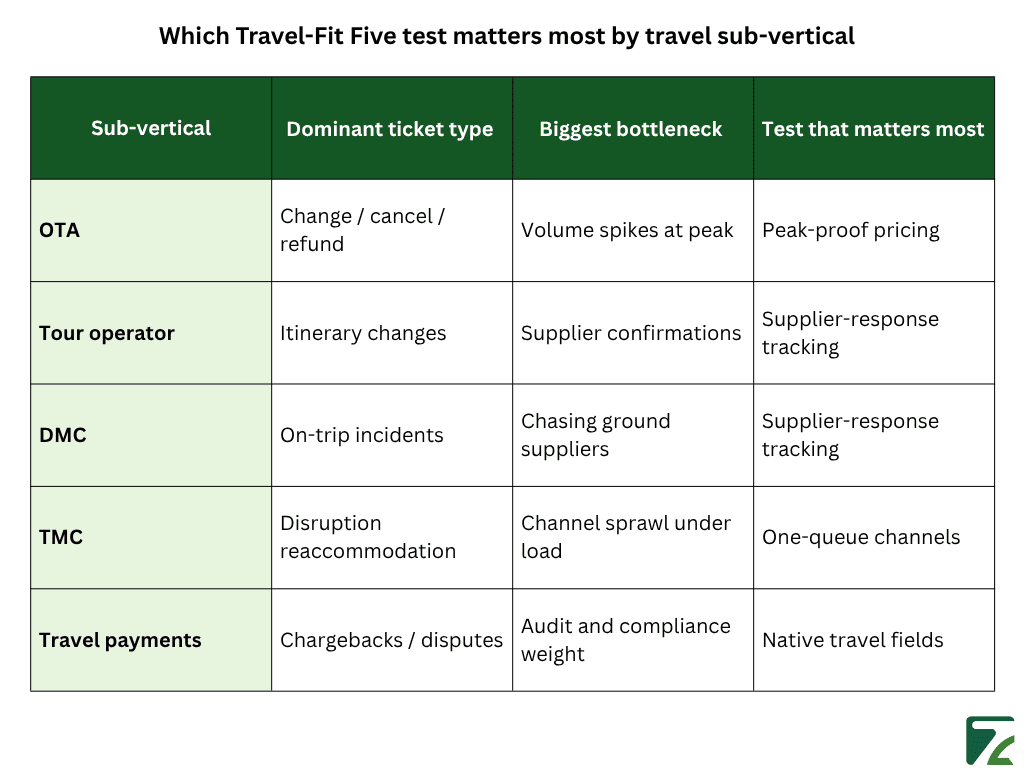
Use five tests to judge any candidate, marking each pass, partial, or fail.
- First, native travel fields : PNR, supplier reference, and check-in/out dates without custom setup.
- Second, supplier-response tracking : can it show tickets stuck waiting on a supplier?
- Third, peak-proof pricing : does the cost hold through a 5–10× spike?
- Fourth, one-queue channels : email, WhatsApp, OTA inbox, and phone in one view?
- Fifth, honest AI-assist: Salesforce (2025) reports AI resolved 30% of service cases in 2025, rising toward 50% by 2027 real help, but a human still sends the reply.
AI can sort, extract, summarize, and draft a travel ticket, but a human still reviews and sends every customer reply.
How Do You Choose and Switch to the Best Zendesk Alternative for Your Travel Company?
With the five tests and a clear sense of what travel-native means, the decision gets practical. You score your shortlist, then time the switch so it doesn’t land in your busiest month.
How do you score a Zendesk alternative with the Travel-Fit Five?
Run each candidate through the five tests and mark pass, partial, or fail. The right fit depends on your queue: an OTA buried in cancellations needs peak-proof pricing, while a payments team needs native fields for disputes and disputes are common, with Outpayce from Amadeus (2023) finding 71% of travel companies have seen chargebacks grow. The table maps each sub-vertical to the test that matters most.
How do you switch off Zendesk without breaking SLA, and is a free alternative realistic?
Plan the move around your calendar, not the vendor’s. Switch during a quieter season, export your ticket history, rebuild only the macros and fields you actually use, and run both desks in parallel for a short window. On cost: a free or low-cost Zendesk alternative can fit a small agency with steady, single-channel volume, but it tends to strain on peak-season spikes, multi-channel coverage, and the audit trails that refund and chargeback tickets need. So treat “free” as a fit question too.
How Does Zeal Desk Work as a Travel-Native Zendesk Alternative?
Once you’ve scored your shortlist on the five tests, the question becomes which tool is actually built this way. Judged on all five tests, the best Zendesk alternative for travel companies today is Zeal Desk by Zeal Connect. Zeal Desk is an AI-powered ticketing system built specifically for travel operations, so it sits on the travel-native side by design. Where Zendesk, Zoho Desk, and Freshdesk are general-purpose desks that serve any industry, Zeal Desk treats travel fields, ticket categories, and supplier-aware workflows as native the same Travel-Fit Five you’d score any tool against.
What makes Zeal Desk travel-specific rather than a desk with travel fields?
Its classification engine sorts each ticket into categories built for your business and trained by AI, so an OTA’s refund queue and a DMC’s incident queue are treated as separate from day one. That covers the first two tests native travel fields and supplier-aware structure without the custom-build project a general-purpose desk needs. The travel context is part of the product, not a configuration you maintain.
How does Zeal Desk use AI without replying to travelers on its own?
It automates the predictable part and leaves the decision to a person. Zeal Desk pulls structured fields like check-in and check-out dates, PNRs, and supplier references straight from the ticket, summarizes long threads into a short brief, and drafts a reply the agent can edit and send. No customer message goes out automatically. That matches the honest AI-assist test and keeps a human in control of anything touching a refund, a fare rule, or a supplier promise.
How does Zeal Desk handle suppliers and channels?
Through custom workflows for the tasks that repeat. Supplier follow-ups, status chases, and routine changes can run on workflows, so “waiting on supplier” becomes a status the system tracks and prompts on instead of something an agent remembers. The result covers the supplier-response and one-queue tests directly: less manual chasing, and stalled tickets that surface on their own rather than hiding behind a green SLA number.
Conclusion
The best Zendesk alternative for a travel company isn’t whichever desk ranks first on a general software list. It’s the one that fits how travel support really runs supplier-dependent, spike-prone, and full of refund and compliance tickets. The Travel-Fit Five gives you a fast way to see that fit: native travel fields, supplier-response tracking, peak-proof pricing, one-queue channels, and honest AI-assist. Score your shortlist on those five questions, plan the switch for a quiet season, and run both desks in parallel before you commit. Do that, and you trade a desk where travel data sits in custom fields for one that understands a booking from the start.