


TL;DR
- A white label travel portal gives travel agencies full brand control over the booking experience keeping client data, repeat bookings, and margin inside their own operation rather than a third-party OTA.
- The right B2B white label travel portal must include five non-negotiables before shortlisting: multi-product inventory, markup architecture, sub-agent tier management, multi-currency support, and live GDS connectivity.
- Before committing to any platform, define your business model first B2B, B2C, or hybrid then verify supplier connectivity, pressure-test the markup logic, and run a live pilot before signing.
What Is a White Label Travel Portal?
A white label travel portal is a fully built online booking platform that travel agencies deploy under their own brand their logo, domain, and pricing. The underlying technology is provided by a third-party vendor. The client sees only the agency’s identity, not the platform behind it.
Why Travel Agencies Are Moving to White Label Travel Portal Solutions
There is a moment every growing travel agency reaches. Bookings are increasing, the client base is expanding, and the operation is running on a patchwork of third-party OTA tools, email confirmations, and manual follow-ups. The revenue is there. The brand is not.
That is the exact problem a white label travel portal solves and why more agencies treat it as core infrastructure rather than a technology upgrade.
Key Terms Worth Knowing
White Label Travel Portal:A fully built booking platform deployed by a travel agency under its own brand, with the underlying technology provided invisibly by a third-party vendor.
Sub-Agent Management: A platform capability allowing an agency to create and manage access tiers for downstream agents, with distinct pricing, product visibility, and booking permissions per tier.
Markup Architecture: The pricing layer within a booking platform that allows agencies to apply their own margin on top of net supplier rates before presenting prices to clients or sub-agents.
Bedbank: A B2B hotel wholesaler that contracts accommodation at net rates and distributes via API to travel agencies and OTAs, typically at prices unavailable through direct hotel channels.
The Hidden Cost of Booking Through Someone Else's Platform
When an agency directs clients to a third-party OTA to complete a booking, three things happen simultaneously. The client’s data stays with the OTA. The repeat booking goes to whoever the OTA surfaces next. And the agency’s brand disappears at the most critical point in the customer journey the moment of purchase.
Commission leakage compounds this. Agencies on supplier-controlled platforms accept fixed payouts with no ability to apply markup, bundle products, or create offers that reflect their positioning. Every booking made through someone else’s platform is a booking that did not build the agency’s own asset base.
What a White Label Travel Portal Changes Operationally
Deploying a white label travel portal shifts the operating model in three concrete ways. First, markup control returns to the agency. Margins on each product : flights, hotels, transfers, packages are set by the agency, not the supplier. Second, sub-agent access becomes manageable. Agencies running distributor networks can create tiered access, with each sub-agent seeing the rates and products appropriate to their level. Third, client data stays inside the agency’s ecosystem, feeding CRM workflows and repeat booking campaigns rather than a competitor’s algorithm.
The agency that owns its booking experience owns its client relationships. The agency that does not is renting them.
The Market Conditions Making This Decision Urgent in 2026
The B2B travel platform market is projected to grow from $2.17 billion in 2024 to $4.8 billion by 2034 at a CAGR of 8.20%, according to market.us. That growth is showing up in platform adoption patterns, agency consolidation, and investment flows. Phocuswright’s 2025 Global Travel Market Report Shows OTAs are projected to generate $408 billion in bookings in 2025, accounting for roughly one in four travel dollars globally. Agencies without their own branded portal are feeding that number for someone else.
Competitive pressure is accelerating.
In summary, the shift to a white label travel portal is not a digital transformation project; it is a margin protection and brand ownership decision that compounds over time.
What Should Travel Agencies Look for in a B2B White Label Travel Portal?
Most agencies approach the platform selection process the wrong way. They start with a demo. They should start with a business model audit.
SaaS Platform vs. Custom-Build Getting This Decision Right First
Two fundamentally different deployment paths exist. A SaaS white label travel portal is a ready-built platform that an agency configures and launches typically within four to eight weeks. A custom build is commissioned from a development vendor who builds a portal from scratch to specification.
For most travel agencies, the SaaS route is the right answer. Custom builds carry higher upfront costs, longer timelines of three to eight months, and ongoing development dependency. The only scenario where custom development makes sense is when an agency has unique inventory relationships or workflow requirements that no existing platform can accommodate.
Startup agencies and mid-tier operations should default to SaaS. Enterprise agencies handling complex multi-market operations or building loyalty program integrations may have a legitimate case for custom architecture. The key is to make that decision before shortlisting vendors not after sitting through three demos and discovering the platform cannot support your commercial model.
Five Non-Negotiable Features Before You Shortlist
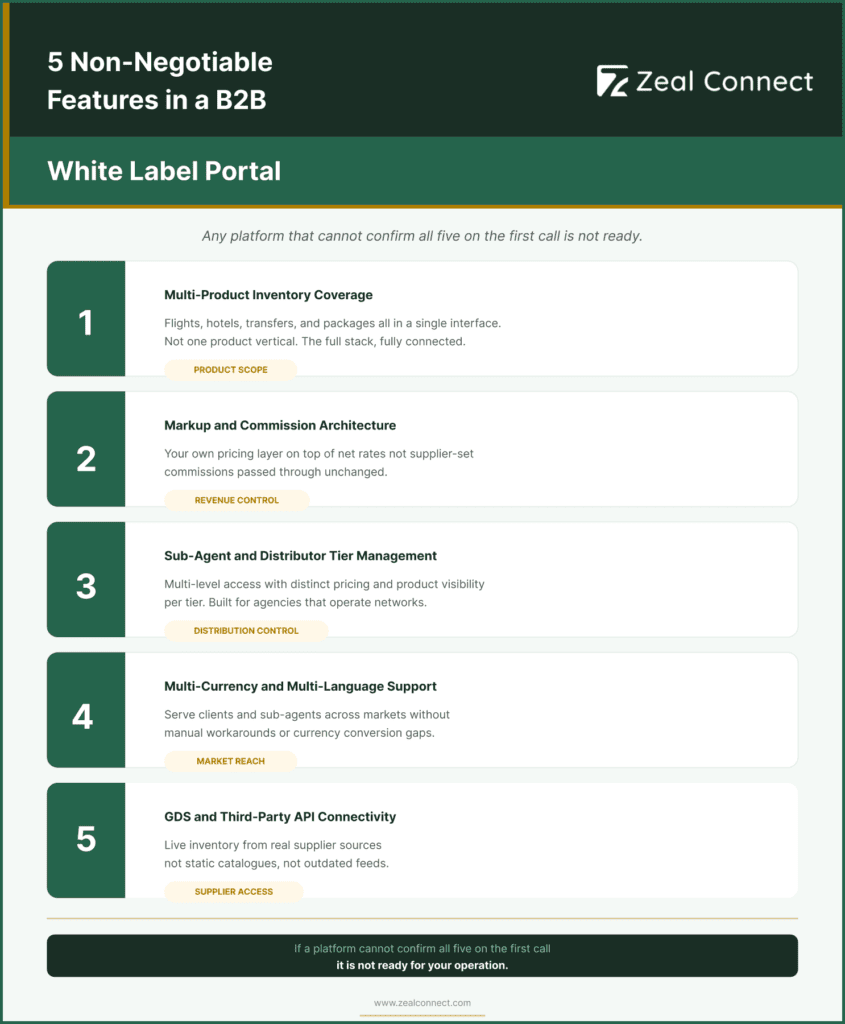
Before a single vendor demo is requested, five features must be present in any B2B white label travel portal under consideration.
- Multi-product inventory coverage means the portal handles flights, hotels, transfers, and packages in a single interface, not just one product vertical.
- Markup and commission architecture means agents can apply their own pricing layer on top of net rates, not just pass through supplier-set commissions.
- Sub-agent and distributor tier management means the platform supports multi-level access with different pricing and product visibility per tier.
- Multi-currency and multi-language support means the portal can serve clients and sub-agents across markets without manual workarounds.
- GDS and third-party API connectivity means the platform pulls real inventory from live supplier sources, not static catalogues.
Any platform that cannot confirm all five on the first call is not ready for deployment.
What 78% of Travel Managers Already Know
According to GBTA research published via GM Insights in March 2024, 78% of travel managers consider personalized travel options a key factor when choosing a B2B travel platform not a consumer preference statistic; it is a B2B purchasing behavior signal. Managers selecting platforms are demanding systems that serve differentiated offerings to different client segments exactly what a properly configured white label travel portal delivers.
Deloitte’s 2025 Corporate Travel Study reinforces this further: three in four travel managers reported expanding travel budgets in 2025, with 57% anticipating increased travel spending. Growing budgets flowing into a fragmented booking environment favor agencies that control their own branded channel.
In summary, the best B2B white label travel portal is not the one with the most features, it is the one that fits your pricing model, your distributor structure, and your product mix from day one.
Top 6 B2B White Label Travel Portal Platforms for Travel Agencies in 2026
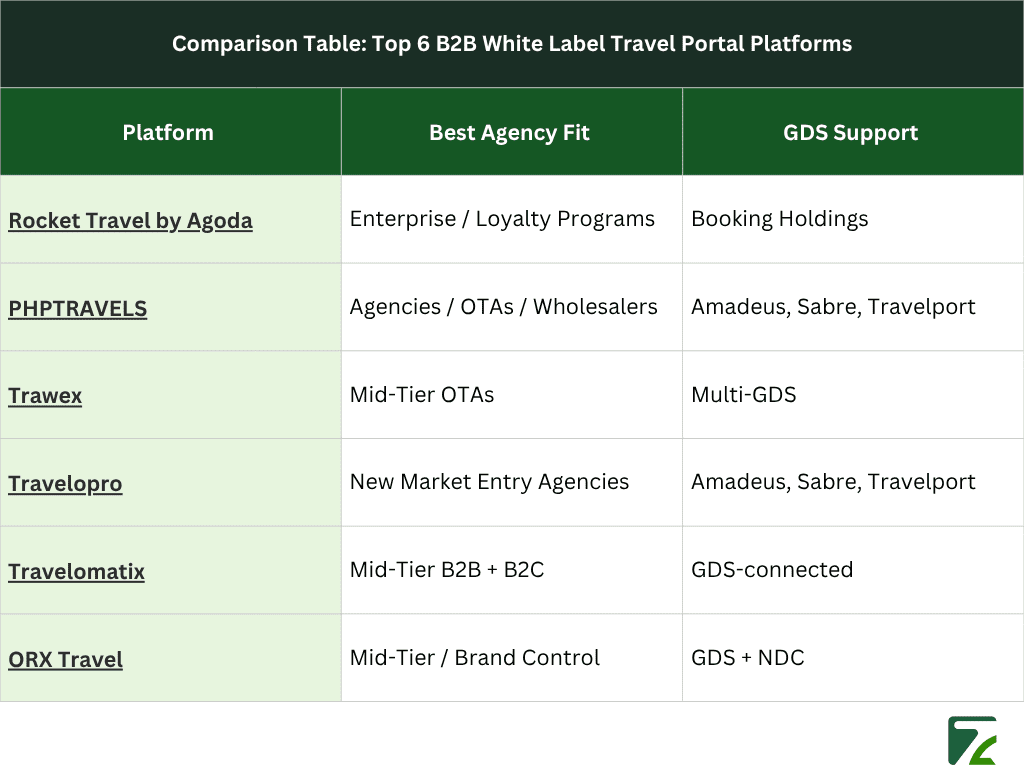
The platforms below are genuinely B2B white-label capable. Each positions white label as a primary product not a feature, not a module, not a loyalty add-on. Each is assessed against the five non-negotiable criteria above.
1. Rocket Travel by Agoda : Best Enterprise White Label Travel Portal
Rocket Travel by Agoda is the enterprise-grade white label travel portal backed by Booking Holdings inventory. It powers travel programs for major banks, airlines, and loyalty platforms globally, handling branded booking experiences for hundreds of millions of loyalty members. For large agencies building white-label programs for corporate or financial services partners, no platform offers comparable inventory depth with flexible loyalty logic and no competing B2C agenda.
2. PHPTRAVELS : Best for Agencies and OTAs Needing Full B2B Control
PHPTRAVELS is a dedicated white label travel portal platform built specifically for travel agencies, OTAs, and wholesalers. The white label portal is the core product not a feature within a broader system. It covers hotels, flights, tours, and transfers with separate B2C and B2B modules, sub-agent tiers, markup and commission controls, credit limits, multi-currency and multi-language support, and GDS connectivity to Amadeus, Sabre, and Travelport. Transparent pricing across Startup, Agency, and Enterprise tiers is publicly listed, making it one of the most accessible and clearly scoped platforms in the market for agencies that want to deploy fast without ambiguity.
3. Trawex : Best White Label Portal Builder for OTAs
Trawex builds white label travel portals with GDS connectivity for agencies and OTAs requiring a custom-branded booking experience across flights, hotels, transfers, and packages. Its API layer supports multiple GDS connections and bedbank feeds. Best suited to mid-tier agencies and OTA operators that need both branded portal capability and multi-supplier inventory access from a single deployment.
4. Travelopro : Best GDS-Integrated White Label Travel Portal
5. Travelomatix : Best Scalable B2B and B2C White Label OTA Platform
6. ORX Travel : Best GDS and NDC White Label Online Booking Engine
ORX Travel delivers a fully branded white label travel portal with GDS and NDC connectivity in a single platform. Dynamic pricing tools allow agencies to apply custom markups, manage promotional fares, and configure commission structures by product and channel. Its NDC support gives agencies access to ancillary content and bundled fares that traditional GDS channels do not carry. A strong fit for mid-tier agencies that want both brand control and modern fare access without building a custom stack.
Expedia Group earnings reported in February 2026 show Expedia’s B2B gross bookings rose 24% in Q4 2024, significantly outpacing the 5% growth in its consumer segment. That gap is not a market coincidence. It reflects a structural shift toward branded B2B distribution rather than open consumer marketplaces.
In summary, the right white label travel portal depends entirely on your commercial model enterprise loyalty programs, mid-tier OTA operators, and growing independent agencies each have platforms built precisely to their architecture.
How Do Travel Agencies Evaluate a White Label Travel Portal Before Committing?
The decision to deploy a white label travel portal is a 12 to 24-month operational commitment. Most agencies underestimate what that means at the point of selection.
Step 1 : Define Your Business Model Before Shortlisting
The single most important question to answer before shortlisting any platform is: who is your buyer? If you are selling directly to end travelers, a B2C-capable portal is the priority. If you are distributing to sub-agents, B2B distributor logic is non-negotiable. If you are doing both, the platform must handle hybrid access without requiring two separate deployments. Agencies that skip this step discover the mismatch six months into a contract when rebuilding is costly and disruptive.
Step 2 : Verify Supplier Connectivity and Inventory Depth
Request a live supplier connection list from every vendor, not a roadmap, not a planned integration, not a promise of future capability. If flights are core to your product, confirm which GDS the platform connects to and whether NDC content is accessible. If hotels are primary, verify which bedbanks are live and whether rate parity is guaranteed. Inventory gaps in core destination markets surface within weeks of go-live and are nearly impossible to fix without switching platforms.
Step 3 : Pressure-Test the Markup and Commission Architecture
This is the step most agencies skip in the excitement of a well-designed demo. Ask the vendor to walk through exactly how markup is applied by product, by route, by sub-agent tier, and by currency. Confirm whether the platform supports dynamic markup rules or only fixed percentage overlays. For agencies managing multiple distributor tiers, the commission architecture needs to match the commercial reality of how they operate before any contract is signed.
Step 4 : Run a Real Pilot Before Signing
A guided demo will not surface the real problems that live bookings expose. Request a structured pilot of ten to fifteen live transactions across core products, flights, hotels, and at minimum one package booking. Track booking time end-to-end, confirmation accuracy, and where agent workflow breaks down. Grand View Research Values the global OTA market at $663.70 billion in 2025, projected to reach $1.316 trillion by 2033 at a 9.0% CAGR. Operating without a robust, tested platform in that environment is not a calculated risk; it is an avoidable one.
In summary, the best evaluation process for any white label travel portal is structured real-world testing against your actual commercial model, not a vendor presentation.
Ready to Evaluate Your White Label Travel Portal Options?
Use the five non-negotiable criteria in this article as your shortlisting framework. Run every platform against them before requesting a demo and always pilot with real bookings before signing.
Conclusion
A white label travel portal is not a digital upgrade; it is a decision about who owns your client relationships, your margin, and your brand at the point of booking. The platforms exist. The criteria are clear. What separates agencies that benefit from those that regret the decision is the discipline to evaluate commercial reality rather than a polished demo.