



TL;DR
Travel agencies are not losing bookings because of price , they are losing them because their booking engine creates friction that travelers will not push through. This blog breaks down what booking engine software actually does for a travel agency, why operating without it costs more than most owners realise in staff time, errors, and ceded digital revenue, and how to choose a platform that fits your distribution model, unlocks your B2B sub-agent channel, and stays visible as AI reshapes how travelers search and book.
What Is Booking Engine Software?
Most agencies think they have a booking engine. What they usually have is a form.
Booking engine software is the infrastructure that connects a travel agency’s sales channels to live supplier inventory , flights, hotels, transfers, and packages and confirms, prices, and validates reservations in real time, without a staff member involved in every transaction.
How Does Booking Engine Software Turn Agency Traffic Into Confirmed Bookings?
Most travel agencies do not have a traffic problem. They have a conversion problem.
Visitors arrive, browse, compare and leave. The instinct is to blame price. The data says otherwise.
Key Terms Worth Knowing
GDS (Global Distribution System):l: A centralised network including Amadeus, Sabre, and Travelport, that connects travel agencies to real-time airline, hotel, and car rental inventory from suppliers worldwide.
B2B Sub-Agent Portal: A restricted-access section of a booking engine that allows partner agents and resellers to access an agency’s inventory at pre-agreed rates with independent markup controls per tier.
Booking Abandonment Rate The percentage of users who begin a booking flow on a travel platform but leave before confirming, an industry benchmark used to measure booking engine UX performance and identify specific friction points in the checkout path.
Why Are Travel Agencies Losing Bookings and How Does Booking Engine Software Fix It?
The abandonment problem in travel is structural. It lives inside the booking experience not in the price point, not in the destination.
OTAs the most optimised booking platforms in the industry, still record abandonment rates of approximately 89%, according to Navan’s 2025 online travel booking statistics. For independent agency booking engines, the figure is typically worse. SiteMinder’s Changing Traveler Report 2025 found that 52% abandon a booking specifically because of a poor digital experience, not a better rate elsewhere. Baymard Institute’s 2024 research adds the mechanics: 22% leave because checkout is too long, and 24% leave because they are forced to create an account.
Every one of those abandoned bookings represents a confirmed sale that the booking engine failed to close.
The right booking engine software removes those friction points directly. AZDS Interactive Group found that booking engine integration can boost travel agency conversion rates by up to 40%. For an agency processing 200 bookings per month, that is 80 additional confirmed bookings from existing traffic with zero increase in marketing spend.
The Hilton 2024 Trends Global Survey confirms why this matters: 80% of global travelers say booking entirely online is essential, rising to 86% among Millennials and 83% among Gen Z. Agencies that cannot deliver a clean end-to-end booking experience are not offering an inferior alternative , they are failing the baseline expectation of the market they are selling to.
In summary, booking engine software does not just enable bookings, it determines how many of your existing visitors actually become paying clients.
What Is a Travel Agency Actually Losing Every Month Without Booking Engine Software?
That conversion argument only tells half the story. The other half is what the absence of booking engine software costs an agency on the operational side in staff hours, compounding errors, and a digital market that has already moved on without them.
There is a version of travel agency operations many owners know intimately staff logging into GDS portals manually, quotes assembled as PDFs, follow-up calls to confirm rates that may have already changed.
This process works at low volume. At scale, it breaks.
Why the Online Channel Is Now the Primary Revenue Battlefield for Travel Agencies
The structural shift in travel distribution has already happened. Phocuswright’s Global Travel Market Report 2025reports that global travel gross bookings reached nearly $1.6 trillion in 2024, projected to climb above $1.8 trillion by 2027 with online gross bookings representing nearly 65% of that total. PhocusWire reported that online bookings grew 9% in 2024 alone.
Skift Research places the OTA market at$94 billion in revenue in 2024, projecting $107 billion ahead. These are the platforms an agency without booking engine software is competing against for the same traveler. According to Statista, cited by Perk’s 2024 travel industry benchmarks, 72% of travelers now prefer online booking compared to just 12% who choose traditional travel agencies.
In summary, the window for a gradual digital transition has closed the online channel is already where the majority of travel revenue is decided.
What Does Running Without Booking Engine Software Actually Cost at Scale?
Operating manually inside a market this size does not just limit growth , it bleeds money at every step.
Every manual booking carries a time cost. An agent spending 20 minutes on a quote that booking engine software generates in seconds is not the isolated problem, it is what that 20 minutes costs across a full month. At 200 bookings per month, that is close to 67 hours of staff time on a task the software handles automatically.
The error rate compounds the cost. Technavio’s travel technologies market analysis found that platforms integrating booking automation reduce processing errors by over 15%, with some achieving a 20% reduction in total processing times. Errors that reach the client become complaints, compensatory rebookings, and lost retention. Agencies managing how those errors carry through to the supplier reconfirmation stage will recognise it as the point where the cost compounds fastest.
The agencies growing fastest are not the ones with the most staff. They are the ones who removed the manual steps quietly capping their capacity.
In summary, manual processing does not just slow an agency down it introduces compounding error at every step, and error at scale becomes a measurable monthly cost.
How Do You Choose Booking Engine Software That Is Actually Built for Travel Agencies?
Not all booking engine software is built for the same operator. A leisure agency building multi-component itineraries has different requirements from a DMC managing group ground arrangements. The decision starts with understanding your own distribution model and then matching the platform to it.
Getting that match wrong is expensive. Most agencies discover it too late.
What Core Features Should Every Travel Agency Evaluate in Booking Engine Software?
GDS connectivity is the foundation , without live access to Amadeus, Sabre, or Travelport, the engine cannot deliver real-time pricing at scale. Direct API connections to bed banks add the contracted inventory layer where an agency’s strongest margins often sit. Dynamic packaging is non-negotiable: SiteMinder’s Changing Traveler Report 2025 found that 54% of travelers are more likely to purchase a bundled package flights, accommodation, and experiences combined , than they were the previous year. That is not a niche segment. Mordor Intelligence’s OTA market analysis separately found that mobile devices accounted for 63.5% of all OTA bookings in 2025, growing at a 6.33% CAGR through 2031, an engine not built mobile-first is losing more than half its conversions before checkout begins.
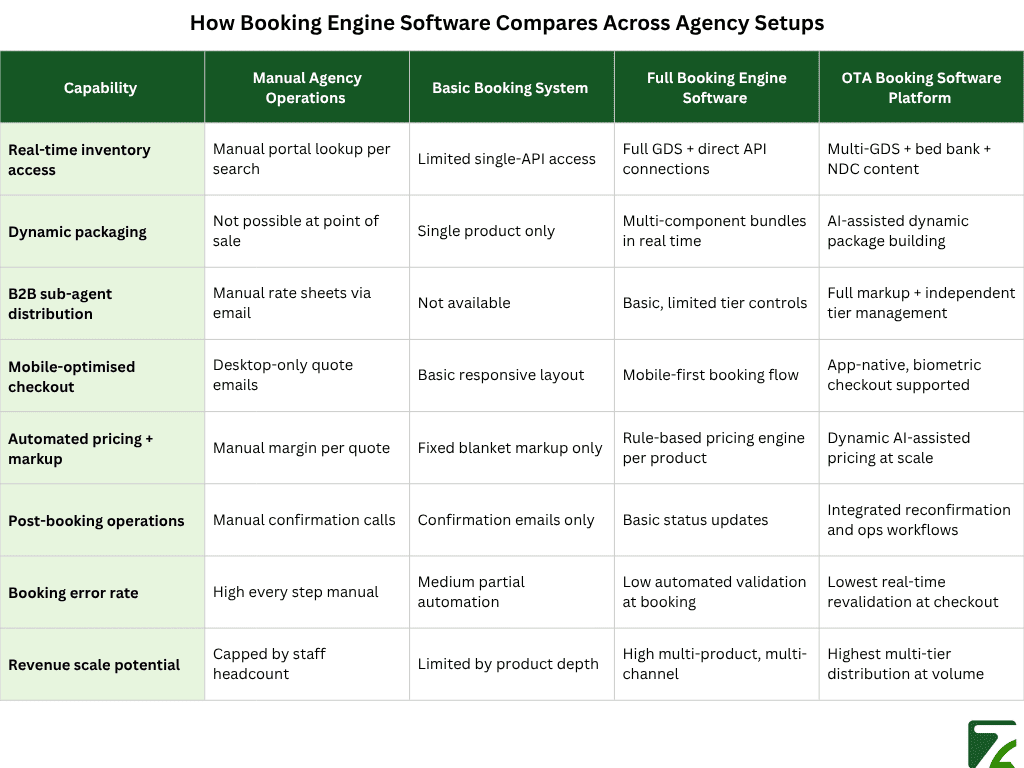
Beyond these, the differentiator is pricing architecture whether the platform allows markup and commission control at the individual product level, or only applies a blanket margin. The former is revenue management. The latter is a booking form.
The right booking engine software for a travel agency is not the one with the longest feature list, it is the one that matches your distribution model, your inventory sources, and your margin structure.
What Is a B2B Sub-Agent Layer in Booking Engine Software and Why Do Most Agencies Never Activate It?
Most agencies operate as single-channel sellers. What they do not build even when the booking engine software supports it, is a B2B sub-agent distribution layer. A B2B portal gives partner agencies and corporate clients access to inventory at pre-agreed rates, with independent markup controls per tier. Volume grows without proportional increases in marketing spend.
This is how OTAs built their scale. Mordor Intelligence’s North America online travel market data shows OTAs retained 61.33% of the North American online travel market in 2024 by offering multi-supplier bundles and B2B agent tools that direct supplier channels could not replicate. The advantage was not price. It was infrastructure. When evaluating any booking engine software vendor, ask directly: does the platform include a B2B portal with independent agent tier management and per-tier markup controls? If the answer is no, the platform will cap the agency’s revenue ceiling before it is reached.
A travel agency that activates its B2B sub-agent layer is not adding a feature ; it is building a second revenue engine that runs in parallel with its consumer-facing channel.
In summary, selecting booking engine software with a B2B sub-agent layer transforms an agency from a single-channel seller into a distribution hub, a structural shift that compounds revenue over time.
What Does the Right OTA Booking Software Actually Deliver and Where Is the Market Heading?
Knowing what to look for in booking engine software is one side of the decision. The other is understanding what the best platforms are actively building toward because an agency that selects the right platform today should not need to replace it in three years.
The booking engine software market is not static. What a competitive platform delivered three years ago is not what it delivers today and agencies evaluating technology now need to understand where it is heading, not just where it currently sits.
Where the Booking Engine Software Market Stands Right Now
Market.us’s Online Travel Agencies Software Market report found that the booking engine software segment held a 38.7% share of the global OTA software market in 2024 , the dominant share of any single software category. The overall OTA software market is growing at an approximately 15% CAGR, according to Market.us. Skift Research confirms the direction: the OTA sector generated $94 billion in 2024 and is projected to reach $107 billion, growing at approximately 7% annually.
Vendor competition in this segment is intense right now. For agencies evaluating platforms, that means better pricing, faster integrations, and more negotiating leverage than at any point in the last decade.
What Separates High-Performing Booking Engine Software From One That Just Processes Transactions?
Feature parity on GDS and mobile checkout is table stakes today. What separates platforms generating real revenue lift is the intelligence layer above the transaction , AI-assisted pricing that moves with demand signals, inventory revalidation at checkout so the searched price matches the confirmed price, and integration with supplier reconfirmation workflows so confirmed bookings do not land in a manual queue.
Phocuswright’s Travel Innovation and Technology Trends 2025 found that 39% of US travelers now use generative AI for trip planning. Separately, Phocuswright’s Travel Forward: Data, Insights and Trends reports that traditional search engines dropped from 51% to 36% as the primary travel discovery channel between late 2024 and mid-2025. Skift’s 2024 Travel and Hospitality Technology Innovation Report found that 83% of travel executives increased their AI budgets in 2024, and 89% expect generative AI to have a meaningful business impact within three years. Booking engine software that cannot surface inventory through AI-driven discovery will lose visibility before it has a chance to convert.
In summary, the agencies that invest in OTA booking software with an intelligence and automation layer today are not ahead of the curve, they are catching up to where the market already is.
Conclusion
The shift to online booking is not a future trend for travel agencies, it is the current operating reality, confirmed by data from Phocuswright, Skift Research, and Mordor Intelligence across every major travel segment. Booking engine software is the infrastructure layer that determines whether an agency captures the digital demand already in the market, or continues to lose it to platforms that built this capability years ago. The agencies that close this gap now are not taking a risk they are correcting a structural disadvantage before it becomes permanent.