


TL;DR
This guide explains why generic “best help desk software” lists fail travel companies, defines the travel-native criteria that separate a real travel desk from a generic one, lists the tools you will come across, and shows how the right fit shifts by sub-vertical from OTAs and DMCs to car rental and travel-tech teams with a scorecard and demo to choose. The short answer: the best help desk for travel models bookings, suppliers, and deadlines natively. Generic tools used to be the only choice; today, desks built specifically for travel exist.
A support lead picked the number-one tool from a “best help desk software” list. The reviews were glowing, the feature grid was deep, and the price looked fair. Then a cancellation landed hours before check-in the kind of ticket that has to move now. The tool had no field for the travel date, so it could not tell an urgent ticket from a routine one. The escalation sat in a flat queue while the clock ran down.
This used to be the only outcome. Travel teams ran on generic desk software built for IT and retail tools that never modeled a booking, a supplier, or a deadline. Today, help desk software designed specifically for travel exists, and that changes how you judge “best.”
For a travel operation, the best help desk software for travel is a question of fit, not leaderboard position; it depends on your ticket mix and your sub-vertical. The examples below center on OTAs, tour operators, and DMCs, but the same criteria apply to any travel business that runs on bookings and suppliers: car rental companies, bed banks, consolidators, travel payments, travel insurance, and travel-tech platforms.
Why Generic "Best Help Desk Software" Lists Fail Travel Companies
Most “best help desk software” rankings score tools for IT and retail buyers. They count features and average star ratings. They rarely ask whether a tool can tag a departure date, route a supplier escalation, or rank a ticket by hours to the trip. So, the ranking is real, it just answers the wrong question.
Key Terms Worth Knowing
Travel Help desk software: The system that receives, classifies, prioritizes, and resolves customer and operational support tickets in one platform. Different from a CRM, a booking engine, or a back-office tool.
Supplier-escalation routing :An automated workflow that directs an unresolved support query to the relevant supplier, tracks the response, and re-escalates if no reply arrives within a set timeframe.
Configuration tax: The cumulative time, cost, and technical debt that builds when a generic tool is adapted to a specific use case through custom fields, manual workarounds, and brittle workflows.
Total cost of ownership (TCO): The full lifetime cost of a software tool: licence fees, implementation, integration, training, maintenance, and ongoing configuration not just the headline price.
A market ranked for the wrong buyer
The blind spot that gets expensive at peak
What Makes the Best Help Desk Software for Travel?
The best help desk software for travel operations scores highest on travel-native criteria: native PNR, departure, and check-in date fields; supplier-escalation routing; travel ticket-type workflows; reconciliation links to bookings and payments; and genuine AI readiness. Feature counts come second to whether the tool models a trip and its deadline at all.
First, the vocabulary. Whether you search for the best support desk software for travel companies, the best service desk software for travel operations, or the best helpdesk ticketing system for travel, you are describing the same job: receiving, classifying, prioritizing, and resolving tickets in one place. The label does not decide fit the data model does.
The practical difference a travel-native tool makes is consolidation. Instead of switching tabs between a booking system, a supplier inbox, and a separate ticketing tool, agents see the booking, the supplier thread, and the ticket in one view. It then automates the repetitive steps: classifying, tagging dates, routing so agents act on the work instead of copy-pasting it between systems.
Five criteria that define the best help desk software for travel
Five things separate a travel-grade desk from a generic one:
- A data model that captures the booking reference, travel date, supplier, and ticket type as native fields
- Supplier-escalation routing that tracks the reply
- Ticket-type workflows for cancellations, amendments, refunds, and disputes not one flat queue
- Reconciliation links that tie each ticket to its booking and payment
- AI that runs on clean, structured inputs
A help desk is not a CRM, a booking engine, or a back office
This is where many travel-software lists go wrong. A CRM manages relationships and sales; a booking engine sells and stores reservations; a back office reconciles invoices and settles payments. A help desk handles the live support questions in between. Mixing these categories produces a shortlist that cannot actually run support, so sort the category before you rank the tools.
The best help desk for travel fits your ticket mix first and tops a feature grid second.
Help Desk Software for Travel: The Tools You'll Come Across
Most shortlists mix two very different kinds of tool: those built specifically for travel operations, and generic, horizontal help desks built for IT and retail that travel teams adapt with custom fields.
- Travel-oriented: Zeal Desk built for travel operations, with booking-centric ticketing and supplier-aware AI.
- Generic help desk platforms: Zendesk, Freshdesk, Zoho Desk, Help Scout, Jira Service Management, and Live Agent. A few now market travel-specific features, but most still model a generic ticket rather than a trip.
This is a list, not a ranking for a feature-by-feature breakdown, see our dedicated comparison
How the Best Help Desk Fit Changes by Travel Sub-Vertical
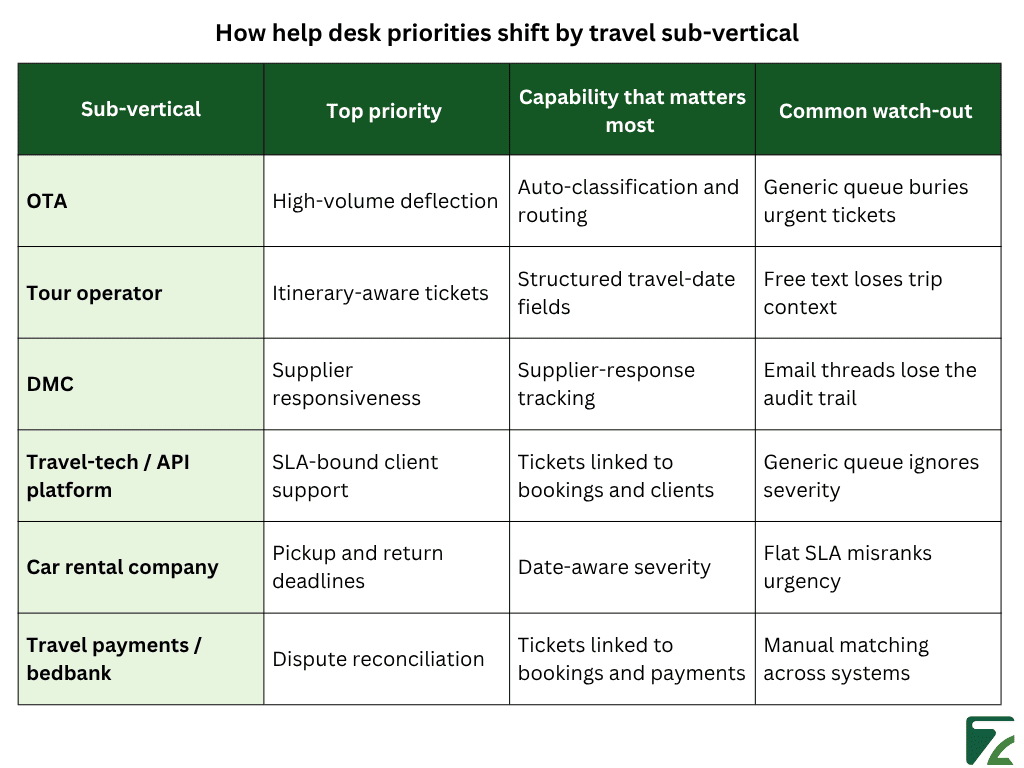
A single “best” rarely fits every travel company. An OTA, a DMC, a car rental operator, and a travel-tech platform run different operations, so they weight the criteria differently. The table below maps each to its top priority and the capability that decides the choice.
OTAs need deflection and fast escalation
An OTA lives on volume, so deflection and fast routing decide the tool. Automating routine pre-trip questions frees agents for the time-critical escalations, and the cost gap is stark: industry benchmarks put the median cost per contact at $1.84 for self-service against $13.50 for assisted channels. The best desk classifies at scale and surfaces the nearest deadline first.
Tour operators need itinerary-aware tickets
A tour operator coordinates multi-part itineraries, so context is everything. When travel dates and itinerary structure are native fields, a query about day four of a trip carries its dates, suppliers, and history instead of arriving as free text that agents must rebuild by hand.
DMCs need supplier-response tracking
A DMC depends on many local suppliers it cannot command. So, the deciding capability is supplier-response tracking: the desk starts a timer when a query goes out, nudges automatically, and escalates when the reply stalls handled over email; that trail disappears.
Travel-tech, car rental, and other deadline-driven operations
The same logic scales across travel. A travel-tech or API platform supports B2B clients under tight SLAs, so it needs tickets linked to the booking, the client, and the integration. A car rental operation runs on pickup and return windows, so it needs date-aware severity tied to the rental and location. Bed banks, consolidators, payment teams, and travel insurance follow the same rule: model the booking, the supplier, and the deadline, and the rest follows.
The best tool for an OTA can be the wrong tool for a DMC weight the criteria for the operation you actually run.
How to Choose the Best Help Desk Software for Your Operation
Three moves turn a list’s “best” into your best.
Score your shortlist on travel-native criteria
Re-score the generic shortlist for travel. Rate each tool on the data model, supplier routing, ticket-type workflows, reconciliation links, and AI readiness, then weight those criteria toward your sub-vertical. A tool that ranked third on a generic list can win once travel-date handling carries real weight.
Is the tool AI-ready, or just AI-labeled?
A “best for AI” label only holds if your data can feed it. According to Amperity’s 2025 State of AI in Travel & Airlines, 80% of travel companies are already using AI in some capacity yet only 35% have deployed it in guest-facing applications, because AI acts on structured inputs and a free-text inbox caps what it delivers. Confirm consistent classification, reliable travel-date and supplier tagging, and standardized fields before trusting any AI claim.
Weigh total cost of ownership, then demo a real cancellation
The “best” sticker price often hides the highest real cost: a generic tool bent to fit travel carries a configuration tax of custom fields, brittle workflows, and constant workarounds. So, weigh total cost of ownership, then test the finalists with a real scenario hand each one a cancellation six hours from check-in and watch it tag the date, route the supplier escalation, and rank the ticket.
Conclusion
The best help desk software for travel operations is not the tool at the top of a generic list; it is the one that models bookings, suppliers, and deadlines the way your operation actually runs. That standard shifts by sub-vertical: an OTA weights deflection, a tour operator weights itinerary context, a DMC weights supplier-response time, and a car rental or travel-tech team weights date-aware severity.
Start with the five travel-native criteria, build your scorecard, weight it for your sub-vertical, and run every finalist through a real cancellation. The desk that tags the travel date, routes the supplier escalation, and ranks the ticket correctly in one view, without tab-switching is the right fit for your operation.
Zeal Desk is built to pass that test natively. Booking-linked tickets, AI-powered classification, supplier-response tracking, check-in and check-out date tagging, SLA prediction, and workforce management all in one view, designed for the work travel operations actually do.