

This article explains the three operational numbers that decide the best support desk software for travel operations, SLA compliance, cost per resolved ticket, and agent productivity, and what specifically distorts each one in travel. It is written for operations and support leaders at OTAs, DMCs, TMCs, and travel payment teams who own those numbers. You will get a definition of each metric in travel terms, a metric anatomy table, and the Operations Baseline, a measure first method for choosing a tool by the number that is costing you most.
Nobody grades an operations leader on how many features their support desk has. You are graded on three numbers: SLA compliance, cost per resolved ticket, and how much your team gets through in a day. So the buying question is not "which tool has the longest feature list." It is which support desk software for travel operations actually moves those three numbers. A generic desk can look strong on paper and still report all three wrong, because it does not understand a booking or a supplier. The best support desk software for travel operations is the one that moves your numbers.
Why Do Travel Operations Teams Judge Support Desk Software by Three Numbers, Not Feature Lists?
Because those three numbers are what your leadership actually reviews. SLA compliance, cost per resolved ticket, and agent productivity are the outcomes an operations or support leader is measured on. A feature comparison tells you what a tool can do; it does not tell you whether any of that shifts the numbers you report each month. In travel, the gap between the two is wide, because the features rarely account for how a booking, a supplier, and a deadline behave together.
A support desk that does not understand a booking reports SLA, cost, and productivity you cannot trust.
Which three numbers does support desk software for travel operations have to move?
Three, and they are the ones on your scorecard. First, SLA compliance: are you hitting response and resolution targets. Second, cost per resolved ticket: what it costs to actually close a case, not just receive it. Third, agent productivity: how much of your team's time goes to solving rather than searching. Every operations leader in travel answers to some version of these. A support desk earns its place by moving them, not by matching a checklist.
Why don't feature checklists predict any of these three numbers?
A tool can tick every box and still leave your numbers flat. Two desks both list "SLA management," yet only one can pause the clock while a supplier is the holdup, so only one reports SLA compliance honestly. The same is true for cost and productivity: the feature exists, but whether it fits travel's booking and supplier reality decides the outcome. The stakes are large. Qualtrics (2024) puts $3.7 trillion in global sales at risk each year from poor customer experiences.
Hasn't AI already fixed these numbers for every support desk?
Not by being present. AI is standard equipment now, so having it moves nothing on its own. According to Roland Berger (2025), 95% of service centers have already implemented AI in customer service, and travel rated itself the most innovative sector of all. When everyone has AI, the question shifts to what it understands. AI that reads a booking and a supplier thread moves your numbers; AI that only sees a block of text does not.
Key Terms Worth Knowing
A few terms used throughout this guide, defined the way a travel operations team uses them.
- Cost per resolved ticket: Total support cost divided by the tickets you actually close, not the tickets you receive. It exposes rework that a raw ticket count hides.
- SLA compliance (split clock): Meeting response and resolution targets, with the timer separating the time your team owns from the time a supplier owns.
- Agent productivity (AHT): How much handle time goes to solving a case versus looking up booking context before the real work starts.
- Deflection vs resolution: Deflection means the customer self serves and never opens a ticket. Resolution means the case actually closes. They are different numbers.
- Booking linked ticketing: A booking and its amendments held as one connected case, so context is not retyped and two teams do not work it blind.
What Distorts Your SLA, Cost, and Productivity Numbers Inside a Travel Support Desk?
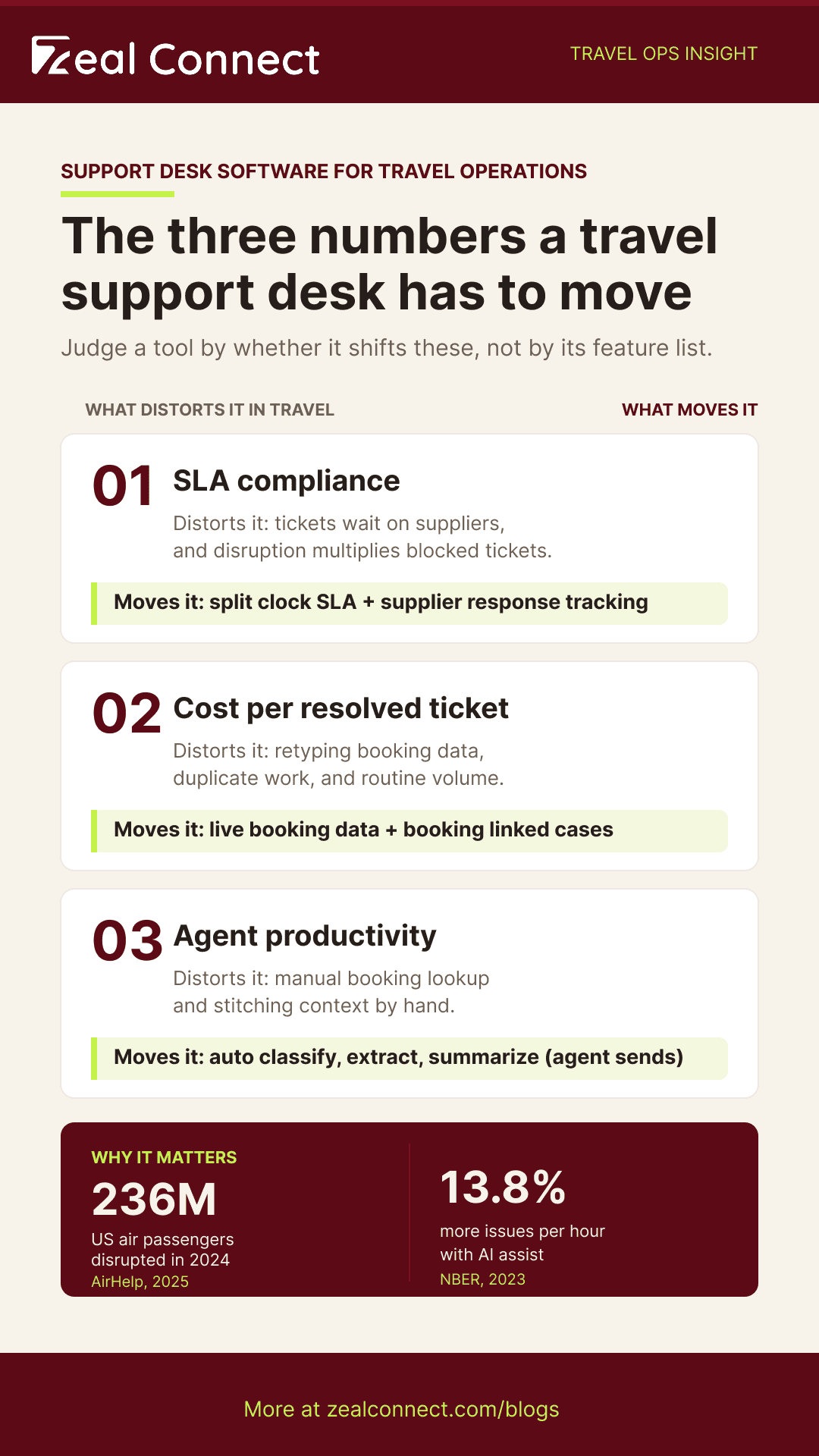
Support desk software for travel operations is a help desk built around bookings, suppliers, and supplier dependent deadlines, used by OTAs, DMCs, TMCs, and travel payment teams to resolve requests at scale. It has to move three numbers: SLA compliance, cost per resolved ticket, and agent productivity. Each one has a specific travel failure mode a generic desk walks straight into. The infographic and table below lay them out; the parts under them explain each row.
Why does supplier wait time make SLA compliance look worse than your team really is?
Because most travel tickets cannot close until someone else replies. A hotel, an airline, or a DMC owns the next step, yet a single SLA clock keeps running against your team the whole time. So your compliance number reflects supplier delay you do not control. A split clock SLA separates team owned time from supplier owned time and reports the breach correctly. Your SLA number should reflect your team's performance, not a supplier's delay. Disruption makes this worse in bulk: according to AirHelp (2025), 236 million US air passengers had a flight delayed or canceled in 2024, roughly one in four of everyone who flew.
What inflates cost per resolved ticket in a travel operation?
Rework does, and travel is full of it. Agents retype check in dates and reference numbers into free text fields because the desk does not hold the booking, the way a purpose built OTA back office would. Two teams touch the same reservation without seeing each other, so the work happens twice. Routine pre trip questions get handled by agents instead of self service. Each of these raises what it costs to close a case, even when the ticket looked simple. The unit cost climbs a little with every retyped field.
What drains agent productivity on a travel support ticket?
Lookup time does, before the solving even starts. On a generic desk, an agent opens a ticket and then goes hunting: the booking sits in another system, the supplier thread in email, the amendment history nowhere obvious. Stitching that context together eats handle time on every case. The fix is not faster typing; it is the booking and its history arriving with the ticket, so the agent starts at the problem instead of the search.
Table: The three operating numbers a travel support desk has to move
| Operating number | What distorts it in travel | What actually moves it |
|---|---|---|
| SLA compliance | Tickets wait on suppliers; disruption spikes | Split clock SLA plus supplier response tracking |
| Cost per resolved ticket | Retyping booking data, duplicate work, routine volume | Live booking data, booking linked cases, routine deflection |
| Agent productivity | Manual booking lookup, context stitching | Auto classification, extraction, thread summaries (agent sends) |
Which of Your Three Numbers Should Decide the Support Desk Software You Buy?
Different travel operations lose the most on different numbers, so the buy should follow whichever one is worst for you. An OTA and a DMC can look at the same tool and reach opposite verdicts, because they are not optimizing the same metric. Before you shortlist, decide which number is costing you most, then weigh tools against that one first.
An OTA and a DMC can judge the same tool oppositely, because the number that hurts them most is not the same.
When is cost per resolved ticket your priority number? (high volume operations)
When volume is your pressure, unit cost decides everything. High volume OTAs and agencies process routine pre trip questions by the thousand, so deflection and no retyping move the number that matters. The scale is real: the global online travel agency market is set to grow from USD 269.8 billion in 2025 to USD 533.7 billion by 2034. At that volume, shaving a minute of rework off each ticket compounds fast, so cost per resolved ticket leads your evaluation.
When is SLA compliance your priority number? (supplier heavy and managed travel)
When your tickets depend on suppliers, SLA is where you lose the most. A DMC's cases span several local providers, and a TMC's corporate bookings must respect policy and approval chains, so both live or die on supplier response timing. Managed travel is large enough to make this a board level concern: GBTA (2025) projects global business travel spending will reach $1.57 trillion in 2025. For these teams, supplier response tracking and a split clock SLA outrank raw deflection.
When does the cost number hide a financial risk problem? (travel payments)
When your tickets carry money, "cost" means more than handle time. Payment teams work chargebacks, refunds, and settlement disputes, where a mishandled case is a direct loss, not just an expensive one. Ravelin (2025) reports the average travel, ticketing, or hospitality company loses about $11 million to fraud each year. So a payment operation reads its cost number through financial exposure, and reconciliation and dispute workflows matter more than speed alone.
How Do You Baseline Your Numbers and Make Support Desk Software Prove It Moves Them?
You measure first, then make the demo prove movement. The Operations Baseline is a simple method: record your three numbers as they are today, decide which one is worst, and require any vendor to show it improving under travel conditions. It replaces a feature by feature bake off with a before and after you actually care about.
Baseline your three numbers first, then buy for the one that is costing you most.
How do you baseline your three numbers before you shortlist? (the Operations Baseline)
You write down where you stand now. Pull your current SLA compliance, your cost per resolved ticket, and a productivity measure like average handle time or tickets closed per agent. That baseline is your reference point, and it usually reveals which number is quietly costing you most. Without it, every demo looks impressive and none of them are accountable. With it, you know exactly what "better" has to mean for your operation.
How do you make a vendor demo prove movement on your worst number?
You ask the demo to move the number, not describe the feature. If SLA is your weak spot, ask to watch the clock pause while a supplier is the holdup. If cost is, ask to resolve a booking with zero retyping. If productivity is, ask to see a ticket arrive with its booking and supplier thread attached. The lift can be real: according to NBER (2023), agents using an AI assistant resolved 13.8% more issues per hour, with the least experienced gaining 35%.
How do you stress test an "AI" claim against your productivity number?
You treat every AI claim as unproven until the demo shows the mechanic. Most travel AI is still early: according to Phocuswright (2026), 61% of travel businesses are experimenting with or scaling agentic AI, but only 6% are scaling it broadly. So ask what the AI does to a real travel ticket, classify, extract, summarize, draft, and who sends the reply. If the answer is a roadmap, it will not move your number this year.
How Does Zeal Desk Move the SLA, Cost, and Productivity Numbers for Travel Operations?
Zeal Desk is built only for travel, so it moves the three numbers by design rather than by custom setup. General purpose desks like Freshdesk, Zendesk, and Zoho Desk can be configured toward the same goals, but a booking, a supplier, and a supplier linked deadline are not native there, they become fields and rules someone has to build and maintain. The difference is architecture, not effort.
How does Zeal Desk protect the SLA number when tickets wait on suppliers?
Supplier coordination and SLA driven escalation are built in workflows. Zeal Desk organizes work around the booking, tracks the supplier leg of a ticket, and runs SLA timers that account for supplier owned time rather than blaming your team for it. Because a general purpose desk has no native concept of a supplier or a booking, that split clock behavior there is a custom build. Here it is how the desk already works, so your compliance number reflects your team's actual performance.
How does Zeal Desk lower the cost per resolved ticket?
It removes the rework that inflates unit cost. The integration hub pulls live booking data onto the ticket, so agents stop retyping dates and references. Parent/child linking holds a booking and its amendments as one case, so two teams do not work it twice. Routine questions get deflected to self service, keeping agents on the cases that need them. Each of those trims what it costs to close a ticket, which is the number a high volume operation watches most.
How does Zeal Desk move the productivity number without auto replying to travelers?
The AI prepares the case; the agent decides. Zeal Desk classifies the ticket, extracts dates and references, summarizes long supplier threads, and suggests the next action grounded in the knowledge base and live booking. For cases that need a person, auto next action proposes the step and the agent reviews, edits, and sends the reply. No customer message goes out on its own, so productivity rises while a human stays in control of the financially sensitive cases travel is full of.
Conclusion
Features do not move an operations team's numbers; the right booking aware mechanics do. A generic desk can match any checklist and still report SLA compliance you did not miss, cost you cannot explain, and productivity lost to lookup time. The way out is not a longer comparison, it is a measurement. Baseline your SLA compliance, your cost per resolved ticket, and your agent productivity as they stand today, decide which one is hurting most, and make every vendor prove it moves under real travel conditions. The best support desk software for travel operations is the one that shifts those three numbers, and now you have a method to find it.
Frequently Asked Questions
What are the three numbers a travel operations team should track when choosing support desk software?
SLA compliance, cost per resolved ticket, and agent productivity. These are the outcomes an operations or support leader is measured on. A feature list will not tell you whether a tool moves them, so evaluate any support desk software for travel operations against these three first.
Why does supplier wait time make SLA compliance look worse than it is?
Most travel tickets cannot close until a supplier replies, but a single SLA clock keeps running against your team during that wait. A split clock SLA separates team owned time from supplier owned time, so the breach is attributed to the right party and your compliance number stays honest.
How do you lower cost per resolved ticket without hurting travelers?
You remove rework, not service. Stop agents retyping booking data, keep a booking and its amendments as one case so it is not worked twice, and deflect routine pre trip questions to self service. That lowers what it costs to close a ticket while agents stay focused on cases that genuinely need them.
Does AI improve agent productivity on travel tickets, and who sends the reply?
Yes, when it fits travel. AI classifies the ticket, extracts dates and references, and summarizes supplier threads, which cuts lookup time. It drafts replies and suggests next steps, but the agent reviews, edits, and sends. Deflection means the customer self serves; AI does not answer travelers on its own.