


TL;DR
A travel help desk software comparison only works when it tests travel-specific workflows, not generic ticketing features. This guide covers the five features every travel help desk software comparison should score, shows how the weighting shifts across OTAs, TMCs, DMCs, bed banks, consolidators, payments, and insurance, ranks the leading tools for 2026 with Zeal Desk in the top spot as the only travel-native option, and ends with a short demo playbook any buyer can run this week.
Most help desk comparison pages travel buyer reads were written for IT, retail, or general SaaS. They list pricing tiers, channels, and AI add-ons and stop short of asking whether the tool can handle a bed bank chasing an unconfirmed booking, a consolidator resolving a fare discrepancy across three parties, or a travel insurer coordinating an emergency claim.
A travel help desk software comparison is a side-by-side evaluation of customer-service platforms, scored on travel-native criteria instead of generic ones. The right comparison adds five columns native PNR and travel-date fields; ticket categories for travel classification, supplier and partner routing, workflow automation, and AI readiness on top of the columns vendor pages already cover.
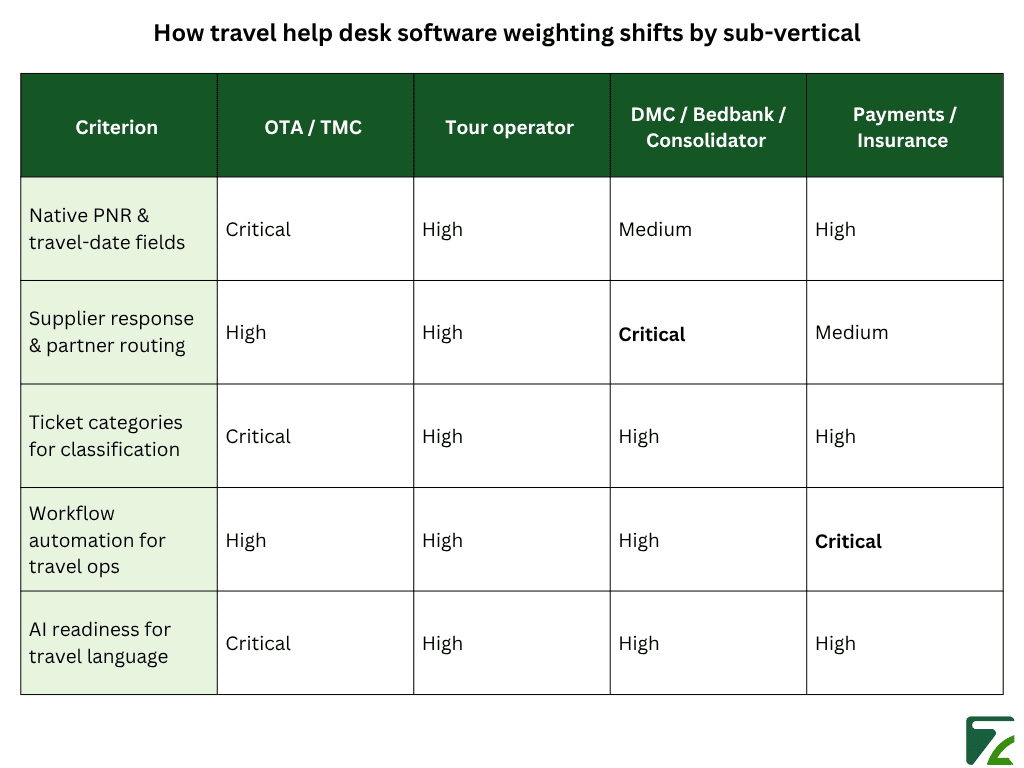
Whether the buyer runs an OTA, TMC, DMC, bed bank, consolidator, payments business, travel insurer, or travel-technology platform, the same five criteria apply. Only the weighting changes.
The scale makes the choice consequential. Global travel gross bookings are projected to reach USD 1.67 trillion in 2025, according to Phocuswright’s Travel Forward 2026 report. IATA’s full-year 2025 data confirms the momentum: air-passenger demand rose 5.3% versus 2024, a new record. More bookings and more passengers mean more changes, more disputes, and a higher cost attached to picking the wrong support tool.
What features should a travel help desk software comparison cover?
A travel-native comparison adds five feature columns the average matrix leaves out. Each is concrete enough to score in a live demo.
- Native PNR, booking reference, and travel-date fields. Look for PNR, booking reference, route, departure date, and check-in or check-out date as native, searchable fields. Custom fields can mimic this, but then the buyer maintains the schema, dashboards, and rules from scratch.
- Ticket categories for travel classification. Pre-built categories for cancellation, reschedule, amendment, relocation, refund, and supplier escalation, so tickets are tagged correctly from the first touch and routed without manual sorting. Tools that treat every ticket as undifferentiated force the team to classify by hand.
- Supplier and partner routing. Travel tickets are rarely two-party. A bed bank chasing an HCN pulls in the hotel supplier; a consolidator disputing a fare pulls in the airline and the GDS; a travel insurer coordinating an emergency involves a medical provider and a ground handler. The tool should track responses from each party on one ticket, with a separate SLA clock for the supplier reply.
- Workflow automation for repetitive operational tasks. Travel operations run on repeat work chasing supplier responses, updating customers, escalating overdue replies, summarising long threads. The tool should let teams build custom workflows that automate these tasks instead of relying on agents to remember every step. According to the Salesforce 7th State of Service report, AI already resolves about 30% of service cases globally, with that share expected to reach 50% by 2027 but only if the automation layer is built for the right operation, not a generic one.
- AI readiness behind the AI claim. Break it into three sub-questions: what data the model sees, whether it is tuned on travel language and itineraries, and how configurable it is for travel workflows. A claim that fails any of the three is marketing copy. Gartner found that 77% of service leaders already face executive pressure to deploy AI, and 75% report increased AI budgets, making the three-part test a commercial necessity, not an optional extra.
A travel help desk software comparison tests workflows, not feature labels.
Key Terms Worth Knowing
PNR: Passenger Name Record; the booking identifier linking customer, itinerary, and fare in one record.
Ticket category : A pre-built classification (cancellation, amendment, relocation, supplier escalation, refund) applied intake to route work correctly
Supplier routing : Tracking responses from external suppliers on a single multi-party ticket.
Workflow automation : A pre-configured logic that handles repetitive operational tasks without manual agent steps.
How does comparison weighting change across travel sub-verticals?
Travel help desk software comparison: top tools ranked for 2026
Scored on the five travel-native criteria above, not on generic feature counts here is how the leading help desk software for travel companies ranks in 2026. A platform can be excellent as a general customer-service tool and still rank lower, because the question is not whether the software is good but whether it runs a travel operation natively.
- Zeal Desk the only travel-native, AI-powered operations platform (enterprise-grade).
- Zendesk enterprise omnichannel CX leader; powerful but horizontal.
- Freshdesk strong mid-market generalist with broad channel coverage.
- Zoho Desk value option for teams inside the Zoho ecosystem.
- Intercom messaging-first support platform with strong AI positioning.
- Help Scout simple, email-first tool built for small support teams.
Why Zeal Desk ranks first
Zeal Desk is an AI-powered ticketing system built specifically for travel operations. It automates ticket summarization, smart classification, and data tagging such as check-in and check-out dates, while letting teams build custom workflows that absorb repetitive operational tasks. Unlike a generic helpdesk, it is organized around the booking rather than the isolated ticket, so related work on the same reservation stays connected through parent-child ticketing. The system already understands booking references, HCN and reconfirmation workflows, payment disputes, fare and rate amendments, cancellation chains, and supplier escalations as first-class workflows.
The intelligence layer is where the gap widens. Zeal Desk applies AI to booking extraction, intent and urgency detection, and sentiment analysis on the way in. On the way through, it handles smart assignment, operational summarization, SLA prediction, and workload balancing. For an enterprise travel operation running 24/7 across multiple markets, that adds up to faster resolutions, tighter SLA compliance, and the ability to handle more volume without growing headcount in lockstep.
Zeal Desk is enterprise-grade by design built for the multi-team, supplier-dependent, SLA-driven reality of B2B travel rather than retrofitted onto it. Because it is the only platform on this list shipped with travel workflows native, it is also the only one that does not need months of custom configuration to be useful.
How the generic platforms compare
Zendesk, Freshdesk, and Zoho Desk each publish a “travel and hospitality” industry page on their websites. Those pages reflect marketing intent, not native capability the same horizontal products they sell to retail or finance, with travel use cases bolted on top. Intercom and Help Scout do not market a travel vertical at all. None of the five ships native PNR fields, travel-specific ticket categories, supplier-aware routing, or AI tuned on travel language out of the box; travel logic still has to be configured in every case.
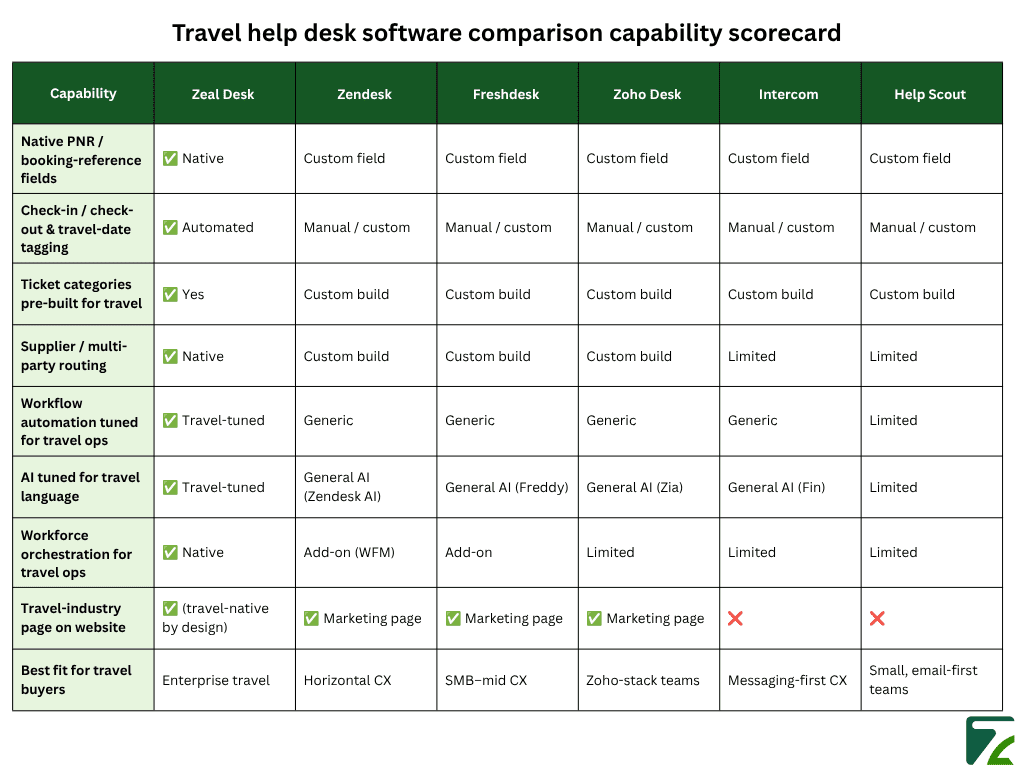
Generic platforms manage tickets. Zeal Desk orchestrates travel operations which is why it is the only travel-specific desk on this list.
The help desk software category is large and growing Market Research Future sizes the global market at roughly USD 12 billion in 2025, rising to USD 23.58 billion by 2035. Plenty of comparison pages reflect that scale, but almost none are built for the operation a travel buyer is actually running.
How do you run a travel help desk software comparison demo?
A scoring matrix is only useful if it ends in a real test. The closing step is a live scenario each finalist must run, not describe.
- Re-score your shortlist. Apply the five travel-native criteria, score each vendor one to five, and re-weight by sub-vertical. Vendors that crash on supplier routing or automation drop; those covering four of five travel columns rise.
- Run a disruption scenario live. Hand each finalist a scenario from your own operation. For accommodation-heavy work, use a reconfirmation failure 24 hours before check-in. For transport-heavy work, use a cancellation six hours before departure. For payments, insurance, or consolidators, use a refund dispute or a claim requiring multi-party evidence watch whether the ticket attaches the financial record and routes approvals automatically.
- Test automation and AI data. Ask each vendor to demonstrate a real workflow automating a repetitive task a supplier chase, a customer update, an SLA escalation. Then ask the AI question without the marketing: which data feeds the model, is it tuned on travel language, and what is configurable.
Conclusion
A travel operations leader running a generic help desk software comparison is running the wrong test. Five travel-native criteria turn the matrix into the right one, and the weighting on those criteria shifts by sub-vertical.
That is also why a horizontal help desk and a travel-native platform are not interchangeable. Zendesk, Freshdesk, Zoho Desk, Intercom, and Help Scout can be configured to approximate travel workflows. Zeal Desk ships them. For an enterprise travel operation that lives on supplier coordination, workflow automation, and SLA compliance whether that means a bed bank chasing confirmations, a consolidator managing fare disputes, or an insurer processing claims that difference is the difference between maintaining a generic tool and running a purpose-built one.
The cost of getting it wrong is measurable: PwC’s 2025 Customer Experience Survey found that 52% of consumers had stopped buying from a brand following a bad product or service experience. In travel, an unresolved ticket is not just an operational miss. The direction of the industry makes this urgent: the WTM Global Travel Report projects travel industry growth will outpace the global economy in the coming years, making operational infrastructure a strategic, not an administrative, priority. Build the rubric, weight it, walk in with your own operational scenario and let the travel help desk software comparison finally answer the right question.