


TL;DR
This article explains why generic “Freshdesk competitors” lists rarely fit travel operations and gives you a sharper way to compare. You’ll learn the two halves of a travel ticket, see three competitor archetypes mapped to your sub-vertical, and get the Three-Ticket Test for checking any alternative before you switch. It’s a method, not a vendor ranking.
A support lead at a growing OTA sets up Freshdesk in a week, and for a while it works. Then a schedule-change weekend hits. Hundreds of amendments land at once, each needing a supplier reply the agent doesn’t control. The desk logs every ticket, yet nobody can see which booking is stuck waiting on which hotel. That isn’t a knock on Freshdesk; it’s a fit problem. So, before you scan another list of Freshdesk competitors for travel operations, it helps to know what the list is missing.
Why Don't Generic "Freshdesk Competitors" Lists Fit Travel Operations?
Most “Freshdesk competitors” lists compare the same things: price per agent, channels, and whether AI is included. Those matter, but they describe a generic support tool, not a travel one. A travel operation runs on bookings, suppliers, refunds, and seasonal swings, and none of those show up in a feature grid. So, the top-ranked option on a list can still be a poor fit for your queue.
Key Terms Worth Knowing
Horizontal help desk: A support tool for any industry, where travel fields and workflows are configured on top rather than built in.
Supplier leg : The second thread inside one ticket, where an agent waits on a hotel, airline, or DMC.
Deflection : A customer resolving their own question through self-service, not an AI replying on its own.
PNR : Passenger Name Record, the booking container that drives much of the queue work in travel support.
What do top-10 Freshdesk competitor lists leave out for travel teams?
They leave out the way travel volume spikes. A normal week sets your staffing; a disruption rewrites it overnight. According to AirHelp (2025), 236 million US passengers had a flight delayed or canceled in 2024, roughly one in four of everyone who flew. Each disruption becomes a wave of amendment and refund tickets, and these events keep rising year over year (IATA). A list built on quiet-week features won’t tell you how a desk holds up when the queue triples.
Why does Freshdesk's strength on traveler questions hide the gap?
Freshdesk handles the traveler-facing side well, so it’s easy to miss what isn’t there. Its travel pages center on cancellations, baggage, loyalty, and fare-rule questions, all of which a horizontal desk does well. The gap sits behind that conversation, in the booking and supplier work no demo shows. On a generic desk, that work falls to the agent by hand, and manual handling is what makes support expensive. Human support already runs about $6 to $7 per contact (LiveChatAI, 2025), with US agents at roughly $28 to $40 an hour (Crescendo, 2025). So, every amendment that needs manual rework adds straight to that cost.
Most Freshdesk competitor lists rank desks on a quiet week, but travel teams are bought or broken on a disruption day.
What Are the Two Halves of a Travel Ticket Every Freshdesk Competitor Must Handle?

Freshdesk competitors for travel operations are help desk platforms travel companies weigh as alternatives to Freshdesk. The strongest options model the operations half of a ticket the booking, the supplier follow-up, and the payment natively, instead of leaving travel teams to build those fields as custom setup.
Every travel support ticket has two halves, and most comparison guides look at only one. The first is the traveler-facing half: the question, the complaint, the request to change or cancel. The second is the operations half: the booking record, the supplier you chase, and the money attached. Horizontal desks like Freshdesk, Zendesk, and Zoho Desk are built around the first half, because it looks the same in any industry. The second half is where Freshdesk competitors actually differ.
What is the traveler-facing half, and why do most Freshdesk alternatives nail it?
What is the operations half and why is it where Freshdesk competitors split?
The operations half is everything behind the reply: which booking, which supplier, which deadline, and how much money is at stake. A generic desk has nothing built in here, because it has no concept of a booking or a supplier. A single dispute can erase real margin ConnexPay (2026) notes that most OTAs earn just 10–15% commission per booking, while card networks treat a 0.9% chargeback rate as a warning and 1.5% as critical. On a horizontal desk, the fields that track all this become custom objects an admin maintains.
A travel ticket’s traveler-facing half looks like any industry’s; its operations half the booking, the supplier, the money is where Freshdesk competitors split.
Why does the operations half decide the real cost of a travel ticket?
The operations half is where the money sits, and travel carries more of it than most sectors. A mishandled refund or a late chargeback isn’t a satisfaction dip; it’s a financial loss. The travel industry saw roughly $25 billion in chargebacks in 2023, at an average rate of 4.68% (PayCompass, 2025). A desk that can’t tag a dispute, hold its deadline, and keep an audit trail leaves that exposure to spreadsheets. So, test the operations half hardest.
Which Freshdesk Competitor Archetype Fits Your Operations Half?
Instead of ranking brands, sort Freshdesk competitors into three archetypes, because tools in the same archetype share the same operations-half strengths and gaps. Once you know which archetype fits your sub-vertical, the shortlist gets much shorter. The three are the enterprise CX suite, the lean shared inbox, and the travel-native desk.
The real question isn't which Freshdesk competitor is best, but which archetype fits your operations half.
What are the three archetypes of Freshdesk competitors for travel?
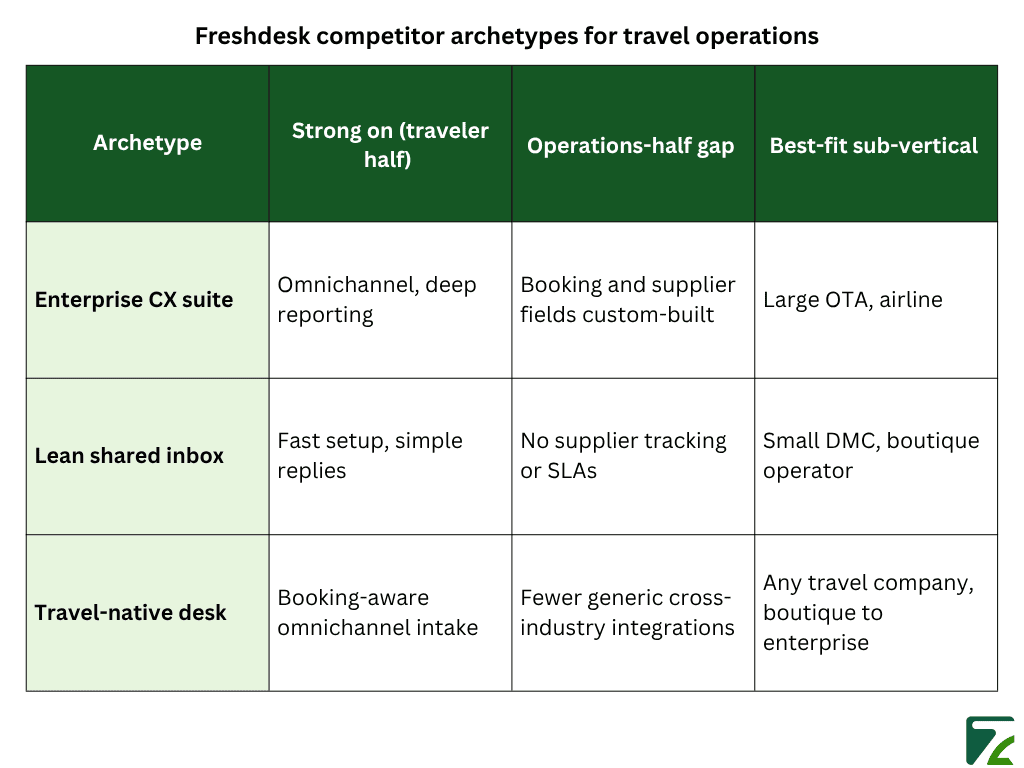
There are three. The enterprise CX suite, such as Zendesk, offers deep omnichannel and reporting, but booking and supplier objects are custom-built work. The lean shared inbox, such as Help Scout or Freshdesk’s simpler tiers, is fast to set up, yet it usually lacks supplier tracking and travel SLAs. The travel-native desk is built only for travel, so booking-aware intake and supplier workflows are standard. It fits any travel company, from a boutique operator to an enterprise OTA or airline, though it carries fewer generic cross-industry integrations. Each solves the traveler-facing half but parts ways on the operations half.
How do Freshdesk competitor archetypes map to OTAs, tour operators, DMCs, TMCs, and payments?
It depends on where your operations half is heaviest. A high-volume OTA or airline leans toward the enterprise suite or a travel-native desk, because supplier and refund load is constant. A small DMC or boutique operator often does fine on a lean inbox until supplier chasing overwhelms it. Payment-heavy teams need dispute and audit depth a generic inbox lacks. The table below maps each archetype to the sub-vertical it fits.
Where does AI separate one Freshdesk competitor archetype from another?
AI is where the archetypes pull apart, because each applies it to a different half. On the traveler-facing half, AI can deflect a share of routine questions; one industry estimate puts tier-1 deflection at 55–70% for small and mid-size teams (Builts AI, 2026). On the operations half, the useful AI work is different: classifying a ticket, extracting check-in dates and supplier references, and summarizing a long supplier thread. A horizontal desk can bolt some of this on; a travel-native one treats it as the default.
How Do You Run the Three-Ticket Test on a Freshdesk Competitor?
The fastest way to judge any Freshdesk competitor is to stop reading feature pages and run three of your own tickets through it. Pick the three that hurt most, then watch how much of each the tool handles without custom build work. This is the Three-Ticket Test. It takes an afternoon in a trial account and tells you more than a month of demos.
Which three tickets reveal whether a Freshdesk alternative fits travel operations?
Use three real cases from last month. First, a multi-supplier amendment, where one itinerary change touches a flight, a hotel, and a transfer. Second, a refund or chargeback, where a deadline and an audit trail matter as much as the reply. Third, a surge sample, a batch of look-alike tickets from one disruption day. Together they cover the operations half: supplier chasing, money and compliance, and volume under pressure.
What should each test ticket prove about the operations half?
Each ticket checks one thing. The amendment shows whether the desk can track several supplier replies in one ticket without losing the thread. The refund or chargeback proves it can tag the dispute, hold its deadline, and keep a record you could show a card network. The surge sample reveals whether classification and routing hold up when fifty similar tickets arrive at once. Anything that needs a heavy custom setup to pass is your answer.
How do you read the results before you switch off Freshdesk?
Score each ticket as handled natively, handled with custom setup, or not handled. A tool that needs custom build work on all three will cost you in configuration and upkeep long after launch, even if its price looks lower. Plan the switch for a low-season window, and keep both desks live briefly, so no SLA slips during cutover.
Don't switch to the Freshdesk alternative that demos best switch to the one that passed your three worst tickets.
How Does Zeal Desk Fill the Travel Gaps Other Freshdesk Competitors Leave?
Zeal Desk is the travel-native desk from the archetype map an AI-powered ticketing system built only for travel operations, which makes it the Freshdesk competitor designed around the operations half instead of bolting it on. In practice, it’s built to pass the Three-Ticket Test where a horizontal desk needs custom work. Any travel company can run it: OTAs, tour operators, DMCs, travel payment companies, and airlines.
How does Zeal Desk handle the supplier leg other Freshdesk competitors can't?
Take the multi-supplier amendment. Because booking fields and supplier-aware workflows are native, the agent sees the booking, each supplier reply, and the deadline inside one ticket. A horizontal desk like Freshdesk, Zendesk, or Zoho Desk has no concept of a supplier, so the same tracking becomes a custom object someone builds and maintains. Zeal Desk treats the supplier leg as part of the ticket the operations-half work the other archetypes leave to the agent.
How does Zeal Desk cut the manual refund, chargeback, and surge work a Freshdesk competitor leaves to agents?
On a refund or chargeback, Zeal Desk classifies the ticket into travel categories trained per business and pulls structured fields check-in dates, PNR, supplier reference from the message, so the dispute carries a clean record and a deadline the agent can act on. On a disruption-day surge, that same classification sorts fifty look-alike tickets instead of an agent doing it, and a smart summary turns a long supplier thread into one read. A horizontal Freshdesk competitor leaves that sorting and record-keeping to the agent.
Why is Zeal Desk the best-fit Freshdesk competitor for travel operations?
Because the operations half is native, not configuration the exact difference the Three-Ticket Test exposes. That’s why a travel-native desk fits any travel company a horizontal tool would ask to build its own travel layer first. On the traveler-facing side, Zeal Desk drafts a reply the agent reviews, edits, and sends; no message goes out on its own. According to Zendesk (2026), 75% of CX leaders see AI as amplifying human intelligence, not replacing it, a view echoed in Skift’s coverage of AI in managed travel. Speed never costs control.
Conclusion
Choosing among Freshdesk competitors for travel operations gets easier once you stop comparing feature counts. Every travel ticket has a traveler-facing half most tools handle well, and an operations half the booking, the supplier, the money where they split apart. Sort the field into three archetypes, match one to your sub-vertical, and the shortlist narrows before you book a demo. Then run the Three-Ticket Test on any tool you’re serious about. The right alternative handles your hardest real tickets natively, not the one that ranks highest on a list. Start with your three worst tickets from last month, and let them do the judging.