




This article explains what AI support for travel operations actually costs and saves on a real support desk: cost per ticket, how much of your work AI can genuinely take on, the blended math, and when it breaks even. It is written for ops and support leaders at OTAs, DMCs, and TMCs who have to justify the spend. You will get a plain read on the cost drivers, a worked cost per ticket example, a build versus buy view, and the one modeling mistake that inflates the promised savings.
You were probably sold a big number. Cut cost per ticket by 90 percent, handle more volume with the same team, watch the savings roll in. Then the invoice arrives, the budget barely moves, and your CFO asks why. AI support for travel operations does save money, but not the way the demo implied. The savings are real, and smaller and differently shaped than the headline suggests. This article shows you where the money actually sits, and how to model it for your own desk before you sign.
Why the Cost of AI Support for Travel Operations Is the Question You'll Be Asked First
The cost case is where these deals stall, because you own the budget and the SLA at the same time. Any platform impresses in a demo. The harder question comes later, when finance asks what changes on the monthly bill. So before you compare features, get the money model straight. The number a vendor quotes and the number you will actually book are rarely the same, and the difference is wider in travel than in most industries.
The AI support savings vendors quote aren't the ones you'll book
A quoted saving usually describes one automated interaction, not your whole operation. AI adoption in travel is genuine, and it does pay back. According to McKinsey (2025), in a survey of 86 travel executives, 59 percent said introducing AI raised employee productivity, with most reporting more than 6 percent annual cost savings. However, those gains are a long way from 90 percent. Read the headline as the ceiling on one task, then model the floor across your full ticket volume.
Why doesn't AI support cut a travel desk's costs the way it cuts other industries'?
Because a travel ticket rarely closes on its own. Most of your queue is time critical and depends on someone else. According to GBTA (2025), 55 percent of travel managers cite friction managing travel disruptions, the messiest and most urgent work a desk handles. A disruption ticket needs a supplier to release a room or an airline to confirm a seat, so AI can prepare the reply but a person still has to finish it. That dependency caps how much work runs without an agent.
In travel, few tickets close without a person, so the savings come from cheaper human tickets, not from deflection.
What Actually Drives the Cost of AI Support for Travel Operations?
AI support for travel operations is the use of artificial intelligence inside your support workflow, classifying requests, drafting replies, extracting booking details, and flagging urgency, all running within the help desk, channels, and booking systems your team already uses. Its cost comes down to three things: how many tickets you handle, what each one costs a person to handle, and how much of that work AI can genuinely take on. Get those right and the payback is easy to model; get the third wrong, and every projection built on it is wrong too.
What sets the cost of AI support: volume, price per ticket, and the eligible share
Start with what a ticket costs before automation. Much of that cost is not the answer but the hunt for context around it. According to Supportbench (2026), support agents spend 3.3 hours a day just gathering context across tools, and context switching costs a 10 person team roughly $276,000 a year. That is the cost AI cuts first, and it is the same tax a purpose built travel help desk is designed to remove. Even when a person sends the reply, removing that search makes each ticket cheaper.
Why the fully automated share caps out fast on a travel desk
The slice a traveler can resolve alone, through self service, is smaller than the marketing suggests. According to Ada (2026), only 24 percent of consumers say their most recent interaction was fully resolved by AI alone, from a survey of 2,000 consumers. In travel, where a booking touches a supplier and a departure clock, that self served share is often lower still.
Most of your savings will not come from tickets that close without a person. They will come from tickets a person still handles, only faster, with less manual work in the middle.
Key Terms Worth Knowing
A quick reference for the cost terms used throughout this article.
- Cost per ticket: the fully loaded cost for a person to handle one ticket, including the time spent gathering context.
- Deflection versus assist: a traveler resolving a request themselves through self service, versus AI making an agent handled ticket cheaper and faster.
- AI eligible share: the fraction of your tickets AI can genuinely take on, either through self service or as assist.
- Blended cost per ticket: the weighted average cost across self served, assisted, and fully manual tickets.
- Break even volume: the monthly ticket volume at which your savings cover the platform cost.
- Time to value: how long until the deployment pays back, which depends on whether it is configured or trained.
Running the Numbers: AI Support for Travel Operations on a Real Desk
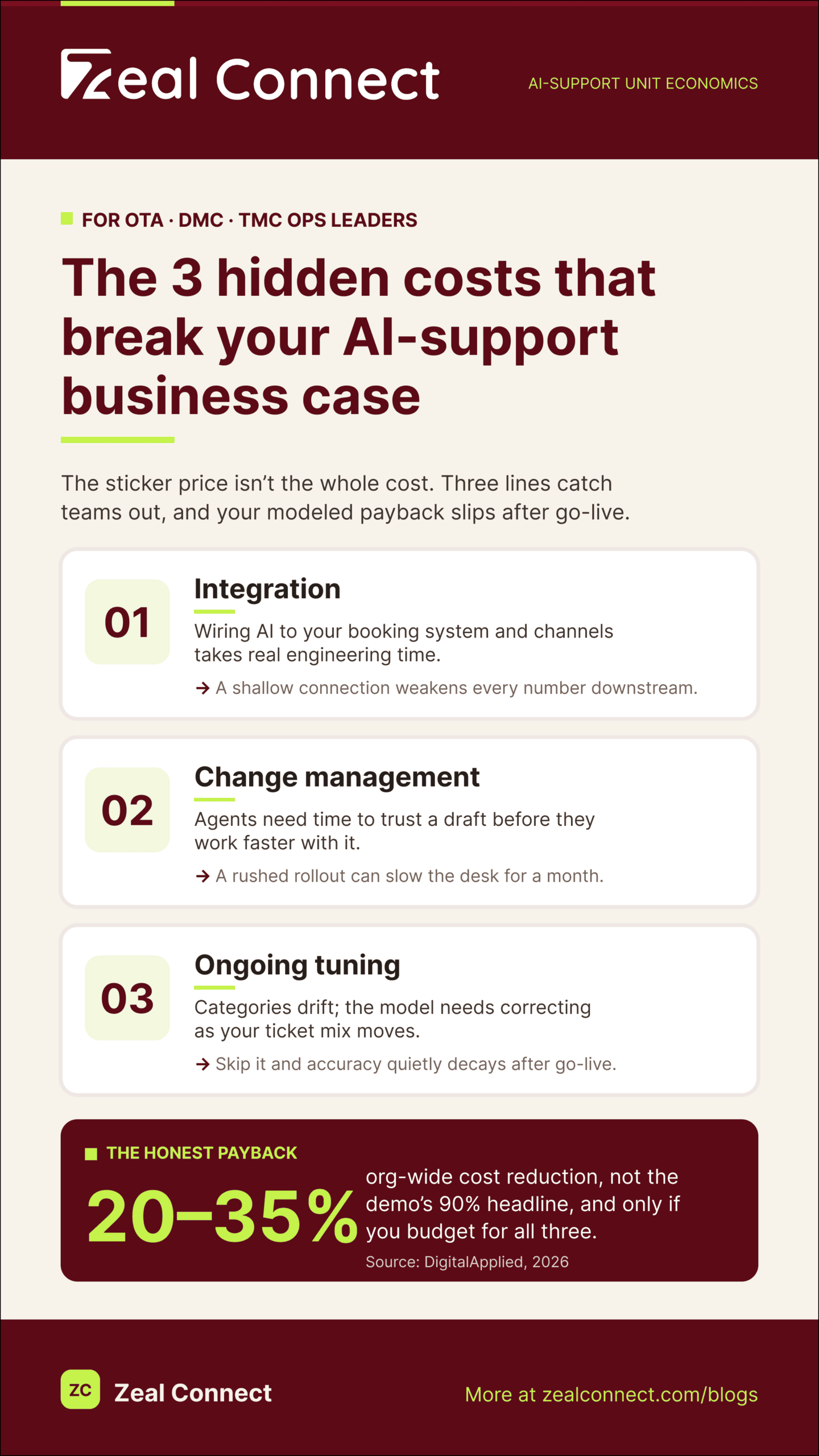
Now put figures against the model. The published ranges are wide but usable, and the arithmetic tells a clearer story than any vendor slide. According to DigitalApplied (2026), a human handled ticket costs $6 to $12 on average while an AI handled outcome costs $0.99 to $2.00, yet realistic organization wide cost reduction lands at 20 to 35 percent once you account for infrastructure and the tickets AI cannot touch.
The gap between the per ticket number and the org wide number is the whole point.
A worked cost per ticket example on a travel support desk
Take a mid size desk and run the blend. Say a human ticket costs about $9 today. Roughly a quarter of tickets deflect, resolved by the traveler through self service, at about $1.50 each. For the three quarters a person still handles, AI removes the context hunt, so those drop from $9 to about $7. The blended cost lands near $5.60, a reduction of roughly 20 to 37 percent depending on how much assist you count. Deflection barely moves that number. The cheaper assisted ticket does most of the work.
Table: A unit economics view of AI support for travel operations (illustrative, using cited cost ranges)
| Line item | Manual travel desk | With AI support | Note |
|---|---|---|---|
| Cost to handle one agent ticket | ~$9 | ~$7 | Context gathered ahead, draft ready; removes the 3.3 hour daily context tax |
| Share of tickets deflected (traveler self serves) | 0% | ~25% | Grounded in Ada's 24% fully resolved without a person |
| Cost per deflected (self served) interaction | n/a | ~$1.50 | Within DigitalApplied's $0.99 to $2.00 range |
| Blended cost per ticket | ~$9.00 | ~$5.60 | 0.25 × $1.50 + 0.75 × $7 |
| Realized reduction | n/a | ~20 to 37% | Matches DigitalApplied's real world 20 to 35%; assist drives it, not deflection |
How does the cost math change for OTAs, DMCs, and TMCs?
The eligible share moves with your ticket mix, so the same model gives different answers. An OTA handles a heavy volume of amendments and cancellations, structured intake that automated customer service for travel handles best. According to SiteMinder (2025), hotels saw a 19.15 percent cancellation rate across 135 million reservations, so cancellation and change requests are a large, repeatable slice a classifier can take on. A TMC leans the other way, with disruption work that stays human. A DMC sits in the middle, where supplier disputes are assist heavy rather than self served.
How Do You Justify the Cost of AI Support for Travel Operations, Build or Buy?
You can build the pieces yourself or buy a platform, and the honest comparison is about time and accuracy, not licence fees alone. A build looks cheaper on a spreadsheet and rarely is, because the hard part is not the model. It is the travel specific accuracy and the booking context that make the model useful on your desk.
Build versus buy AI support: what you're actually paying for
You are paying for accuracy you would otherwise have to reach yourself. According to IrisAgent (2026), AI reaches 85 to 95 percent triage accuracy on mature deployments, against a 40 to 50 percent ceiling for rules based systems. Hitting the top of that range takes tuned classification, live booking data, and months of iteration. A bought platform arrives with that work done, grounded in travel workflows. A homegrown build starts at the rules based floor and climbs on your team's time.
The hidden costs to budget for in AI support
The sticker price is rarely the whole cost, and three lines catch teams out. Integration comes first, because connecting AI support to your booking system and your channels takes engineering time, and a shallow connection weakens every number downstream. Change management comes next, since agents need time to trust a draft before they work faster with it, and a rushed rollout can slow the desk for a month. Then there is ongoing tuning, because categories drift and the model needs correcting as your ticket mix moves. Budget for all three, or the payback you modeled on a spreadsheet slips a quarter or two after go live.
Model the assist, not the deflection, on a travel desk
Base your business case on the cheaper assisted ticket, not a hopeful deflection rate. That is the number that survives contact with your real queue. It also keeps you honest about risk, because a person still reviews and sends the customer reply. That matters beyond cost. In Moffatt v. Air Canada (2024), a tribunal held the airline liable for wrong information its chatbot gave a traveler. The same human in control principle underpins any credible AI in travel customer service.
Let AI draft and prepare; keep the decision, and the accountability, with your agent.
Conclusion
The honest number is a 20 to 35 percent cost reduction, and it comes from assist, not a hopeful deflection rate. Model your own desk with three inputs (volume, cost per ticket, and the share AI can genuinely take) and count the cheaper assisted ticket as your main saving. When you weigh build against buy, you are really buying travel tuned accuracy, booking context, and a short time to value. Keep a person on the send button, for quality and accountability. Do that, and the business case you take to your CFO will hold up after go live, not just in the demo.
Frequently Asked Questions
How much does AI support for travel operations actually save per ticket?
Expect a blended reduction of roughly 20 to 35 percent, not the 90 percent quoted per automated interaction. Most of it comes from making agent handled tickets cheaper, since only a minority of travel tickets are resolved through self service without a person.
Is the 90 percent cost reduction vendors quote real?
That figure describes the cost of a single automated interaction, not your whole desk. Once you include the tickets that still need a person and the platform cost, real organization wide reduction lands closer to 20 to 35 percent.
Should we build AI support in house or buy a travel native platform?
Buying usually wins on time and accuracy. The hard part is not the model but reaching 85 to 95 percent classification accuracy grounded in live booking data, which a travel native platform delivers on day one instead of after months of building.
Which travel tickets are cheap enough to automate?
Structured, repeatable intake automates well, such as amendment and cancellation requests, status checks, and document reissues. Time critical, multi supplier work such as disruption reaccommodation stays human, with AI assisting rather than closing the ticket.