




This article explains what a customer support chatbot for travel can finish on its own, why it breaks where it breaks, and what it has to route to a person, mapped to the real queries travelers send. It is written for operations and support leaders at OTAs, DMCs, tour operators, TMCs, and travel tech teams deciding where to put a chatbot in a live, SLA driven queue. You will get a plain definition, the difference between chatbot types, the containment versus resolution distinction, a query by query scope table, and a way to deploy without overreaching.
A customer support chatbot for travel is easy to switch on and hard to scope. It sits on your website, your app, and your WhatsApp line, and it answers before anyone on your team sees the message. The problem is that travelers bring their hardest questions to it first, often at the worst possible moment. So the useful question is not "how many chats can it deflect?" It is "what can this chatbot actually finish, why does it stop where it stops, and how cleanly does it hand off the rest?" This article answers that, query by query.
Why a Customer Support Chatbot for Travel Is a Frontline Decision Now
A chatbot is now the first thing many travelers reach when a trip goes wrong, which makes its scope an operational decision, not a website feature. You own the queue behind it, so where you draw its limits shapes your SLA, your cost per contact, and how many escalations spiral into complaints. Getting that line right starts with knowing when travelers show up and what they actually ask.
Travelers bring their hardest questions to the chatbot first
Disruption is common, and it lands on the chatbot before it lands on an agent. According to TravelPerk (2024), 78% of business travelers experienced a travel disruption in 2024, and 41% missed or were late for a customer meeting because of it. Those are the moments when someone opens the chat window. The first message is rarely "what is your baggage policy." It is "my flight is cancelled, what now," which is exactly the query hardest to finish automatically.
What does a customer support chatbot for travel actually get asked?
The inbound mix splits into a few clear buckets. Travelers ask for information, such as baggage rules, visa requirements, or a cancellation window. They ask to check a record: where is my booking, has my refund gone through. And they ask to change something, such as moving a date, correcting a name, cancelling, or rebooking. Those buckets behave very differently. Corporate buyers already rate the servicing they get poorly: GBTA (2025) found 50% cite friction with the TMC servicing process, and slow or ineffective issue resolution ranks among the top complaints at 32%. A chatbot helps or hurts depending on which bucket it is handed, which is why it pays to cut repetitive ticket volume deliberately rather than by default.
What Is a Customer Support Chatbot for Travel, and What Does "Resolve" Really Mean?
A customer support chatbot for travel is a self service conversational assistant travelers use across web, app, and messaging to get answers, check bookings, and start requests. It handles routine questions on its own, but a person still decides and sends the reply on anything that touches money or a booking. Once you see it as a front door rather than an agent, the next question is what kind of chatbot you actually have, because that decides what it can do.
A travel support chatbot is a self service front door, not the support team
Self service means the traveler settles their own question through the chat, without an agent picking it up. For a simple information request, that works well and no ticket is created. For anything that touches a booking or money, the bot's job changes: it gathers the facts and passes them on. The reply a traveler gets on a refund or a complaint is written and sent by a person, not published automatically by the bot. That distinction is the whole game, and it is why "resolve" needs a careful definition.
Rule based, conversational, and agentic chatbots resolve very different things
Not every chatbot is the same tool. A rule based bot follows scripted menus and can only answer what its author anticipated. A conversational, NLP based bot understands intent and rephrasing, so it handles varied questions and holds a multi turn thread. An agentic bot goes further: it reasons, calls other systems, and pulls live data, often using retrieval so its answers come from your real content instead of guesswork. A scripted bot answers an FAQ. Only a connected, agentic one can check a live booking, and even then only within limits.
Containment or resolution: which is your travel chatbot actually delivering?
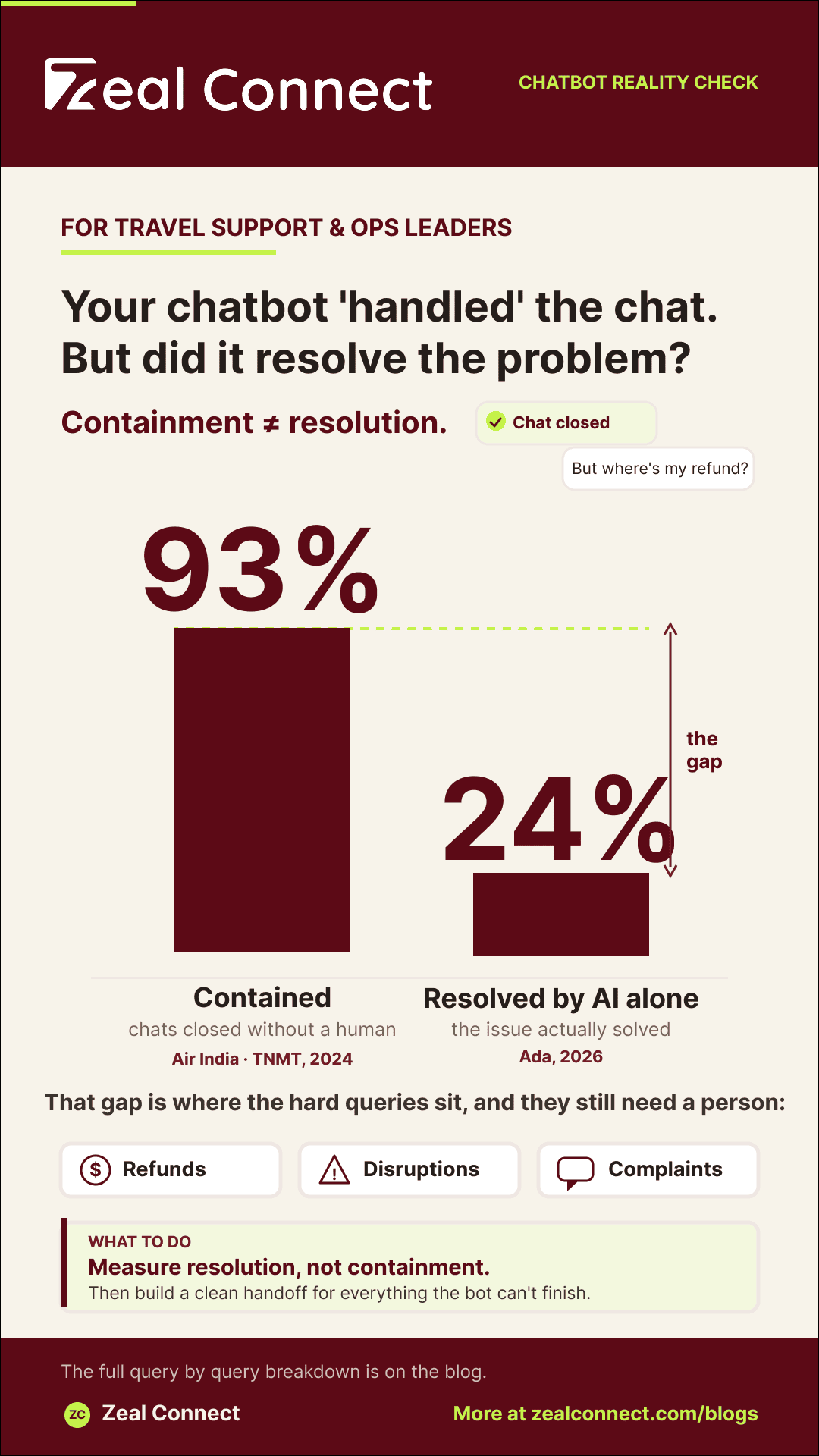
These two numbers are not the same, and travel teams often report the wrong one. Containment counts chats that ended without a human. Resolution counts chats where the traveler's problem is actually done. The gap is large. Gartner, reported by Customer Experience Dive (2025), found self service fully resolves just 14% of customer service issues. Air India's chatbot, by contrast, reports a 93% containment rate (TNMT, 2024).
A chatbot can contain almost every chat and still resolve very little of what travelers actually came for.
Key Terms Worth Knowing
A few terms come up throughout this article. Here is what each one means in plain language.
- Containment / deflection rate: The share of chats that ended without a human agent. It tells you direction, not whether the traveler's problem was solved.
- Resolution rate: The share of chats where the traveler's issue was actually completed. This is the number that matters.
- Grounding: Tying an answer to a live, reachable source such as a policy page, a booking record, or a reservation system.
- RAG (retrieval augmented generation): Feeding the model your real data at answer time so it responds from your content, not from guesswork.
- Warm handoff: Passing a case to an agent with the booking, context, and request already attached, so the agent does not start cold.
- IRROPS: Irregular operations, meaning delays, cancellations, and weather or strike disruption that spike volume without warning.
Why a Travel Chatbot Resolves Some Queries and Breaks on Others
Three things decide whether a chatbot can finish a query: whether the answer is grounded in data it can read, whether it has the authority to act, and whether the case needs human judgment. Miss any one and the query cannot be closed in the chat, however fluent the bot sounds.
Grounding, authority, and judgment decide what a travel chatbot can finish, and travel strains all three more than most industries do.
Grounding: a travel chatbot can only answer what it can read
A bot is safe on a question whose answer sits in a source it can reach, and dangerous on one that only sounds answerable. A published cancellation policy is fine. Fare rules, change fees, and refund eligibility are not; they are conditional logic that depends on booking class, route, and ticket type, and they need live data rather than a help article lookup. When a bot guesses instead, the company owns the result. A Canadian tribunal ordered Air Canada to pay $812.02 after its chatbot stated a refund policy that did not exist, ruling the airline liable for negligent misrepresentation (Forbes, 2024).
Authority: resolving a change means moving money or inventory the chatbot doesn't control
Answering a question is one thing; changing a booking is another. A date change reprices the itinerary and needs a supplier reissue. A refund moves money that sits with a supplier, a payment gateway, or your finance team. A chatbot touching that flow also sits inside your cardholder data environment and needs live access to reservation systems like Amadeus, Sabre, or Navitaire (Fini, 2026). Without that authority and that connection, the bot can prepare the change, but a person has to complete it, usually through your supplier coordination workflows.
Where does judgment, not data, decide the outcome?
Some cases have no lookup that settles them. A complaint, a goodwill decision, or a tradeoff during disruption depends on judgment the bot should not make alone. The line often runs through the traveler, not the query type. As Parloa puts it, a solo traveler rebooking to the next available flight can often be handled by the bot, while a stranded family with young children needs a person. Same disruption, different call. Recognizing that a case needs judgment, and routing it, is itself something the bot has to be built to do.
What a Customer Support Chatbot for Travel Can and Cannot Resolve
Apply those three tests to real traveler queries and the scope becomes concrete. The bot can finish grounded, low stakes questions. It can prepare reversible but chargeable changes and hand them over. Anything that needs money movement, live rebooking, or judgment, though, it should route on sight. The table below maps common queries against that line, including what the agent should receive when the bot steps back.
Table: What a customer support chatbot for travel resolves, tees up, and must route.
| Traveler asks the chatbot | What it resolves on its own | Why it stops there | What the agent receives (the warm handoff) |
|---|---|---|---|
| Booking status, resend a confirmation or boarding pass | Full answer, if grounded | Needs a live booking read, nothing to decide | Identified booking, verified traveler |
| Cancellation window, baggage or visa rule | Full answer | Lives in a published, reachable policy | Nothing (self served) |
| Date change or name correction | Prepares only | Reprice and supplier reissue required | Booking, requested change, verified traveler |
| Refund status and the refund itself | Status only | Money moves on supplier, gateway, or finance | Refund request, amounts, timeline set |
| Disruption rebooking or a complaint | Routes on sight | Live inventory, judgment, and liability | Full transcript, booking, urgency flag |
Queries a travel chatbot handles on its own
The safe zone is grounded information and simple status. Baggage allowances, visa requirements, cancellation windows, booking confirmations, and boarding passes all sit here. KLM's assistant, for instance, sends booking confirmations, boarding passes, and flight status updates across ten languages. These are the high structure questions bots do best with: DigitalApplied (2026) found high structure intents deflect at around 78%, while complaints deflect at only 19%. The traveler self serves, no agent is needed, and no ticket is created.
Queries the chatbot can only tee up for an agent
Amendments and refunds are the middle band. A date change, a name correction, or a refund request is real work the bot can start but not finish. Here the bot earns its keep by preparing the case: verifying the traveler, identifying the booking, capturing exactly what they want, and setting an expectation on timing. Then it hands a complete package to an agent, who makes the change and sends the reply.
The value is not that the chat ended. It is that the agent starts at step three, not step one.
Where should a travel chatbot stop and route immediately?
Some queries should never be attempted. Money movement, live disruption rebooking, and complaints carry inventory risk, judgment, and liability at once. GenAI chatbots are strong on early engagement but, as TNMT (2024) notes, they are "not a wonder weapon for managing complex tasks like advanced rebooking management during flight disruptions." The right behavior is to recognize the case, collect the context, and route it with an urgency flag, rather than improvise an answer that becomes a liability later.
How to Deploy a Customer Support Chatbot for Travel Without Overreaching
Scope matters more than ambition here. A chatbot set to answer what it can ground, and prepare what it cannot, will outperform one told to close everything. The work is deciding what to switch on first, designing the handoff, and setting an honest fallback for the day disruption hits.
Measure a travel chatbot on resolution and handoff quality, not on a containment number.
Which queries should you let the chatbot resolve first?
Start where the answer is grounded, reversible, and low stakes. Published policies, baggage and visa rules, and simple status lookups give you fast wins with almost no downside. Add booking linked answers only once the integration behind them is live and tested, since an ungrounded status reply is worse than none. Expand the scope as each connection proves out, not before. This sequencing keeps early errors cheap and builds trust in the tool, especially once you classify and route incoming tickets consistently.
Design the handoff so the agent starts at step three, not step one
The handoff is where most of the value lives, and where most bots waste it. When a case exceeds self service, the bot should attach the identified booking, the verified traveler, the request, and the full transcript before routing. That is what turns containment into a real outcome. It matters because most AI chats do not finish alone: Ada (2026) found only 24% of consumers said their most recent AI interaction was fully resolved by AI alone, while 76% escalated, got partial resolution, or gave up.
During disruption, set the chatbot to inform and route, not to rebook
Disruption is the moment a bot is most tempted to overreach and most likely to fail. When inventory is gone and options are messy, a wrong answer is expensive. The honest setting is to inform and route: give the traveler real time status, set expectations, and pass the case to a person with full context. That is also what buyers already feel is missing, given how poorly they rate disruption servicing today. Trying to rebook automatically here is where containment turns into a complaint.
Conclusion
A customer support chatbot for travel resolves grounded information and simple status, prepares amendments and refunds for an agent, and routes money movement, disruption rebooking, and complaints to a person. The line falls where it does for three reasons: grounding, authority, and judgment. When one is missing, the chat cannot close on its own, no matter how well the bot writes. So scope the chatbot to what it can ground, design the handoff so agents start with the full picture, and measure it on resolution and handoff quality rather than on containment. Do that, and the bot becomes a reliable front door instead of a liability that surfaces on the next bad weather day.
Frequently Asked Questions
Can a customer support chatbot for travel actually process a refund?
It can start and status a refund, but it cannot move the money. The refund is released by a supplier, a payment gateway, or your finance team, on their timelines. The bot's real job is to capture the request, set an expectation, and route it so a person authorizes and completes it.
What should a travel chatbot do during a flight disruption it can't fix?
It should inform and route, not rebook. Give the traveler real time status and clear expectations, then hand the case to an agent with the booking and context attached. Automated rebooking during irregular operations needs live inventory and judgment the bot does not have, so improvising there creates complaints.
How do I stop my chatbot from inventing a policy like Air Canada's?
Ground every answer in a live, reachable source, and keep topics it cannot ground out of scope. Fare rules and refund eligibility should never be answered from a guessed help article. For edge cases, have the bot collect the details and let a person send the answer, since your company owns whatever the bot says.
Containment or resolution: which should I report?
Report resolution and handoff quality. A high containment rate can look excellent while the money and disruption queries go untouched, because containment counts chats that ended, not problems that were solved. Resolution and a clean handoff tell you whether travelers actually got what they came for.