


TL;DR
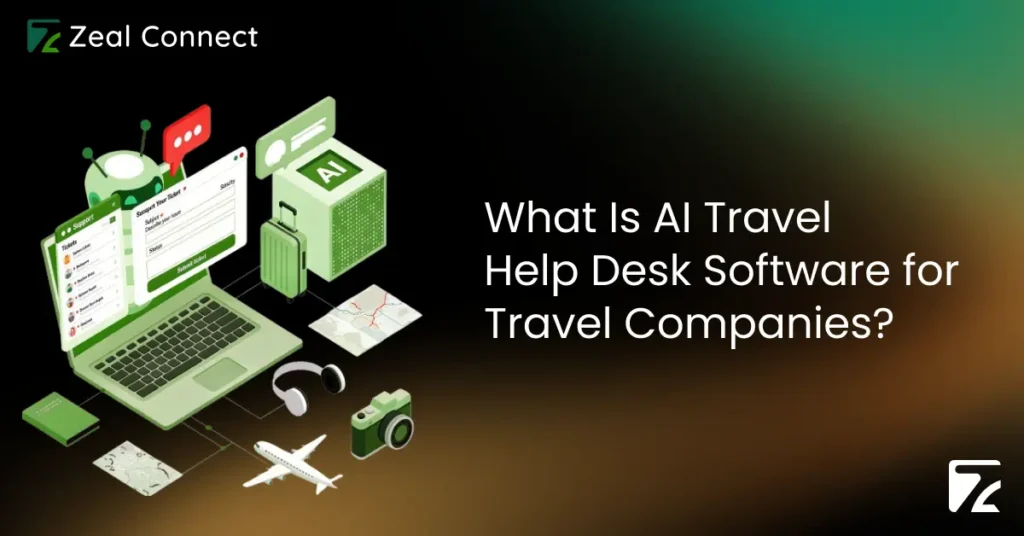
AI travel help desk software is a desk-first operations platform built for travel companies, with AI capabilities layered in response generation, detail extraction, ticket summarization, and a configurable knowledge base. This guide covers what those capabilities deliver for operations teams, how outcomes shift by sub-vertical, and what to test before choosing a vendor.
Operations and customer experience leaders at travel companies are not looking for a chatbot. They are looking for a platform that reduces the manual burden on their teams across supplier coordination, booking queries, SLA compliance, and escalation management without asking the business to rebuild how it works.
AI travel help desk software is a desk platform with an AI layer built in. The desk handles tickets, workflows, supplier communication, and team assignments. The AI makes each of those functions faster and more consistent so that the team handles more volume, responds more accurately, and follows the company’s own procedures, even as case volumes and team compositions change.
For Heads of Operations, COOs, Service Delivery Managers, and Customer Experience leaders across any travel company OTA, DMC, TMC, bed bank, consolidator, tour operator, travel payments business, or travel insurance operation this is an operational infrastructure decision, not a technology experiment.
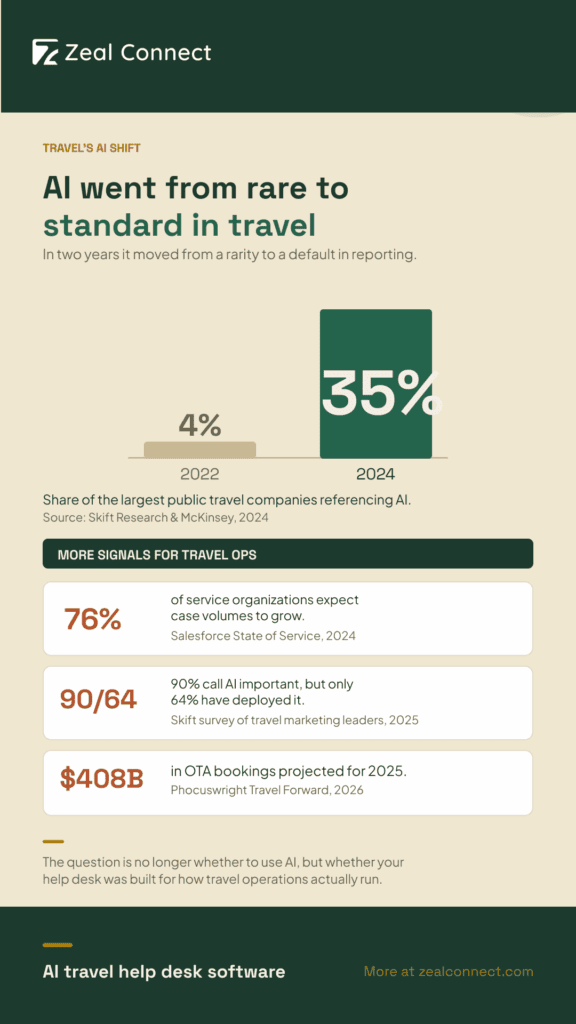
According to the Salesforce State of Service Report (2024), 76 percent of service organizations expect case volumes to grow. For travel businesses managing multi-supplier operations under time pressure, that growth is not theoretical. The platform an operations leader selects today will determine how the team scales tomorrow.
Why Do Travel Operations Teams Need a Purpose-Built Help Desk?
Travel operations run on complexity that general-purpose platforms were not built to handle. A single booking can involve a hotel supplier, a payment processor, and a ground partner simultaneously. Every case is tied to a booking reference, a check-in deadline, and a supplier relationship that must be tracked through to resolution.
Without a purpose-built platform, that complexity falls on people. Supplier follow-ups live in inboxes. SLA clocks are tracked manually. Knowledge of how to handle each scenario sits in the heads of experienced team members, which means every new hire starts from zero, and every departure takes institutional knowledge with it.
A travel help desk built for this environment changes that picture. It organizes tickets around bookings, tracks supplier SLAs per counterparty, routes of work based on configured rules, and gives the operations leader real-time visibility across the team. The AI layer on top of that infrastructure is what compounds the value handling the structured, repetitive work before any team member opens the ticket, and drawing on the company’s own procedures when generating output.
The travel industry is moving in this direction at speed. According to Skift Research and McKinsey, only 4 percent of the largest public travel companies referenced AI in their annual reports in 2022. By 2024, that figure had risen to 35 percent. The question for operations leaders is no longer whether to adopt AI it is which platform is genuinely built for travel operations.
Key Terms Worth Knowing
AI travel help desk software :A ticketing and operations platform with AI capabilities response generation, detail extraction, summarization, and knowledge retrieval built specifically for travel companies.
AI context window : The knowledge base within a help desk platform where a travel company configures its own SOPs, supplier procedures, and policies; the AI draws on this when generating responses.
Human-in-the-loop :a workflow design requirement that routes AI-generated output through a human reviewer before send, applied to any reply touching money, identity, or regulatory compliance.
Hallucination: an AI output that is factually confident but incorrect; treated as a workflow design problem route around it by design, do not rely on vendor assurances.
What Does an AI Helpdesk for Travel Actually Do for an Operations Team?
The AI in a travel help desk is not a standalone process. It is a set of capabilities embedded into the desk itself each one reducing manual effort at a specific point, applied consistently across every ticket the team handles.
The AI in a travel help desk is not a standalone process. It is a set of capabilities embedded into the desk itself each one reducing manual effort at a specific point, applied consistently across every ticket the team handles.
Response generation from conversation context. When a team member opens a ticket, the AI has already read the full thread prior messages, supplier replies, previous notes and generated a draft response. The team member reviews and sends. Writing from scratch on every interaction is removed. Handling time drops, and output volume increases without adding people.
Detail extraction and classification. The AI reads every incoming ticket and extracts the booking reference, supplier name, check-in and check-out dates, and query intent. Fields are populated automatically. Tickets are classified before the team touches them. This eliminates a layer of manual data entry that, at scale, consumes significant team capacity.
Ticket summarization. Long supplier email chains, multi-message booking disputes, and escalated cases are condensed into a clean brief. For operations managers reviewing team output or conducting performance oversight, summaries replace lengthy message scrolls. For team members inheriting mid-conversation tickets, the context is immediately clear.
AI context window and company knowledge base. This is where the AI layer becomes an operational asset rather than a productivity tool. Travel companies configure the platform with their own SOPs, supplier procedures, escalation policies, and product rules. The AI draws on this knowledge base every time it generates output ensuring responses reflect the company’s actual operating model, not generic templates. When a procedure changes, it is updated once in the knowledge base and applied consistently across the entire team from that point forward.
What Should a Purpose-Built Travel Help Desk Platform Be Able to Handle?
Beyond the AI layer, a travel-fit desk platform is built around the operational scenarios travel businesses encounter every day. These are the platform capabilities to evaluate in any vendor selection.
Does the Platform Handle Booking Data as a Structured Operational Record?
Every case in a travel operation is anchored to a booking. The platform should treat booking references, supplier names, and check-in and check-out dates as structured fields, not unformatted text. When booking data is structured at the point of arrival, every downstream step routing, prioritization, and case ownership operates on verified information without manual cross-referencing.
How Does the Platform Manage Supplier Coordination Across Multi-Party Cases?
Travel operations are multi-party by default. A single case may involve a hotel, a payment processor, and a ground partner simultaneously. The platform keeps a separate SLA clock per supplier counterparty, sends outbound follow-up messages, and holds the case open until a response arrives. Supplier accountability is tracked at the platform level not in someone’s inbox.
How Does the Platform Handle Refund and Payment Cases?
When a refund or payment dispute is in scope, the platform surfaces the payment record, the original booking amount, and the supplier counterparty alongside the case without the team switching between systems. According to PwC’s Future of Customer Experience report, 32 percent of customers say they would stop doing business with a brand they love after just one bad experience. For operations leaders, payment accuracy is not a support metric; it is a revenue retention issue.
How Does the Platform Apply Deadline-Based Ticket Priority?
Urgency thresholds are configured by each travel company based on their own SLA structure and operational requirements. The platform applies those rules automatically when a case matches the defined criteria. A booking approaching its check-in window escalates in priority without manual intervention. The thresholds are set by the business the vendor does not determine them.
Does the Platform Support International and Multi-Market Operations?
Travel businesses operate across international markets, time zones, and diverse supplier networks. A platform designed for any travel company should be configurable to support the communication and operational requirements of the markets it serves whether that means managing regional supplier correspondence, handling cross-border booking workflows, or applying SLA rules that reflect different market operating hours.
What AI Service Desk Outcomes Should Travel Companies Expect by Sub-Vertical?
The AI layer is consistent across the platform. The outcomes that matter most, however, shift depending on the type of travel business deploying them.
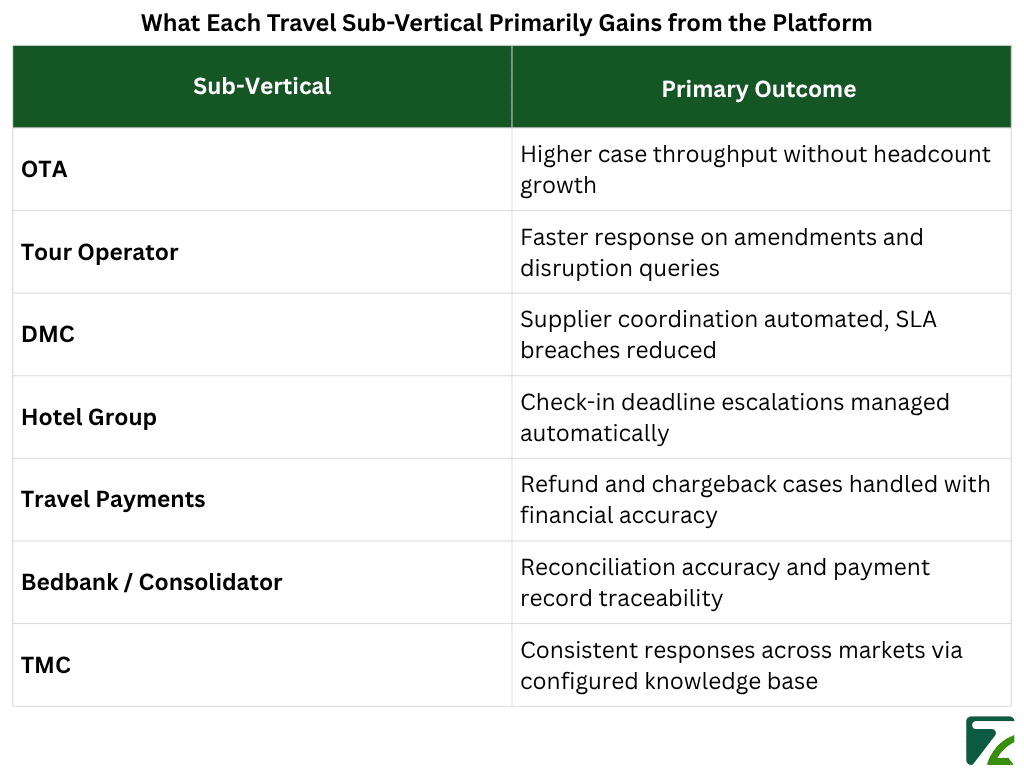
OTAs and tour operators manage the highest case volumes in travel. According to Phocuswright’s Travel Forward 2026, OTAs are projected to generate $408 billion in bookings in 2025 accounting for approximately one in every four travel dollars spent globally. At that scale, operational throughput is the primary outcome: the team processes significantly more volume without adding headcount, with consistent response quality across all case types.
DMCs and supplier-facing operations benefit most from supplier coordination automation. Automated follow-ups, open cases tracked against slow partners, and escalations triggered before SLA breach are the outcomes that directly reduce operational leakage for these businesses.
Travel payments businesses, consolidators, and bed banks depend on reconciliation accuracy above all else. Every chargeback requires correctly packaged evidence. Every refund chain must trace back to the original payment record. The AI outcome here is financial precision, not just speed.
An AI-ready travel help desk starts with travel. An AI-labelled one starts with marketing.
How Does Zeal Desk Deliver These Capabilities Natively?
Zeal Desk is an AI-powered ticketing and operations platform built specifically for travel companies. The travel context is the design foundation not a configuration layer applied after onboarding.
On every case, the AI automatically summarizes the thread, classifies the intent, and extracts structured booking data: booking references, supplier names, check-in and check-out dates. Custom workflows automate supplier follow-ups, escalation triggers, and SLA tracking per counterparty. The AI context window allows each travel company to build its own knowledge base SOPs, supplier procedures, escalation policies, product rules which the AI draws on when generating output. Responses reflect the company’s operating model, and that consistency holds across the team regardless of experience level or tenure.
Operations leaders get real-time dashboards, workforce productivity tracking, workload balancing, and shift management alongside the AI capabilities. Zeal Desk is designed for any travel company OTAs, DMCs, TMCs, tour operators, bed banks, consolidators, travel technology platforms, travel payments businesses, and travel insurance operations.
How Do Travel Operations Teams Benefit from AI in a Help Desk Platform?
For operations and customer experience leaders, the value of AI in a travel help desk is not abstract. It shows up in how the team performs day to day in the volume they handle, the consistency of their output, and the time they reclaim from work; the AI now does for them.
The team handles more volume without growing headcount. AI-generated response drafts, automatic classification, and structured data extraction remove repetitive manual steps from every case. The same team processes significantly more cases in the same time, without a proportional increase in staffing costs.
Responses are consistent, not dependent on individual experience. When the AI draws on the company’s configured knowledge base to generate output, every team member regardless of how long they have been with the company responds in line with the same SOPs and procedures. Institutional knowledge stops living in people’s heads and starts living in the platform.
New team members contribute faster. Onboarding time shortens when the AI surfaces the right context and suggests accurate responses from day one. The learning curve that typically comes with understanding supplier procedures, escalation policies, and booking workflows is compressed significantly.
Supplier accountability improves without manual chasing. Automated follow-ups, separate SLA clocks per supplier counterparty, and escalation triggers mean the operations team tracks supplier response compliance without manual effort. Delays surface before they become breaches.
Operations managers get visibility, not noise. Ticket summaries, productivity dashboards, and workload distribution data give team leads a clear picture of where cases stand and where the team is stretched without reading through every message thread manually. According to Nextiva’s State of Customer Experience (2025), CX teams use an average of 6.3 tools for customer interactions alone and 13 percent use more than ten. A unified AI help desk consolidates that visibility into one place.
What Should You Look for in a Demo of AI Travel Help Desk Software?
Conclusion
AI travel help desk software is an operational infrastructure decision. The desk platform centralizes ticket management, supplier coordination, SLA tracking, and team workflows. The AI layer response generation from conversation context, detail extraction, ticket summarization, and a company-configured knowledge base is what makes that infrastructure compound in value over time.
For operations leaders managing high-volume, supplier-dependent travel businesses, the five platform capabilities booking data extraction, ticket classification, supplier routing, refund-reconciliation linkage, and deadline-based priority stay consistent. What shifts is the weighting that matters most to the specific business: throughput for OTAs, supplier automation for DMCs, reconciliation accuracy for payments businesses.
Get the knowledge base right before launch. Configure urgency rules to reflect the business. Deploy in phases against milestones. Keep human review in front of every money-sensitive or compliance-sensitive output.
The travel operations team that deploys this correctly does not just become faster it becomes consistent, accountable, and genuinely built to scale.