



TL;DR
A travel help desk handles ten ticket types every day booking changes, refund disputes, payment issues, baggage problems, itinerary questions, document and visa queries, loyalty issues, multi-leg failures, post-trip claims, and supplier escalations. The top four absorb around 55% of daily agent time. Every travel ticket carries a departure date and often a supplier dependency, so routing must factor hours-to-departure and supplier accountability not just severity. This guide ranks the 10 query types by volume, maps each to a four-tier urgency model, and routes them into self-serve, agent, or supplier lanes.
Open the queue of any travel help desk on a regular Tuesday. At lunchtime, a flight cancellation surge hit. A month-old refund dispute has landed. A hotel is chasing a missing payout. A guest is stuck at check-in with the wrong visa documents. Every one of those tickets carries a date, a payment window, and a downstream supplier, and that single fact is what makes a travel help desk impossible to run on a generic ticketing tool.
Most help desk content was written for software support teams. It talks about channels and features but never quantifies what actually fills a travel desk queue. This guide names the 10 ticket types a travel help desk handles every day, ranks them by volume, and routes each one to its right lane.
The 10 Most Common Travel Help Desk Query Types
A travel help desk processes roughly 10 recurring query types. Each carries a different ticket structure, a different resolution path, and a different cost profile. The list below ranks them by typical daily volume share across mid-to-high volume travel operators.
Key Terms Worth Knowing
Agent + Supplier Routing: A travel help desk routing lane where the customer-facing ticket needs human handling AND a parallel B2B ticket to a third party (hotel, airline, activity provider) before it can close. Most baggage, disruption, and multi-leg tickets sit here.A travel help desk routing lane where the customer-facing ticket needs human handling AND a parallel B2B ticket to a third party (hotel, airline, activity provider) before it can close. Most baggage, disruption, and multi-leg tickets sit here.
Agentic AI : AI systems that autonomously perform complex tasks across multiple systems and workflows for example, rebooking a flight, processing a refund, and sending a confirmation email without human intervention. Different from generative AI, which only creates content.
Average Handle Time (AHT) : The total time an agent spends on a single ticket, including hold time, talk or chat time, and after-call work like logging notes. A core productivity metric for any travel help desk.
B2B Ticket : An operator-to-vendor ticket that runs parallel to a customer-facing ticket. When a guest cancels a hotel booking through an OTA, the customer ticket sits on the OTA’s desk, while a B2B ticket sits between the OTA and the hotel to release inventory and recover the payout.
Travel Help Desk Query #1 : Booking Modifications and Cancellations
Booking changes lead every travel help desk queue. Date changes, name corrections, room swaps, and full cancellations sit here. They typically account for 20–25% of daily volume.
The pressure is structural. McKinsey’s travel sector analysis found nearly 80% of American travelers ran into a travel problem in the first half of 2023 and modifications dominate that volume. Cloudbeds’ 2026 State of Independent Hotels Report, built on 90 million bookings, found OTA cancellation rates hit 21.8% in 2025 more than double the 10.6% direct-booking rate. The average cancellation window also expanded to 39 days.
Why this needs a travel help desk: A generic tool sorts tickets by age. A travel help desk sorts them by hours-to-departure. A cancellation from a guest flying tomorrow cannot sit behind a three-day-old email from last week.
Travel Help Desk Query #2 : Refund Status and Disputes
Refund tickets follow at 15–18% of daily volume. They split into status checks (“where is my refund”) and disputes (challenging the amount or eligibility).
Refund volume is now structurally elevated. A DOT Inspector General audit published in September 2025 found the U.S. DOT received over 139,000 refund complaints between 2020 and 2022 well above pre-pandemic levels.
Why this needs a travel help desk: Refund eligibility depends on the supplier contract, the payment processor’s settlement window (the number of days a payment processor takes to release funds back to the merchant), and the booking’s cancellation policy. A generic desk has none of that context. A travel help desk pulls all three into view before the agent opens the ticket.
Travel Help Desk Query #3 : Payment and Billing Questions
Payment tickets cover failed charges, currency mismatches, split-payment confusion, and chargebacks. They make up 8–10% of daily volume.
This is the easiest category to automate. Most payment tickets have a clear data answer the card declined; the conversion rate was this; the partial payment landed on this date.
Why this needs a travel help desk: A failed travel charge usually involves multiple parties the OTA, the bank, the supplier, sometimes a currency conversion layer. A generic desk shows the ticket. A travel help desk shows the booking, the payment timeline, and which party broke the chain.
Travel Help Desk Query #4 : Baggage and Disruption Issues
Baggage and disruption tickets spike on irregular operations days. They normally sit at 6–9% of daily volume but can multiply ten-fold during a single bad weather event.
Per SITA’s Baggage IT Insights 2025 report, the global mishandling rate hit 6.3 bags per 1,000 passengers in 2024. The total still topped 33 million mishandled bags and cost the industry around $5 billion. Transfer mishandling alone caused 41% of cases.
Why this needs a travel help desk: During a disruption surge, a generic queue treats every ticket as equal. A travel help desk surfaces tier-1 disruption tickets first and groups them by flight number, so one agent can handle 30 affected passengers from a single canceled flight in one workflow.
Travel Help Desk Query #5 : Itinerary Clarifications
Itinerary tickets ask simple things. Where do I meet the guide? What time does check-in open? Is breakfast included? These tickets fill 8–10% of daily volume.
Almost all of them should land in self-serve, because the answer already sits inside the booking.
Why this needs a travel help desk: A generic desk asks the agent to look up the answer manually. A travel help desk shows the booking detail next to the ticket or lets the customer self-serve before the ticket ever opens.
Travel Help Desk Query #6 : Document and Visa Questions
Document tickets cover passport validity, electronic travel authorizations, transit-visa rules, and vaccination requirements. They run 5–7% of daily volume.
According to IATA’s 2025 Global Passenger Survey, 78% of passengers want a single smartphone experience that combines digital wallet, passport, and loyalty cards a clear signal of self-serve appetite.
Why this needs a travel help desk: Visa rules change by nationality, destination, and transit point. A generic desk has no idea what the customer’s passport country is. A travel help desk pulls the passenger profile and destination rules together, so the answer is specific, not a generic disclaimer.
Travel Help Desk Query #7 : Loyalty and Rewards
Loyalty tickets cover point posting, status matches, and redemption disputes. They sit at 4–6% of daily volume and tend to compound one delayed posting often triggers three follow-ups.
Why this needs a travel help desk: Loyalty disputes need the agent to see the customer’s tier, points, lifetime spend, and program rules in one place. A generic desk shows the ticket. A travel help desk shows the loyalty record alongside it, so the agent resolves the request without bouncing between five tabs.
Travel Help Desk Query #8 : Multi-Leg and Multi-Supplier Issues
Multi-leg tickets involve itineraries with two or more airlines, a hotel, and ground transfers (the airport pickups, intercity transfers, and last-mile rides booked alongside the main trip). When one piece fails, the rest cascades. These tickets make up 3–5% of daily volume but take far longer to resolve.
Why this needs a travel help desk: Each leg is a separate contract with a separate supplier. A generic desk treats this as one ticket. A travel help desk treats it as one customer ticket with linked sub-tickets to each supplier, so the agent tracks which leg is resolved, and which is still pending without losing the whole picture.
Travel Help Desk Query #9 : Post-Trip Disputes
Post-trip tickets land days or weeks after travel ends. They cover damaged-room claims, missed-tour refunds, insurance documentation, and chargeback responses. They fill 5–8% of daily volume.
Insurance is a major driver. Squaremouth’s 2024 claims data reported an 18% jump in paid claims year-over-year, with over 40% of paid claims tied to canceled or cut-short trips.
Why this needs a travel help desk: Post-trip claims need documentation review and policy interpretation often weeks after travel ends. A generic desk has no booking context. A travel help desk keeps the booking, supplier communications, and original itinerary linked to the ticket, so the agent does not have to reconstruct the case from scratch.
Travel Help Desk Query #10 : Supplier-Side Escalations
Supplier escalations are operator-to-vendor tickets chasing missing payouts, unconfirmed allocations, and contract clarifications. They make up 10–15% of daily volume at tour operators and DMCs.
This is where most help desk content goes wrong. Generic tools treat supplier escalations as exceptions. In travel, they are structural every customer refund or change can spawn a parallel B2B ticket.
Why this needs a travel help desk: Generic tools treat the customer ticket and the supplier ticket as separate. A travel help desk links them. When the supplier responds, the customer-facing agent sees it immediately and the pairing is the difference between an honest SLA and a guessed one.
Roughly one in four customer-facing tickets at a travel business spawns a paired supplier-side ticket.
Priority and Routing Frameworks for a Travel Help Desk
Naming the 10 categories is half the job. The other half is deciding which tickets get attention first, and who handles them. Two frameworks govern that decision the departure-window urgency model and the three-lane routing matrix.
What Is the Departure-Window Urgency Model for a Travel Help Desk?
Each ticket behaves differently depending on how close the customer is to their trip. A refund question 14 days out is routine. The same question with a flight in three hours is a brand-defining moment.
A simple four-tier model handles the priority logic.
- Tier 1: 0–24 hours to departure. Top of queue, regardless of category.
- Tier 2: 24–72 hours. Same-day handling is required.
- Tier 3: 72 hours to two weeks. Standard SLA applies.
- Tier 4: Beyond two weeks. Self-serve or batched agent review.
Every booking carries a departure timestamp, so the tier applies automatically. The result: a tier-1 cancellation surge never sits behind a tier-4 loyalty query.
Travel Help Desk Routing: Self-Serve, Agent, or Supplier?
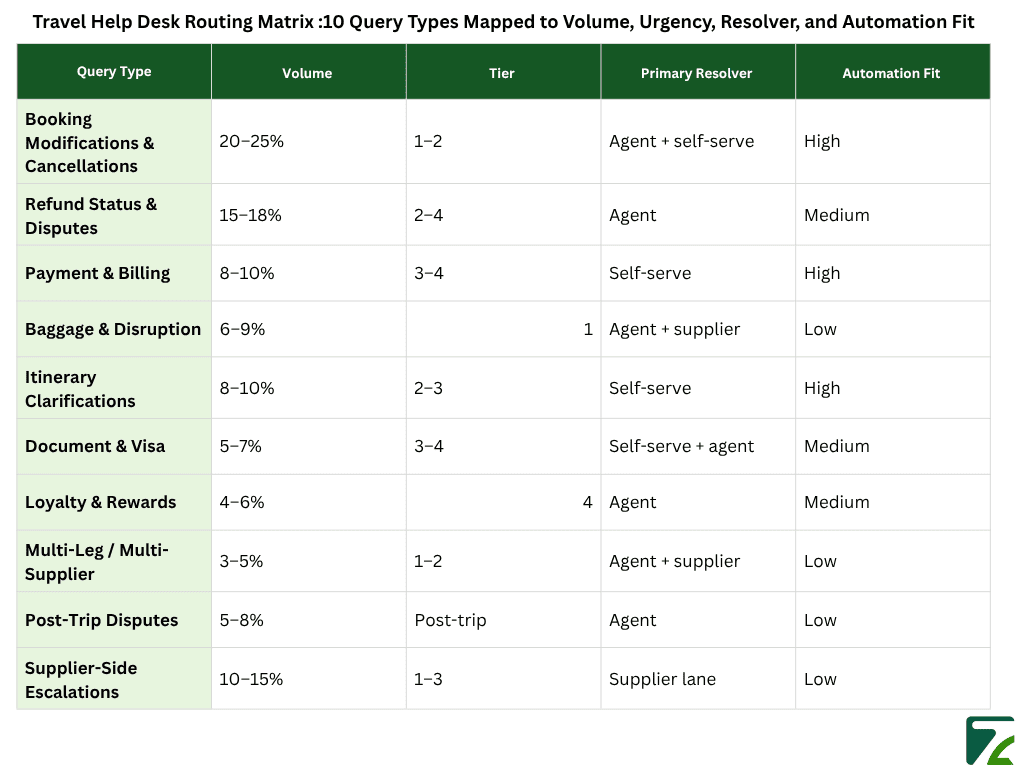
Once a desk knows what arrives, the next call is routing. Every ticket lands in one of three lanes: self-serve, agent, or supplier escalation. Picking the wrong lane is the single biggest reason help desk implementations fail in travel.
Indicative benchmarks for a mid-to-high volume travel help desk. Volume shares shift by sub-vertical.
Automation in a Travel Help Desk
The routing matrix names which categories belong in each lane. The next decision is how much of each lane an AI ticketing system can handle, and where the line between automated and human work actually sits for a travel-specific workflow.
Which Travel Help Desk Tickets Can Be Automated?
Automation pays where volume is high, and structure is repetitive. Phocuswright’s research found that 61% of travel businesses are now experimenting with or scaling agentic AI. McKinsey’s Remapping Travel with Agentic AI names airline rebooking, refund processing, and voucher issuance as the routine tasks most ready for autonomous handling.
The categories best suited to automation are payment questions, itinerary clarifications, and high-volume booking modifications. Categories that need humans are post-trip disputes, multi-supplier failures, and any escalation that requires real negotiation.
How Zeal Desk Automates Travel Help Desk Ticket Workflows
That decision framework what to automate, what to keep human, how to route by departure window is the design brief Zeal Desk was built against. It is an AI ticketing system built specifically for travel operations, not retrofitted from a generic support tool.
Four AI agents handle the lifecycle of every ticket.
The Classifier auto-tags each inbound ticket against travel-native categories.
The Prioritizer ranks by check-in proximity, severity, and customer value.
The Resolver pulls booking data, drafts the response, and closes routine tickets end-to-end.
The Auditor reviews every resolution to catch errors before they reach the guest.
Zeal Desk also tags structured data on every ticket check-in dates, booking references, voucher codes, supplier IDs, reporting works against travel timelines, not generic ticket age. Custom workflows handle the repetitive long tail.
For a full walkthrough, visit the Zeal Desk product page.
Conclusion:
A travel help desk’s day is not channels: email, chat, voice. It is a 10-category ticket mix shaped by departure timing and supplier escalation. Once the taxonomy is named, the routing decision becomes structural, not a per-ticket judgment call.
The action sequence is simple. Audit the existing queue against the 10 categories. Tag every inbound ticket consistently at intake. Decide self-serve, agent, or supplier escalation for each category. Set SLAs by departure window tier instead of a flat severity matrix. Treat supplier escalations as their own lane.
Here is the part most travel desks miss: the single ticket category most teams under-resource is the one that does not even reach their main queue the supplier-side escalation that customer-facing agents end up handling on the side, between their “real” tickets. It looks like one in four tickets on paper. It absorbs closer to one in three hours of agent time in practice, because nobody planned for it. Name it as its own lane, and the entire queue starts behaving differently.