



TL;DR
A travel help desk pays back through cost-per-ticket reduction, automated deflection, and recovered reconciliation hours. But the return only appears when you model savings by ticket type, not when you trust a generic, one-size-fits-all calculator. Travel tickets are not interchangeable: a refund racing a departure deadline cost nothing like a routine pre-trip question. The biggest returns hide in four cost lines horizontal tools average away supplier escalations, departure-deadline severity, refund and chargeback exposure, and reconciliation labor. So, price your own cancellations, reissues, disputes, and reconciliations first. Then fix your ticket data so that AI can act on it. Finally, choose help desk software for travel that captures booking context natively. That is the number your CFO will believe.
A refund request lands at 11pm. The flight leaves in nine hours, but the ticket never captured the departure date or the supplier reference. So, one agent hunts the PNR, a second emails the airline, and a third reconciles the payment by hand the next morning. Three people, one ticket and the generic ROI spreadsheet still counts it as a single contact.
That gap is the whole problem. Generic help desk math treats every ticket as interchangeable, yet travel tickets never are. Cancellations, reissues, and supplier disputes each carry a different cost, and the savings only become visible once you model them by type.
This guide is written for operations and support leaders who need a defensible savings number. It speaks to OTAs, tour operators, and DMCs first. But it applies equally to any travel company running a high-volume, supplier-dependent desk. That includes travel tech platforms, travel insurance providers, payment companies, bed banks, and consolidators. You will learn the travel-specific cost drivers generic ROI models miss. You will also get a cost-per-ticket-by-type breakdown, a vertical-versus-generic comparison, the data readiness AI savings require, and a seasonality-aware payback timeline.
What Is Travel Help Desk ROI?
Travel help desk ROI is the net financial return from running operational support on a ticketing platform built for travel. It is measured as cost-per-ticket savings, deflection, and reconciliation gains against platform cost over a payback period. Unlike a generic calculation, it also counts the supplier-escalation labor and departure-deadline severity that horizontal models leave out entirely.
The base formula is simple, and most generic guides stop there. It is cost per ticket times volume, reduced by deflection and automation, then measured against platform cost over a payback period. According to HappyFox, a typical help desk ROI ranges from 150% to 400% within the first year. A Forrester study commissioned by Sprinklr found modeled customers reached 210% ROI over three years, with payback in under six months. That range is a useful anchor, but it is not a travel number, because it assumes every ticket costs the same to resolve.
Travel operations need two extra layers on top of that base. The first is the cost lines unique to travel. The second is the deflection gap that turns volume into savings. Define both first, and the per-type breakdown later in this guide becomes easy to read.
Key Terms Worth Knowing
Cost per ticket : The total cost to resolve a ticket, including agent time, escalation, and reconciliation, divided by total ticket volume over a period.
Deflection rate : The share of incoming tickets resolved without a human agent, usually through self-service, knowledge bases, or automated responses.
Payback period : The time required for cumulative savings from a platform to cover its total cost, after which the investment turns net positive.
Configuration tax : The ongoing effort and cost of bending a generic tool to fit travel workflows, including custom fields, workarounds, and manual maintenance.
Why Is Travel Help Desk ROI on Every Operations Agenda Now?
Three pressures have pushed desk savings to the top of the operations agenda. Ticket volume is rising. Cost scrutiny is tightening. And AI is expected to absorb routine work. None of these are travel-specific on their own. Together, though, they force a question generic tools answer badly how much does each ticket actually cost, and what would a better platform save?
Rising ticket volume is outpacing manual travel help desks
Rising volume makes per-ticket cost the metric that decides whether a desk scales. Salesforce’s 2025 State of Service report, based on 6,500 service professionals, finds AI is expected to handle half of all service cases by 2027, up from 30% today a sign of how fast volume is outpacing manual capacity. Demand is intensifying alongside it: peak-season research shows 76% of customers expect immediate responses during busy periods. For a travel operator, that growth rarely arrives evenly it clusters around disruptions, peak seasons, and supplier failures. A manual desk answers rising volume with more agents. A measured desk answers it with a clear cost baseline, which is the first thing any ROI case needs.
Volume without a per-ticket cost baseline is just a headcount waiting to happen.
Travel tech budgets are growing, so help desk ROI needs proof
Bigger budgets raise the bar for proof, not just the spend. Airlines invested an estimated $36 billion in IT in 2025, with 72% raising their technology spend that year, according to SITA’s Air Transport IT Insights 2025. Across the wider sector, industry technology spend hit a record $50.8 billion. Travel companies are clearly willing to invest. But when spend grows, finance asks harder questions about return, and “it feels faster” stops being an acceptable answer. A defensible ROI number matters more now than it did when budgets were flat. Every new tool competes against alternatives for the same money.
AI expectations make every travel help desk savings claim sharper
AI now sets a high-ceiling for-desk savings. Zendesk’s CX Trends research reports that 75% of CX leaders expect 80% of customer interactions to be resolved without human intervention within the next few years. By 2026, Zendesk frames contextual AI as the deciding factor in retention. That expectation cuts both ways. It promises large savings, but it also sharpens scrutiny leaders now expect automation to show up in the numbers. A travel help desk that cannot connect automation to a cost line will struggle to justify itself, no matter how modern it looks.
What Cost Lines Do Generic Help Desk Models Miss?
Four travel cost lines rarely appear in horizontal models, and they decide the real return.
First, supplier-escalation labor, where agents chase airlines, hotels, or DMCs for a resolution. Second, departure-deadline severity, because a ticket worth real money today is worthless after the flight leaves. Third, refund and chargeback exposure are tied to payment timing. Fourth, reconciliation hours, where finance matches tickets to payments by hand.
Each line adds real cost that a generic formula buries inside a blended average. Until you add them back, the ROI number stays theoretical and understates what a travel-built desk would save.
A travel ROI model that ignores supplier escalations and reconciliation understates your real savings.
Why the deflection gap drives the number
The deflection gap is where most first-year return comes from. Gartner benchmarks put an assisted channel contact at about $13.50. A self-service contact costs about $1.84 roughly a seven-times difference. That gap, multiplied across thousands of routine tickets, is the engine of the savings. Newer AI-resolution benchmarks land even lower, with some fully AI-owned tickets resolving for $0.50 to $2.37 each. For travel, the key move is deflecting routine pre-trip questions, so agents keep capacity for the high-cost cases that genuinely need them.
How Travel Help Desk Savings Vary by Ticket Type
Once the cost lines are clear, savings stop being abstract. They concentrate in specific ticket types, and they vary by sub-vertical. An OTA bleeds money on cancellations; a DMC bleeds it on supplier disputes; a payment company or insurer bleeds it on reconciliation and claims. Mapping cost to type is what separates a travel ROI model from a horizontal one.
Which travel ticket types carry the most cost?
The expensive ticket types are predictable, which makes them easy to model. The breakdown below maps common travel ticket types four ways. It shows why they cost what they do, how a generic desk handles them, and where a travel-built desk recovers savings.
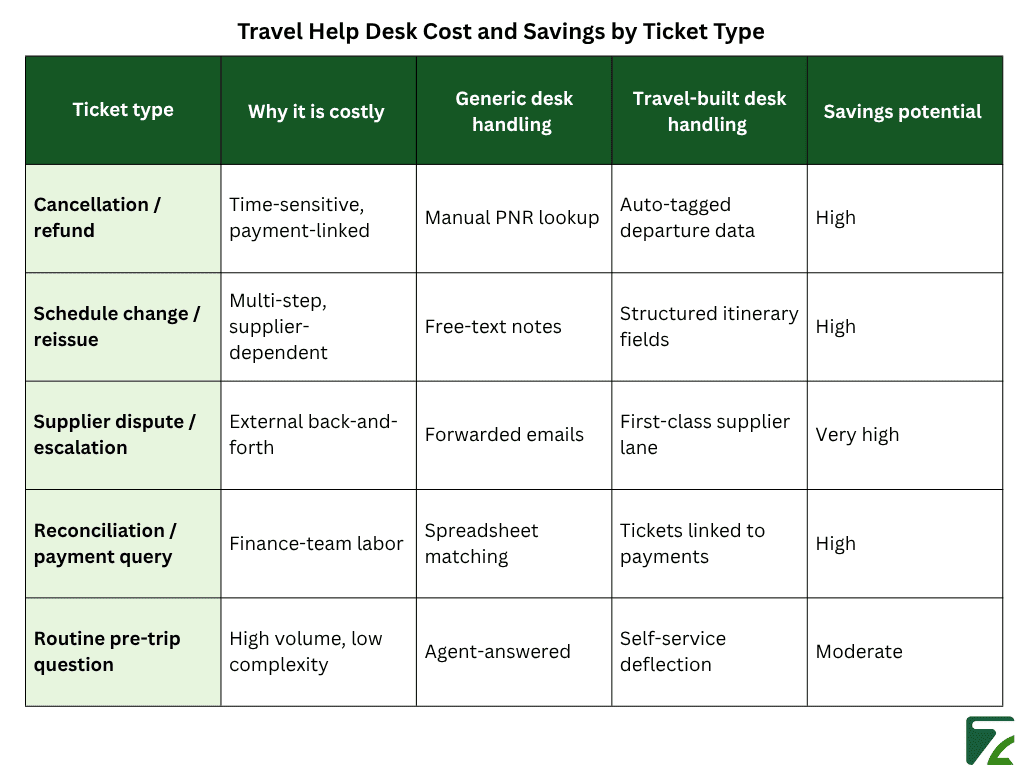
How deflection and classification cut travel help desk cost
Structured data pays off first in routing and classification. Pylon reports that companies using AI typically deflect 40–60% of queries, with best-in-class implementations reaching 85%. The travel signal is even sharper: Freshworks reports its AI agent deflected 52% of travel queries, easing peak-season pressure and resolving common issues in seconds. Those deflected tickets are mostly routine, which frees agents for the costly cases.
Classification matters just as much, because a misrouted cancellation can miss its departure window entirely. When the desk tags ticket type, supplier, and travel dates automatically, the right case reaches the right agent before the deadline. The expensive scramble in our opening example never happens.
Why reconciliation is the savings line no one counts
Reconciliation is the hidden cost line, and it hits payment-heavy operators hardest. Consider a travel payment company or insurer processing refund and claim disputes. When tickets sit apart from payment records, the finance team rebuilds the link by hand, matching transactions to cases across two systems. That labor never shows up in a deflection-only ROI model.
Connect tickets to payments, though, and the matching becomes near automatic. For OTAs, payment providers, and insurers, those recovered finance hours can rival the savings from agent deflection. Yet most horizontal calculators ignore them completely.
The savings hiding in reconciliation can match what you save on deflection and no generic calculator counts them.
How Zeal Desk Works as a Travel Help Desk Built for Operations
Most of the savings above depend on one thing: a desk that understands travel before a human touch the ticket. That is the gap Zeal Desk is built to close.
Zeal Desk is an AI-powered ticketing system built specifically for travel operations. It automates ticket summarization and applies smart classification to route work to the right team. It also tags operational data like check-in and check-out dates automatically. So, a refund racing a departure deadline is recognized as urgent the moment it arrives, not after an agent reads it. On top of that, custom workflows handle the repetitive operational tasks that consume most of a travel team’s day.
Rather than asking travel teams to bolt travel logic onto a generic helpdesk, Zeal Desk organizes work around bookings rather than isolated tickets. It treats supplier coordination, HCN handling, booking amendments, reconfirmation, and SLA-driven escalation as recognized workflows rather than free-text tickets. That domain fluency is what turns the ROI math in this guide from a projection into a result. The deflection, classification, and reconciliation savings only materialize when the platform already speaks the language of travel.
How to Build and Defend Your Travel Help Desk ROI Case
A savings map is only useful if you can defend it to finance. Three decisions turn the map into a business case. First, get your data ready for automation. Second, choose between a vertical and a generic platform. Third, time the payback around your season. Work through them in order each one protects the ROI number from the objections a careful CFO will raise.
Fix data readiness before counting travel help desk AI savings
Is a vertical travel help desk worth more than a generic one?
The platform choice changes the math through hidden, recurring costs. A generic desk can be configured for travel, but configuration carries an ongoing cost. Teams build custom fields, maintain brittle workflows, and still forward supplier emails by hand. That configuration tax and the workaround labor around it erode the return quietly, month after month.
A travel help desk SaaS platform treats departures, PNRs, and suppliers as native fields, so the workarounds disappear. That native fit matters because the manual workarounds are expensive: Worldline reports that a full-service airline can spend up to 90 minutes per flight on manual payment reconciliation alone. For travel, native fit is exactly where the ROI gap opens.
Time the payback around your season
Rollout timing decides when the return actually appears. A help desk platform pays back as it absorbs ticket volume, so the more volume it handles per month, the faster the cumulative savings cover its cost. Travel volume is seasonal, though, so timing shifts that curve. The deflection and reconciliation savings modeled earlier in this guide only start compounding once the platform is live and handling real tickets which is why when you deploy matters as much as what you deploy.
Deploy before peak season, and the platform absorbs the surge, accelerating payback. Deploy mid-peak and you fight the volume you hoped to manage. Aim to go live in the quiet weeks before your busiest stretch, so the desk is tuned, and your team is trained before volume spikes.
Conclusion
The savings were never hiding in a generic formula. They live in the travel cost lines that horizontal models average away. Supplier escalations that drag on. Refund tickets that expire. Reconciliation hours that never get counted. Rising volume and tighter budgets make those costs urgent, while AI expectations make them measurable.
The travel companies that win the ROI argument do three things. They model their own tickets by type first. They fix the data so automation can act on it. Then they choose a platform that captures travel context natively, instead of taxing the team to recreate it. Before you trust any vendor’s headline return, price your own cancellations, reissues, disputes, and reconciliations. That number grounded in your real ticket mix and timed around your season is the one your CFO will believe.
The right travel help desk does not just answer tickets faster. It turns a cost center into a measurable, defensible saving.