


TL;DR
- A service desk for travel is the live operational layer that receives, classifies, routes, and resolves time-sensitive queries from travelers, agents, and suppliers. It is built around bookings and travel deadlines, not generic tickets.
- It works for any travel company that coordinates suppliers under deadline pressure, OTAs, tour operators, DMCs, TMCs, bed banks, consolidators, travel tech platforms, travel payment providers, and travel insurance teams alike. If a deadline is running and the answer sits with an outside party, it is built for you.
- Supplier queries are the hardest load, because the resolver a hotel, airline, payment processor, underwriter, or GDS sits outside your walls. The clock is a real deadline, not an SLA timer.
- Generic tools such as Zendesk, Freshdesk, and Zoho Desk treat every escalation as a flat ticket. Travel work instead needs a dedicated supplier lane, classification by supplier, type, and reference, and deadline-aware severity.
- Strong service desk software for travel tracks the supplier response time you cannot enforce. It ranks work by hours-to-deadline, and it automates triage only when each ticket carries structured travel context.
A hotel has not confirmed a rebooking. Check-in is six hours away. The query sits in a shared inbox behind fifty routine tickets, and no agent has flagged it. By the time someone notices, the room is gone, and the guest stands in a lobby with no reservation. That is what a generic queue does to a supplier query. It is exactly the failure a service desk for travel exists to prevent.
The breakdown is not an agent problem. Instead, it is a tooling problem. The resolver here a hotel, but just as easily an airline, a payment processor, an underwriter, or a GDS sat outside the company and could not be commanded. The deadline was a real check-in time, not an SLA timer. And the system treated a stranded-guest escalation exactly like a password reset.
Most help desks were designed for internal IT requests. There, the person who resolves the ticket sits down the hall and answers to your targets. Travel breaks that model, because the work depends on outside suppliers and runs against hard deadlines. As a result, it lives or dies on whether the right query reaches the right agent in time.
This guide speaks to support and operations leads at any travel company that coordinates suppliers under deadline pressure. That spans OTAs, tour operators, DMCs, and TMCs, and it reaches just as far into bed banks, consolidators, travel technology platforms, travel payment providers, and travel insurance teams. The business model changes; the operational problem does not. Wherever bookings, suppliers, and deadlines meet, a travel-native service desk does work a generic one cannot.
What Is a Service Desk for Travel?
A service desk for travel is the live operational layer that receives, classifies, prioritizes, and resolves queries from travelers, agents, and suppliers in real time. It organizes work around bookings and travel deadlines rather than generic tickets. In practice, it is the front line of travel operations: schedule changes, rebookings, reconfirmations, amendments, and supplier escalations all land here. Each one must clear before its deadline passes. It is not the finance system, and it is not a generic IT help desk.
Key Terms Worth Knowing
Service desk for travel: The live operational layer that receives, classifies, prioritizes, and resolves queries from travelers, agents, and suppliers in real time, organized around bookings and travel deadlines.
Back office: The financial layer that handles supplier reconciliation, invoicing, allotments, and settlement, separate from the live query desk.
Supplier lane: A dedicated ticket class for external supplier queries, kept separate from the general queue, so escalations stay visible.
Deadline-aware severity: A prioritization method that ranks tickets by hours remaining until a travel deadline rather than by ticket age.
Which travel companies need a service desk for travel?
The short answer is broader than booking. A travel company needs one whenever it must resolve time-sensitive operational queries it cannot close on its own because the answer depends on an outside party, and a real deadline is already running. That bar is wider than it sounds: it sweeps in companies that never book a trip, and even the suppliers fielding everyone else’s requests. The same operational shape repeats across all of it. OTAs, tour operators, DMCs, and TMCs coordinate large volumes of hotel and airline inventory across markets under constant SLA pressure. Bed banks and consolidators run supplier coordination at scale. Travel technology and supplier-connectivity platforms field escalations on behalf of their clients. Travel payment and travel insurance teams resolve booking-linked disputes against the clock. None of these are exceptions; each is a version of the same problem. The common thread is simple: if your work depends on an outside party and a date you cannot move, a generic queue will eventually let an urgent query slip.
The query itself looks different in each corner of travel, yet it behaves the same way. For an OTA, tour operator, or DMC, for example, it is a hotel that has not reconfirmed a booking hours before check-in. Likewise, a bed bank or consolidator faces an allotment, rate, or mapping dispute with a property, and a connectivity platform sees a GDS or supplier API that has gone quiet mid-transaction. Payments teams, similarly, chase a refund or chargeback stuck with an acquirer, while insurance teams wait on an underwriter to confirm cover or a claim. Even the suppliers feel it from the other side: a hotel fields reconfirmation and amendment requests from dozens of distributors at once, just as an airline handles schedule changes and ticketing queries. In every case the answer depends on an outside party, a deadline is running down, and no agent can close the query alone.
How does a travel service desk differ from the back office?
A supplier query lives on the service desk until it is resolved, even when the money settles later in the back office.
Why Do Generic Tools Fail as a Service Desk for Travel?
Supplier queries have become the heaviest load on a travel desk for three reasons. Volume is climbing. The answer usually sits with an outside party. And the tools most travel companies run were never built for this work. A generic queue treats a supplier escalation like any other ticket. A supplier query, however, behaves differently. It depends on a third party; it carries a hard deadline, and the agent who owns it often cannot close it alone. Understanding that difference is the first step toward handling these queries on time.
Why rising query volume overwhelms a travel service desk
Rising query volume drags supplier escalations up with it, and the pressure is reshaping how service teams operate. In Salesforce’s Seventh Edition State of Service, AI leapt from the tenth priority for service leaders to the second in a single year. The same research expects AI to resolve half of all service cases by 2027, up from 30% in 2025. In travel, that load rarely arrives evenly. Instead, its clusters around disruptions: a cancelled flight, a closed hotel, or a weather event that triggers hundreds of rebookings at once. Each moment produces supplier queries, not just customer complaints. So as overall volume rises, the share that depends on a supplier rises too, and a flat queue buries the urgent ones.
Why the resolver sits outside your service desk
The party who must resolve a supplier query sits outside the company. The airline or hotel answers on its own schedule, and no SLA binds them to you. An internal IT ticket routes to a colleague bound by your targets. A supplier ticket, by contrast, routes to an inbox you do not control. That single difference breaks the standard help-desk model, because the agent owns the ticket but not the resolution. And when you are the supplier rather than the buyer, the same model still breaks from the other side: queries pour in from outside, in volume, each tied to a booking and a deadline a generic queue cannot see.
A supplier ticket routes to an inbox you do not control that is what breaks the standard help-desk model.
Why travel companies fund booking tech, not the service desk
Travel companies spend heavily on technology, yet rarely on the supplier-query desk itself. Airline IT spend reached an estimated $37 billion in 2024, and 74% of airlines forecast an increase over the next two years (SITA Air Transport IT Insights, 2024). Much of that money funds booking engines and inventory systems. Meanwhile, the live desk that fields supplier escalations often still runs on a shared mailbox. As a result, the investment grows while the queries that decide guest outcomes stay unmanaged.
How Does a Service Desk for Travel Handle Supplier Queries?
The practical question is how to run the desk, so deadlines hold. In short, it comes down to three moves. First, give supplier queries a dedicated lane. Second, classify and route them by travel context. Third, rank them by how close the deadline is. Each move counters a specific failure of the generic queue. Together, they turn a buried inbox into a managed flow, so the hotel rebooking from the opening never slips past check-in unnoticed.
The supplier-query lifecycle on a travel service desk
Every supplier query moves through the same six stages: receive, classify, route, chase, resolve, and log. Classification and chasing are where travel desks struggle most, because the supplier controls the pace. Fortunately, automation increasingly supports these stages. According to Atlassian’s State of AI in Service Management Report 2025, 98% of organizations now use AI in service management in some capacity, and 93% report increased efficiency from it. Travel simply adds a deadline and an external resolver to every stage.
Give supplier queries a first-class lane on the service desk
A supplier query should be its own ticket class, not a tag buried in a general queue. Consider an agent fielding a schedule-change escalation from an airline. On a generic desk, that ticket competes with password resets and billing questions. On a dedicated supplier lane, however, it sits with other supplier work, visible to the agents trained to chase that supplier. As a result, the lane gives the query a home, a clear owner, and a view that operations and support can both watch without losing it.
How a travel service desk classifies and routes supplier queries
Routing decides whether a query reaches the right agent before the window closes, and it starts with context. Because the desk connects to your booking, reservation, and supplier systems through travel APIs, it pulls the full booking or case into the ticket automatically the moment a query lands dates, supplier, status, and history so the agent has everything in one place instead of switching screens to look it up. With that data in hand, the desk auto-classifies each query by supplier, type, and reference, then routes it to the agent who handles that supplier or region. Done well; automation also resolves much of the routine. Intercom’s Fin reports an average autonomous resolution rate of 67% across more than 7,000 customers, while the broader market lands at 40% to 60% on initial deployment and climbs past 60% with optimization. That deflection frees agents to chase the supplier for escalations that genuinely need a human.
Why a travel service desk ranks by hours-to-deadline
A flat SLA timer misranks travel work, because urgency depends on the trip, not the ticket age. A query forty-eight hours from a deadline can wait. The same query six hours out cannot. Therefore, deadline-aware severity ranks each ticket by hours-to-deadline, so the desk always works the most time-critical query first. The table below shows how query types map to deadline pressure, and how a generic queue and a service desk for travel handle each one. The examples are hotel- and flight-led, but the same logic applies to a stuck refund, an unconfirmed claim, or a downed supplier API: the closer the deadline, the higher the severity.
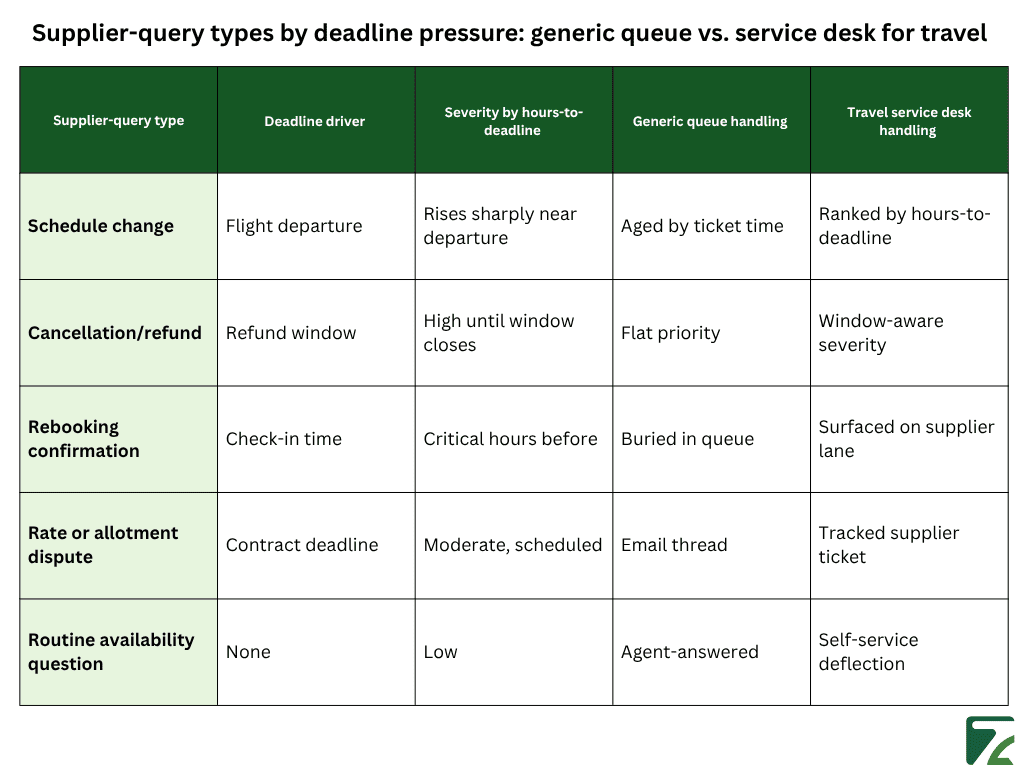
Rank supplier queries by hours-to-deadline, because a ticket worth saving today is worthless once the deadline passes.
How Do You Run a Service Desk for Travel That Hits Deadlines?
A routing model only works if the daily operation supports it. In practice, three habits keep deadlines intact. Track supplier response time even though you cannot enforce it. Measure the metrics that actually predict missed windows. And apply automation only where it preserves travel context. These habits separate a desk that hits deadlines from one that explains why it missed them.
Track the supplier response time your service desk cannot enforce
You cannot force a supplier to reply, but you can measure and chase. So, start a timer when the query goes to the supplier. Set automated nudges at intervals. Then escalate to a named contact when the response stalls. In effect, tracking turns an invisible wait into a managed one. The Travel Booster guide to working with DMCs underscores how much operator outcomes hinge on supplier responsiveness. That is exactly why the desk should record every response time, even unenforceable ones.
Which service desk metrics actually matter in travel?
Generic desk metrics miss what matters in travel. For instance, average resolution time hides the queries that blew a deadline. Instead, track three things: time-to-supplier-response, deadline-hit rate, and reopen rate. Time-to-supplier-response shows which suppliers drag. Deadline-hit rate reveals whether the desk beats the clock. Reopen rate confirms whether resolutions actually held. Cost reinforces the point: Gartner puts the median cost per contact at $1.84 for self-service against $13.50 for an assisted channel. Every avoidable touch adds up.
Average resolution time hides the queries that blew a deadline.
How should a travel service desk automate triage?
Automation triage works only when the ticket carries a structured travel context. A model can rank by hours-to-deadline or route by supplier, but only if the desk tags those fields first. According to Phocuswright (2026), 61% of travel businesses surveyed are experimenting with or scaling agentic AI, with 6% already actively scaling and 22% beginning to. Yet agentic triage on a free-text inbox cannot tell a six-hour rebooking from a routine question. So, structure the data first, then automate.
What Should You Look for in Service Desk Software for Travel?
When you evaluate service desk software for travel, the test is simple. Does the tool understand travel, or does it ask your team to translate travel into generic tickets? The best service desk solutions for travel share one trait. They organize work around bookings and deadlines, not flat cases.
In practice, that means a handful of travel-native capabilities a horizontal help desk lacks:
- Booking- or case-centric tickets that group work by reference, so two teams never work the same case blind.
- Travel API integration that pulls the full booking or case into each ticket automatically dates, supplier, status, and history, so agents work from one screen instead of switching systems.
- Automatic classification and deadline-aware SLA timers that tag each query by supplier and type, then rank it by hours-to-deadline.
- Supplier coordination and escalation workflows for the messy cases travel actually produces from HCN requests, reconfirmations, and room-type discrepancies to refund disputes, claim confirmations, mapping errors, and supplier-API outages.
- Parent-child ticketing and workforce management that keep related work connected and put the right agents on shift when peak escalations hit.
- AI summarization and field tagging that condense long supplier threads and capture the fields deciding urgency, so automation can act without losing context.
Signs a travel service desk application understands your operation
A capable travel service desk application proves itself in the details. It reads an inbound message and extracts the booking or case automatically. A deadline date registers as urgent, not just another field. The system surfaces a query six hours from its deadline above a routine one, without a human sorting the queue. Operations and support then see the same booking-centric view, so nobody duplicates work. In short, a generic tool moves manual work from an inbox into a prettier queue. A travel-native one absorbs that work instead.
Zeal Desk: AI-Powered Service Desk Software for Travel
Zeal Desk is an AI-powered ticketing system built specifically for travel operations. It automates ticket summarization, smart classification, and data tagging like check-in and check-out dates while letting teams build custom workflows that handle repetitive operational tasks efficiently.
That focus is what separates a travel service desk application from a generic one. Where a horizontal help desk sees an undifferentiated ticket, Zeal Desk reads the incoming query, extracts the booking, and tags the fields that decide urgency, such as supplier, query type, PNR, and travel dates. Routine, repeatable work then runs through automation playbooks for example, reconfirmation follow-ups, HCN requests, refunds, and standard amendments, so they resolve without tying up an agent. As a result, your team spends its time on the escalations that genuinely need a human.
The platform is booking-centric rather than ticket-centric. Because of that, related work stays connected through parent-child ticketing, while supplier coordination, SLA prediction, and workforce orchestration arrive as first-class capabilities rather than bolt-ons. For any travel company running high query volumes under deadline pressure whether you resell travel, connect it, pay for it, insure it, or supply it that is the difference. A generic queue buries the six-hour rebooking. A service desk for travel surfaces it in time.
Conclusion
Supplier queries are not ordinary tickets. They depend on a party you cannot command. They carry deadlines that erase their value once passed. And they hide easily in a queue built for internal requests. Rising volume makes them more frequent. The external resolver makes them harder. A flat clock makes it easy to misrank.
The fix is structural, not heroic. A service desk for travel gives supplier queries a first-class lane. It classifies and routes them by supplier and reference. It ranks them by hours-to-deadline. And it tracks every supplier response, even when no SLA binds it. The hotel rebooking from the opening only slips when no system watches the deadline. So, build the lane whatever kind of travel company you run, whether you resell travel, connect it, pay for it, insure it, or supply it and the desk watches the clock for you.
Start this week. First, separate supplier queries from your general queue. Next, add deadline-aware severity before your peak. Then let automation handle the routine, so your agents can chase the escalations that decide whether a guest reaches a room or an empty lobby.