
TL;DR
- Generic help desk software fails travel at the data-model level, not the feature level. It stores a ticket as a subject, a body, and a status. So, it has no native field for a departure date, a supplier to chase, or a payment to reconcile. That one gap caps every workflow above it.
- Three failures trigger the switch: no native travel data model, no supplier-escalation lane, and reconciliation that falls back to spreadsheets.
- Vertical travel desk software fixes this structurally. Departure dates, booking references, and suppliers become first-class, queryable fields. As a result, routing, escalation, and reconciliation run automatically instead of by hand.
- AI readiness is now the deciding factor. Automation only acts on structured data. Therefore, your desk-software choice gates how far any AI investment can go.
- The move applies to any travel company OTAs, tour operators, DMCs, bed banks, consolidators, travel tech, travel insurance, and payments providers not just the largest enterprises.
A generic help desk treats a refund ticket the same way whether the trip starts in three hours or three weeks. It has no field for the departure date. It has no lane for the supplier; you must chase. It has no link to the payment that has to reconcile. Travel companies are noticing.
They are switching desk software for a clear reason. Generic tooling fails at the data-model level, and that failure caps every workflow built on top of it. So, this blog names the failures that trigger the switch. Then it shows what a vertical travel desk does differently. Finally, it gives a migration playbook for moving without breaking live operations. The goal is a decision you can defend, not a trend you follow.
OTAs, tour operators, and DMCs feel this pain most visibly. However, the problem is universal across travel. Any company coordinating bookings, suppliers, and payments under time pressure hits the same wall. That includes bed banks, consolidators, travel tech platforms, travel insurance, and payments providers.
What Is Travel Desk Software, and Why Switch Now?
Travel desk software is ticketing software whose data model and workflows are purpose-built for travel, rather than configured onto a general-purpose tool. In practice, that means departure dates, suppliers, and booking references are native fields the system reasons about. This is the structural difference behind the switch from generic help desk software.
The move from generic to vertical desk software is not a sudden fashion. Instead, it is the result of three pressures arriving at once: rising volume, rising cost, and rising AI expectations. Each one exposes the same gap. A generic desk does not understand travel.
Key Terms Worth Knowing
Vertical SaaS: Software purpose-built for one industry’s data model and workflows, rather than configured across many industries from a general-purpose base.
Horizontal SaaS: General-purpose software designed to serve many industries through configuration, custom fields, and templates rather than a native industry data model.
Desk Software: The ticketing and support system a company uses to triage, route, escalate, and resolve operational tickets across its service channels.
Data Model: How a system natively structures its records and fields. In travel, a native model treats departure dates, PNRs, and suppliers as first-class fields.
Why Are Travel Support Volumes and Costs Rising?
Volume is climbing across every service desk. According to Salesforce (2024), 76% of service organizations anticipate higher case volumes in the year ahead. Travel sits at the steep end of that curve. Moreover, the customer service software market itself is expanding fast. The Business Research Company (2025) values it at $11.01 billion in 2025, growing to $22.47 billion by 2029 at a 19.5% CAGR. Refund, cancellation, and disruption work sit among the largest cost categories. At that scale, a desk that fights the work becomes a measurable drag.
Generic help desk software fails travel at the data-model level, not the feature level and that is what makes the switch structural.
How Generic Desk Software Became an Operational Risk
Two years ago, a generic desk with custom fields was good enough. At low volume, agents could paper over the gaps by hand. As volume rose, however, those gaps stopped being annoyances and became risk. The help desk software market is projected to grow from USD 12.20 billion in 2025 to USD 22.47 billion by 2034 (Market Research Future, 2025). Yet config-only verticalization does not change the underlying data model. A re-skinned generic desk still cannot reason about a departure date. The travel desk data model is what actually changes.
Why AI Made Switching Desk Software Urgent
AI turned a slow migration into an urgent one. According to Phocuswright (2026), more than 60% of travel businesses surveyed are experimenting with or scaling agentic AI. But automation only works on structured data. An AI agent cannot prioritize a near-departure ticket it cannot see. Likewise, it cannot auto-reconcile a refund; it cannot link to a payment. A generic desk caps what AI can do, because the travel context lives in free-text notes. That ceiling is why AI readiness now moves the buyer.
Where Does Generic Help Desk Software Break for Travel?
Naming the pressure is not the same as naming the failure. To build a case for a switch, a buyer needs the specific ways generic tooling breaks under travel work. Three failures show up on every travel desk running horizontal helpdesk solutions. Each one starts at the data model. Then it compounds outward into workflows, and finally into reconciliation.
Failure 1: No Native Travel Data Model
The root failure is structural. A generic desk stores a ticket as a subject, a body, and a status. Travel context departure date, PNR, fare class, supplier gets bolted on as custom fields the desk cannot reason about. Yet a generic desk cannot natively tell a change request 48 hours out from one six weeks out. As a result, the ticket classification that travel needs has nowhere to live.
Failure 2: No Supplier-Escalation Lane
The second failure is a missing workflow. A large share of travel tickets spawns a parallel B2B ticket to a hotel, airline, bed bank, or DMC. A generic desk has no native lane for that. So, supplier work becomes a forwarded email or a side note. Disruption makes it worse. The airline mishandling rate of 6.9 bags per 1,000 passengers globally (SITA, 2024) generates a steady stream of claims. Each one needs a supplier chased. Without a lane, those tickets have no owner and quietly age past their SLA.
Failure 3: Reconciliation Falls Back to Spreadsheets
The third failure lands downstream. When a ticket closes, the money still has to reconcile against payments, refunds, and supplier settlements. A generic desk treats “resolved” as the end. Therefore, reconciliation moves to a spreadsheet a finance analyst maintains by hand. That manual step is where leakage hides a refund logged but never matched; a supplier credit never claimed. Because the desk and the ledger never connect, discrepancies surface weeks later. By then, tracing them costs far more than catching them would have.
Generic desk software breaks in three places data model, supplier lane, reconciliation and all three start at the data model.
What Does Vertical Travel Desk Software Do Differently?
Having named where generic tooling breaks, this section shows what a travel-vertical desk does instead. The difference is structural, not cosmetic. A vertical desk data model, workflows, and automation are purpose-built for travel. They are not configured onto a general-purpose base.
How a Native Travel Data Model Works
A vertical desk starts from travel’s nouns. Departure date, PNR, fare class, and supplier become first-class fields. They are indexed and queryable, not text buried in a note. That single difference cascades. A native departure field lets the desk surface near-departure work automatically, rather than leaving it for an agent to spot. The data model is the foundation. Every workflow and automation a buyer wants depends on it existing first.
How Departure- and Supplier-Aware Workflows Run
The native model unlocks workflows a generic desk cannot run. For example, routing can tier by hours-to-departure, not flat severity. Furthermore, a supplier-escalation lane becomes a first-class queue with its own SLA. Meanwhile, reconciliation runs against linked payment records instead of a spreadsheet. The travel workflow automation that was impossible on generic tooling becomes routine, because the data it needs is structured.
A native model also connects outward. Because the desk already knows which fields matter, it can pull them from your booking engine, GDS, supplier portals, and payment systems through APIs. So, the agent sees the booking, the supplier status, and the payment in one view. There is no opening a separate spreadsheet, hunting for the record, and matching it by hand. That single-pane view cuts handling time on every ticket, because the context arrives with the ticket rather than getting assembled after it.
Generic vs Vertical Travel Desk Software: A Side-by-Side
The choice comes down to five dimensions. Score your own situation against each, rather than arguing in the abstract.
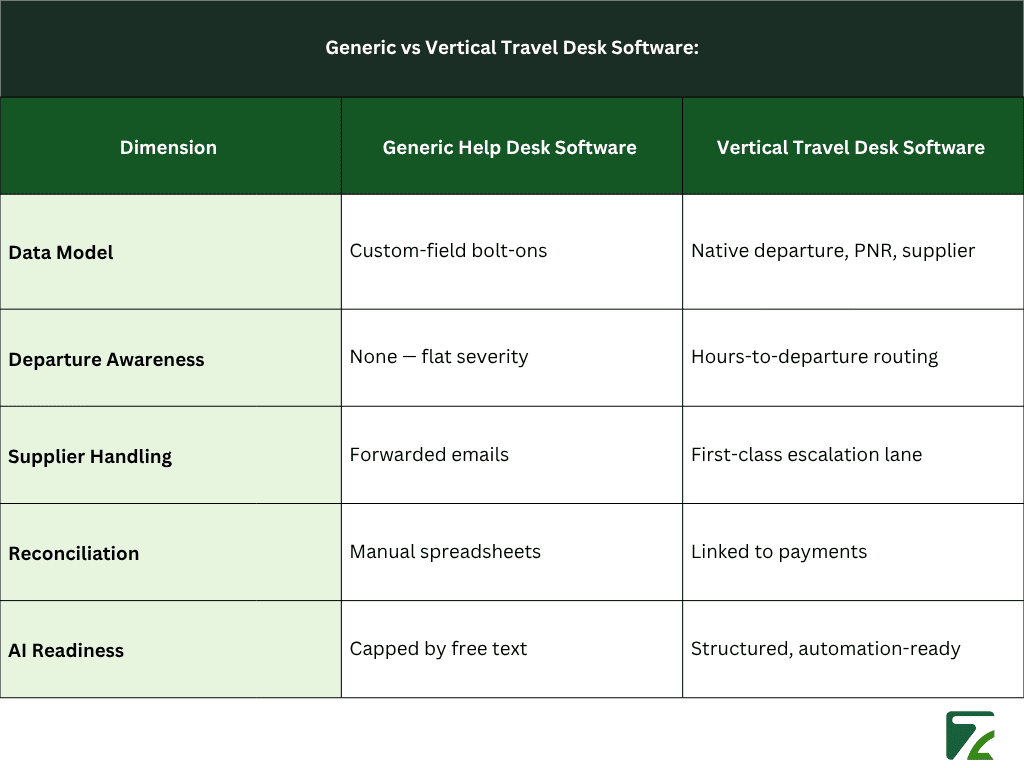
Vertical wins wherever travel context matters and across a travel operation, that is almost everywhere.
How Zeal Desk Delivers Travel Desk Software Built for Operations
Zeal Desk is an AI-powered ticketing system built specifically for travel operations. A generic helpdesk treats every interaction as a generic ticket. Zeal Desk, by contrast, organizes work around the booking. So, a ticket already knows its travel dates, its supplier, its booking reference, and its payment and reconfirmation status whether that booking is a hotel stay, a flight, a package, a transfer, or an insurance policy. For a hotel booking, that includes check-in and check-out dates and the HCN (Hotel Confirmation Number); for a flight, the departure date, PNR, and fare class. The desk reasons about whichever fields the booking type carries.
That booking-centric foundation is what makes the automation meaningful:
- AI ticket summarization condenses long operational threads into a clear summary an agent can act on. This includes supplier back-and-forth, amendment history, and escalation notes.
- Smart classification and data tagging reads an incoming request, detects intent and urgency, and tags travel-specific data such as check-in/check-out dates, room type, and booking reference. As a result, near-departure work surfaces on its own instead of hiding in a queue.
- Custom workflows codify the repetitive operational tasks that fill a travel team’s day. These include HCN requests, supplier follow-ups, reconfirmation, amendments, relocations, payment mismatches, and supplier escalations. Each becomes a recognized, automatable workflow rather than a one-off.
The contrast is simple. Generic platforms manage tickets, whereas Zeal Desk orchestrates travel operations. It natively understands hotel operations, supplier ecosystems, booking workflows, travel SLAs, and reconfirmation. A re-skinned generic desk cannot fake that domain fluency. And this fit is not limited to one type of travel business. Any travel company that coordinates bookings, suppliers, and payments can run on it OTAs, tour operators, DMCs, wholesalers, bed banks, and consolidators, but equally travel tech platforms, travel insurance providers, and travel payments companies. For any of them, Zeal Desk turns a support team into an AI-powered operational command center.
How Do You Evaluate and Migrate Travel Desk Software Safely?
A switch is an operational project, not a purchase. The risk is real. A botched cutover during a disruption event can bury a desk. For example, the U.S. Department of Transportation received 6,921 airline service submissions in January 2024 alone complaints, inquiries, and opinions combined. A migration timed into that kind of surge fails.
Which Capabilities Should You Test Before Switching?
Test five capabilities before you commit:
- Data model are departure, supplier, and booking references native fields?
- Supplier-escalation Lane is it a first-class queue with its own SLA?
- Reconciliation does the desk link to payment records?
- Integrations does it connect to your booking engine, GDS, and payment stack?
- AI readiness can automation act on the structured data?
A vendor that cannot demonstrate all five is selling a re-skinned generic desk. The “travel” label on the box does not change that.
What Does a Safe Migration Playbook Look Like?
Sequence the cutover to protect live operations:
- Map and export ticket data cleanly so nothing is lost in transfer.
- Build the booking-stack and payment integrations, then test them in a sandbox.
- Retrain agents on the new workflows before any traffic moves.
- Run a phased rollout one queue or sub-vertical at a time, not a big-bang switch.
- Schedule the cutover into a low-disruption window never a peak-departure or known irregular-operations period.
In short, a phased plan turns a risky replacement into a controlled migration.
Why AI Readiness Should Decide Your Travel Desk Software Choice
Conclusion
Generic help desk software fails travel at the data-model level. There is no native departure field, no supplier lane, and no link to the ledger. That single gap caps every workflow and every automation built above it. A vertical travel desk fixes the problem structurally, not cosmetically. This is why the switch is an operational project worth planning, rather than a trend worth chasing.
The decision is concrete. First, name your failure modes. Next, score generic against vertical on data model, departure awareness, supplier handling, reconciliation, and AI readiness. Then run a phased migration timed away from disruption.
Return to that refund ticket with no departure date. On a generic desk, it stays a guess. On a vertical one, it routes, escalates, and reconciles itself. Staying generic does not just cost agent time today. It also caps what your operation can become tomorrow. So, whether you run an OTA, a tour operation, a DMC, or a bed bank, the question is the same. Is your travel desk software helping your operation grow, or quietly setting its ceiling?