





This article explains how AI is rebuilding the way a travel customer service desk operates: who handles first contact, when service happens, what the team does, and how the whole thing is run. It is written for operations and support leaders at any travel company: OTA, TMC, DMC, travel payments, or airline. You will get a clear picture of the shift from reactive to proactive service, what agentic AI actually changes, how three roles on the desk are being redrawn, and how to run the new operation without a failed project.
A storm rolls through a hub and cancels a bank of flights. In the old operation, the phones light up within minutes, the queue buckles, and the team works late clearing a backlog that should never have grown that fast. In the operation being built now, most of those travelers have already been rebooked and messaged before they think to call. That gap is the real story of AI and customer service in travel. It is not a faster chatbot bolted to the queue. It is a change in who makes the first move, what the team does, and how the desk is run.
How Is AI Becoming the First Line of Travel Customer Service?
For years the operation had one shape: every message hit a human queue, and the team worked it down. AI changes that shape at the front. It now takes first contact and passes on only what it cannot resolve, so people sit behind the AI instead of in front of it. That single move rearranges everything downstream, starting with the queue that used to define the job.
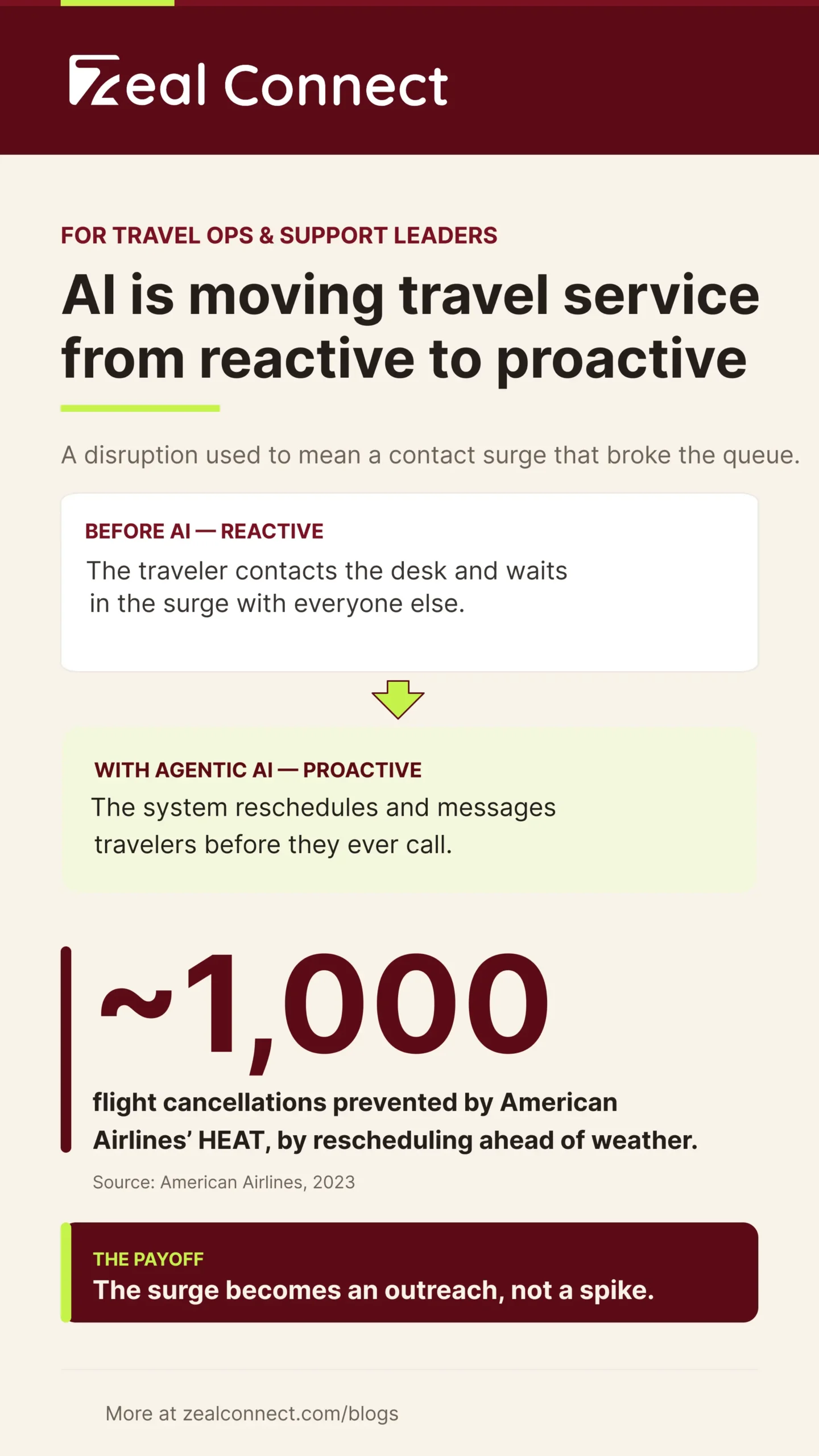
Before AI: the reactive travel service desk
Before AI, the desk was reactive by design. A traveler hit a problem, contacted support, and waited in line behind everyone else who had a problem that day. Staffing was built around peaks you could never quite predict, so a disruption meant a contact surge that broke the model. Global demand keeps pushing those peaks higher, too. According to IATA (2025), full year 2024 air passenger demand rose 10.4% over 2023, a record high. More travelers means more of everything the old queue was already struggling to absorb.
AI as the first line of travel support
Against that pressure, AI moves to the front and answers first. Support automation is already standard equipment, not an experiment. According to Roland Berger (2025), 95% of service centers have implemented AI in some form. Travelers are willing to meet AI there, too. According to Amadeus (2026), 68% of travelers say they are likely to use an AI powered travel assistant. That willingness holds only when the AI actually resolves the issue, though, which is why the next two changes matter as much as this one.
AI now takes first contact; people move behind it, not in front of it.
What Does Agentic AI Change in Travel Customer Service?
Agentic AI customer service in travel is software that can read a request, reason about it, and act across booking and operational systems in several steps toward a goal, then hand off to a person when it reaches its limit. It goes past answering questions to doing work, like pulling a booking, checking a rule, and starting a rebooking. That ability to act is what changes the operation, in two ways worth separating.
From chatbot to agentic AI in travel
The first change is what the software can do. A basic chatbot replies; an agentic system works across your systems to move a case forward. Malaysia Airlines put this into production in early 2026 with an agent called Mavis, built with the agentic AI firm Ada. As reported by the World Aviation Festival (2026), Mavis handles flight schedules, itineraries, and online check in across the airline's website, app, and email, in English and Malay. The point is not the channel. It is that the AI does the steps and escalates the rest to a person.
Proactive AI in travel, before the traveler calls
The second change is timing, and it is the one ops leaders feel most, because it attacks the surge at its source. Agentic systems can act before a traveler ever makes contact. American Airlines runs a tool called HEAT that reschedules flights at its hubs ahead of severe weather, weighing connections, crews, and gates. According to American Airlines (2023), HEAT has prevented nearly 1,000 flight cancellations across its network. Its companion tool, AURA, reaccommodates passengers at risk of missing a connection automatically. Back to the storm: the same event that once flooded the queue becomes an outreach the desk sends first.
The same disruption that once flooded the queue becomes an outreach the desk sends first.
Key Terms Worth Knowing
- Agentic AI: AI that can reason and take multi step actions across your systems toward a goal, not just answer a question, and that hands off to a person at its limit.
- Deflection vs. resolution: Deflection is keeping a contact away from an agent; resolution is the traveler's problem actually being solved. They are not the same number, and travelers care about the second.
- IROPs / reaccommodation: Irregular operations: delays, cancellations, and schedule changes, plus the rebooking work they create across the desk.
- Human in the loop / escalation threshold: The rule that sends a case to a person once it passes a set risk, value, or confidence line, so AI does not act alone on high stakes work.
- Orchestration: Coordinating AI, human agents, and suppliers on a single case so the work moves as one flow instead of separate handoffs.
How Does AI Change the Travel Customer Service Team?
The hardest part of this shift is not the software; it is the people plan. When AI takes first contact and handles the routine, the human job moves to what is left: the exceptions, the judgment calls, and supervising the AI itself. Roles that looked stable for a decade are being redrawn, and new ones are appearing that did not exist on a travel desk two years ago.
The frontline agent's new role under AI
The agent stops handling every contact and starts handling the ones AI can't. That is a bigger share than the hype suggests. According to Ada (2026), only 24% of consumers say their most recent AI interaction was fully resolved by AI alone, which leaves roughly three in four cases needing a person at some point. So the agent's day fills with harder, higher value work while routine minutes fall away. The skill that matters shifts from speed of typing to quality of judgment.
When AI takes the routine, the human job becomes the exceptions and supervising the AI.
The ops manager in an AI plus human operation
The manager's job changes just as much. Instead of rostering to survive a surge, they tune when AI escalates, coach the AI on the cases it gets wrong, and watch resolution quality rather than raw ticket counts. Forrester notes that AI also frees time on the floor: it expects daily agent workloads to drop by about an hour as AI absorbs narrow tasks, which the manager has to redirect deliberately rather than let it quietly evaporate.
New travel customer service roles built around AI
Alongside those shifts, entirely new jobs are appearing beside the old ones. According to Forrester (2025), 30% of enterprises will create parallel AI functions that mirror human service roles: people who onboard and coach AI agents, teams that optimize AI performance, and specialists who step in to unblock the AI when it falters. On a travel desk that means someone owns the playbooks, the escalation rules, and the AI's booking knowledge as a real job, not a side task.
Table: How AI reshapes three jobs on a travel service desk
| Role | What it was | What it becomes | The new skill |
|---|---|---|---|
| Frontline support agent | Handle every contact | Own exceptions AI can't close | Judgment on hard cases |
| Service ops manager | Roster for peaks | Run an AI + human operation | Tuning and coaching AI |
| AI operations owner (new) | Did not exist | Own playbooks and AI knowledge | Grounding AI in booking data |
How Do You Run an AI First Travel Customer Service Operation?
Plenty of these projects do fail, and it helps to know why before you start. The pattern is rarely the model itself. It is a bot bolted to the queue with no grounding in real booking data, sold on hype, and measured on the wrong number. Avoiding that comes down to three things, taken in order: expect the failure mode, keep people in control, and measure resolution.
Why AI customer service projects in travel stall
Most stall because they are built on hype, not grounding. According to Gartner (2025), over 40% of agentic AI projects will be canceled by the end of 2027, on cost, unclear value, or weak controls. Gartner also warns of "agent washing", chatbots rebranded as agents. The travel version shows up in the results: GBTA (2026) found 58% of travel buyers say AI has had little or no impact on their program so far. The tell is an AI that can talk but can't reach a real booking.
Keeping people in control of AI customer service
Control comes from setting the lines before you turn anything on. Escalation thresholds and confidence routing decide what AI may act on and what it must pass up. Large refunds, compliance sensitive cases like chargebacks, and VIP travelers route to a person with full context, not to an automated reply. You also keep an audit trail for anything the AI executes, so a rebooking or a refund can be reviewed later. This is the same human oversight line that PhocusWire (2025) reports travel companies drawing around agentic AI.
Measuring AI customer service by resolution, not deflection
The last piece is what you count as success. Ada's research makes the case plainly: enterprises tend to optimize for deflection and cost while travelers judge service on whether their issue was actually solved. So track resolution rate, agent workload, and how often the AI escalates, alongside first response time.
Measure whether issues get resolved, not just whether contacts get deflected.
Investment is not the constraint here. Travel Tech Show (2026) found 64% of travel operators plan to increase AI spending in the next year. The question is whether it funds grounding and roles or just another bot.
How Does Zeal Desk Fit an AI First Travel Customer Service Operation?
Zeal Desk is built only for travel, which is what makes the operating model above workable rather than risky. The whole platform assumes bookings, suppliers, and amendments as first class objects, so its AI acts on real reservation data instead of guessing from retyped text. General purpose desks like Freshdesk, Zendesk, and Zoho Desk serve every industry, so a booking or an amendment becomes custom setup you build and maintain.
Grounding travel customer service AI in real booking data
The foundation is that Zeal Desk works from the live booking, not a summary. Records are organized around bookings, and an integration hub pulls real reservation data onto ticket fields, so the AI classifies, extracts dates and references, and summarizes long supplier threads from the actual booking. That grounding is the difference Gartner points to between a real agent and a rebranded chatbot. A general purpose desk does not know what a booking is, so its AI works from whatever text a traveler happened to type.
Supporting the agent's role in AI first travel service
For the cases that need a person, the platform does the setup and leaves the decision to the agent. Auto next action suggests the grounded next step, drawn from the live booking and the playbooks you configure. Support AI agents and playbooks handle the bands they are configured for and escalate the rest with full context attached. The agent then reviews, edits, and sends the reply, since there is no unattended auto reply across every ticket. That keeps the human squarely on the exceptions the earlier section described.
Giving the ops manager control of the AI
Control lives in playbooks the manager can see and change. The logic that decides what AI handles sits in transparent, configurable playbooks tuned per segment, so the manager adjusts behavior as the ticket mix shifts. SLA prediction and escalation detection flag cases before they breach, while admin controls (audit logging, PII redaction, field level permissions) give the governance the previous section calls for. The manager runs the operation instead of trusting a black box.
Conclusion
Come back to the storm. The change AI brings to travel customer service is not a smarter chatbot answering faster; it is an operation that acts before the traveler calls and a team whose job moves from handling volume to supervising AI and owning the hard cases. Getting there takes discipline: ground the AI in real booking data, keep people on any decision that carries money or compliance, and measure whether issues actually get resolved rather than merely deflected. The projects that fail skip those steps and buy the hype instead. Pick one high volume or disruption flow, put a grounded AI on first contact, and redesign the human role around exceptions. That is where the operation starts to change for real.
Frequently Asked Questions
Is AI replacing travel customer service agents?
No. The role shifts rather than disappears. AI takes first contact and the routine work, while agents own the exceptions it cannot resolve, and Ada found only 24% of AI interactions are fully resolved without a human. New roles also appear, from coaching AI agents to owning escalation rules, so teams are being redrawn, not removed.
What is agentic AI in travel customer service?
It is AI that acts, not just answers. An agentic system reasons about a request and takes steps across your booking and operational systems toward a goal, then hands off to a person when it hits its limit. Malaysia Airlines' Mavis, for example, manages bookings and check in across channels and escalates to a live agent.
Can AI handle travel disruptions on its own?
Partly, and increasingly upfront. Tools like American Airlines' HEAT and AURA reschedule and reaccommodate travelers proactively, before many even call, which is how a disruption stops becoming a phone surge. Complex, high value, or compliance sensitive cases still route to a human with full context rather than resolving automatically.
How do we start without a failed project?
Ground the AI in your real booking and policy data, set escalation thresholds so people keep control of high stakes cases, and measure resolution rather than just deflection. Gartner expects over 40% of agentic AI projects to be canceled by 2027, mostly on hype, so start narrow and prove real resolution first.