




This article explains, in concrete terms, how AI is used in customer service across a travel operation, from self service chatbots, voice AI, and real time translation to agent assist, sentiment detection, quality analytics, and proactive alerts, and how each use improves a specific operational result like response time, cost, or SLA compliance. It's written for support and operations leaders at OTAs, DMCs, TMCs, tour operators, and airlines. One thing to keep straight throughout: AI assists and travelers self serve, but a person still owns the decision and the reply.
Ask most travel teams how they use customer service AI for travel operations and the honest answer is "a chatbot on the website." That was the starting point, not the current picture. Today AI answers a baggage question at 3 a.m. in Spanish, takes a routine status call, drafts an agent's reply, condenses a twenty email supplier thread, flags an angry message, and warns a traveler about a delay before they call. Each of those is a different job with a different payoff. This article walks through the real uses, grouped by who they serve, and the operational result each one delivers.
What AI in customer service covers in a travel operation
Customer service AI covers a set of jobs done inside your existing support workflow, some facing the traveler and some behind the agent. Adoption is already broad. According to Phocuswright (2026), 61% of travel businesses are experimenting with or scaling agentic AI. Skift research reported by Forbes (2025) puts it wider: 90% of major travel companies have launched some generative AI project.
What does "customer service AI for travel operations" mean?
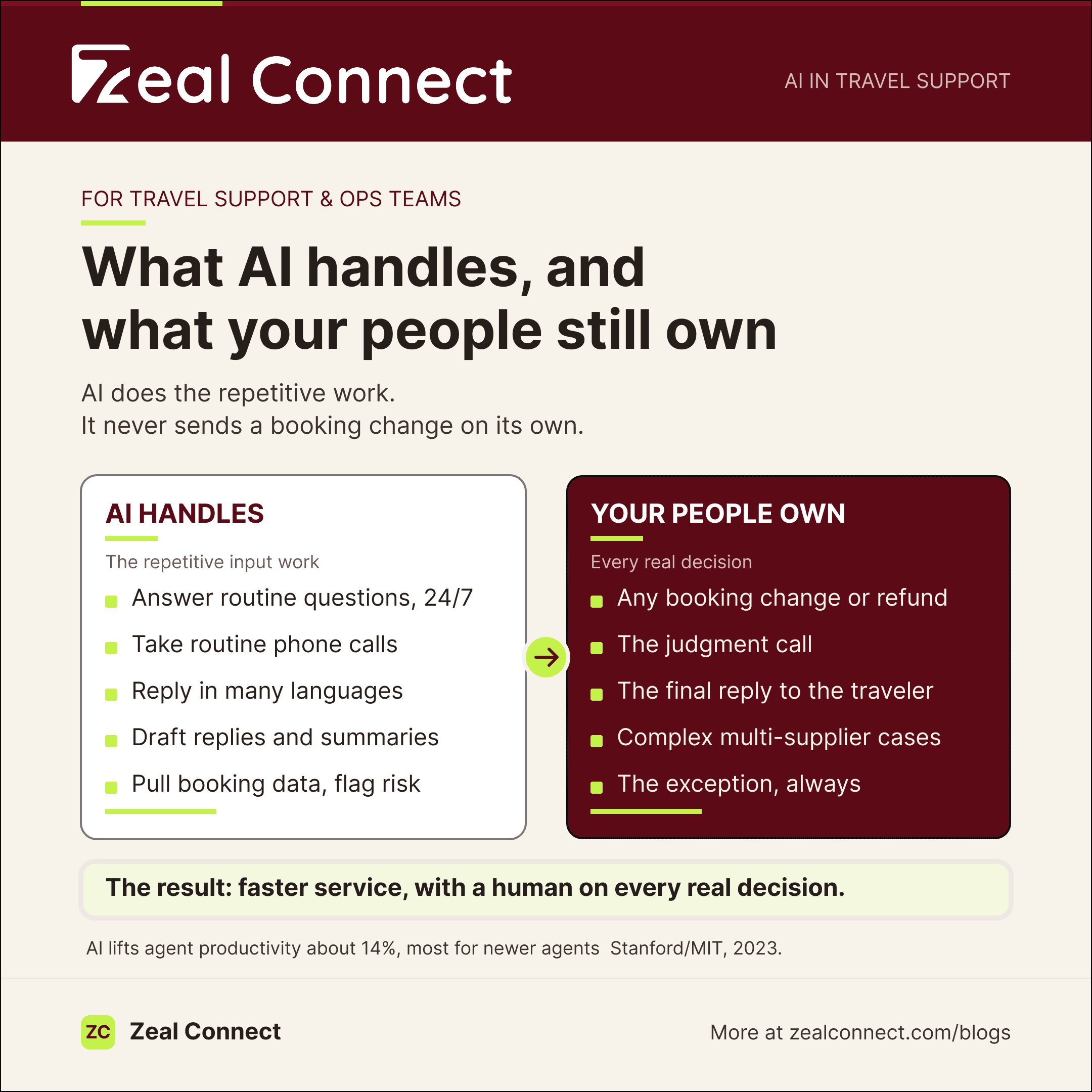
Customer service AI for travel operations is the use of artificial intelligence inside your support workflow, answering common questions, translating, classifying and routing, extracting booking details, drafting replies, and flagging risk. It runs within the channels and help desk a team already uses. Travelers self serve the easy cases themselves, and a person reviews and sends anything that changes a booking.
Two sides: traveler facing and agent facing uses
The uses split cleanly into two groups. Traveler facing AI talks to the customer: chatbots, voice agents, translation, and proactive alerts that handle or head off routine contacts. Agent facing AI never talks to the customer at all: it drafts, summarizes, transcribes, flags sentiment, and scores quality so the human works faster and more consistently. Most operations start on the traveler side for quick wins, then find the larger, quieter gains sitting behind the agent.
Why travel raises the bar
Travel support carries money, deadlines, and third parties, so the AI has to do more than chat. A refund waits on a supplier. An amendment reprices against fare rules. A cancellation inside a penalty window has real cost. So the useful AI uses in travel are the ones tied to the booking and the supplier, not just a website FAQ bot. The value shows up when AI touches the operational record, not only the conversation.
Key Terms Worth Knowing
- Agentic AI: AI that can take defined actions across systems, such as starting a rebooking draft, rather than only generating text. A person still approves the action.
- Deflection (containment): the share of contacts a traveler resolves themselves through self service. It means the customer solved it, not that AI closed a ticket for you.
- Agent assist (copilot): AI that drafts replies and surfaces knowledge for a human agent, who reviews, edits, and sends. The agent stays in control of the message.
- Conversation analytics / AI QA: AI that reviews interactions for quality and compliance, across all of them rather than a small manual sample.
- Sentiment detection: AI that reads tone and urgency in a message or call to flag upset or at risk contacts for priority handling.
- First response time (FRT) / average handle time (AHT): how fast the first reply goes out, and how long an agent spends per contact. AI tends to move both first.
How AI is used to serve travelers directly
The traveler facing uses are the ones people picture first, and they hold the fastest wins. They handle or head off the high volume, repetitive contacts that fill a queue, so agents keep their time for cases that need judgment. None of them replaces the agent on a hard case. They shrink the pile of easy ones and hold the line when volume spikes.
Self service chatbots and virtual assistants
The most common use is a chatbot that lets travelers answer their own routine questions, at any hour. Baggage rules, check in times, and "where is my confirmation" are predictable and high volume, so a good assistant deflects them without an agent. This is self service, which means the traveler resolves it themselves. Anything that needs a booking change or a judgment call hands off to a person, with the conversation and context attached.
Voice AI and support in the traveler's language
AI now handles voice, not just chat. Voice agents take routine phone calls, such as status checks and confirmations, in place of a rigid press one menu. Anything complex passes to a human. Alongside voice, real time translation lets a small team support many languages at once. It reads a message in Portuguese, works in your policies, and replies in Portuguese, with no native speaker on shift. For OTAs and DMCs selling across borders, that removes a real staffing constraint.
Personalized and proactive outreach
AI also reaches out before a traveler has to ask. Using booking and history data, it can flag a likely delay and offer options early. It can also tailor a reply to the traveler's trip and preferences. That shift from reactive to proactive is what travelers increasingly expect: Amadeus (2025) found generative AI use for travel up 64% year over year across 9,500 travelers. Done well, a proactive alert prevents a wave of inbound contacts instead of just answering them.
How is AI used to support agents and back office work?
The uses that change an operation most are the quiet ones behind the agent. Here AI does not talk to the traveler at all. It prepares the work so the agent resolves faster and with fewer mistakes. This is where travel's complexity pays off, because the AI is working with bookings and supplier threads, not just canned answers. The agent stays in control and sends the final reply.
Agent assist copilots
The highest impact back office use is agent assist. AI drafts a reply for the agent to check and surfaces the right knowledge base answer. It also condenses a long supplier chain into a two line summary. A Stanford and MIT study of over 5,000 support agents found a gen AI assistant raised productivity 14% on average, with the largest gains going to less experienced agents (HR Dive, 2023). Agents welcome it: 73% say an AI copilot helps them work better (Zendesk, 2024).
Transcription, sentiment, and real time coaching
AI also listens and reads for signals a busy agent can miss. It transcribes and summarizes calls automatically, so notes are not lost. It detects sentiment and urgency, flagging an angry message or an at risk case for priority. On live calls, it can prompt the agent on tone or the next step. In travel, catching a frustrated traveler early, mid disruption, is often what stops a complaint from escalating.
Quality assurance and conversation analytics
AI changes how teams check their own quality. Instead of a supervisor sampling a handful of interactions, AI reviews every conversation for tone, accuracy, and policy compliance. That turns quality assurance from a spot check into full coverage. It also surfaces patterns, such as a policy travelers keep misunderstanding or a supplier issue spiking. Those patterns feed back into training and self service, so the same contact does not keep returning.
Table: How each AI use in customer service improves travel operations
| AI use | What it does | Operational benefit | Metric it moves |
|---|---|---|---|
| Self service chatbot | Lets travelers answer routine questions | Deflection, coverage | Deflection rate, cost per contact |
| Voice AI | Handles routine calls, routes the rest | Shorter call queues | Call wait time |
| Real time translation | Serves each market in language | Fewer language hires | Market coverage |
| Agent assist | Drafts replies, surfaces knowledge | Agent productivity | AHT, ramp time |
| Sentiment detection | Flags upset or at risk contacts | Prioritized escalations | CSAT, escalation rate |
| QA analytics | Reviews all interactions, not a sample | Consistent quality | QA coverage |
| Booking data extraction | Pulls PNR, dates, amounts | Fewer fulfillment errors | Rework rate |
| Proactive alerts | Warns and offers options early | Fewer inbound spikes | Inbound volume, SLA |
How does AI customer service improve travel operations?
Put the uses together and the operational gains are measurable, not vague. Automating routine contacts, triage, drafting, and quality checks is not about novelty. It builds a faster, cheaper, more consistent operation that holds up when volume moves. The returns are landing: 90% of CX leaders report positive ROI on AI tools for agents, per Zendesk (2024). That is why this is now an operations decision, not a marketing one.
Faster, always on, multilingual service
The first gain is speed and reach. Self service and voice AI answer routine contacts instantly, in many languages, around the clock. First response time drops, and coverage no longer needs a night shift in every market. That effect is largest during a disruption spike, because the automated uses absorb the first wave. A queue that used to back up for hours during a weather event stays closer to its targets.
Higher productivity at lower cost
The second gain is doing more without adding headcount. When AI drafts, summarizes, transcribes, and extracts, each agent handles more contacts per hour, and newer agents reach competence faster. According to McKinsey (2025), 59% of travel executives report AI has increased employee productivity, and 30% credit it with faster decision making. For an operation that scales support cost with volume, that loosens the link between more tickets and more hires.
What teams must get right to see the gains
The gains are not automatic, and two things decide them. First is accuracy. AI is only as good as the data it reads, and Amadeus (2025) found 25% of travelers have hit outdated or inaccurate AI information, so connect it to live booking data, not a stale FAQ. Second is scope and oversight. Gartner (2025) expects over 40% of agentic AI projects to be canceled by 2027, usually from unclear goals. Start with one high volume use, keep a human on every decision, and measure it.
Conclusion
AI in customer service is best understood as a set of specific jobs across the support workflow. On the traveler side, it answers routine questions, takes routine calls, translates, and reaches out before problems land. Behind the agent, it drafts, summarizes, transcribes, flags sentiment, and checks quality across every interaction. Each use improves a concrete operational result, from first response time to cost per contact to SLA compliance during a spike. Travelers self serve the easy cases and a person still owns every real decision. The teams that gain most treat AI use by use. They connect each one to accurate booking data, and measure the metric that use is meant to move.
Frequently Asked Questions
How is AI used in customer service for travel operations?
AI powers self service chatbots and voice agents for routine questions, translates across languages, classifies and routes requests, drafts replies for agents, transcribes and summarizes calls, flags sentiment, reviews quality, extracts booking data, and sends proactive alerts. Each use targets a specific, repetitive part of the workflow.
Does AI resolve travel support tickets on its own?
No. Travelers self serve the easy questions themselves, and for everything else AI assists a human who reviews, decides, and sends. AI drafts, summarizes, and flags, but a person owns any booking change or judgment call. Full autonomous resolution is not the standard in travel support today.
Does AI customer service replace travel agents?
No. The common pattern is agent assist, where AI prepares the work and the agent handles the decision and the reply. Research shows AI raises agent productivity most for newer staff, so it changes how teams train and scale rather than removing the human from the loop.
How do travel companies measure whether AI customer service is working?
They track the operational metric each use is meant to move: deflection rate and cost per contact for self service, average handle time for agent assist, rework rate for booking extraction, and SLA compliance for disruption handling. Baseline before rollout, then compare per use.