




This article opens up what "autonomous resolution" really means for customer support AI for travel. No AI on the market today closes a travel ticket on its own. Instead, it assists a human across the whole ticket lifecycle, intake, understanding, grounding in the booking, drafting the reply, while an agent reviews, sends, and closes. You'll see what the AI does at each stage, what it grounds on inside a live booking, and which parts still need a person. Written for support and CX leaders judging "autonomous" AI claims.
You've seen the headline: "our AI resolves 80% of tickets autonomously." Then you open your own queue and see a refund that needs a supplier's sign off, and a chargeback no bot should answer unsupervised. Both are real, and both expose the same gap. No AI on the market today closes a travel support ticket end to end by itself. What customer support AI for travel actually does is assist a person across the entire lifecycle of a ticket, so the resolution comes faster while a human still makes the call and sends the reply. This article shows how that assist works, step by step.
What does customer support AI for travel do, and what does it leave to a person?
It starts with a simple division of labour, and that split explains everything that follows. The AI takes on the reading, sorting, and drafting at every stage of a ticket, while an agent makes the decisions and sends the customer the reply. So a request comes in, and the AI classifies it, pulls up the booking, condenses a long supplier thread into a line or two, and prepares an answer grounded in the record. The agent then reviews that draft, adjusts the terms or the tone, sends it, and closes the ticket. Calling that "autonomous" misses what is really happening, because from the first message to the last, the work is assisted, not unattended.
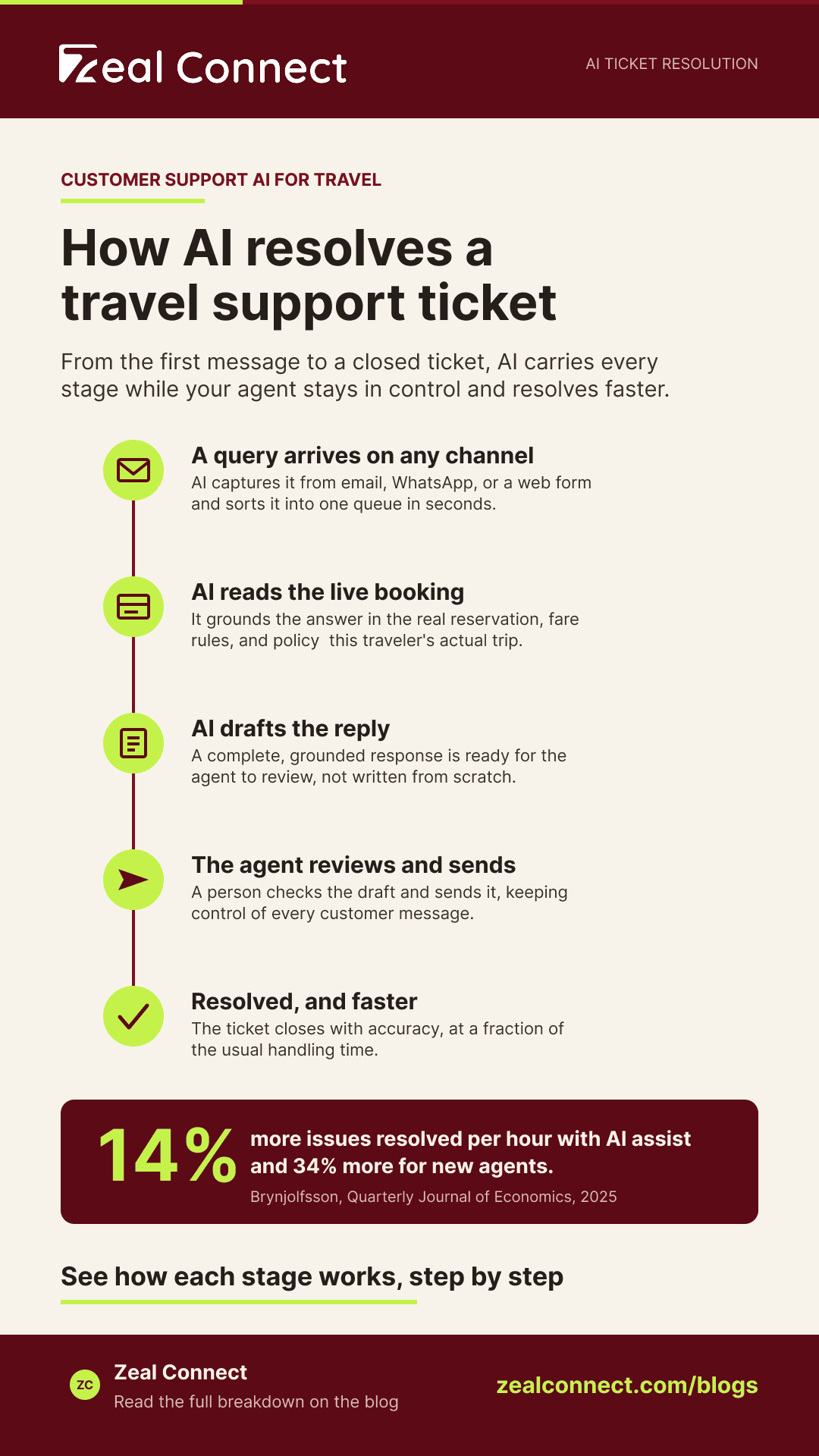
No AI on the market today closes a travel support ticket on its own, it assists a person who makes the close.
An agent still closes the ticket
Whatever the marketing promises, the last action belongs to an agent. Gartner (2025) predicts that by 2029, agentic AI will autonomously resolve 80% of common customer service issues without human intervention, yet that is a forecast about simple, repeatable issues, and travel tickets are rarely that clean. A single booking touches suppliers, fare rules, and money, so the closing judgment stays with a person while the AI does the groundwork underneath.
Where does the "80% autonomous" claim break down?
That one word, common, is where the headline quietly shrinks, because a live travel queue is anything but common. Customers feel the gap, too. In the Verizon 2025 CX Annual Insights Report, satisfaction reached 88% with human agents but only 60% with AI driven interactions, and 47% of consumers named clumsy AI to human handoffs as their main frustration. A blanket "autonomous" claim, then, describes the demo rather than the queue you work on a disrupted Monday.
What does AI reliably take off an agent's plate?
If judgment stays with the agent, the repetitive input work is where AI clearly earns its place. Travel tickets are full of structured data, dates, PNRs, supplier references, fare rules, and that is exactly what a model classifies, extracts, and summarizes well. So rather than have an agent reread a twenty email supplier chain, the AI hands over one line of current state and a drafted next step. The manual reading and typing largely disappears, and the agent is left with the part that needs a human.
Customer support AI for travel across the ticket lifecycle, stage by stage
To see exactly where that help starts and stops, follow a ticket through its life. Customer support AI for travel supports an agent at every stage of a ticket, intake, understanding, grounding, drafting, review, and follow up, without ever sending the customer reply or closing the ticket itself. At each stage it works a step ahead of the agent. That rhythm mirrors the understand, decide, act, and escalate loop common to autonomous agents everywhere, except that in travel the agent still owns the send. The table below shows the split, stage by stage.
Customer support AI for travel doesn't close the ticket. It does the work at every stage so a person can close it faster.
Table: What the AI does vs. what the person owns, at each stage of a travel ticket
| Stage | What the AI does | What the person owns |
|---|---|---|
| Intake | Capture across email, WhatsApp, web; classify | Confirm priority on edge cases |
| Understand | Detect intent, extract booking fields | Judge ambiguous or emotional requests |
| Ground | Pull live booking and policy | Verify the record looks right |
| Draft | Prepare a grounded reply or next action | Edit for tone and accuracy |
| Review & send | Suggest, wait | Approve and send the reply |
| Follow up & close | Track SLA, chase, flag risk | Confirm resolution and close |
Stages 1 to 2: Intake and understanding
The first two stages are about getting the ticket ready. A request arrives by email, WhatsApp, chatbot, or web form, and the AI pulls it into one queue, classifies it by type, and extracts the structured fields, check in dates, PNR, supplier reference. From there it condenses any prior back and forth into a single line of state. None of this reaches the customer yet; it just sets the ticket up so an agent can act on it quickly.
Stages 3 to 4: Grounding and drafting
With the ticket understood, the next two stages produce something the agent can use. The AI reads the actual booking and drafts a reply grounded in it, answering from the live reservation and the customer's policy rather than guesswork, which is what stops it inventing a refund rule. Even then, grounding reduces fabrication without eliminating it, so a confidence score decides what happens next: a threshold of 0.80 is a common starting point, above which a reply can be auto suggested and below which the AI escalates to a human (Supportbench, 2026).
Stages 5 to 6: Review, send, and close
The final two stages hand control back to the agent for good. The AI presents its draft and the reasoning behind it, and the agent edits, approves, and sends the customer facing message. This is where the earlier work pays off: generative AI raised the number of issues resolved per hour by 14% on average, and by 34% for novice agents (Brynjolfsson, Li & Raymond, 2025), largely because the reading and drafting are already done. Once the reply goes out, the AI tracks the SLA and flags risk while the agent confirms the outcome and closes.
Key Terms Worth Knowing
A few terms used throughout this article:
- Assisted resolution: the AI does the input work at each stage while a person decides and sends the reply.
- Grounding: tying the AI's answer to a real source (the live booking, the policy) so it doesn't fabricate.
- Confidence threshold: the score below which the AI escalates to a human instead of suggesting a reply.
- Escalation: handing a ticket to a person when confidence, policy, or sensitivity requires it.
- Containment: the share of contacts handled without a human; often mislabeled as full resolution.
- Human in the loop: the AI prepares the action, and a person approves, sends, or overrides it.
What does the assist look like on a live travel booking?
That lifecycle looks much the same in any industry. What sets travel apart is the grounding stage, and it decides how useful the whole assist turns out to be. The answer to "can I move my flight" doesn't live in a help article, it sits in the reservation, the fare rules, and the supplier's terms. So the AI is only as good as the booking data it can reach, which makes what it can read the thing that matters most.
The quality of the assist depends on what the AI can read. In travel, that's the live booking, not a help article.
What does the AI ground on in a travel ticket?
It reads the traveler's actual booking, not a static help article. IrisAgent, for instance, pulls its answers from the reservation system, loyalty program, and policy knowledge base (IrisAgent, 2025) rather than a generic FAQ. Because the source is the live booking, the draft can cite this traveler's real dates, fare, and change fees. That accuracy is what makes the suggestion worth an agent's time, instead of a template they have to rewrite.
Assisting inside a booking system, not acting alone
Reading the booking is one thing; changing it is another, and that line matters. The AI can pull the reservation, summarize the supplier thread, and draft the amendment or the refund reply for the agent. What it will not do is push an irreversible change to a live booking and tell the customer it's done. An agent confirms that step, because a wrong amendment on a live PNR costs real money and trust to unwind.
Walk through: a date change on an OTA booking, from query to close
Put the stages together and it looks like this. A traveler messages an OTA to move a flight, and the AI captures the message, classifies it as a date change, and pulls the PNR and fare rules. It checks the rules, drafts a reply with the change fee and the new option, and hands it over. The agent reviews the fare logic, sends the reply, and once the traveler confirms, makes the change and closes the ticket. The AI did the legwork at every stage, while the agent made each decision.
Which parts of resolving a travel ticket still need a person?
If the earlier stages show where AI carries the load, three parts of the job are where it hands off for good: sending the customer reply, closing a ticket that waits on a supplier, and handling anything with money or compliance weight. None of these is a temporary gap waiting for a better model. Each is a place where judgment, accountability, or an outside response actually lives, so no amount of automation clears them cleanly.
The parts of a travel ticket that stay human are the ones that carry judgment, money, or an outside reply.
Why can't AI close a ticket that depends on a supplier?
Take the supplier case first, because it's the clearest. The answer isn't in your systems, it's in the supplier's inbox. When a hotel has to confirm a room move or an airline has to approve a waiver, the AI can draft the chase and summarize the thread, but it can't manufacture a reply that hasn't arrived. Disruption only sharpens the problem, since a single weather event floods the queue at once, and disruption already costs the airline industry around $60 billion a year, roughly 8% of revenue (CMAC, citing Wipro, 2024). The drafting stays fast; the close still waits on people.
Setting the confidence threshold on refunds and chargebacks
Money tickets sit differently, and here you deliberately keep the threshold high so they escalate by default. A chargeback carries financial and regulatory weight, travel and hospitality payment disputes average $120 globally, the highest of any industry studied (Mastercard, via JustPricing, 2026). You still want the AI to classify the dispute, pull the transaction, and draft the response for review. What you don't want is it settling a dispute unsupervised, because on money tickets a low confidence bar and a fast human handoff beat a confident wrong answer.
Why does the human matter most at escalation?
However you route these tickets, the handoff itself is where a shaky case is saved or lost. A field experiment at Alibaba found that human intervention preserves service quality in algorithm triggered technical escalations (Wang et al., 2026), the handoff works when a person steps in with context. The lesson for travel is to design that moment, not just allow it: the AI should pass the agent the full picture, so they resolve the hard case rather than restart it.
Conclusion
Autonomous resolution, as the market uses the phrase, oversells what customer support AI for travel does today. No system closes a travel ticket on its own. What it does, and does well, is assist a person across the whole lifecycle: capturing the query, understanding it, grounding the answer in the live booking, and drafting the next step, so the agent resolves faster and sends with confidence. The parts that stay human are the ones that should: the send, the supplier dependent close, and anything carrying money or risk. When you judge a vendor, ask what the person still does at each stage. A clear answer means the tool respects where judgment belongs.
Frequently Asked Questions
Does customer support AI for travel ever send a reply or close a ticket on its own?
No. On self service questions the customer resolves things themselves, but on agent handled tickets the AI only drafts. A person reviews, edits, sends the customer facing reply, and closes the ticket. The AI prepares the work at each stage but never takes the final customer facing action unsupervised.
So, what does "autonomous resolution" really mean in practice?
In practice it means the AI carries the repetitive work across a ticket's lifecycle, intake, understanding, grounding, and drafting, while a human makes the decisions and the close. Vendor "autonomous" claims usually describe simple, common queries, not the supplier dependent or financial tickets that fill a real travel queue.
What parts of a travel ticket can't be handed to AI?
Three: sending the customer reply, closing a ticket that waits on a supplier's response, and resolving anything with money or compliance weight like refunds and chargebacks. The AI can draft and prepare all three, but the decision and the final action stay with a person for accuracy and accountability.
How do I tell if a vendor is overselling "autonomous" resolution?
Ask what the human still does at each stage. If the answer is "nothing," be skeptical, because a live booking, a supplier, and a payment all need judgment. A trustworthy vendor explains where the AI drafts, where it grounds its answers, and where it escalates to a person, rather than promising hands off closure.