

- This article explains what an AI customer service agent does at an online travel agency (OTA) and how its two operating modes differ: Copilot, where AI drafts and an agent sends, and Autopilot, where AI acts on the booking within set rules.
- It is written for support and operations leaders deciding which requests each mode should handle and what must be in place before AI acts on its own.
At 11:40 on a busy morning, a support agent at an OTA approves the 200th AI-drafted reply of the shift with one click. Every help desk vendor now sells an AI customer service agent, so for most OTAs the open question about AI customer service is now how much the AI should do before a person looks. The answer differs for a hotel reconfirmation and a goodwill request after a cancelled flight. Underneath, the two modes differ on one thing: who answers for the result.
Why OTAs Need an AI Customer Service Agent That Acts on Bookings
Most traveler messages reach an OTA after the booking, and they ask for something to change: a name, a date, a room, a cancellation. Early AI could explain a policy. Today, travel platforms want it to carry out the change too. That raises a harder question for operations leaders, because acting on a booking has a cost when it goes wrong.
Most OTA support requests end in a booking change at a supplier
An OTA rarely owns what it sells. The room sits with a bedbank or the hotel, and the flight sits with the airline in a Global Distribution System (GDS). So a name correction is not finished when someone replies. It is finished when the supplier accepts the change. The AI can only act on that booking if your desk reaches it through a booking-engine connector or an API. Without that link, AI can draft the reply, but a person still makes the change.
Large travel platforms already use AI customer service to handle requests
Some of the biggest platforms already let AI handle service requests without a person. In the US, Airbnb's AI assistant has cut people's need to contact a human agent by around 15% (Airbnb, 2025). In India, MakeMyTrip said its Myra assistant handled more than 53% of post-booking flight and hotel queries on its own in the quarter to 30 September 2026. Both figures are company-reported and cover routine requests. Neither says how many harder cases still reach a person.
Why do travelers still want a person in charge of the money?
Travelers welcome help from AI, but they hesitate when it decides about their money alone. Amadeus found that only 20% of US travelers would let an AI tool spend money for them without further approval, even within a set budget (Amadeus, 2026). Europe and the Middle East show the same pattern: across 13 countries, including the UAE and Saudi Arabia, only 6% of consumers trust AI on its own to dispute a suspicious transaction (ServiceNow, 2025). So the mode you choose matters most where money moves.
What Is an AI Customer Service Agent? Copilot vs Autopilot Explained
An AI customer service agent is the use of AI to read a customer's request, pull the booking and policy behind it, and either prepare the response for a human agent or carry out an allowed action itself. When a case falls outside its rules, it hands the case to a person with the context attached.
Both modes use the same AI to understand the request. However, they differ in who takes the final step, and therefore in who owns the outcome.
Copilot: AI agent assist that drafts while your agent decides
On Copilot, the AI works as agent assist. It sorts the request, pulls the booking reference, summarizes the thread, and drafts a reply. Your agent checks the draft, edits it, sends it, and makes any change to the booking. The evidence for this mode is strong. In a study of 5,179 support agents, an AI assistant raised issues resolved per hour by 14% on average and by 34% for newer agents (NBER, 2023). Experienced agents gained much less.
Autopilot: an autonomous AI customer service agent acting within guardrails
On Autopilot, the AI acts on the live booking for the request types you switch on. It confirms, amends, or cancels within your rules, then tells the traveler. Anything outside those rules goes to a person with the case prepared. Gartner projects that by 2029 agentic AI will handle 80% of common customer service issues without human intervention (Gartner, 2025). That is a cross-industry forecast, though; in travel, supplier dependency keeps the share lower.
Table: Copilot vs Autopilot on an OTA support desk
AI Customer Service Agent Glossary: Key Terms for OTA Support Teams
A few terms come up throughout this article. Here is what each one means.
- Agent assist: AI help shown to a human agent during a case, such as a suggested reply, a summary, or booking details on the ticket.
- Guardrail: A rule that limits what the AI may do alone; requests outside it go to a person.
- Escalation with context: Handing a case to a person with the booking, a summary, and what the AI already did, so the traveler doesn't repeat the story.
- Automation bias: The habit of approving AI output without checking it properly, which grows when the AI is usually right.
- Booking-engine connector: The live link that lets the help desk read a booking and change it.
- Audit log: A record of every action on a ticket, by a person or the AI, with the time and result.
AI Customer Service Agent in Practice: One OTA Morning on Both Modes
Here is an illustrative morning built from typical request types. A mid-size OTA based in Singapore sells hotels and flights to travelers in Australia, the UK, and the European Union (EU). Between 08:00 and 12:00 Singapore time (UTC+8), 420 requests arrive by email, chat, and WhatsApp. The team has already set which request types run on Autopilot.
The 260 requests that ran on Autopilot
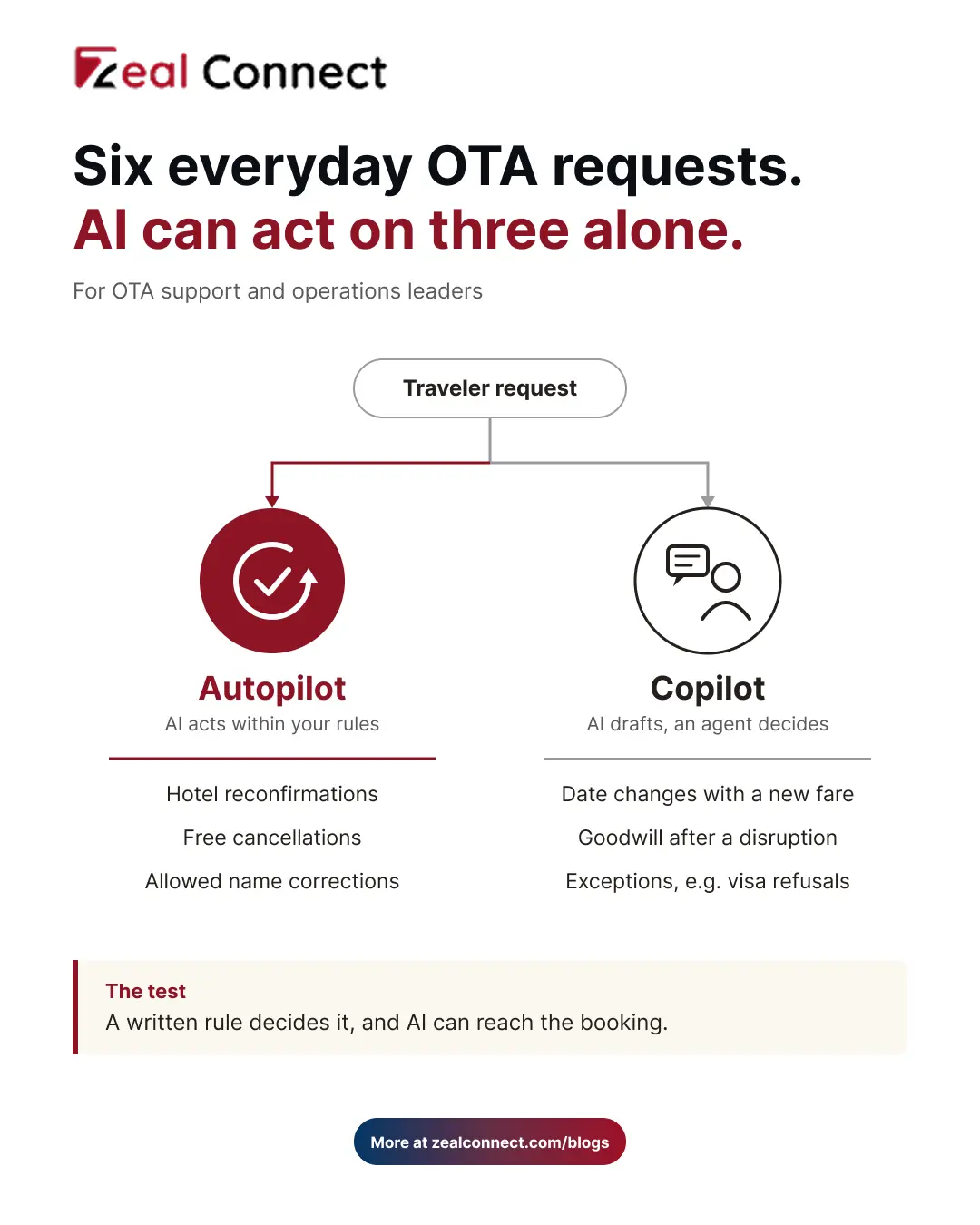
Three request types ran on Autopilot: 140 hotel reconfirmations, where the bedbank returned a hotel confirmation number (HCN); 40 name corrections the supplier allows, such as a swapped first and last name; and 80 cancellations inside a rate's free cancellation window. Each had a written rule and a booking the desk could reach. The AI completed 230 and logged every action. The other 30 came back to agents with context, for example because a supplier didn't answer in time.
The 160 requests that stayed on Copilot, and why
The rest needed judgment or a choice from the traveler. Seventy date changes would alter the price, so the traveler had to accept a new fare first. Fifty complaints after a disrupted trip asked for goodwill, which is a business decision. Forty needed discretion, such as a family asking to keep a non-refundable room after a visa refusal. For all 160, AI drafted the reply and pulled the booking, while agents edited and sent each one. The newest agents gained the most.
Where did a mistake get caught in each mode?
On Copilot, the reviewer is the safety check. After a few hundred correct drafts, though, people approve faster and read less. The EU's AI Act names this risk as the tendency of over-relying on the output of an AI system. On Autopilot, by contrast, the check is the rule and the log, and the OTA answers for every word the AI sends. In Canada, a tribunal held Air Canada liable in 2024 for wrong advice its website chatbot gave a passenger, rejecting the airline's argument that it wasn't responsible.
How to Choose Copilot or Autopilot for Your AI Customer Service Agent
Your split will differ from the Singapore example, because your suppliers, rules, and markets differ. The decision logic stays the same: decide who should answer for the outcome, check the AI can reach the booking, and agree how each mode is measured.
Four questions that place each request type on Copilot or Autopilot
Take real tickets and ask four questions. First, is the outcome set by a written rule you could defend if the traveler disputes it? Second, can the AI reach and change the booking through a connector? Third, must the traveler accept a price or make a choice? Fourth, would you be comfortable reading the AI's message aloud in a complaint review? Yes, yes, no, and yes makes an Autopilot candidate. Otherwise, keep it on Copilot, and review the split whenever a supplier or rule changes.
What will your CTO ask before Autopilot goes live?
Your CTO or head of automation will want proof before AI acts alone. Prepare five things. Show which suppliers the desk can reach live, and confirm every AI action lands in an audit log. Confirm that personal data is redacted before it reaches the model, and that you can switch Autopilot off for one request type without stopping the rest. Finally, check disclosure: in the EU, the AI Act requires that people are informed they are interacting with an AI system from 2 August 2026, unless it is obvious.
How to measure AI customer support on each mode
Each mode needs its own numbers. For Copilot, track handle time, how fast new agents reach full speed, and the share of drafts sent without edits; a very high unedited share can signal rubber-stamping. For Autopilot, track the share handled without a person, how often actions are reversed or reopened, and whether agents had to ask the traveler again after an escalation. In both, keep the route to a person easy to find. In a Gartner survey, 60% of customers worried that AI would make it harder to reach a person (Gartner, 2024).
Conclusion: Running Your AI Customer Service Agent on Copilot and Autopilot
Most OTA desks will run both modes at once. Autopilot fits requests with a written rule, a booking the desk can reach, and no choice left for the traveler. Copilot fits requests where judgment, price, or goodwill decide the outcome, and it makes newer agents faster. Either way, the OTA answers for what the traveler is told. So for each request type, ask who should own the result and whether you could defend it. Start with your highest-volume routine requests, measure each mode on its own numbers, and review the split whenever a supplier, a rule, or a market changes.
AI Customer Service Agent FAQs for OTAs
Is an AI customer service agent the same as a chatbot?
No. A chatbot, sometimes called a virtual agent, mainly answers questions from a script or knowledge base. An AI customer service agent also reads the booking behind the question and, on Autopilot, can act on it within rules, such as confirming or cancelling. Anything outside those rules goes to a person.
Can one OTA run Copilot and Autopilot at the same time?
Yes, and most will. The mode is set per request type, not for the whole desk. Routine requests with a clear rule and a reachable booking can run on Autopilot. Requests that need judgment, a price decision, or goodwill stay on Copilot, where an agent reviews and sends each reply.
Who is liable if an AI customer service agent gets it wrong?
The company that deploys it. In Canada, a British Columbia tribunal held Air Canada responsible in 2024 for wrong fare advice from its website chatbot. Rules differ by country, but an OTA should assume that whatever its AI tells a traveler counts as what the OTA told them.
Do travelers have to be told an AI handled their request?
It depends on the market. In the EU, the AI Act requires that people are told they are interacting with an AI system from 2 August 2026, unless it is obvious. Elsewhere there is no single rule yet, so check local consumer law. Telling travelers clearly is good practice in every market.
Does AI agent assist replace support agents?
No. On Copilot, AI agent assist makes agents faster, especially newer ones, while they still review and send each reply. Autopilot changes the job instead: routine requests leave the queue, and agents spend more time on exceptions, escalations, and cases where AI customer support needs a human decision.