




This article explains what AI-powered customer service really means for an OTA or tour operator support desk, its honest limit (AI assists, a person still sends the reply and closes the ticket), the real tasks it can take on, and a prioritized order for which to automate first. You'll get a working definition, a map of the market's AI support tasks, and a starting sequence. It's written for ops and support leaders, and it stays vendor-neutral.
An OTA or tour operator desk fields questions around the clock, in many languages, and most of them repeat. Then a disruption doubles the volume overnight. AI-powered customer service helps with that load, but not by replacing your agents or closing tickets for them. It assists: answering common questions so travelers help themselves, sorting and routing the rest, translating, summarizing, and drafting replies a person still reviews and sends. So the real decision isn't whether to adopt it. It's which of the many tasks to hand it first.
Why AI-powered customer service has become essential for OTAs and tour operators
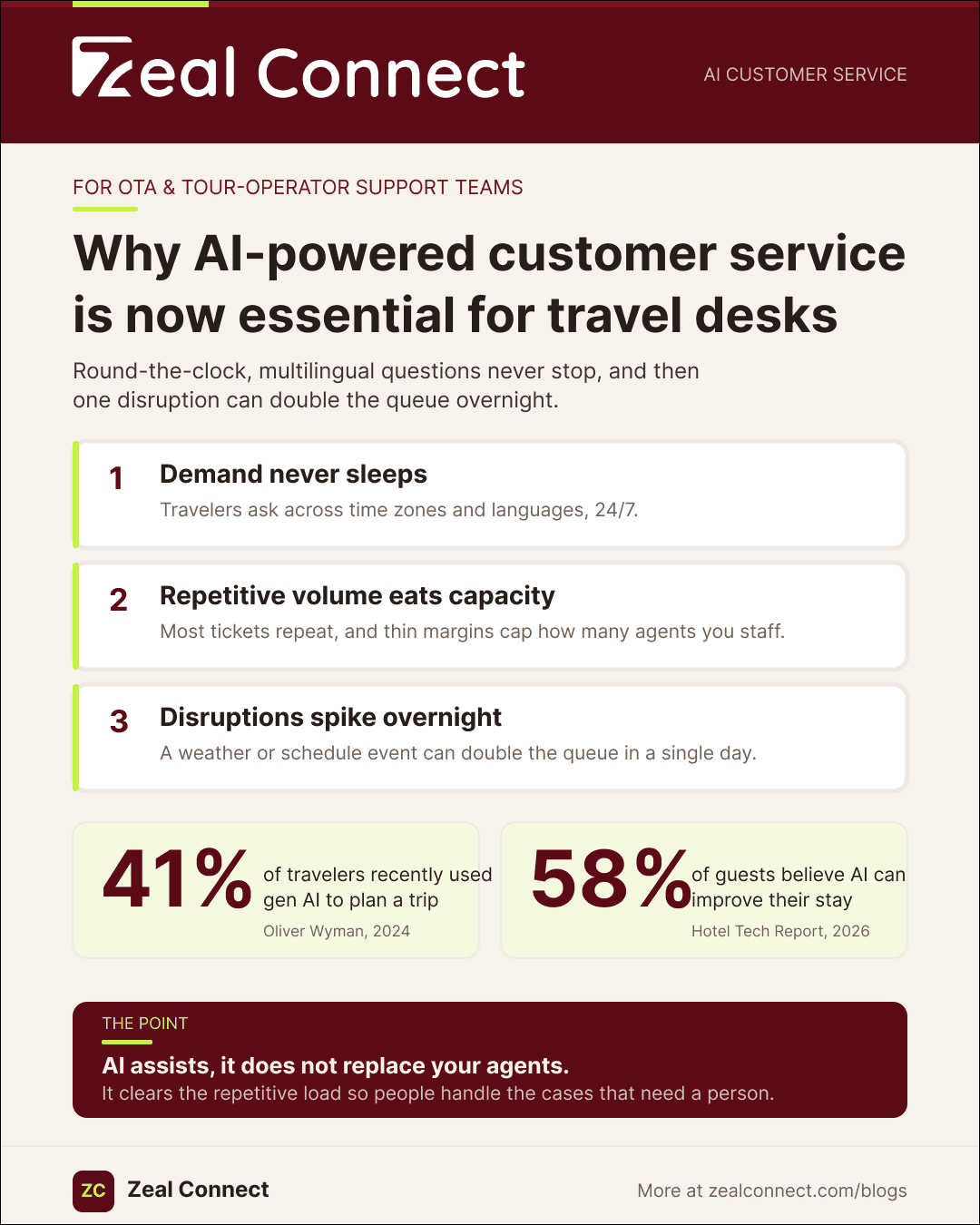
Three pressures now hit travel support at once: demand that never sleeps, queries in every language, and thin margins that cap how many agents you can staff. A disruption event then multiplies all three in a day. That mix is why AI-powered customer service has shifted from an experiment to a planning assumption for most OTAs and tour operators.
Around the clock, in any language, demand never stops
Travelers ask for help whenever their trip happens, not during your office hours. A booking made in one time zone generates a question in another, often in a language your night shift doesn't cover. Coverage gaps cost bookings, since a request answered fast tends to convert while a slow one drifts. As Arival (2025) notes, operators are automating communication to keep up without losing the personal touch.
Are travelers bringing AI expectations into travel support?
Yes, because they already use AI elsewhere in the trip. According to Oliver Wyman (2024), 41% of roughly 2,100 US and Canada consumers had recently used generative AI tools for travel inspiration or planning. That habit sets a new baseline for support. In hospitality, 58% of guests believe AI can improve their stay (Hotel Tech Report, 2026), so an instant, accurate answer no longer feels novel to them.
Thin margins make agent time the real constraint
Most travel support tickets are repetitive: where is my confirmation, can I change a date, what does this fare rule mean. Because margins are tight, you can't simply hire through every peak, so agent hours become the scarce resource. When people spend their day on questions a system could answer, the complex cases wait. AI earns its place first by clearing that repetitive load, not by taking over the hard tickets.
What does AI-powered customer service actually do, and what can't it do?
AI-powered customer service uses artificial intelligence to support a travel desk without replacing it. It answers common questions so travelers self-serve, sorts and routes incoming messages, translates across languages, summarizes long threads, and drafts replies. A human agent still reviews that reply, sends it, and closes the ticket. That last part is the line the demos tend to blur.
What AI-powered customer service means on a travel desk
AI-powered customer service is the use of artificial intelligence to handle the repetitive and behind-the-scenes parts of support: answering routine questions through self-service, sorting and routing tickets, translating, summarizing threads, and drafting replies. It speeds the work up, while human agents still make the decisions, send customer facing messages, and close tickets.
Can AI-powered customer service resolve a ticket on its own?
No. On common, low risk questions it can power self-service, so a traveler finds the answer without an agent. On everything else it assists: it drafts, summarizes, and suggests, but a person reviews and sends the reply. Across service teams, 54% depend on humans assisted by AI to resolve complex tickets (HubSpot, 2024). In travel, where a reply can commit a booking or a refund, that human check matters.
Two ways AI helps: self-service and agent-assist
There are two distinct modes, and mixing them up causes most disappointment. Self-service means the traveler resolves a common question themselves, guided by AI, with no agent involved. Agent-assist means the ticket still reaches a person, but AI has already translated it, summarized the history, and drafted a starting reply. One reduces volume; the other speeds up the work that remains. You need both, for different tickets.
AI-powered customer service assists the desk. A human still sends the reply and closes the ticket.
Key Terms Worth Knowing
A few plain definitions for the terms used throughout this article.
- Deflection (self-service): When a traveler resolves a common question on their own through an AI guided help experience, so no agent ever handles a ticket.
- Agent assist (human-in-the-loop): AI prepares a ticket, such as a translation, a summary, a draft reply, or a suggested next step, and a human agent reviews, decides, and sends.
- First response time (FRT): How quickly a request gets its first reply. It's the metric AI usually improves first, through self-service and drafting.
- Triage and routing: Automatically reading an incoming message, working out what it is, and sending it to the right team or queue.
- Escalation: Handing a ticket from AI or a frontline agent to a specialist when it involves money, policy, or an unhappy traveler.
The real tasks AI-powered customer service handles on an OTA or tour operator desk
Look past the marketing and the market's AI support tasks are fairly concrete. Some run in the background with no traveler facing message at all. Others put a person in a better position to reply. Grouping them this way, rather than by vendor feature name, makes it clear where AI is safe to start.
Tasks AI customer service can run in the background
Some tasks never touch the traveler directly, which makes them the easiest to hand over. AI can triage and route a message, tag it with the booking reference, summarize a long supplier or traveler thread into a few lines, and translate an incoming query so any agent can read it. Coverage from Parloa (2025) describes the same split between background handling and human resolution. None of these sends a reply, so the risk is low.
How does AI customer service speed up first response without replacing agents?
By answering the easy questions and preparing the hard ones. AI guided self-service lets travelers settle routine questions instantly, and it drafts replies for agents on the rest. The results show up in speed: Freshworks reports that in 2024 its Freddy agent deflected 52% of travel queries through self-service, and rail operator Eurail improved first response times by 95% after adopting AI support. Agents still send the substantive replies.
What stays with your agents
The judgment calls stay human. A booking change, a refund, a chargeback, an upset traveler after a cancelled tour, AI can gather the context and draft an option, but a person decides and sends it. As Ada (2026) frames it, AI handles the routine so agents can focus on stranded travelers and complex rebookings. The goal isn't fewer agents; it's agents spending their time where it counts.
Which AI customer service tasks should you automate first?
Rank the tasks by two things: how much volume they clear and how little can go wrong. The safest, high volume tasks that never send a customer facing resolution come first; the ones that commit money or a booking come last, and only ever with a person in control. Automating in that order keeps you from stalling in a broad rollout, a pattern McKinsey (2025) ties to sprawling, horizontal AI projects rather than focused ones.
Start with high volume, low risk tasks
Begin where the volume is highest and the risk is lowest: self-service for common questions and triage and routing. Self-service lets travelers answer their own repeat questions, and triage quietly sorts the rest to the right queue. Neither sends a resolution on its own, so you get real relief with little downside. Prove the deflection and response time gains here before you go further.
Add agent-assist next
Once self-service and routing are working, help the agents on the tickets that remain. Turn on translation so any language queries reach any agent, thread summaries so nobody reads a chain of 20 messages again, and drafted replies the agent edits and sends. This is where most of your ticket volume actually gets resolved, so speeding the human up has an outsized effect on first response time and handle time.
Which automated travel customer service tasks should wait?
Anything that moves money or changes a booking. Refunds, chargebacks, and booking amendments carry financial and policy weight, so AI should prepare the details and flag the rule, while a human makes the call and sends the reply. Coverage from Skift (2025) makes the same case for keeping people on higher stakes decisions. These tasks can automate later, as assist, never as autopilot.
Table: AI customer service tasks for travel, in the order to adopt them
| Start order | Task | What AI does (assist) | Where the human stays |
|---|---|---|---|
| Start | Self-service for common questions | Answers routine FAQs so travelers self-serve | Agent takes anything beyond the FAQ |
| Start | Triage, classification and routing | Sorts and routes messages behind the scenes | Agent works the routed ticket |
| Next | Language translation | Translates in and out so queries flow | Agent still writes the substance |
| Next | Thread summaries and drafted replies | Summarizes long threads, drafts a reply | Agent edits and sends it |
| Later | Booking changes, refunds, chargebacks | Prepares details, flags the policy | Human decides, sends, and closes |
Automate the tasks that never send a customer facing reply first. Keep people on the booking, the refund, and the send.
Conclusion
AI-powered customer service is worth adopting, as long as you're honest about what it is. It doesn't replace your agents or close tickets on its own, it assists, clearing the repetitive load and preparing the rest so people work faster. The pressure that makes it necessary is real: around the clock, multilingual, high volume demand on thin margins, with disruption spikes on top. So start where it's safe and high volume, with self-service and triage, then add translation, summaries, and drafted replies. Keep your agents on the booking, the refund, and the reply. Get that order right and AI gives you back the one thing a travel desk never has enough of, which is agent time for the cases that need a person.
Frequently Asked Questions
Can AI-powered customer service resolve a ticket without a human?
Not on its own. It can power self-service so a traveler answers a common question themselves, and it can draft, translate, and summarize for agents. But on anything that sends a reply, changes a booking, or moves money, a human reviews, decides, and closes the ticket.
Which customer service task should an OTA or tour operator automate first?
Self-service for common questions and ticket triage. Both clear high volume, run in the background or let travelers help themselves, and never send a resolution on their own. They give you the fastest relief with the least risk, which makes them the right first move before agent-assist.
Does AI customer service replace travel support agents?
No. It removes repetitive work and prepares tickets, so agents spend their time on stranded travelers, complex rebookings, and unhappy customers. Most teams pair AI with people rather than cutting headcount, because the hard travel cases still need human judgment and a human to send the reply.
How does AI handle multilingual, 24/7 travel queries?
It answers common questions through self-service at any hour, and it translates other messages so any agent can pick them up regardless of the language. Queries that need a decision still route to a person, but AI keeps first response fast when your team is offline or the request arrives in an unfamiliar language.