



TL;DR
Cloud help desk software for travel is a ticketing platform hosted on remote servers, accessed over the internet, and built around the operational complexity of travel businesses supplier coordination, booking amendments, payment disputes, reconfirmation workflows, claims handling, compliance-governed refunds, and SLAs tied to travel events rather than generic response-time averages. This guide covers what it is, the four capabilities that make a platform travel-fit, how requirements shift by sub-vertical, and a demo playbook for any shortlist.
Introduction to cloud help desk software for travel
Travel support is not customer service. It is operations under a hard deadline.
When a bedbank’s reconfirmation queue opens each morning, the most urgent ticket is not the most recent arrival it is the one whose guest checks in tonight. When an OTA’s disruption queue spikes, the tickets that matter are the ones with passengers in transit in the next four hours. When a consolidator chases a room amendment, the thread involves four parties, and the SLA clock is already running. When a travel payments team receives a chargeback, the dispute evidence window is already counting down.
Every travel business runs on hard deadlines, departure dates, check-in windows, chargeback windows, claim filing cutoffs, supplier SLAs, compliance reporting cycles. They just call them different things.
Cloud help desk software for travel is the platform category built around those deadlines, whatever form they take.
What is cloud help desk software for travel?
A cloud help desk is a ticketing system hosted on remote servers and accessed over the internet with no on-premises installation, no infrastructure to maintain. Cloud help desk software for travel takes that delivery model and shapes it around travel operations specifically.
That means the system is designed around the work travel businesses actually do supplier coordination, booking and amendment workflows, reconfirmation, payment reconciliation, dispute handling, claims management, and regulatory compliance. It is not a repurposed IT ticketing tool.
The working unit changes by business type. For an OTA, it is the booking. For a fintech or payments team, it is the transaction or dispute. For a travel insurer, it is the claim. For a bed bank or consolidator, it is the supplier thread. A travel-fit platform understands whichever unit applies and builds its schema, routing logic, and SLA engine around it.
Key Terms Worth Knowing
PNR: A passenger name record; the booking identifier linking a customer, itinerary, and fare across GDS and carrier systems.
Parent-child ticketing : A structure that links relatedbooking issues multiple legs of an itinerary, amendments on a group booking under a single parent record, giving agents full context across related work
Event-aware SLA : SLA logic that escalates tickets based on proximity to an operational deadline (departure, check-in, chargeback window, claim cutoff) rather than time elapsed since ticket creation.
Why cloud delivery matters specifically to travel
Travel operations are typically distributed agents across multiple cities and time zones work the same booking stack. A cloud platform means they all operate from the same live data, without synchronization lag.
Disruption events also create sudden, unpredictable case volume spikes. Salesforce (2024) reports that 76 percent of service organizations already anticipate higher case volumes in the year ahead in travel; that pressure arrives without warning. IATA (2024) projects passenger numbers reaching 5.2 billion in 2025, the first time the count has crossed the five billion mark. Cloud infrastructure scales elastically to absorb disruption-driven spikes; fixed, on-premises capacity does not.
A travel ticket is not a generic support request; it is an operational event with context the system must read immediately. For a booking team, that context is the PNR or confirmation number, the check-in date, and the supplier. For a payments team, it is the transaction ID, the dispute type, and the chargeback window. For an insurance team, it is the policy number, the claim category, and the filing deadline. Those fields drive everything downstream: prioritization, routing, SLA clock, escalation point.
What capabilities define cloud help desk software for travel
Not every platform that claims to serve travel actually runs a travel operation. Four capabilities separate one that does from one that merely processes travel-related tickets.
Schema requirements for cloud help desk software for travel
The platform needs to carry travel’s operational fields natively, not as custom attributes someone configures and maintains manually.
For booking-centric teams, that means booking identifier, property or route, check-in or departure date, and supplier counterparty as searchable, sortable fields inside routing rules and SLA logic. For payments and fintech teams, it means transaction ID, dispute type, chargeback deadline, and payment status. For travel insurance teams, it means policy number, claim category, coverage type, and filing window.
When these fields are native, the queue organizes itself around operational reality. When they are not, someone re-triages manually at the start of every shift.
Why does cloud help desk software for travel need multi-party supplier orchestration?
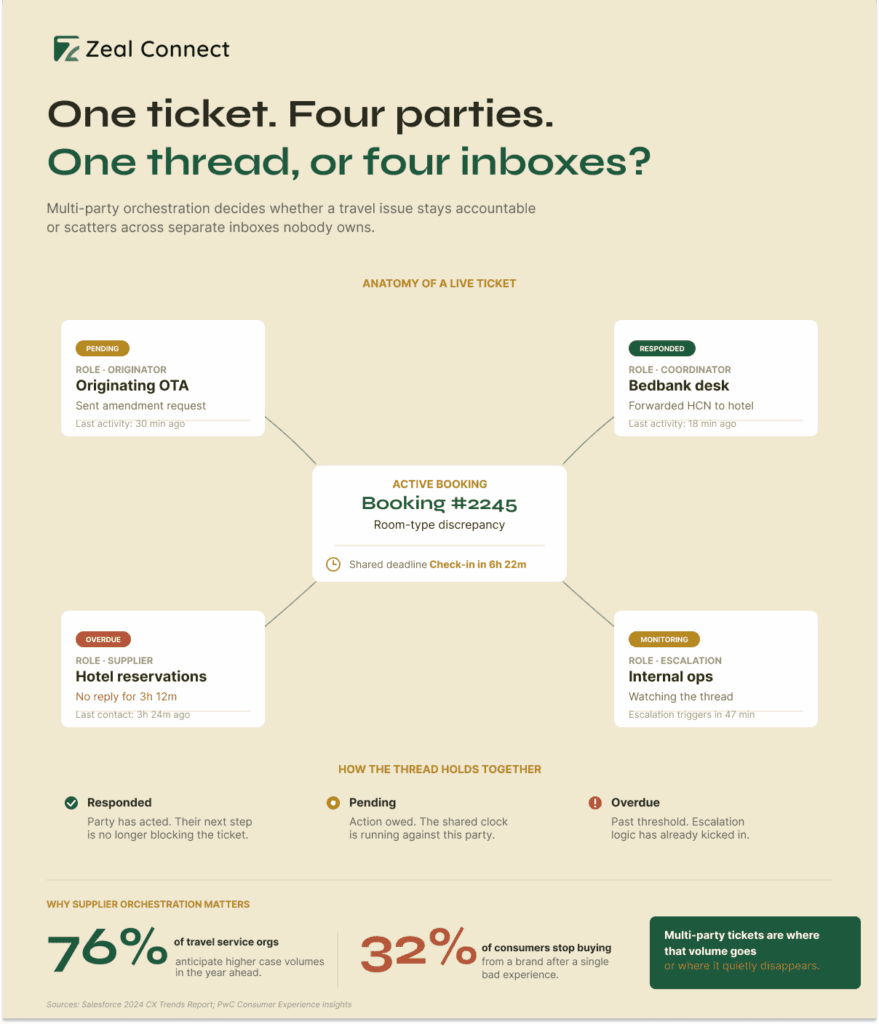
A single travel issue rarely involves one party. A room-type discrepancy might involve the OTA, the bed bank, and the hotel reservations team simultaneously. A consolidator chasing a name amendment works across an airline, a GDS record, and an internal ops team. A bedbank handling an HCN request loop between the property and its own desk until confirmation lands.
The platform has to hold all of this on one ticket tracking who has responded, who has not, what the outstanding action is, and when the deadline arrives. If that thread scatters across inboxes and spreadsheets, accountability disappears with it.
AI inside cloud help desk software for travel
The Zendesk CX Trends Report (2025) finds 90 percent of CX leaders reporting positive returns on AI tools for agents. In travel, those returns only materialise if the AI is tuned on travel language and operational structures.
An AI layer built for travel classifies a reconfirmation request separately from a room-type discrepancy or a payment dispute. It detects urgency based on departure proximity or chargeback deadline, not just sentiment. It summarizes a twelve-message supplier thread into three lines an agent can act on immediately.
AI that has not been trained on travel vocabulary deflects. AI that has is a genuine productivity layer across every queue.
McKinsey (2025) notes that AI-enabled companies captured 45 percent of travel startup funding by mid-2025, up from just 10 percent in 2023 a signal of where the industry expects operational leverage to come from.
Event-aware SLA in cloud help desk software for travel
In travel, SLA is not a fixed clock that starts when a ticket is created. It runs toward an external event that cannot move.
For booking-centric teams, that event is departure time or check-in. A hotel arriving tomorrow holds completely different urgency at 9 am versus 9 pm, regardless of when the ticket was opened. For payments and fintech teams, the event is a chargeback window or a regulatory reporting deadline. For insurance teams, it is a claim filing cutoff or a compliance cycle.
Cloud help desk software for travel applies this event-aware logic natively, so the queue reorders itself as deadlines approach without anyone manually re-triaging it.
How cloud help desk software for travel works across sub-verticals
The four capabilities above apply to every travel business. What changes is how much each one matters to your specific operation.
How OTAs and travel-tech platforms use cloud help desk software for travel
How DMCs, bed banks, and consolidators use cloud help desk software for travel
If you run a bedbank, DMC, or consolidator, your help desk is essentially a supplier communication layer. The daily work is reconfirmation, HCN follow-up, and amendment tracking across partners who respond on their own schedule, not yours.
Tickets stay open for days and must resurface at exactly the right moment. Miss the window and the guest has no room, or the booking goes unconfirmed. Supplier orchestration is the decisive capability here: tracking open actions per party, escalating when a deadline nears, holding the thread intact across the full conversation.
How TMCs and tour operators use cloud help desk software for travel
If you manage corporate travel or group tours, the ticket profile is more complex multi-leg group amendments, mid-trip supplier changes, and client SLAs that cannot wait for a standard queue.
The capability that matters most is itinerary visibility. When an agent handles a date amendment on leg two of a booking, they need to see legs one and three automatically. Parent-child ticketing provides that without forcing a manual search for related records.
How payments, fintech, and travel insurance teams use cloud help desk software for travel
Signs your travel operation needs cloud help desk software for travel
Most travel businesses do not set out to find a new help desk. They arrive at the decision because something keeps breaking and the same things keep breaking every week.
The same booking gets worked by multiple teams
Two agents pick up the same supplier escalation independently. Neither knows the other is on it. By the time the duplication surfaces, hours have been lost, and the supplier has received conflicting instructions. This happens when the help desk has no booking-centric view tickets exist in isolation, with no way to see that another thread on the same booking is already open.
When supplier follow-ups bypass your cloud help desk software for travel
Reconfirmations, HCN requests, room amendment chasers, board basis disputes when these travel over email; they leave the help desk entirely. There is no SLA on them, no visibility into whether a reply has arrived, and no escalation when a deadline approaches. The agent who sent the email is the only person who knows it exists.
Is your cloud help desk software for travel sorting by urgency or arrival time?
A ticket about a guest arriving tonight sits below a query about a booking three weeks away because it arrived in the inbox later. The agent working top-to-bottom does not know the system does not tell them. This is the most common and most expensive failure mode in travel support: urgency that is invisible to the platform.
SLA breaches are discovered after the fact
The team finds out a deadline was missed when a client escalates or a chargeback land not because the system flagged it in advance. Without event-aware escalation logic, the platform has no way to know that a ticket is about to breach until it already has.
When cloud help desk software for travel cannot scale beyond headcount
Adding agents relieves pressure temporarily, but the volume returns. If the platform has no intelligent assignment or workload balancing, new agents absorb the same inefficiency at larger scale. Rosters are managed in spreadsheets. Shift handovers lose context. Productivity is invisible.
Operational accountability is unclear
When a booking goes wrong and the post-mortem begins, no one can reconstruct exactly who did what and when. Tickets were split across email, the help desk, and a shared spreadsheet. There is no single thread, no audit trail, and no clear owner.
If more than two of these are recognizable, the help desk is not a support tool at this point it is a bottleneck.
Zeal Desk: cloud help desk software for travel, built natively
Most of the capabilities above are things a buyer has to hunt for, configure, or bolt on to an existing platform. Zeal Desk treats them as defaults, and it is built for the full breadth of B2B travel, not one slice of it.
Zeal Desk serves OTAs, bed banks, hotel wholesalers, DMCs, consolidators, TMCs, tour operators, travel-tech platforms, supplier connectivity businesses, and travel operations outsourcing teams. The common thread across all of them is a reliance on coordinating complex operational work across multiple parties, under time pressure, at scale. That is exactly what the platform is designed to absorb.
The AI layer runs the full length of every ticket regardless of business type: classification, intent detection, urgency detection, and sentiment analysis on intake; operational summarization, smart assignment, and SLA prediction through resolution. For a bedbank, that means reconfirmation workflows, HCN handling, and supplier-coordination threads tracked to resolution. For a payments or fintech team, it means dispute workflows, payment-ID tagging, and compliance-window SLA logic. For a TMC or tour operator, it means itinerary-linked tickets, amendment tracking, and group booking visibility. For a travel-tech platform, it means operational issue classification and multi-team routing.
The event-aware SLA engine prioritizes every queue around the deadline that matters for that business, a check-in for accommodation teams, a chargeback window for payments teams, a filing cutoff for insurance teams, not a generic response-time average.
Across all of them, workforce orchestration runs underneath: intelligent workload balancing, shift and roster management, and productivity visibility that gives 24/7 operations teams the structure that manual scheduling cannot provide.
Whether or not it makes your shortlist, Zeal Desk is a useful benchmark for what travel-native capability should look like across the full industry.
Conclusion
Cloud help desk software for travel manages the operational complexity of travel businesses, bookings, supplier chains, payment disputes, claims, compliance workflows, and every deadline those events carry at whatever volume disruption brings.
The four capabilities that decide a deployment: a travel-native operational schema, multi-party supplier orchestration, AI tuned on travel language, and event-aware SLA logic.
If the operational signals in the previous section are familiar, the platform your team is currently running is already working against them. The right cloud help desk for travel does not just process tickets; it gives the operation back the visibility, the SLA control, and the supplier accountability it is currently losing.