


TLD;R
- There are 5 main types of travel booking engines: B2C retail, B2B agent portals, white-label SaaS, dynamic packaging, and AI-powered engines.
- Written for travel agency owners and operations managers choosing or upgrading their booking stack in 2026.
- The right engine depends on your role in the value chain, the products you sell, and how your agency earns revenue.
What Is a Travel Booking Engine And Why Most Agencies Choose the Wrong One
The 3 Dimensions That Define Any Booking Engine
Every booking engine maps across three axes: its role in the travel value chain, the product domain it covers, and its deployment model. All three determine whether a platform genuinely fits your agency.
Who it serves : consumers (B2C), sub-agents (B2B), corporates (B2E), or metasearch. Sets your pricing model and commission structure.
What it books : flights, hotels, transfers, activities, or bundled packages. Must match your inventory mix or you end up patching disconnected systems.
Key Terms Worth Knowing
Internet Booking Engine: Software enabling travellers or agents to search, price, and confirm reservations online without manual intervention. It connects to GDSs, bed banks, and airline platforms via APIs to retrieve live availability and pricing. IBE is the technical term used interchangeably with “online booking engine” across airlines, hotels, and agencies.
Global Distribution System: A centralised network distributing inventory from airlines, hotels, and car rental companies to travel agents and booking platforms worldwide. The three dominant providers are Amadeus, Sabre, and Travelport. GDS connectivity is a foundational requirement for any full-service booking engine serving travel agencies.
NDC ( New Distribution Capability):An IATA-defined standard enabling airlines to distribute full product content ancillaries, seat upgrades, bundled fares directly to agencies and booking engines, bypassing traditional GDS routing. NDC adoption accelerated through 2025–26 as major carriers including British Airways, Lufthansa, and Air India expanded direct API programmes.
Dynamic Packaging: Real-time assembly of flights, accommodation, transfers, and activities into a single bookable and priced product, built on demand from live supplier inventory. The agency controls the markup on each component. Dynamic packaging engines automate this assembly at scale.
What Are the 5 Main Types of Travel Booking Engines?
1. B2C Retail Booking Engines : Built for the Traveller-Facing Web
A B2C booking engine is the platform your end customer books through directly your public website, branded app, or OTA-style portal with no agent involvement in the transaction.
Revenue comes from supplier commission or markups at the engine level. According to Grand View Research, 52.36% of global online travel bookings in 2025 were made via mobile apps any B2C engine must be mobile-first by architecture. The conversion challenge is equally critical: Baymard Institute records average cart abandonment in travel at 70.22%. Speed, saved search, and frictionless payment directly determine conversion.
Best suited for: Leisure retail agencies, OTA-model agencies, and tour operators selling directly to the public.
2. B2B Agent Portal Engines : Built for Your Sub-Agent Network
A B2B booking engine serves your distribution network sub-agents, franchise partners, and independent agents booking on behalf of their clients at your negotiated net rates.
It is invisible to the end traveller your agency controls markup, per-agent credit limits, and booking rules. According to Business Research Insights, the global B2B travel market is projected to reach $35.87 billion by 2026, with 72% of enterprises now prioritising digital booking solutions. B2B portals reduce quote preparation time from 2–3 hours to 15–20 minutes through unified multi-supplier search, as documented in this analysis of B2B portal capabilities.
Best suited for: Consolidators, wholesalers, host agencies, and large retail agencies managing a sub-agent or franchise network.
3. White-Label & SaaS Booking Engines : Going Online Without Building From Scratch
A white-label booking engine is a fully built platform an agency deploys under its own brand , no custom development required. The vendor manages infrastructure; the agency customises the front-end and connects its inventory.
This is the most widely adopted deployment model. According to Business Research Insights, approximately 47% of travel agencies use white-label B2C platforms. A custom-built engine costs upwards of ~$50,000 USD versus near-zero upfront for white-label, per Caryaati’s 2026 analysis. The tradeoff: agencies are tied to the vendor’s roadmap and pricing at renewal.
Best suited for: Small to mid-size agencies going online for the first time, and agencies managing upfront capital carefully.
4. Dynamic Packaging Engines : Where the Real Margins Live
A dynamic packaging engine assembles flights, hotels, transfers, and activities in real time into a single priced and confirmed itinerary with the agency controlling the markup on every component.
According to Switchfly, packaging enables profit margins of 15% to 50% versus single-digit returns on standalone airline tickets. The segment grows at 9% annually, perGM Insights.These engines require multi-supplier connectivity GDS for air, bed banks such as Hotelbeds or WebBeds for hotels, and DMC or API feeds for ground services.
Best suited for: DMCs, outbound tour operators, destination specialists, and agencies controlling multi-product inventory.
5. AI-Powered Booking Engines : The Engine Type Most Agencies Are Not Yet Using
An AI-powered booking engine uses machine learning to personalise search, predict fare windows, generate itinerary recommendations, and in its agentic form complete multi-step booking workflows across systems without human input.
As of 2026, only 2% of travel companies have widely deployed autonomous agentic AI, per Datappeal’s 2026 travel tech analysis. Yet agencies offering AI-personalised itineraries already report 18–25% increases in booking conversion rates, per TechnoHeaven and Mindful Ecotourism. For most agencies, AI today is a capability layer on top of an existing engine not a ground-up replacement.
Best suited for: Mid-to-large agencies with booking volume to generate personalisation data, and OTAs working to improve look-to-book ratios.
"The right booking engine is not the most advanced one it is the one that matches your position in the value chain, your inventory mix, and how your agency earns revenue."
Which Type of Booking Engine Is Right for Your Travel Agency?
The Traditional Leisure Agency Going Digital for the First Time
Start with a white-label B2C engine. It delivers a branded storefront, connects to standard GDS or aggregator inventory, and requires no in-house technology team. If sub-agents feed you volume, add a B2B portal, most vendors bundle both under one contract. Watch per-booking fees carefully; they erode margins silently as volume grows.
The DMC or Tour Operator Selling Packaged Experiences
A dynamic packaging engine is non-negotiable , a standalone flight booking engine or hotel booking engine cannot build, price, and confirm a bundled product in real time. For agencies in India or the Middle East, verify native support for local LCCs (IndiGo, Air Arabia, flydubai), regional bed banks, UPI, net banking, and instalment payment plans. Regional payment compatibility directly determines conversion.
The TMC or Corporate-Focused Agency
A corporate or B2E engine must enforce travel policies, route bookings through approvals, surface negotiated rates, and integrate with expense platforms. The global OTA market is projected to reach $107 billion by 2026 (Skift Research, December 2025), with managed corporate travel among the fastest-growing distribution segments.
What Makes a Booking Engine Truly "Agency-Grade"?
An agency-grade booking engine supports back-office and distribution workflows unique to travel agencies , sub-agent hierarchies, net fare management, and multi-supplier reconciliation beyond just search and payment.
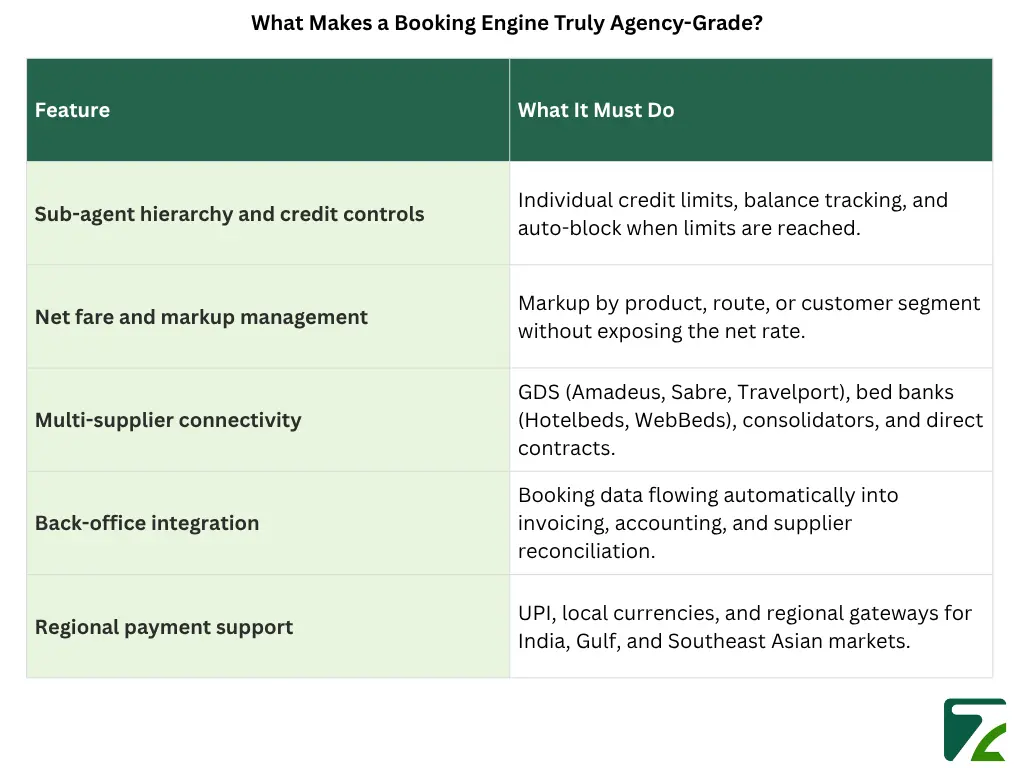
"An engine that doesn't integrate with your back-office is not saving you work it is relocating manual effort to where it costs more to fix."
Conclusion: Choose Your Engine Like You Choose Your Suppliers
Supplier selection is never about the lowest net rate alone , it is about which partner fits your product mix, your market, and your long-term model. The same logic applies here.
Each engine type serves a distinct distribution role, a different user, and a different revenue model. Map where your agency sits in the value chain. Match engine type to products and customers. Technology should follow strategy.