



TL;DR
This article explains what 24/7 customer support in travel actually requires, why the overnight window is the hard part, and how to cover it across time zones without tripling your headcount.
It is written for the ops or support leader building or fixing round the clock coverage at a travel agency, OTA, TMC, DMC, or bedbank.
You will get a working definition, a four model coverage comparison, the time zone hub math, and a severity based way to staff the night.
A flight cancels at 2am and a traveler is stranded at an airport with no return booked. Who answers? In travel, demand never keeps office hours, so round the clock customer support is not a premium add on. It is the baseline. Yet most teams get 24/7 wrong in one of two ways. They overstaff the quiet overnight hours, or they leave them uncovered and hope nothing breaks. This guide treats 24/7 customer support in travel as a coverage design problem, not a hiring problem, and shows how to solve it.
Round the Clock Customer Support in Travel Is No Longer Optional
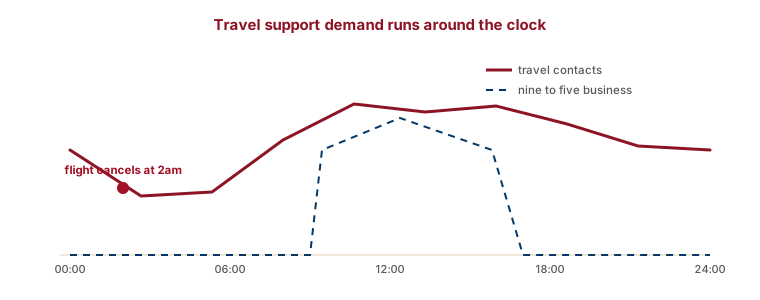
Travel is a 24 hour, global activity, so the support behind it has to be too. A booking made in Sydney can go wrong in Lisbon while your head office sleeps. Disruption is frequent and rarely polite about timing. Getting customer support in travel right therefore starts with accepting that the hardest hours are the ones your team is least likely to be awake for.
Why Customer Support in Travel Never Keeps Business Hours
The volume that lands overnight is real, not theoretical. According to SAP Concur (2024), 88% of business travelers were forced to take unanticipated steps in the past year because of delays, cancellations, or rerouting. Those moments often happen far from the traveler’s home time zone. A cancelled connection or a closed border creates an urgent request the instant it occurs, whether or not your office is open.
In travel, the hardest support hours are the ones your team is least likely to be awake for.
What an Unstaffed Overnight Costs Your Travel Support
An empty overnight queue has a price, and it is not only a missed reply. A stranded traveler who cannot reach you rebooks alone, usually at a worse rate, and remembers that you were not there. The risk is also structural. GBTA (2026) reports that 79% of business travel respondents now cite geopolitical instability and conflict as a top travel risk. Duty of care does not pause at midnight, and airlines’ overnight commitments, shown on the DOT cancellation and delay dashboard, set a bar travelers expect you to meet.
What Does 24/7 Customer Support in Travel Actually Mean?
24/7 customer support in travel means a traveler can reach appropriate help at any hour, through at least one channel, with a response that matches how urgent the request is. The clock is covered by design, sometimes a live agent, sometimes an on call manager, sometimes self service, so the right help is ready whenever a request lands. Coverage is the goal, not a full team on every shift.
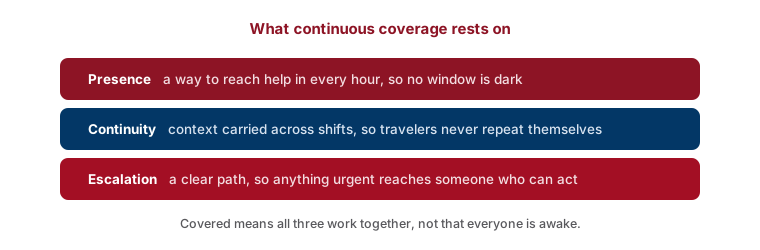
What Covered Means in 24/7 Customer Support in Travel
Being covered at 3am can take three forms: a live agent, an on call duty manager, or a self service path that handles the request without a human. What matters is that the answer fits the problem. A routine question needs a good answer, not necessarily a person. A stranded traveler needs a person with authority to act, not a chatbot. You can handle more contacts without hiring once you match the response to the request.
In travel, 24/7 does not mean everyone works all night. It means the clock is covered by design, with the right response ready for whatever arrives.
Coverage, Continuity, and Clean Handoffs in Travel Support
Continuous coverage rests on three things working together. First, presence every hour, so no window is dark. Second, continuity of context across shifts and regions, so a case handed from your Manila team to your Lisbon team carries its full history and the traveler never repeats themselves. Third, a clear escalation path, so anything urgent reaches someone who can act. Speed matters here too. HubSpot (2025) found 67% of consumers expect a support ticket resolved within three hours, a bar an overnight queue left for the morning will miss, given how slowly travel brands already answer email.
Key Terms Worth Knowing
Follow the sun: coverage handed between time zone hubs so each team works its own daytime instead of a night shift.
Coverage window / dead zone: the low demand overnight hours that are hardest to justify staffing with a full live team.
Severity tier (P1/P2/P3): the priority level of a request, which decides whether it needs a live human, an async reply, or self service.
Escalation / on call (duty manager): the person reachable after hours who gets contacted, or woken, for a genuine emergency.
Warm handoff: passing a case between shifts or regions with full context, so the traveler does not start over.
Duty of care: the operator’s obligation to assist travelers in trouble, which continues after office hours.
Four Coverage Models for 24/7 Customer Support in Travel
There are four practical models for covering the clock, and most global travel companies blend two or three of them. Each covers a different slice of the 24 hour day and fits a different operation. Before choosing, look at where your travelers actually are and what your overnight requests actually look like, because those two facts decide which model earns its cost.
The Four Coverage Models, Side by Side
Each model answers the same question differently: who is covering the clock, and for which requests? Follow the sun spreads live coverage across regions. A central hub concentrates it in one place. An outsourced overnight hands the quiet hours to a partner. A self service led model deflects the routine load and keeps a human on call for the rest. The table compares them on fit, not on which is best, because the right answer depends on your operation.
Table: Four models for covering the 24/7 clock in travel
| Coverage model | How it covers the 24 hour clock | Best fit travel operation | Where it strains |
|---|---|---|---|
| Follow the sun (regional hubs) | Live queue handed between 2 to 3 time zone hubs | Mid to large OTAs, TMCs with real regional volume | Needs volume and clean handoffs in each zone |
| Central 24/7 hub with night shifts | One location staffs rotating round the clock shifts | Concentrated, single region traveler base | Night premiums, burnout, fewer languages |
| In house day plus outsourced overnight | Your team owns peak, a partner covers the dead zone | Low but non zero overnight volume | Brand voice control, context handoff |
| Self service and AI assist plus on call | Self service deflects routine, a duty manager owns P1 | Lean teams, high routine volume, spiky severity | Only covers the deflectable band |
How Many Hubs Do You Need for 24/7 Coverage in Travel?
Three hubs, offset by about eight hours each, cover the full day with no one working a graveyard shift. Put a team in Asia Pacific, one in EMEA, and one in the Americas, and each works a normal local daytime while the world’s clock stays covered. Two hubs roughly twelve hours apart cover most of the day with a thin seam to watch. Keep a 30 to 60 minute overlap at each handoff so cases transfer with context. If your travelers span many languages, plan hubs to cover multiple languages as well as time zones.
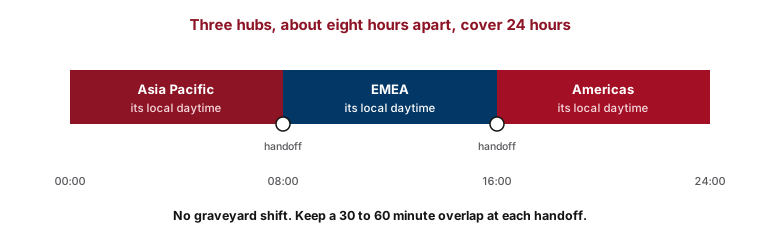
Three hubs offset by about eight hours each cover the entire day with no one working a graveyard shift.
Where Self Service and AI Fit in Overnight Travel Support
Self service is the cheapest overnight capacity you have, but only for the deflectable band. When a trip is disrupted, Perk (2025) found 33% of travelers still prefer a real time phone call to rebook, 30% prefer online self service, and just 7% choose an AI chatbot. So a well built self service layer can handle routine questions overnight, and AI can draft replies and triage the queue, but a person reviews and sends anything that touches a booking. AI assists the work, it does not close the ticket on its own. Point routine overnight questions at a good knowledge base first.
Design Overnight Customer Support in Travel Around Severity, Not Volume
Overnight volume is usually low, but its severity swings hard, so you staff the night by severity rather than by headcount. On a quiet night, a handful of routine questions arrive that can wait or self serve. Then a storm grounds flights and every contact is urgent at once. A model that staffs for average volume is wrong for both states. Sorting requests by severity is what makes round the clock customer support in travel affordable.
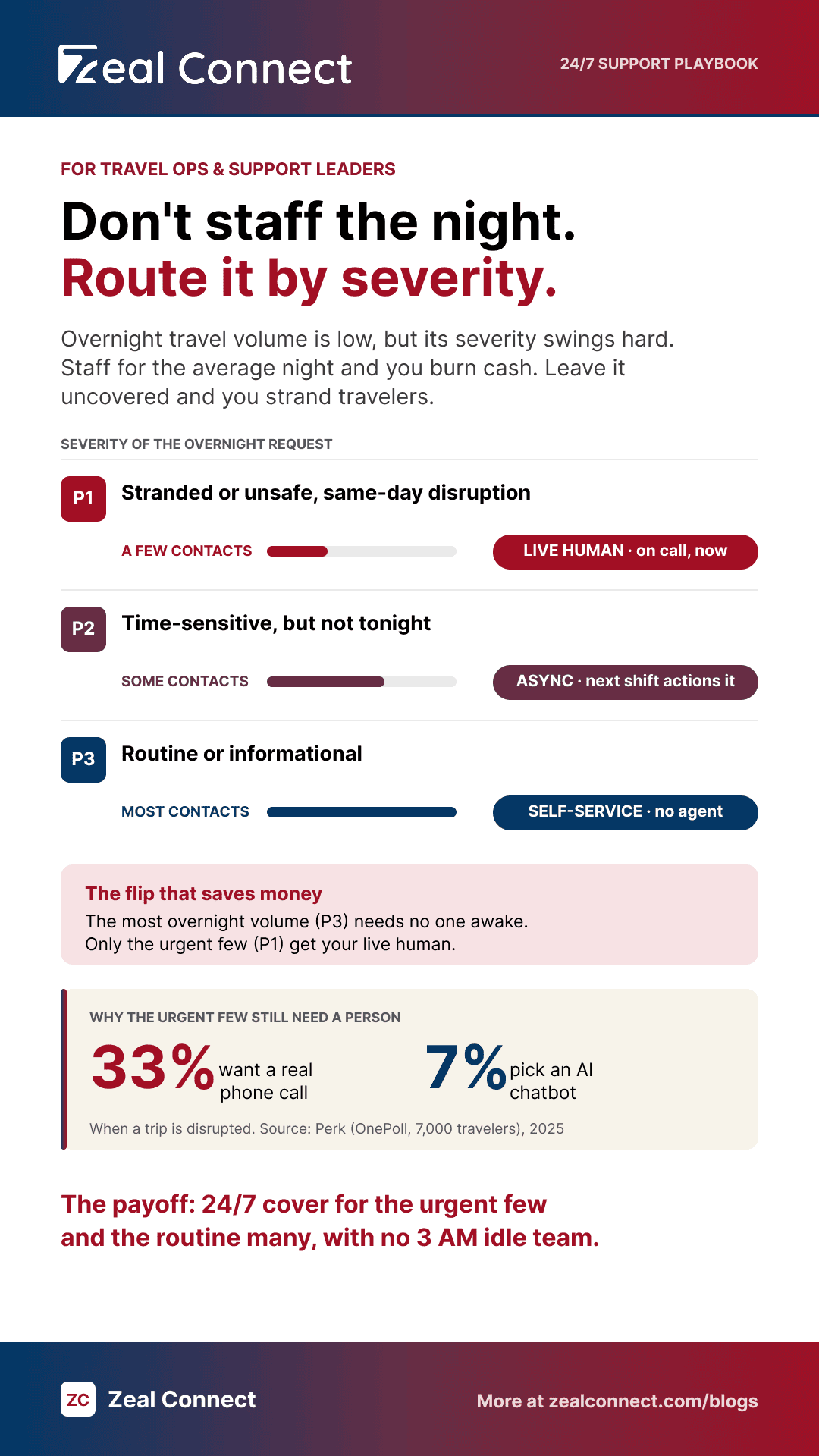
Sort Overnight Travel Support Contacts Into Three Severity Tiers
Start by putting every overnight request into one of three tiers. A P1 is a stranded or unsafe traveler, a same day disruption, or a payment failure blocking travel, and it needs a live human now. A P2 is time sensitive but not tonight, such as a change to tomorrow’s booking, and it can go async for the next shift to action. A P3 is routine or informational, like a baggage allowance question, and self service should handle it. The cause of a disruption often tells you the tier.
Overnight volume is low, but its severity swings hard. Staff the night by severity, not by headcount.
Build the Escalation Ladder and the Authority to Act
An overnight owner without authority is a message taker, not support. Decide in advance what triggers an escalation, who is on call, and who gets woken for a P1. Then give that person real authority to rebook, refund, or spend within set limits, so a stranded traveler is not stuck waiting for a manager who is asleep. This is where a partner covering your overnight needs clear rules of engagement. The speed of the response matters more than the size of the team, because 51% of consumers say they prefer a bot over a human when they want an immediate answer, according to Zendesk (2026), but only when the bot can actually help.
A Sequence to Set Up 24/7 Customer Support in Travel
Build it in five steps. First, map your contacts by hour and region so you can see where demand really sits. Second, set your severity tiers and decide what each channel does after hours. Third, pick a coverage model for each window, blending models where it fits. Fourth, design the escalation ladder and give the overnight owner authority to act. Fifth, instrument your overnight SLAs separately from daytime and watch what breaks first, because the failure is usually a handoff, not a headcount.
Conclusion
Round the clock coverage is where travel support is won or lost, because the worst moments rarely happen during business hours. The trap is treating 24/7 as a staffing problem and either overspending on idle night shifts or leaving the hours uncovered. Treat it instead as a design problem. Cover the clock by matching a model to each window, use the time zone math to decide how many hubs you need, and run the overnight dead zone by severity so a live human handles the urgent few while self service handles the routine many. Do that, and the traveler stranded at 2am reaches someone who can help, without your cost line paying for a full team to wait for the phone to ring.
Frequently Asked Questions
Does 24/7 customer support in travel mean every channel has to be live all night?
No. Some channels can go async after hours while others stay live. Reserve live coverage for severity, not for every channel. A common setup keeps phone open for emergencies, lets email and non urgent chat queue for the next shift, and points routine questions at self service overnight.
How many support hubs do we need for true 24/7 coverage without night shifts?
Three hubs offset by about eight hours each, such as Asia Pacific, EMEA, and the Americas, cover the full day with no graveyard shift. If three is not feasible, run two hubs about twelve hours apart and cover the seam with an overnight partner or a strong self service layer.
When should we outsource the overnight window in travel support?
Outsource when overnight volume is low and predictable and most of it is routine. A partner handles the dead zone cost effectively. Keep genuine P1 emergencies on an in house on call, though, because a partner unfamiliar with your suppliers cannot move as fast on a complex disruption.
How much of overnight customer support in travel can self service and AI actually handle?
Self service and AI handle the routine, deflectable band well: policy questions, booking lookups, simple changes. They do not own a disrupted rebooking or an emergency, and a person still reviews and sends any reply that touches a booking. Treat them as your first overnight layer, not your only one.
Is 24/7 support worth it for a smaller travel agency?
Yes, at the right scale. A small agency does not need three night teams. A strong self service layer plus one on call duty person can cover the clock for most requests, with a clear escalation path for the rare emergency. Match the investment to your actual overnight volume and severity.