


- This article explains the difference between omnichannel and multichannel customer service through the moment it actually shows up in travel: a traveller changing channel partway through a trip.
- It covers why travellers switch, what must carry across each switch, and how to measure it.
- It is written for operations and support leaders at OTAs, TMCs, DMCs and bedbanks who run email, WhatsApp, chat and phone side by side.
A family emails to move their airport pickup the day before they fly. Nobody replies, so they send a WhatsApp from the transit lounge. Then they land with mobile data switched off and phone the number on the voucher. That's three channels and one booking, and on many travel desks it means three agents who each start from zero. Most explanations of omnichannel vs multichannel stay abstract. In travel, the difference comes down to one moment: the switch. This article looks at what happens to a live case when the traveller moves.
Mid-Trip Channel Switches Are Where Omnichannel vs Multichannel Support Split Apart
On a quiet day, a multichannel desk and an omnichannel desk can look the same. The difference appears when an open request moves. Travellers move requests more often mid-trip than at home. The trip keeps changing what they can reach and how urgent the problem feels.
Four Reasons a Traveller Changes Channel Mid-Trip
Travellers switch channel for four reasons. The first is silence: the email got no reply, so they try WhatsApp. The second is circumstance, such as no mobile data abroad or a queue at a counter. Sometimes the job needs a person to decide, so a chat turns into a call. And for a refund or expense claim, they need the outcome in writing. When Which? tested eight airlines in April 2024, it found emails that went unanswered and phone calls that were cut off. One KLM issue stalled on email and was fixed only after the researcher phoned and reached a different agent.
In-Trip Conditions Force Channel Switches in Omnichannel and Multichannel Setups Alike
Some switches have nothing to do with your service. A traveller abroad often turns off mobile data to avoid roaming charges. The WhatsApp thread goes quiet, and the phone line takes over. According to the UK Civil Aviation Authority (2025), 64% of passengers prefer SMS for the first delay alert because it works without an internet connection. Your desk can't prevent these switches. It can only make sure the case survives them.
Why Does a Channel Switch Cost More in Multichannel Customer Service?
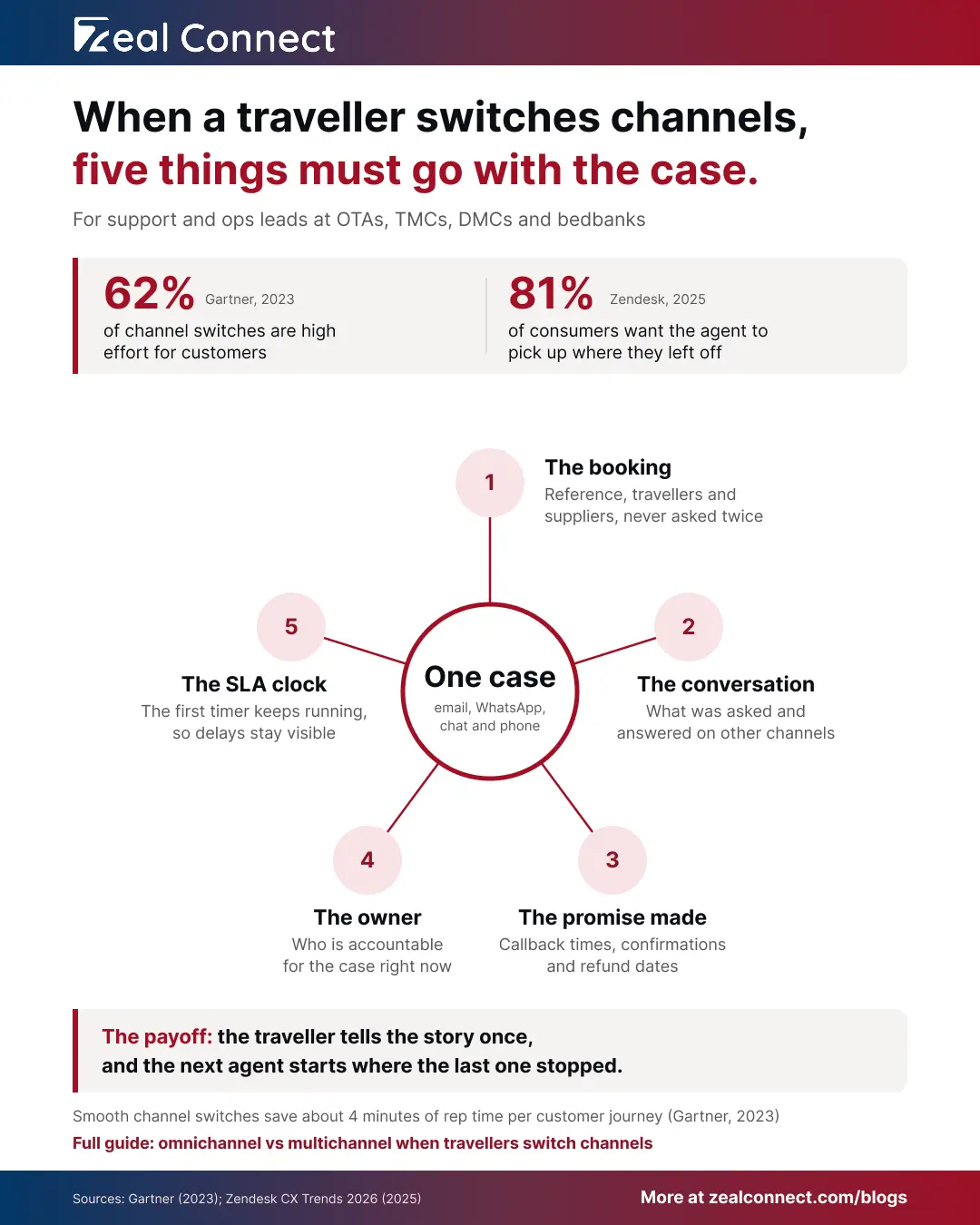
In a multichannel setup, the second channel starts from nothing. The agent asks for the booking reference, the traveller explains again, and any promise made on the first channel disappears. Gartner (2023) found that 62% of customer service channel transitions are high effort for customers. Corporate travel shows the same strain. A 2026 Christopherson survey of 123 US travel professionals found only 10% say their tools support travellers very effectively during unplanned disruptions. It also found that travellers move channel when they expect a faster answer elsewhere.
A multichannel desk restarts the case at every channel switch, while an omnichannel desk carries the case across it.
What Is the Difference Between Omnichannel and Multichannel Customer Service?
Multichannel customer service offers several contact channels, but each one runs separately with its own queue and history. Omnichannel customer service connects those channels to one shared case, so when a customer moves from email to WhatsApp or phone, the next agent sees the full history and the customer doesn't repeat themselves. For a travel desk, that decides what the second agent knows when a traveller switches.
Multichannel Customer Service: Each Channel Keeps Its Own Record
Multichannel is where most growing travel companies start. Email sits in one inbox, WhatsApp on a separate tool, and calls go to a phone team. In a multichannel contact center, agents usually specialise in one channel and handle it apart from the others. Multichannel contact center software follows the same design. One product handles voice, email and chat, yet each contact creates a new task and the history stays with its channel. That holds up as long as customers stay on one channel.
Omnichannel Customer Service: The Case Travels With the Traveller
Omnichannel keeps one case open across every channel. Say the traveller who emailed yesterday writes on WhatsApp today. The message lands on the same case, and the agent replies with the email thread in view. According to Zendesk's CX Trends 2026 research, 81% of consumers want representatives to pick up where they left off. Another 74% get frustrated when they have to repeat information. The number of channels stays the same. What changes is that each one writes to the same case.
What Must Survive a Channel Switch in Omnichannel Customer Service?
Five things must carry across every switch on a travel desk, and a shared case only helps if all five travel with it:
- The booking: reference, travellers, services and suppliers.
- The conversation so far: what was asked and answered on earlier channels.
- The promise made: a callback time, a confirmation deadline or a refund date.
- The owner: who is accountable for the case right now.
- The SLA clock: the original response timer, still running.
If any one of the five drops, the traveller feels the restart, even when the reply is quick.
Key Terms Worth Knowing
A few terms come up throughout this article on omnichannel vs multichannel customer service. Here is what each one means.
- Channel switch: A traveller moving an open request to another channel, such as from email to WhatsApp. Analysts also call it a channel transition.
- Multichannel contact center software: One product that handles voice, email and chat while keeping a separate queue and history for each channel.
- Case record: The single record of a request, holding the booking, every message on every channel, the owner, the status and any promises made.
- SLA clock: The timer for a response or resolution target. On a switch, it either keeps running on the same case or restarts on a new one, which hides the delay.
- Customer effort: How much work a customer must do to get help, such as repeating details or chasing a reply.
One Trip, Four Switches: Omnichannel vs Multichannel Side by Side
The example below is illustrative, but each step in it happens on travel desks every week. A family booked a Bali package through an OTA, with airport transfers run by a local DMC.
A Worked Example: A Bali Family Package and a Pickup Change
At 09:00 the day before departure, the family emails to move their airport pickup to 21:00. The email waits in a busy queue. At 05:00 the next morning, from a transit lounge in Singapore, they send a WhatsApp asking whether anyone saw it. A WhatsApp agent asks for the booking reference again and promises a confirmation by 18:00. At 16:40, the DMC confirms the new time by email to the OTA's supplier inbox, where nobody links it to the chat. The family lands at 20:45 with mobile data off and phones the number on the voucher. The phone agent can see neither the chat nor the DMC's email, so the family gives up and takes a taxi. Nine days later, they email the receipt and ask for a refund.
Under multichannel, that's four contacts on three channels, handled by three agents, with the story told four times. The 18:00 promise was missed because nobody saw the DMC's reply. Under omnichannel, the WhatsApp message lands on the email's case. The DMC's confirmation attaches to the same case at 16:40, so the agent sends the new pickup time before the family boards.
Common Travel Channel Switches and What Omnichannel and Multichannel Desks Do With Them
These switches turn up at OTAs, TMCs, DMCs and bedbanks alike, and each one tests the two models differently.
Table: Common mid-trip channel switches and what each support model does with them
When the Answer Arrives on a Channel the Traveller Isn't Using
The hardest switch in travel isn't made by the traveller at all. The hotel, airline or transfer company usually answers by email while the traveller waits on WhatsApp. As a result, the reply and the question sit on different channels. B2B desks see a version of this daily. A sub-agent emails a bedbank, calls the account manager, then posts about the same booking in a partner WhatsApp group. United shows what carry-over looks like when it works. During irregular operations, it gives live agents a summary of the caller's voice-bot interaction, including the booking reference and steps already completed.
In travel, the reply that settles a case often arrives on a channel the traveller never used.
How to Move From Multichannel to Omnichannel Support One Switch at a Time
You don't need to connect every channel at once. Start from the few switches your cases make most. Then decide whether your operation needs omnichannel at all, and track whether the switches you can't avoid get cheaper.
Which Switches Should You Connect First When Moving to Omnichannel?
Connect the channel pairs your cases already switch between most. To find them, pull last month's closed cases, count the ones that touched two or more channels, and list the pairs behind them. On many travel desks, a few pairs carry most of the switching. Often that means email to WhatsApp before departure and messaging to phone during the trip. A shared case across email and WhatsApp, readable by the phone team, would have covered every switch in the Bali example.
When Is Multichannel Customer Service Still Good Enough?
Multichannel is fine when customers rarely switch. Take a B2B bedbank desk whose partners stay on email, or a phone line that handles short one-touch calls. Either may lose very little by running channels apart. Multichannel contact center software is also simpler to set up, because it needs fewer integrations. The cost shows up as your share of multi-channel cases climbs, usually when in-trip volume grows or WhatsApp becomes a main channel. From then on, every switch adds a restart, and restarts pile up fast during a disruption.
Measure Omnichannel Progress by the Switch, Not the Channel Count
Track four numbers instead of counting channels:
- Multi-channel case rate: the share of cases that touched two or more channels.
- No-reply switches: switches made while the first contact was still unanswered.
- Repeat explanations: how often agents ask for details already given, from a QA sample.
- Promises kept across a switch: callbacks and deadlines met after the channel changed.
No-reply switches should fall over time. The other three show whether the unavoidable switches got cheaper. The same Gartner research found that smooth transitions save about four minutes of rep time per customer journey (Gartner, 2023).
Judge the move to omnichannel by how cheap each switch becomes for the traveller and for your team.
Conclusion
Go back to the family at Bali airport. Every channel they used was answered, so on paper the desk worked. What failed was the space between channels: the unread email, the promise nobody else could see, the supplier reply in another inbox. That is the practical gap in the omnichannel vs multichannel choice. Your job is to make each switch cost the traveller nothing and to cut the switches caused by silence. Before you compare platforms, count how many of last month's cases touched two channels and which pairs they used. That number tells you how much multichannel is costing you.
Frequently Asked Questions
What is the main difference between omnichannel and multichannel customer service?
Multichannel gives customers several channels that each run separately, with their own queue and history. Omnichannel links those channels to one shared case. An agent on any channel then sees the earlier conversation, the booking and any promises made. In travel, the difference shows up when a traveller switches channel mid-trip.
Is multichannel contact center software the same as an omnichannel platform?
No. Multichannel contact center software puts several channels in one product, but each contact usually becomes a separate task with its own history. An omnichannel platform keeps one case across channels. A quick test: can an agent on the phone read the WhatsApp chat from an hour ago without asking?
What should happen to the SLA clock when a traveller switches channels?
The original clock should keep running on the same case. If a WhatsApp message opens a new case with a fresh timer, a request that has waited 20 hours looks brand new. Your SLA reports then hide the delay. Keep one case and one clock, whichever channel the reply goes out on.
Should a travel company try to stop travellers switching channels?
Only the switches caused by silence. A traveller who moves to WhatsApp because the email went unanswered is telling you the first channel failed, so answer faster there. Switches caused by roaming, airports or the need for written proof are normal parts of a trip, and your desk should absorb them.
How can I tell if my support is really omnichannel?
Pick a recent case that moved channels and open it. Could the agent on the second channel see the earlier messages, the booking, the owner and any promise made without asking the traveller? If so, that switch was omnichannel. If they had to ask, that switch is still running as multichannel.