


- This article explains what help desk software is and what it is used for, through ten everyday examples from travel operations.
- They cover booking inboxes, amendments, supplier follow-ups, refunds, partner support, in-trip problems, disruption days, repeat questions, complaints and reporting.
- It is written for operations and support leaders at OTAs, bedbanks, wholesalers, TMCs and DMCs.
It's Monday morning. The reservations inbox is full, and a hotel still hasn't confirmed Friday's group. Meanwhile, a partner agent is asking about the same refund for the third time. Plenty of travel teams run that day from shared inboxes and mobile phones. Yet most help desk software examples online look nothing like it. They're password resets, laptop faults or lists of product names. This guide shows ten examples from travel operations instead. Each one is matched to the help desk feature that runs it, with results travel companies have published.
What Is Help Desk Software Used For in a Travel Company?
Help desk software is the system a support team uses to turn every incoming request (email, chat, WhatsApp, phone or web form) into a ticket with an owner, a status, a priority and a full history. The team then routes each ticket, tracks it against a response target and reports on the results.
In a travel company, it runs the work that follows a booking: changes, supplier confirmations, refunds, partner questions and problems during the trip.
Help desk software meaning, in five working parts
All ten help desk software examples below use the same five parts. A ticket is the record of one request. Tickets wait in a queue (often called a department), such as a hotel desk or a refunds desk. Rules assign tickets, send reminders and raise priority automatically. Service targets put a clock on each ticket, and history and reports show what happened. TechTarget describes the help desk as a tactical function for specific issues, while a service desk covers wider IT service management.
Why are most help desk software examples online IT examples?
They come from IT teams, where an agent can usually fix the problem alone, such as a password reset or a broken laptop. Travel requests behave differently. They come from travelers and trade partners outside the company, and each one is tied to a booking. Many can't move until a hotel, airline or ground handler replies. Most also carry money or a departure date.
A useful travel help desk example shows who is waiting, on whom, and how close the trip is.
Key Terms Worth Knowing
A few terms come up throughout these help desk examples. Here is what each one means.
- SLA policy: the response and resolution targets set for each queue or priority, with a timer running on every ticket so overdue work is easy to see.
- Pending status: a ticket status showing the request is waiting on someone outside the team, such as a hotel or airline.
- Linked tickets: a master ticket connected to related tickets, so one event, such as a cancelled flight, can be updated once for every traveler affected.
- Saved reply (macro): a stored response, often bundled with actions like a status change, that an agent applies in one click.
- Contact reason: the category recorded on a ticket for why someone got in touch, used in reports to see what drives volume.
Help Desk Software Examples 1 to 5: Bookings, Suppliers and Partners
The table sums up all ten examples. The first five cover the work that starts with a booking, from the inbox it lands in to the partners who sell it.
Table: 10 help desk software examples in a travel company
Example 1: One help desk queue for every booking inbox
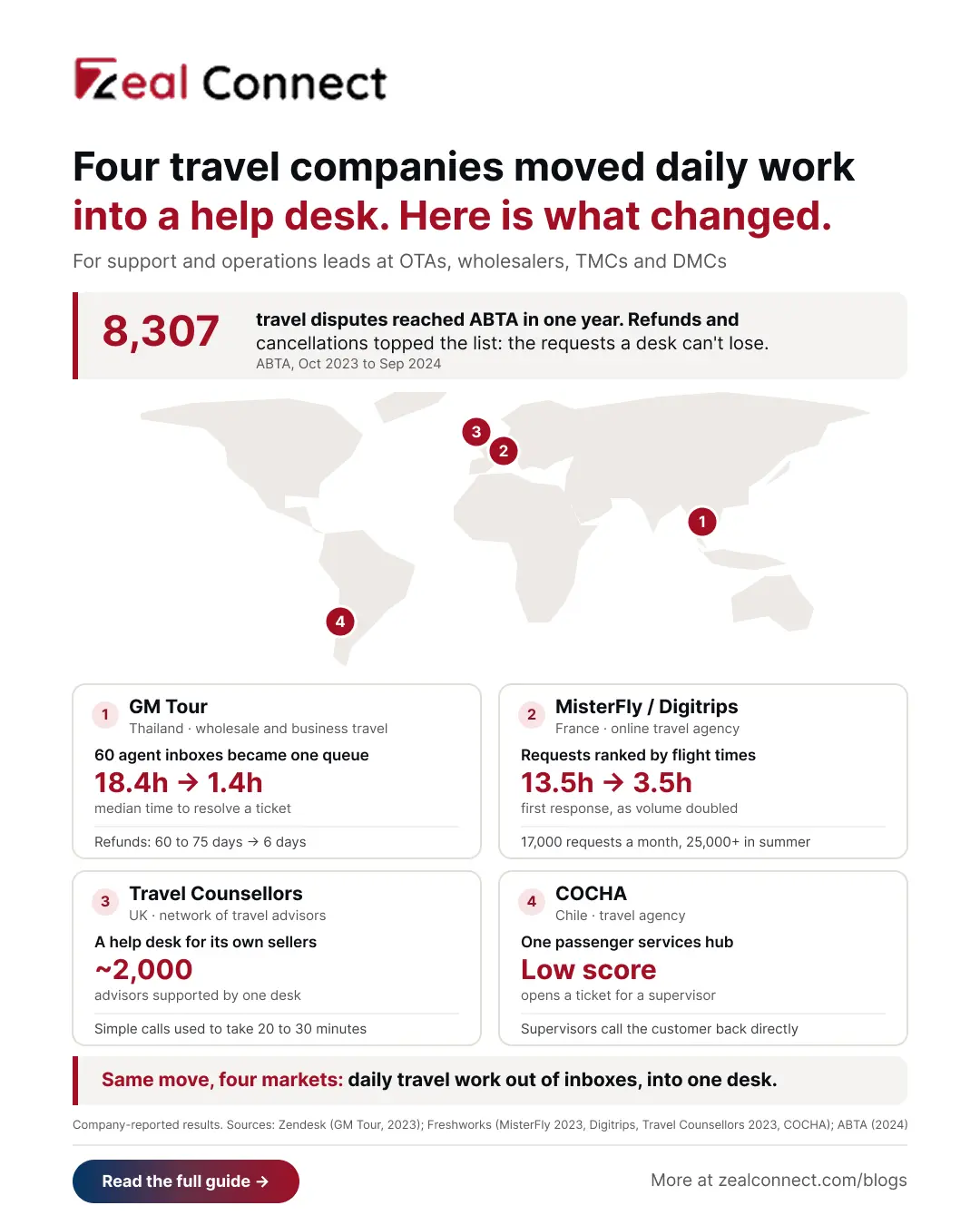
Most travel teams start here. Reservations@, groups@ and each agent's own inbox feed one queue, and every email becomes a ticket with one owner. GM Tour, a Thai wholesale and business travel agency, says its 60 agents once emailed from separate addresses with no clear standard. After moving to one ticketing system, it reports that median full resolution time fell from 18.4 to 1.4 hours.
Example 2: Booking changes recorded on the help desk ticket
Each change request carries the booking reference in its own field. As a result, every date change, name correction and room swap sits on one history. That history matters when you must show what the traveler agreed to. Since a US DOT rule took effect in October 2024, Delta asks agencies to record a customer's schedule change acceptance in the PNR. The PNR carries the code, and the ticket keeps the conversation behind it.
Example 3: Supplier follow-ups tracked with a help desk waiting status
A hotel hasn't confirmed a guest arriving on Friday. The agent emails the hotel, sets the ticket to "waiting on supplier" and notes what was asked. If no reply comes within a set number of hours, a rule reminds the owner, and that window shortens as arrival gets closer.
A pending status keeps a supplier wait visible without making the agent look late.
Example 4: Refund and cancellation requests run as tracked help desk cases
Every refund needs the same details: booking reference, reason, amount, payment method and supplier terms. A request form collects them up front. The ticket then moves through stages such as requested, supplier approved, sent to finance and paid. GM Tour says it added sample emails and simple forms to its help center. It reports that refunds now take six days instead of 60 to 75.
Example 5: A separate help desk queue for trade partners and travel advisors
Bedbanks, wholesalers and consolidators answer trade partners as often as travelers. A partner queue with its own form and response target stops a sub-agent's urgent question from waiting behind consumer email. The same setup works for your own sellers. Travel Counsellors runs a help desk for about 2,000 self-employed travel counsellors. Before it moved to ticketing for complex cases and articles for simple ones, simple issues took 20 to 30 minutes per call.
Help Desk Software Examples 6 to 10: Live Trips, Disruption and Feedback
Examples 1 to 5 deal with the booking. The next five cover the trip in progress, the busiest days of the year, and what the desk learns from its tickets.
Example 6: In-trip problems ranked on the help desk by departure time
A traveler at hotel reception with no booking on file can't wait behind a question about next month. So the desk sets priority by travel date. Tickets for anyone flying or checking in within a day move to the top. If nobody picks one up, an escalation rule alerts a team lead. Digitrips, the group behind MisterFly, says it scores inbound requests by flight times and connections. It reports first response falling from 13.5 hours to just over 3.5 as ticket volume doubled.
Example 7: Disruption days handled as one help desk event
A storm closes an airport, and hundreds of tickets arrive about one event. The desk tags each to the event and links them to a master ticket. Agents then send one approved update to everyone affected, using a bulk action and a saved reply. When new flights are confirmed, the master ticket is updated once. Seasonal peaks need the same habits. MisterFly's 100 advisors handle 17,000 requests a month, and over 25,000 in peak summer, with every ticket categorised.
Example 8: Repeat traveler questions answered from the help desk's help center
Baggage allowances, voucher wording, documents and payment links come up daily. A help center article answers travelers who look first. For those who write in, a saved reply answers in one click. Self-service won't empty the queue, though. In a Gartner survey of 5,728 customers, only 14% of service issues were fully resolved in self-service. Agents still need fast, consistent answers.
Example 9: Complaints and negative feedback escalated inside the help desk
A short survey goes out when a ticket closes or the trip ends. A low score, or a message mentioning a complaint, opens a ticket for a supervisor. COCHA, a Chilean travel agency with one passenger services hub, says its supervisors contact customers directly after negative survey responses. Caught here, a complaint is easier to settle than later, when it may arrive as a chargeback, a public review or a formal dispute.
Example 10: Help desk reports that show why travelers contact you
When every ticket carries a contact reason, a monthly report shows why people get in touch. A spike in "where is my voucher?" points to a confirmation email that needs rewriting. Likewise, repeated "no booking found" tickets from one hotel point to a supplier problem. The requests that escalate furthest are predictable too. ABTA's dispute scheme received 8,307 disputes in the year to September 2024, and refund and cancellation were the top two complaint types.
Last month's contact reasons are the clearest list of what to fix in your vouchers, confirmations and supplier contracts.
How Do You Use These Help Desk Software Examples to Check Your Own Desk?
Treat the ten help desk examples as a checklist you can run in one meeting with your team leads. Most travel desks run a few inside a help desk already. Others run halfway, and the rest live in inboxes, phones and spreadsheets.
Mark where each help desk example runs today
Give each example one of three marks: in the desk, partly, or outside. "Partly" usually means a ticket exists while the real work happens elsewhere. A supplier chase kept on a notepad is one case, and a refund tracked in a finance spreadsheet is another. Anything marked outside has no owner, no timer and no report. Those requests go missing when someone is on leave, or when a busy week doubles the volume.
Start with the help desk examples that carry money or a departure clock
Move the examples where delay costs most into the desk first. That means in-trip problems, supplier confirmations close to arrival, and refunds and cancellations. ABTA's figures show refunds and cancellations are also what travelers escalate most. Leave reporting until last, because contact reason reports are only as good as the tagging behind them. They become useful once the other nine examples run inside the desk.
Which questions show whether help desk software fits these examples?
Five checks tell you whether a help desk, yours or one you're considering, can run all ten examples:
- A booking reference can sit on a ticket as a searchable field.
- Tickets can wait on a supplier without counting as overdue.
- Partners can have their own queue and response target.
- Many tickets can be linked to one event and updated together.
- Reports can be run by contact reason without a spreadsheet export.
Conclusion
The best help desk software examples for a travel company are the jobs it runs every day, from the booking inbox and the supplier chase to the disruption day and the monthly report. Each job has a specific feature behind it. Travel companies such as GM Tour, MisterFly and COCHA have published what changed after moving that work into one system.
Your next step is short. Mark where each example runs today, then move the ones carrying money or a departure date into the desk first. The Monday inbox will still fill up. However, every request in it will have an owner, a status and a clock.
Frequently Asked Questions
What are some examples of help desk software?
Common examples include Zendesk, Freshdesk, Zoho Desk and Help Scout for customer service teams. ServiceNow, Jira Service Management and Freshservice are widely used by IT teams. Some help desks are built for one industry, including travel. The right example depends on whether your requests come from customers and partners or from employees.
What is the difference between a help desk, a service desk and a ticketing system?
A ticketing system is the record-keeping core that turns requests into tracked tickets. On top of it, a help desk answers and finishes specific requests for customers or users. The service desk is the broader IT function, covering changes, assets and service requests as well as everyday support.
Is help desk customer service the same as a call centre?
No. A call centre mainly handles phone calls as they arrive. A help desk tracks every request across email, chat, WhatsApp and phone until it's finished, including requests waiting days for a supplier. Many travel companies run both and log calls as tickets, so each booking's history stays in one place.
If we have a help center, why do travelers still contact the desk?
Because a help center covers general questions, not their booking. It can explain baggage rules or refund policy. However, it can't confirm that a hotel holds the reservation or that a refund has left finance. Gartner found only 14% of customer service issues are fully resolved in self-service.
Can one help desk serve travelers and trade partners with different response targets?
Yes. Most help desks let you set separate queues, request forms and SLA policies for each group. For example, a partner agency can have a one-hour response target while consumer email has a longer one. The same team can work both queues, and reports show each group separately.