


This article reports where helpdesk solutions for OTAs and tour operators stand in 2026: what has become standard, what is changing, and what the data projects through 2028. It's for operations and support leaders deciding whether their current desk will still fit in two years. You'll get a plain read on the modern travel helpdesk, a sourced 2025 to 2028 trajectory table, and the questions worth asking a vendor.
If you run support for an OTA or a tour operator, most buying guides for helpdesk solutions for OTAs share one blind spot. They describe what a desk does today, then leave you to sign a two year contract on it. That's a problem, because travel support is shifting underneath you. Ticket volume keeps climbing, and so does the share of it that software clears before an agent ever looks. A desk that fits this year's workload can feel dated long before the contract is up. So this piece reports where the market actually stands and where the numbers say it's going. Every figure carries a date and a named source.
The market for OTA and tour operator helpdesks in 2026
Two forces are squeezing travel support teams at once. Demand keeps breaking records. The ten busiest travel days in TSA history have all fallen since May 2024, and on July 7 that year, screenings passed three million people in a single day for the first time (U.S. DOT / TSA, 2024). Any of those trips can become a change, a cancellation, or a question. When disruption hits, a week's worth of that lands in an afternoon. Headcount rarely grows to match.
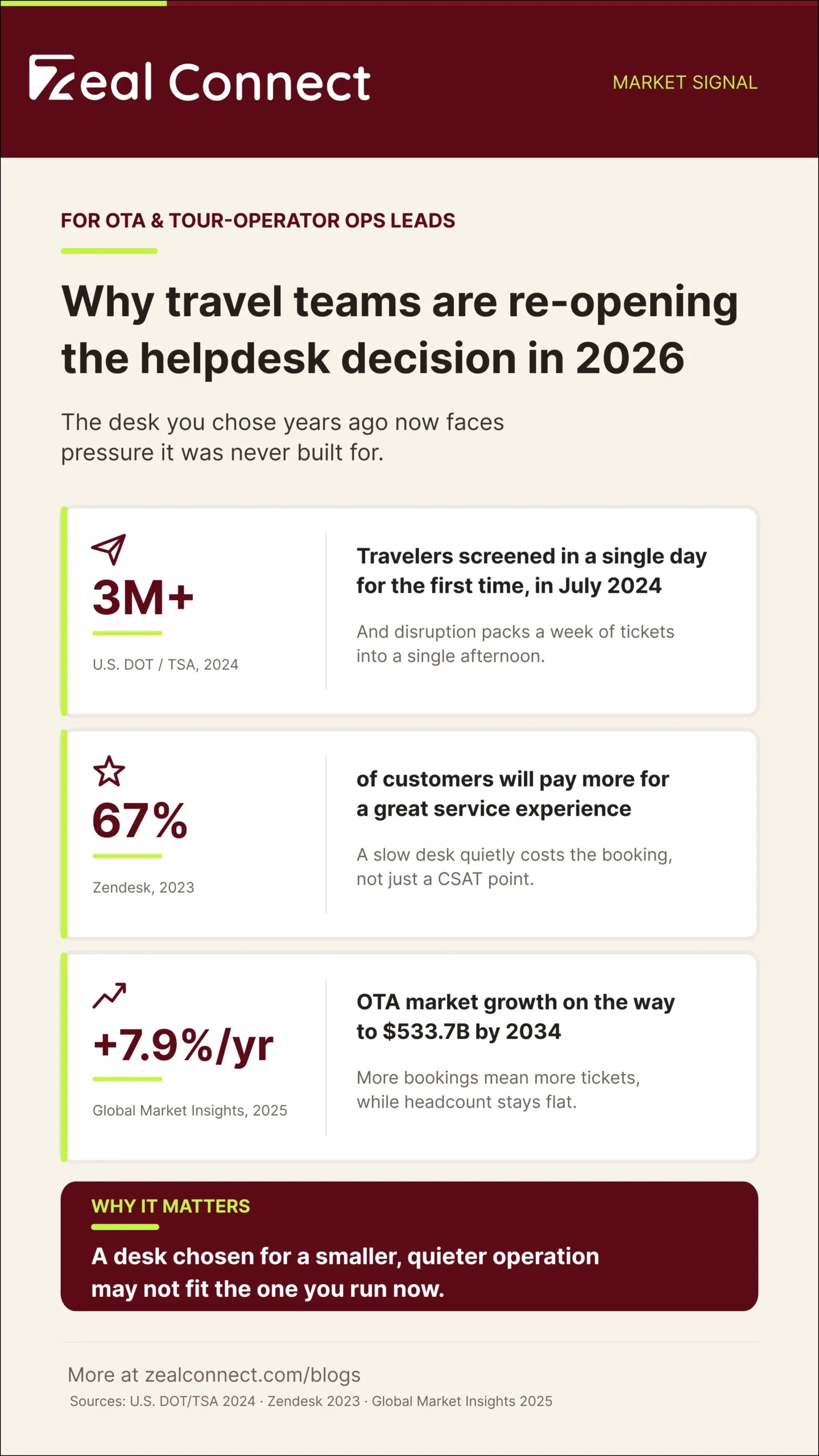
That pressure sits on top of a market that keeps expanding. The global online travel agency market was worth USD 253.2 billion in 2024 (Global Market Insights, 2025). It is on track to reach USD 533.7 billion by 2034. More bookings mean more amendments, more refunds, and more suppliers to chase. So a desk that copes at today's scale may not cope at twice it.
What has really changed, though, is how the desk gets judged. Service is now something travel companies compete on, and 67% of customers say they will pay more for a good experience (Zendesk, 2023). So when an operations lead reopens this decision, the question in the room is no longer what the licence costs. It is what the desk protects.
What counts as a travel native helpdesk now
That shift in judgement has moved the goalposts for the software itself. A travel native helpdesk links each incoming request to the live booking, pulls every channel into that one record, and uses AI to classify, extract, and summarize the work before an agent opens it. The team then resolves tickets from the reservation rather than a retyped summary. Three things that were premium five years ago now count as baseline, and it is worth being clear about each.
The first is booking aware ticketing. Retyping reservation details is the biggest avoidable time cost in travel support. A booking linked ticket removes it, so the agent sees the PNR, dates, supplier reference, and fare rules without opening another system. A tour operator feels this on amendments, where one change touches several suppliers, while an OTA feels it on refunds. Desks that cannot read the booking record directly push that work back onto agents, one ticket at a time.
Booking aware ticketing has crossed from differentiator to baseline, so a desk that cannot read the reservation now creates work instead of absorbing it.
The second is AI that handles the intake rather than the outcome. According to Freshworks (2025), AI agents deflected 52% of travel queries through self service, and first response times fell by roughly 55%. What automation does reliably is the predictable input: it classifies the ticket, extracts dates and references, summarizes a long supplier thread, and drafts a reply. The agent still reviews and sends it, because how a travel ticket ends usually depends on a supplier or a traveler, not the software.
The third is channel coverage that consolidates instead of just adding. WhatsApp Business passed 200 million monthly active users in late 2025 as airlines, OTAs, and hotels moved traveler contact onto messaging (Hotel News Resource, 2025). Covering a channel is not the same as consolidating it, though. Unless email, WhatsApp, the OTA inbox, and phone resolve into one booking aware record, the same traveler opens three tickets. Then three agents work the same problem.
Key Terms Worth Knowing
Quick definitions for the terms used across this guide.
- Deflection rate: the share of tickets resolved by self service, without an agent touching them.
- Booking aware ticketing: a ticket linked to the live reservation, so agents and automation work from the real booking.
- PNR (Passenger Name Record): the booking container holding a traveler's itinerary; it drives most agent work.
- Agentic AI: software that takes multi step actions on a ticket rather than only answering a question.
- FRT / AHT: first response time and average handle time, the metrics operations leaders manage to.
- Human in the loop: the AI drafts or suggests, and a person reviews and sends.
Where helpdesk solutions for OTAs are heading by 2028
If booking aware records and AI assisted intake are the present, the near future is mostly about how much more of the queue software absorbs. One caution before the numbers: the clearest forward looking data covers customer service across all industries, not travel alone. Travel's supplier dependency likely keeps its curve behind that one. A ticket waiting on a hotel cannot close on schedule however good the tool is.
Within that limit, the direction is consistent. Service teams estimate 30% of cases are handled by AI today, and expect that to reach 50% by 2027 (Salesforce, 2025). Their own plans point the same way: 35% of organizations intend to automate more than 60% of inbound inquiries by 2028 (McKinsey, 2024). For an OTA or tour operator, read those figures as the share AI touches, not the share it closes alone. In travel, most of it looks like drafted replies and summarized supplier threads that a person still checks before sending.
Read the 50% figure as the share of cases AI touches by 2027, not the share it closes unattended.
Set out together, the shifts are easier to weigh than any single vendor's summary of them. The table below puts five of them side by side, each with its source.
Table: What the published data says about travel support between 2025 and 2028
| What's shifting | Where it stands today | Where it's heading | Publisher |
|---|---|---|---|
| Travel demand | Record TSA volumes since May 2024 | Sustained pressure on the desk | U.S. DOT / TSA (2024) |
| Market size | USD 253.2 billion (2024) | USD 533.7 billion by 2034 | Global Market Insights (2025) |
| AI share of cases | About 30% | About 50% by 2027 | Salesforce (2025) |
| Automation of inbound | 52% of travel queries deflected | 35% of orgs plan over 60% by 2028 | Freshworks (2025) / McKinsey (2024) |
| Channel mix | WhatsApp Business past 200M users | Messaging keeps absorbing contact | Meta, via Hotel News Resource (2025) |
Choosing a helpdesk that will still fit in two years
All of that points to a simple rule for the decision in front of you. Judge a desk on the direction it is built for, not on the feature list it ships with this quarter. A desk aligned with where the market is going will still fit when the contract renews. One that only matches today needs replacing at the worst possible time.
In practice that means asking a vendor a few pointed questions. Find out how the desk reaches your booking data and what happens when that API changes. Ask where the automation boundary sits and who reviews an AI drafted reply. Check which channels ship natively rather than through a connector, and how you would export your ticket history if you left. Roadmap answers tend to be vague, so weight the answers about data access most heavily.
The same direction still reads differently depending on which business you run. An OTA handles change, cancel, and refund tickets at volume, so the deflection and automation numbers matter most, since absorbing surges without hiring is the goal. A tour operator handles fewer tickets that each take longer and lean on several suppliers. For them, booking aware records and supplier thread tracking count for more than raw deflection. Both are reading the same market, weighting it toward different work.
What ties the decision together is the cost of getting it wrong, which shows up in retention rather than licence fees. Customers now defect after just 2.4 negative experiences (Adobe, Publicis Sapient & Incisiv, 2025). Firms with strong service recovery, by contrast, see retention rise by an average of 63%. Set against the rising cost of acquiring each traveler, a desk that slows resolution during a disruption week is expensive in ways finance notices later.
A desk that stalls during a disruption week costs more in lost retention than its licence ever saves.
Where Zeal Desk fits the travel helpdesk market
The shifts described here are the assumptions Zeal Desk was built on, because it is built only for travel. General purpose desks such as Freshdesk, Zendesk, and Zoho Desk serve travel teams capably. But they are made for any industry, so bookings and suppliers arrive as configuration work rather than native concepts. That difference is where a travel native desk earns its place.
On the booking aware side, Zeal Desk organizes work around bookings rather than isolated tickets. Parent and child linking keeps a booking and its amendments connected as one case, so a group of forty travelers reads as a single thread. Its integration hub registers external APIs and pulls live booking records onto ticket fields. Smart summaries then condense a long supplier chain into one line of current state. A general purpose desk does not know what a booking is, so those links become custom fields someone maintains.
On the automation side, it leans into the same boundary the data describes. Smart classification and field extraction tag dates, references, and amounts as tickets arrive, and SLA prediction flags an escalation before it breaches. AI playbooks encode each customer's travel policy and suggest the next action, grounded in the live booking. The AI drafts; the agent reviews, edits, and sends the reply. That line matters more in travel than elsewhere, because the outcome usually waits on a supplier's answer rather than the software's.
Conclusion
Travel support is mid shift rather than settled. Demand keeps rising, and booking aware records and AI assisted intake have become baseline rather than premium. The data also points toward a larger automated share of the queue by 2027 and 2028. What is not changing is who owns the response, since a ticket waiting on a supplier still needs a person to judge the reply. So weigh a helpdesk on the direction it is built for and on how it handles your booking and supplier work. Then ask where its automation stops and who reviews what it drafts. That answer will age better than any feature comparison you run this quarter.
Frequently Asked Questions
What is the difference between a travel helpdesk and a general purpose help desk?
A travel helpdesk links each ticket to the live booking, supplier, and traveler as native concepts. A general purpose desk treats every message as a standalone ticket. Booking fields, supplier threads, and amendment logic all become custom configuration someone maintains.
How much of travel customer support can realistically be automated today?
Automation reliably handles the predictable input: classification, field extraction, thread summarization, reply drafting, and deflection. Self service reached 52% of travel queries in 2025. Resolution is different, because it usually depends on a supplier or traveler reply that no software controls.
Will AI replace travel support agents by 2028?
The published projections point to AI handling a larger share of cases, not to agents disappearing. Travel tickets frequently wait on a supplier and carry refund or compliance weight. The realistic pattern is AI drafting and summarizing while an agent reviews, edits, and sends.
When should an OTA or tour operator replace its current helpdesk?
Replace it when agents routinely retype booking details, or when the same traveler opens duplicate tickets across channels. Recurring peak week hiring is a third sign. Those signs indicate the desk is adding work rather than absorbing it.