

- Customer support in travel splits into two different operations: a B2B pipeline serving the businesses that resell or manage travel, and a B2C pipeline serving the individual traveler.
- This article explains how the two pipelines differ across SLAs, channels, money, automation, and metrics, and gives you a two pipeline rulebook to run both.
- Written for operations and support leaders at any travel company, it ends with how to keep one desk from underserving either side.
Picture your support inbox on a normal morning. Some tickets come from businesses that resell or manage travel, and some come from the people actually taking the trips. Those are your two customers, and most travel companies serve both from the same team. The trouble starts when you treat them as one. A partner agency and a stranded traveler want almost opposite things, so a single queue built for the average serves neither well. That gap is where customer support in travel quietly breaks.
In Travel, Customer Support Runs on Two Pipelines, Not One
Before you can fix the desk, you have to see that it is really two desks wearing one badge. A travel company sells to businesses and to travelers, and each group arrives with its own problems, its own urgency, and its own idea of good service. Once you separate the two customers, the daily friction on the desk starts to make sense.
Most Travel Companies Serve Both a Business Customer and a Traveler
Start by naming the two customers, because they are easy to blur. A bedbank or consolidator supports agencies; an OTA supports travelers plus its affiliate partners; a DMC supports overseas trade clients; a TMC supports corporate accounts and their travelers; a tour operator sells direct and through agents. The scale of the business side is often invisible from the outside. A bedbank alone connects hotels with more than 60,000 travel distributors across 135 markets, according to HBX Group (2026). Behind that reach sits a support desk serving businesses, not travelers.
Why Does One Customer Support Playbook Fail Across B2B and B2C in Travel?
Because the two customers judge good service by opposite standards. The partner wants depth, continuity, and a contact who already knows the account. The traveler wants a fast, correct answer right now and forgives almost nothing during a disruption. One optimizes for the account; the other optimizes for the moment. So a single queue, SLA, and metric cannot fit both, and whichever customer the desk is not tuned for pays for it, usually the high value partner stuck behind a wall of consumer tickets. For routine traveler questions, good self service takes pressure off the queue.
The Two Support Pipelines Carry Different Money, Not Just Different Tickets
That account versus moment split shows up most sharply in the money. The B2B side runs on net rates, credit lines, commissions, and settlement cycles, the same wholesale plumbing behind the bed banks and wholesalers that sell to the trade. The B2C side runs on card payments, refunds, and chargebacks. So a settlement dispute and a consumer refund are not two versions of one ticket. They need different evidence, different systems, and different specialists.
A growing travel company is really running two support operations at once, one for its business partners and one for its travelers.
What B2B and B2C Customer Support in Travel Actually Mean, and the Rules Each Runs On
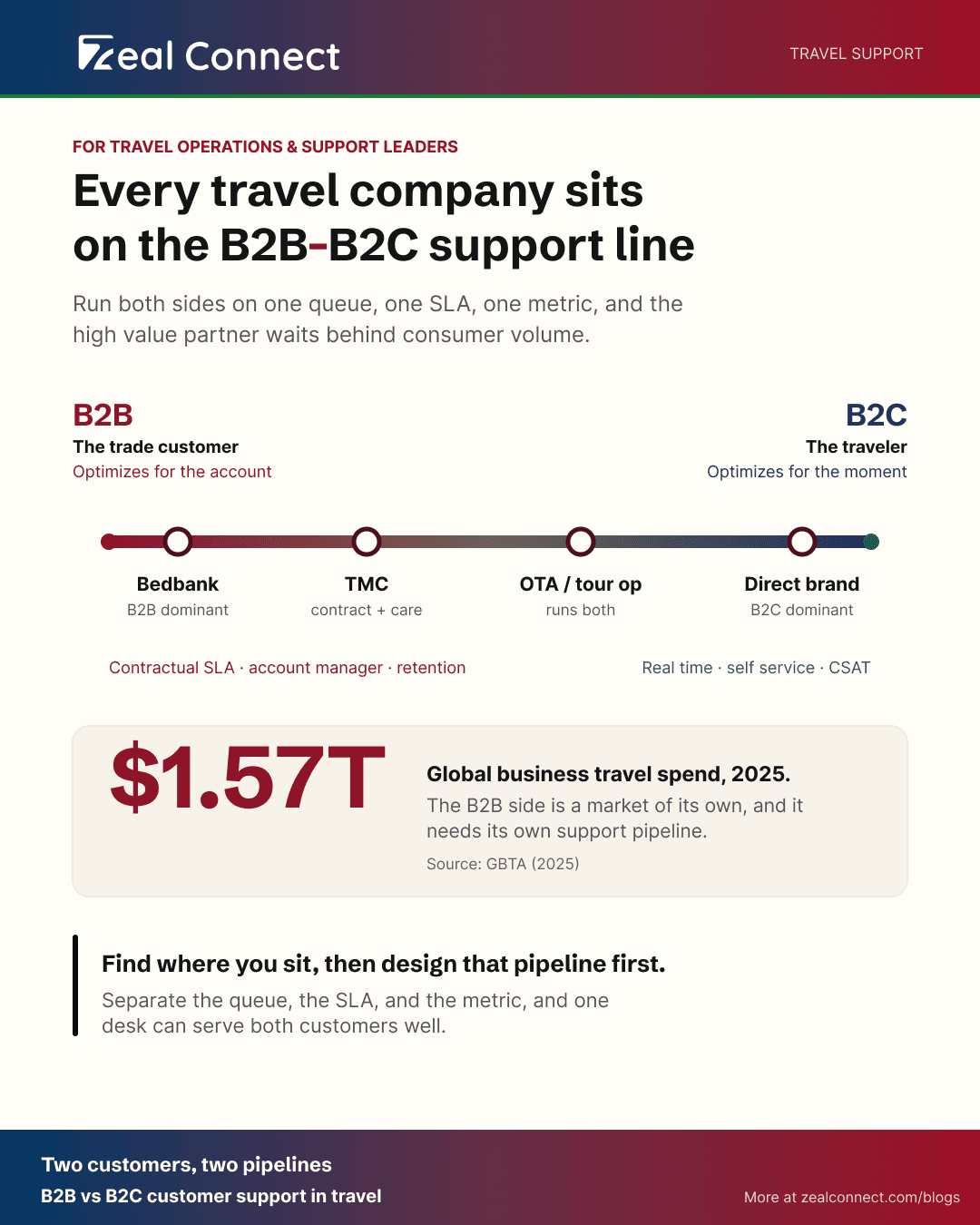
If you are running two operations, the useful question is what each one is built to optimize. In travel, B2B customer support serves the businesses that resell or manage travel, agencies, corporates, tour operators, and suppliers, while B2C customer support serves the individual traveler. The two share a help desk, but they run on different rules. B2B optimizes for the account, because one partner represents many bookings. B2C optimizes for the moment, because one traveler needs one problem fixed now. Everything below follows from that split.
B2B support optimizes for the account; B2C support optimizes for the moment. Every other rule follows from that one split.
The B2B Support Pipeline Optimizes for the Account
Take the account rule first. A trade partner expects a named account manager, a response time written into a contract, and support that remembers the last conversation. Continuity matters more than raw speed here. In fact, 74% of consumers are frustrated when they have to repeat information, and 67% expect brands to tailor support based on prior interactions, according to Zendesk (2025). For a business client, that memory is the relationship. Lose one account and you lose its whole book of bookings, not a single sale.
The B2C Support Pipeline Optimizes for the Moment
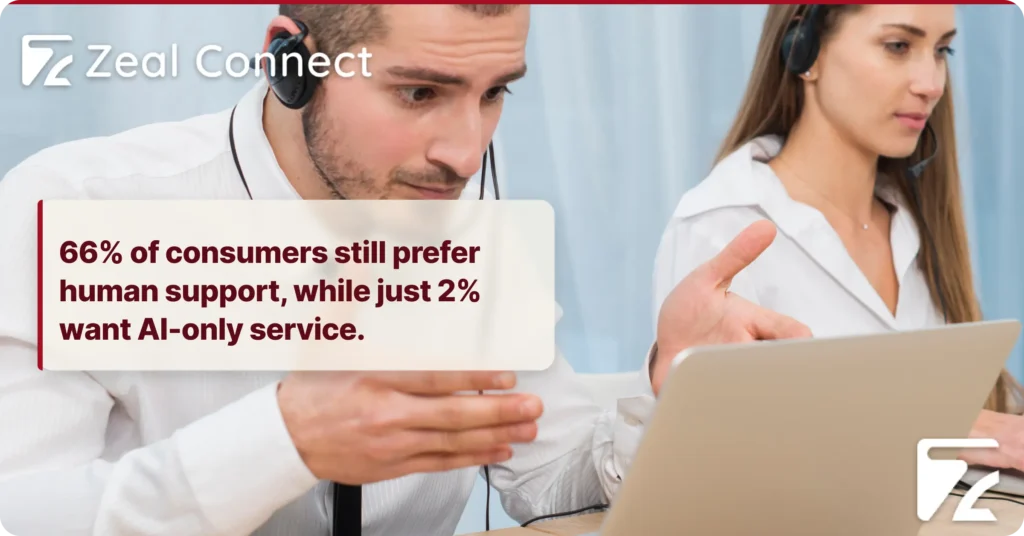
The moment rule is almost the mirror image. Travelers handle routine questions themselves, reach out through chat and messaging, and want a person the instant a trip is on the line. Most still prefer that person: 66% of consumers prefer human led support over AI, and only 2% want to deal exclusively with an AI chatbot, according to Pegasystems (2026). So the pipeline has to absorb routine volume cheaply while keeping a real agent ready for the hard moment, which is the opposite balance from the B2B side.
The Rulebook: Where B2B and B2C Support Diverge
Put those two rules side by side and the differences line up on every dimension that matters operationally. The table sets the B2B rule beside the B2C rule, so you can see exactly where a shared desk needs to split.
Table: The two pipeline rulebook, where B2B and B2C customer support in travel diverge
| Dimension | B2B pipeline (trade customer) | B2C pipeline (traveler) |
|---|---|---|
| Who the customer is | A business reselling or managing travel | The individual traveler |
| Typical request | Amendments at volume, settlement, integration | Booking changes, refunds, disruption help |
| SLA basis | Contractual, often penalty bound, tiered | Best effort, real time in disruption |
| Primary channels | Email, partner portal, account manager | Chat, messaging, self service, phone |
| Money model | Net rates, credit lines, settlement | Card payment, refunds, chargebacks |
| Automation fit | Automate the paperwork, keep it human | Deflect routine, proactive alerts |
| The metric that matters | Contract SLA attainment, retention | First response time, deflection, CSAT |
Key Terms Worth Knowing
A few terms worth pinning down before you split the pipelines:
- Trade customer (B2B): an agency, corporate, tour operator, or supplier that buys or resells travel, rather than the end traveler.
- Contractual SLA: a response or resolution time written into a partner agreement, often penalty bound and tiered, unlike a best effort consumer target.
- Duty of care: an organization's legal and moral obligation to protect and support the travelers it sends on the road.
- Net rate and settlement: the wholesale price and the credit or invoice cycle behind a B2B booking, unlike a consumer card payment.
- Warm handoff: passing a self service or automated conversation to an agent with the full booking and account history attached.
- Account manager: a named owner of a B2B partner relationship who handles escalations the consumer queue is not built to carry.
How Do the B2B and B2C Customer Support Pipelines Play Out Across Travel Companies?
The rulebook explains how the pipelines differ; where you feel that difference depends on what your company sells. Some travel businesses live almost entirely on one side, and many run both at once. Three common shapes show which pipeline dominates, and where the strain lands during a busy week.
Bedbanks and Consolidators Run a B2B Dominant Support Pipeline
At one end sit the pure B2B operators. For a bedbank, wholesaler, or consolidator, nearly every ticket comes from a business: amendments at volume, credit and settlement disputes, integration issues, and contracted rate questions. Each one routes to the account owner who knows the partner. Because a single agency can represent thousands of bookings, one churned account takes a book of business with it, so getting the hard case right beats raw speed. Much of it comes down to supplier coordination across the parties behind one booking.
OTAs and Tour Operators Often Run Both Pipelines at Once
In the middle sit the companies that carry the full split. An OTA or tour operator handles consumer disruption and refunds in the B2C queue, while affiliate and agent partners send B2B tickets to the same team. The trap appears during a spike. When a storm or an outage floods the consumer queue, a blended desk quietly parks the partner behind hundreds of traveler tickets, and the account that took years to win waits its turn. Running both pipelines is fine; running them through one undifferentiated queue is what hurts.
During a consumer spike, a blended queue leaves your highest value partner waiting behind travelers.
Where Does a TMC Sit, B2B Contract or B2C Care?
At the far end sit the hybrids, and a travel management company is the clearest one. Its paying customer is the corporate, so the relationship is a B2B contract with duty of care obligations written in, the same duty behind any corporate travel program. Yet the person contacting support is an individual business traveler who needs a fix in real time. Business travel is a large market to serve this way, projected to reach US$1.57 trillion in 2025, according to GBTA (2025). So a TMC has to hit a contractual SLA and a stranded traveler moment at once, which no single pipeline playbook handles well.
How to Run Both Customer Support Pipelines in Travel Without Breaking Either
Whether you lean B2B, lean B2C, or run both like a TMC, the fix is the same: stop stretching one operation over two customers. Running both pipelines well is a design decision, not a staffing one. Separate what needs separating, the queue, the SLA, the routing, the automation, and the metric, while keeping one shared record so nothing gets retyped. Get that right and one desk serves both; blend everything into one flow and both customers drift toward an average that fits neither.
Separate the Support Queues, SLAs, and Routing Before You Scale
The separation starts at intake. Tag the customer type on the way in, then route from there. Send the B2B side to a contractual SLA and account based routing, and the B2C side to a real time, self service front door. Good travel customer support software makes that split at the point of entry rather than leaving agents to sort it by hand. The shared record still travels with the ticket, so a partner never re explains the account and a traveler never repeats the booking. Skip this step and every later fix fights the queue instead of the problem.
Which Customer Support Tasks Should Be Automated in Each Pipeline?
Automation is where the two pipelines want almost opposite things. On the B2C side, a self service front door and proactive disruption alerts take routine volume off the queue, which is exactly where support automation earns its place. On the B2B side, the same reflex backfires. Automate the paperwork, the amendment forms and the status lookups, but keep a human on the account. A partner pushed into a chatbot reads it as being demoted from a relationship to a transaction. Given that only 2% of customers want a bot alone, that is a costly signal to send.
Measure Each Support Pipeline on Its Own Numbers
The last thing to separate is the scorecard, because you cannot manage two pipelines with one number. Track the B2C side on first response time, deflection, CSAT, and cost per contact. Track the B2B side on contract SLA attainment, partner retention, and resolution latency on tickets that wait on a supplier. Read them side by side, never averaged.
Two pipelines need two scorecards. A strong consumer CSAT can hide a partner SLA you breach every week.
Conclusion
Customer support in travel is really two operations sharing one roof. The B2B pipeline serves a business, runs on a contract, and lives or dies on the account. A B2C pipeline serves a traveler, runs on the clock, and lives or dies on the moment. Yet the mistake almost every growing travel company makes is running both on one queue, one SLA, and one metric. That quietly underserves whichever customer the desk was not tuned for. Map your own tickets to the two pipelines, separate what needs separating, and measure each on its own numbers. Start with whichever pipeline is breaking first, usually the partner stuck behind consumer volume.
Frequently Asked Questions
What is the difference between B2B and B2C customer support in travel?
B2B support serves businesses that resell or manage travel, such as agencies, corporates, tour operators, and suppliers, and it optimizes for the account: depth, continuity, and a contractual SLA. B2C support serves the individual traveler and optimizes for the moment: speed, self service, and real time care during disruption.
Can one help desk handle both B2B and B2C travel support?
Yes, if you separate them inside it. Use different queues, SLAs, routing, and metrics so a high value partner ticket never waits behind consumer volume. One shared record keeps context, while the split keeps standards. A single blended queue on one SLA is what underserves both customers at once.
Why do B2B travel customers need a different SLA?
Because their agreement often writes response and resolution times into a penalty bound contract, and one partner represents many bookings. A missed partner SLA can breach that contract and cost you a whole book of business, not just one sale. Consumer SLAs, by contrast, are best effort and reputation bound.
Should travel companies automate B2B support the same way as B2C?
No. In B2C, self service and deflection absorb routine volume well and cut inbound contacts. In B2B, automate the paperwork, such as amendment intake, data extraction, and status updates, but keep the relationship human. Deflecting a trade partner into a chatbot damages the account you are trying to keep.
Which metrics matter for B2B versus B2C travel customer support?
B2C runs on first response time, deflection, CSAT, and cost per contact. B2B runs on contract SLA attainment, partner retention, and resolution latency on supplier dependent tickets. Measuring both on one blended number hides the pipeline that is failing, so review the two scorecards side by side.