


- Scaling customer support in travel is a volatility problem, not a growth problem, because the volume that breaks a team arrives on the one day you cannot predict.
- This article reverse engineers how Airbnb, Expedia, Booking.com, and Delta each handle it, showing the four different bets they make and the trade off in each.
- Written for operations and support leaders, it ends with how to pick the bet that fits your own load shape.
Most days, a travel support queue is quietly predictable. You know roughly how many messages will land, and you have staffed for them. Then a storm closes an airport or a software outage grounds a fleet, and that same queue swells to five or six times its size before lunch. That surge, not the quiet Tuesday, is the real test of customer support in travel at scale. The companies that pass it best did not all solve the problem the same way. Airbnb, Expedia, Booking.com, and Delta each rebuilt a different part of the support flow, and their choices are worth borrowing.
Customer Support in Travel Is Defined by Its Worst Day
Growth is not what makes support hard to run in travel. Volatility is. Most of the year, volume sits near an average you can plan around. But travel runs on disruption, and disruption does not arrive politely spaced out. It lands all at once, on a day nobody picked, with a crowd of anxious travelers behind it. So your capacity has to be built around the worst day, because that is the day your customers will remember.
One Bad Day Sets Your Customer Support Requirement
Your capacity requirement is set by your worst day, and monthly averages hide it. Consider one event. On 19 July 2024, a faulty CrowdStrike software update knocked airline systems offline worldwide, and 64 percent of US passengers had a flight delayed or canceled that day, according to AirHelp (2025). Across the year, 236 million US passengers were disrupted. A team rostered for a normal Tuesday cannot absorb a morning like that. Plan for the average, and the peak is exactly where your travelers get let down.
Why Can't Travel Companies Just Hire for Customer Support at Scale?
The obvious fix for a volume problem is to add people, and in travel it quietly fails. Staffing for the peak means paying for a large team that sits idle most of the year. Hiring only once the spike lands is worse, because a capable travel agent is not a temp; they need weeks to learn fares, systems, and how your suppliers behave. Travel is labor hungry too, supporting 366 million jobs in 2025 and one in three new jobs worldwide, according to WTTC (2026). Trained people are not sitting spare.
One Disruption Cascades Into a Support Spike
The peak is so steep partly because one problem rarely stays one problem. A delayed aircraft is late for its next flight, and every knock on strands another set of travelers, which is why reactionary delay was the biggest single cause of flight delay in Europe in 2024, at 46 percent of all delay minutes, according to EUROCONTROL (2025). Each broken connection becomes a rebooking, a refund, or a furious message. One weather front, and a calm morning turns into thousands of contacts by noon.
In travel, the day that decides your capacity is the one you cannot forecast, when a single disruption multiplies contacts within the hour.
The Biggest Travel Companies Handle Customer Support at Scale With Four Different Bets
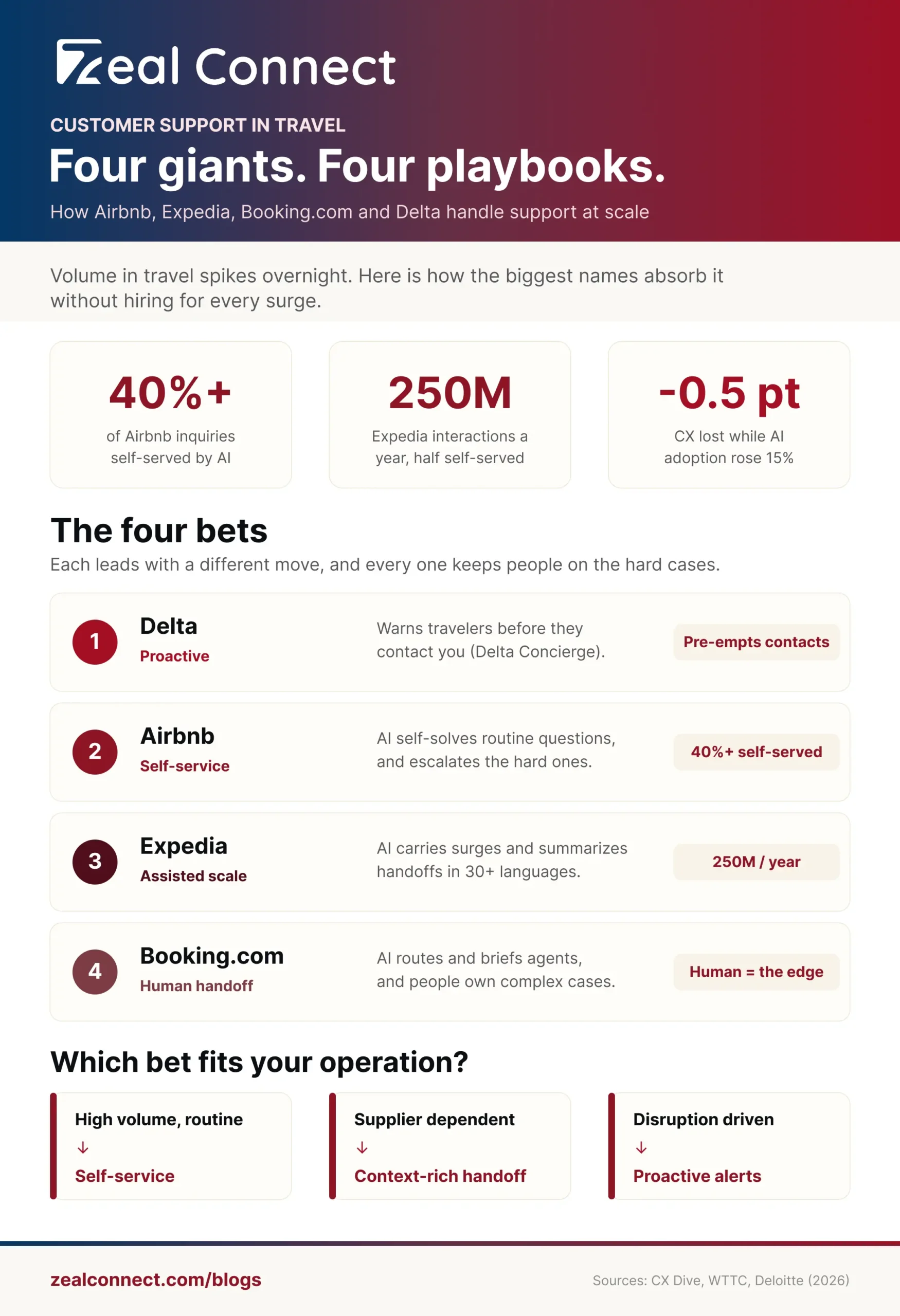
If you cannot hire through the peak, the load has to be absorbed somewhere else, which is the real story of how customer service in travel scales. Handling customer support in travel at scale means absorbing spiky, unpredictable volume without adding a person for every extra contact. In practice it comes down to four moves: stopping contacts before they start, letting travelers help themselves, shrinking the effort each contact takes, and protecting the human handoff. Each big platform built its operation around a different one, on purpose.
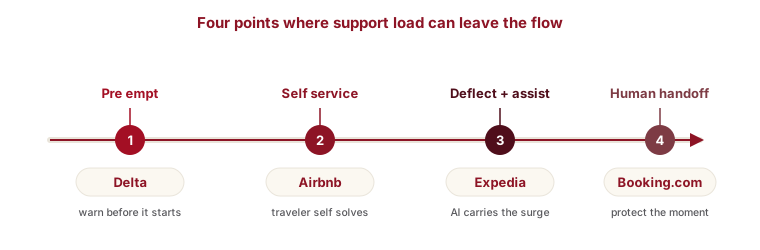
Four Points in the Flow Where Customer Support in Travel Can Scale
Picture a support interaction as a line from the moment a problem appears to the moment it is settled. Load can leave that line at four points, and each has a natural owner among the companies below. One warns the traveler before they make contact. Another lets them fix routine things themselves. A third uses AI to take the weight off the busiest moments and brief a human faster. The last keeps people in charge of the cases that carry real weight.
Table: Four bets on customer support at scale, where each company optimizes and who it fits
| Company | The bet (where in the flow) | How it works | Trade off and best fit |
|---|---|---|---|
| Delta | Proactive, pre empt the contact | Concierge notifies on flights, bags, passport or visa, then hands off to human care | Needs deep data integration; fits disruption driven load (airlines, TMCs) |
| Airbnb | Self service, handle it before an agent | Travelers self solve routine inquiries; escalate timely or trust and safety cases | Needs huge, patternable volume; fits high volume marketplaces and OTAs |
| Expedia | Assisted scale, absorb the surge | AI holds volume, summarizes handoffs in 30+ languages, carries spikes | Fits global, multilingual, high variance volume |
| Booking.com | Handoff, protect the human moment | AI routes and briefs agents with booking history; humans own complex cases | Keeps humans in the loop; fits trust sensitive, complex bookings |
Why Didn't the Giants All Make the Same Customer Support Bet?
They chose differently because their problems are shaped differently. An airline lives and dies by disruption, so its best move is to reach travelers before the phones light up. A marketplace like Airbnb fields a huge stream of routine, repeatable questions, exactly the load self service can carry. An online travel agency selling complex, high trust trips gets more from a well briefed human than from a slicker bot. None of them uses only one move in practice; each leads with the one that matches where its own volume piles up.
There is no single right way to scale customer support in travel, and each of these companies won by matching its bet to where its own volume concentrates.
Key Terms Worth Knowing
A few terms come up throughout this article on customer support in travel. Here is what each one means.
- Deflection: the share of contacts a traveler resolves through self service, without ever reaching an agent. It counts only when the issue is genuinely handled, not when a bot merely holds the conversation.
- Self service: any channel where the traveler answers their own question, from a help center to an AI assistant. A contained chat that solves nothing is not scaled support.
- Warm handoff: passing an automated or self service conversation to a human agent with the full booking context attached, so the traveler never has to start over.
- Proactive support: reaching the traveler with information or options before they contact you, such as a delay alert that already carries rebooking choices.
- Omnichannel intake: email, phone, chat, WhatsApp, and OTA messaging converged into one queue and one record, so nothing gets worked twice.
- Supplier dependent ticket: a case whose resolution waits on a third party such as a hotel or airline, whose reply time caps how fast the hardest cases clear.
How Do Airbnb, Expedia, Booking, and Delta Handle Customer Support at Scale?
These moves are easier to trust when you watch them run at real scale, in companies whose volume would break an ordinary support team many times over. None of the four handed its hard cases to a machine. Each decided, on purpose, where its automation would earn the most and what to leave for people. Finding that line, the right split between humans and AI, is most of the job.
Airbnb Bets on Self Service: Handle It Before an Agent
Airbnb's bet is that most of what guests and hosts ask can be answered without a human at all. Its scale makes that possible, because the same questions repeat by the million, so an AI assistant learns the patterns and hands the traveler an answer directly. By the first quarter of 2026 it was handling more than 40 percent of customer inquiries through self service, according to CX Dive (2026). The line matters as much as the number: anything time critical or touching trust and safety still goes to a person. The whole approach depends on the huge, repeatable volume that self service in travel learns from.
Expedia Bets on Assisted Scale: Absorb the Surge, Brief the Human
Expedia made a subtler bet: use AI to carry the flood and speed the handoff, not to replace the agent. It sees more than 250 million service interactions a year, over half resolved by travelers in self service, and more than 30 percent of those powered by AI, according to CX Dive (2026). When someone does reach a human, the AI has already written a conversation summary, in any of more than 30 languages, so the agent starts halfway through. During flight cancellation surges, that assist absorbed the spike while people took the tangled, time critical cases.
Booking and Delta Bet on the Human and the Head Start
Booking.com and Delta both keep people at the center, but defend different moments. Booking.com uses AI as a fast concierge at the front door: it reads what a traveler needs on first contact, routes them, and briefs the agent with booking history before a word is exchanged. Its leaders are blunt about why, calling the human connection the real "differentiator" for emotional and complex cases (CX Dive, 2026).
Delta plays the same instinct earlier in the trip. Its Concierge assistant answers routine questions and gets ahead of them, nudging travelers about a gate change, a bag, or an expiring passport. When it hits its limit, in Delta's own words, it "knows when to phone a friend" and passes the traveler to Reservations and Customer Care (Delta News Hub, 2025).
Even the most automated operators in travel keep people on the timely, complex, and trust and safety cases; the AI is there to reach them faster, never to replace them.
How to Choose the Right Customer Support Bet for Your Travel Company at Scale
You are almost certainly not running Airbnb's volume or Delta's engineering budget, and you do not need to. The logic of these bets travels even when the scale does not. You do not have to build everything they built. You have to find the single point in your own support flow that gives way first when a spike hits, and put your effort there.
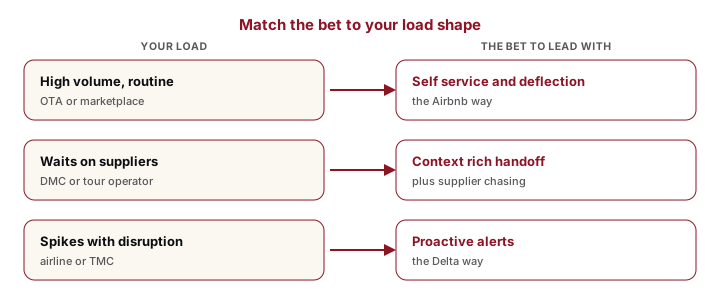
Match the Customer Support Bet to Your Load Shape
The right bet follows from the shape of your load, not from whichever tool is fashionable this quarter. A high volume OTA or marketplace, where questions repeat, gets the most from self service and deflection, the way Airbnb does. A DMC or tour operator has a different bottleneck: the queue clogs on waiting, because a ticket cannot close until a hotel or airline replies, so a context rich handoff and disciplined supplier chasing beat another chatbot. When disruption drives your spikes, proactive disruption communication beats a front line hire, because the cheapest contact is the one that never happens.
The right bet is the one that relieves the point in your support flow where volume breaks first.
Can You Copy Airbnb's Customer Support Without Airbnb's Budget?
Yes, as long as you copy the discipline and not just the software. The trap is buying an AI tool and expecting it to sort things out alone, and it rarely does. Across contact centers, a 15 percent rise in AI adoption from 2023 to 2025 came with an average half point drop in customer and employee experience, according to Deloitte (2025). Good travel customer support software, sometimes called customer care software, earns its place when it pulls the live booking onto the agent's screen, runs self service with an honest handoff, and drafts replies a human reviews and sends. Outsourcing buys capacity, not booking context, so on its own it moves the backlog rather than clears it.
The Metrics That Show Your Customer Support Is Scaling
Watch the numbers that show capacity is genuinely growing, not just the spend. Contacts per booking is the honest one, because if each trip you sell costs less to support as you grow, the machine is working. Peak week SLA attainment tells you more than the tidy monthly average, since the peak is the only test that counts. Track backlog age, cost per contact, and a deflection figure that counts only contacts a traveler genuinely resolved, not the ones a bot simply absorbed. Together they separate real scaling from a bigger software bill.
Conclusion
The companies that handle customer support in travel at scale never found a single answer, and that is the useful part. They found four, and each backed the one that fit where its own volume gathers. Delta gets ahead of the traveler, Airbnb lets them help themselves, Expedia leans on AI to carry the surge, and Booking.com defends the human moment for the cases that deserve it. You do not have to choose the same way any of them did. You do have to choose on purpose, design for the worst day rather than the quiet one, and measure whether real capacity is growing underneath you. Start with the one point in your own flow that breaks first.
Frequently Asked Questions
How do large travel companies handle customer support at scale?
They engineer one point in the support flow rather than hire for every spike. Some pre empt contacts with proactive alerts, some push routine questions into self service, some use AI to absorb surges, and some protect the human handoff. What drives the design is the peak day rather than the routine average.
Which company's approach to customer support in travel is best?
None is best universally, because the right approach depends on your load shape. High volume, routine queries suit self service like Airbnb's. Supplier dependent work needs context rich human handoffs. Disruption driven volume rewards proactive service like Delta's. Match the bet to where your own volume actually concentrates.
Does AI replace human agents in travel customer support at scale?
No. Even the most automated operators route timely, complex, and trust and safety cases to people, and AI drafts or summarizes rather than sending replies on its own. Booking.com goes further and calls the human connection its main differentiator for emotional and complex cases.
What should travel customer support software do to help you scale?
Good travel customer support software should route and contextualize each contact on a booking aware record, run self service with an honest handoff, summarize long supplier threads, and support proactive outreach. It should draft replies an agent reviews and sends, not close tickets on its own.
Can smaller travel companies copy these customer support strategies?
Yes. Focus on one thing: find the point in your flow that breaks first at the peak, and engineer that before adding anything else. A small proactive alert setup or a focused help center often beats a broad, shallow rollout of everything.