



This article explains what ticketing systems like Zendesk do, why travel operations outgrow horizontal help desks, and where generic ticketing falls short for OTAs, tour operators, TMCs, DMCs, and travel payment companies. You'll get a plain definition of travel native ticketing, a sub vertical view of how travel tickets really behave, and the Trip Ticket Test, a four check tool for judging any ticketing system for travel. It's written for operations and support leaders choosing or reevaluating a support platform.
Ticketing systems like Zendesk handle email, chat, and SLA timers well enough for most industries. Yet in travel, your agents still keep three tabs open: the booking system, the supplier inbox, and the ticket itself. The ticket tracks a conversation, but it doesn't know that conversation is about a trip with a check in date, a PNR, and a supplier waiting to reply. That gap is small on a quiet Tuesday and expensive during a disruption. This article looks at why travel teams outgrow ticketing systems like Zendesk, and gives you a simple way to test what fits.
Why Are Travel Companies Outgrowing Ticketing Systems Like Zendesk?
Travel companies outgrow generic ticketing for two reasons: volume keeps climbing, and spikes hit without warning. A horizontal desk assumes a steady stream of customer questions arriving one at a time. Travel doesn't work that way. Bookings change, suppliers go quiet for days, and a single weather event can flood the queue overnight. The tool that felt fine at launch starts to strain once these patterns show up at scale.
Why Do Ticketing Systems Like Zendesk Feel Undersized Once Travel Volume Climbs?
They feel undersized because volume is climbing on both sides of the ledger. According to Salesforce (2024), 76% of service organizations expect higher case volumes this year, and budgets are responding, up 23% on average. But that spending doesn't fix a desk that doesn't understand travel. For a travel team, the extra volume means more change requests, refund chases, and supplier follow ups, and a generic desk logs each one while the agent still pieces the context together by hand.
How Do Seasonal Spikes Break a Generic Travel Ticketing Setup?
Volume growth is one problem. Timing is another, since travel support spikes without warning instead of rising steadily. Flight delays across Europe in summer 2024 rose 47% compared with summer 2023, the worst on record since 2001 (EUROCONTROL, 2024). Every delayed flight seeds change, cancel, and rebook tickets, so a queue running a few hundred tickets a day can pass a thousand overnight. A horizontal desk just adds the load to the same queue, so the backlog outgrows what agents can read. It's tempting to assume AI absorbs this pressure on its own. It doesn't, at least not yet.
What Makes a Travel Ticketing System Different From Zendesk and Freshdesk?
A travel native ticketing system is a help desk built only for travel, where each ticket is attached to a booking and carries fields like dates, PNR, and supplier reference by default. Unlike ticketing systems like Zendesk, it treats the trip, not the message, as the core record.
That's exactly what closes the gap the last section raised: a horizontal desk like Zendesk or Freshdesk still models a generic ticket, a subject, a status, a priority, and a thread of messages, instead of a trip.
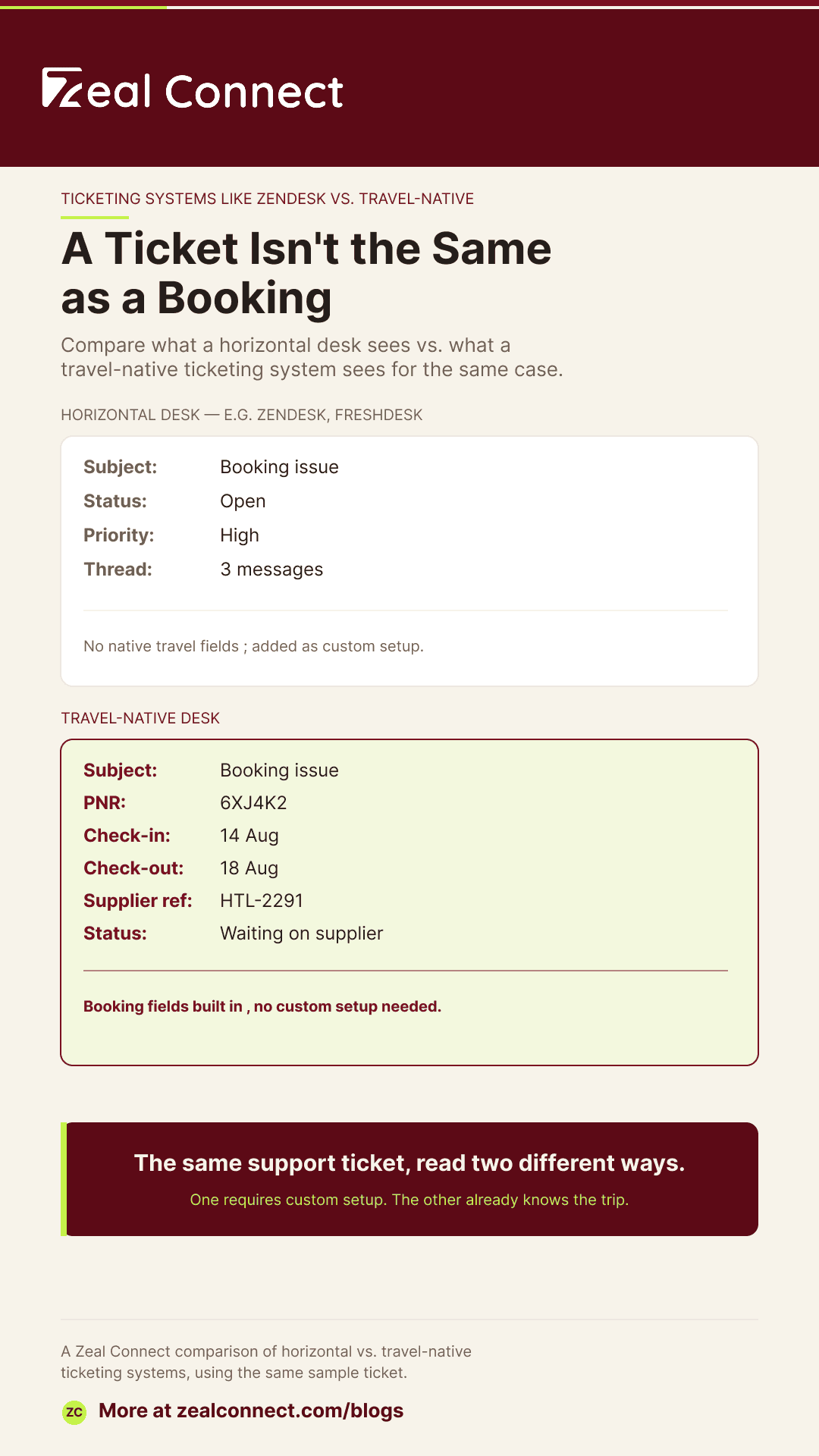
What Is the Difference Between a Horizontal Help Desk and a Travel Native Ticketing System?
A horizontal help desk is built for any industry, so travel details become custom fields someone has to design and maintain. A travel native ticketing system treats the booking as a built in object instead. The difference shows up daily: on a generic desk, an agent reads the thread, then opens the booking system to find the check in date and supplier reference. On a travel native desk, those fields are already on the ticket, so the agent starts from context instead of rebuilding it.
Why Does Supplier Dependency Change How Travel Tickets Resolve?
Even with that context in hand, the agent is rarely the bottleneck. To close a single amendment, your team might wait on a hotel, an airline, and a local DMC at once. The ticket sits open not because the agent is slow, but because a supplier hasn't replied. First response time can look fine while resolution time slips.
In travel support, resolution time is often a supplier metric, not an agent metric.
That's why the ability to track supplier dependent tickets separately from agent held ones matters more than raw response time.
Which Parts of a Travel Ticket Can AI Automate, and Which Can't?
That supplier dependency is exactly why more AI alone doesn't fix this. According to McKinsey (2025), 90% of travel executives say their organization uses generative AI in some way, but only 2% say agentic AI use is widespread, and this is where that gap actually shows up. AI can classify the ticket type, pull the booking fields, summarize a long supplier thread, route it to the right queue, and draft a reply. What it can't do is decide the outcome when that depends on a supplier's answer or a fare rule. Deflection helps here too, but deflection means the customer finds the answer through self service, not an AI replying on their behalf. According to HubSpot (2024), 78% of CRM leaders say customers prefer to solve issues independently.
Automation speeds up the input. It rarely finishes the ticket on its own.
Key Terms Worth Knowing
A few terms come up again and again in this discussion. Here's what each one means:
- Horizontal help desk: A general purpose support tool built for any industry, where travel details must be added as custom fields and workflows.
- Travel native ticketing system: A desk where booking fields, ticket categories, and supplier aware workflows are built in rather than configured from scratch.
- Deflection: An issue resolved by customer self service, before it reaches an agent. It does not mean an AI sending replies to customers.
- Response dependent resolution: A ticket that cannot close until a supplier or traveler replies, no matter how fast the agent works.
- ADM (Agency Debit Memo): An airline issued charge for an agency error. It creates a back office ticket that carries financial weight, not a customer satisfaction one.
Where Do Horizontal Ticketing Systems Fall Short for Travel Operations?
Horizontal ticketing systems fall short where travel work stops looking like generic support. The booking object gap covered above is the root cause, but it shows up differently depending on the kind of travel business running the desk. An OTA's queue looks nothing like a TMC's queue, and neither looks like a payment company's dispute pile. Mapping the real ticket mix turns that abstract gap into something specific.
How Do Travel Ticket Types Differ Across OTAs, TMCs, DMCs, and Payment Companies?
Each sub vertical runs a different mix, so no single desk fits all of them well. OTAs handle change, cancel, and refund tickets at high volume. TMCs handle disruption reaccommodation and policy compliance for corporate travelers, and according to GBTA (2024), 89% of travel managers are focused on automated disruption management and rebooking. DMCs handle on trip incidents and supplier reconciliation, while payment companies handle settlement and dispute tickets. Each of these needs its own custom setup on a generic desk.
Why Do Back Office and Financial Tickets Break a Generic Ticketing System?
Back office tickets are the clearest example, because they aren't about customer satisfaction at all. Chargebacks, ADMs, refund disputes, and BSP reconciliation carry money and compliance weight instead, including the first party "friendly fraud" disputes merchants increasingly report. Travel and hospitality carry the highest average chargeback value of any sector, at $120 per dispute (Chargeflow, 2025).
A horizontal help desk has no concept of a settlement or a debit memo.
So these high cost tickets get forced into a model built for simple questions.
What Does Channel Fragmentation Cost a Travel Support Team?
Ticket type is one axis of the problem. Channel is another, because the same case often arrives in pieces: a WhatsApp message from the traveler, a forwarded email from the OTA, a separate supplier reply, a phone call update, all belonging to one booking. Consolidating customer channels only solves half of this, since supplier threads need pulling together too. When a desk can't do that, agents stitch the story together by hand on every ticket.
How Do You Run the Trip Ticket Test on a Ticketing System for Travel?
Every gap covered so far (the missing booking object, supplier dependency, seasonal spikes, and back office blind spots) points to the same question: does this desk actually understand a trip? The Trip Ticket Test turns that question into four checks you can run during any demo or trial. Score a tool on all four, and the right fit becomes obvious, whatever the brand name on the box.
Checks 1 and 2: Booking Awareness and Supplier Dependency
Start with the two checks that decide everything else, because they cover the gaps from earlier in this article. Check one is booking awareness: does a ticket carry the PNR, dates, and supplier reference natively, or do you build those fields yourself? Check two is supplier dependency: can the desk track a ticket that's waiting on a supplier, separate from one waiting on the agent? Fail these two, and your team ends up rebuilding booking context and chasing suppliers manually on every case, no matter how polished the interface looks.
Checks 3 and 4: Spike Readiness and Settlement Handling
The next two checks cover the moments that hurt most: spikes and settlements. Check three is spike readiness. Can the desk compress the backlog by classifying and summarizing fast when volume jumps 5 to 10x, or does triage stay manual? Check four is settlement handling: does it fit financial tickets like chargebacks and ADMs? Gartner (2025) predicts agentic AI will autonomously resolve 80% of common customer service issues by 2029, but that number depends on supplier replies in travel, so judge automation by how well it assists, not how much it claims to resolve alone.
Scoring the Trip Ticket Test by Travel Sub Vertical
Score each check as native, possible with setup, or absent, then weight the result by your sub vertical. An OTA leans hardest on booking awareness and spike readiness. A payment company weights settlement handling above everything else. A DMC cares most about supplier dependency. The table below shows what each check asks, and how a horizontal desk and a travel native desk tend to answer it.
Judge a ticketing system for travel by these four checks, not by the length of its feature list.
Table: The Trip Ticket Test, four checks for a travel ticketing system
| Check | What it asks | Horizontal help desk | Travel native ticketing system | Who feels it most |
|---|---|---|---|---|
| Booking awareness | PNR, dates, supplier ref on the ticket? | Custom fields, manual setup | Built in | OTAs, tour operators |
| Supplier dependency | Track tickets waiting on a supplier? | Generic status only | Supplier aware workflow | DMCs, OTAs |
| Spike readiness | Compress backlog during 5 to 10x surges? | Manual triage | AI summary and classification | Airlines, OTAs, TMCs |
| Settlement handling | Fit chargebacks, ADMs, reconciliation? | Not modeled | Custom workflows | Payment companies, TMCs |
How Does Zeal Desk Close the Travel Gaps That Zendesk Alternatives Leave?
Most Zendesk alternatives are still horizontal desks, so they pass the Trip Ticket Test only through custom configuration. Zeal Desk is built only for travel, which means it meets all four checks by design instead. That's not a knock on general purpose tools. They simply don't know what a booking is, so travel teams end up building that knowledge in themselves.
How Does Zeal Desk Pass the Booking and Supplier Checks by Design?
Zeal Desk reads the booking straight from the ticket. It extracts structured fields, check in and check out dates, PNR, and supplier reference, then classifies each ticket into categories built for your business and trained by AI. Because that context arrives automatically, an agent doesn't need to open a separate booking system to understand the case. A horizontal desk can store the same fields, but only after someone designs and maintains them, since travel isn't its native model.
How Does Zeal Desk Handle Spikes and Back Office Tickets?
That same automatic context helps during a surge. Zeal Desk summarizes long supplier email chains into a short brief, so an agent reads one line instead of forty messages, keeping the backlog readable when volume jumps. For repetitive back office work, custom workflows handle the recurring steps in refund, reconciliation, and disruption tickets, ticket types a general purpose desk never modeled, so on those tools they usually live in a spreadsheet beside the queue.
Does Zeal Desk Keep a Human in Control of Customer Replies?
Yes. The human stays firmly in the loop. Zeal Desk drafts a reply using the original query context, then the agent reviews, edits, and sends it. No AI generated reply goes to a customer on its own, which keeps judgment with the person who understands the booking and the supplier relationship while AI removes the slow first draft step. In travel, where a wrong answer can mean a missed flight or a disputed charge, that human check is the part you don't want automated away.
Conclusion
Generic ticketing systems treat every case as a conversation to track. Travel work is bigger than that: each ticket sits on a booking, leans on a supplier, swells during disruption, and sometimes carries money and compliance weight. That's why teams running OTAs, TMCs, DMCs, and payment operations keep hitting the same wall with horizontal tools. Before you pick a desk, run the Trip Ticket Test. Check booking awareness, supplier dependency, spike readiness, and settlement handling, then weight the four by your own sub vertical. The best choice isn't the most popular brand or the longest feature list. It's the system that already knows your ticket is a trip.
Frequently Asked Questions
Can Zendesk or Freshdesk work for a travel company?
Yes, for basic email, chat, and SLA tracking they work fine. The trade off is custom setup: travel fields, supplier workflows, and booking context all have to be built and maintained, because these horizontal desks were designed for any industry rather than travel specifically.
What does "deflection" really mean in travel ticketing?
Deflection means a customer resolves their own issue through self service before it reaches an agent. It does not mean an AI answering on the customer's behalf. In travel, real deflection comes from clear self service options for common change, cancel, and status questions.
Which travel tickets can AI actually automate?
AI automates the predictable input: classifying the ticket, extracting booking fields, summarizing supplier threads, routing, and drafting replies. It can't decide outcomes that depend on a supplier's answer or a fare rule. So most travel automation assists the agent rather than closing the ticket alone.
What should I evaluate first in a ticketing system for travel?
Start with the Trip Ticket Test's first two checks: booking awareness and supplier dependency. If a desk can't carry the PNR and dates natively or track supplier dependent tickets, your team rebuilds context manually on every case, which is the most common hidden cost in travel support.