




This article explains what AI based customer support for travel is, the benefits it reliably delivers, and the operations metrics each one moves. It is written for support and operations leaders across OTAs, DMCs, TMCs, tour operators, and travel payment teams weighing a real deployment. You will get a working definition, a benefit to metric map, and an original failure taxonomy table, the five ways AI based travel support breaks and the tell for each, plus a measured way to roll it out.
A support lead gets sold the same three words at every demo: instant, 24/7, hands off. Then a traveler messages at 2am, and the bot confidently quotes a refund rule that does not exist. Both moments are real. AI based customer support genuinely speeds up the predictable work in a travel operation, and it fails in specific ways a generic priority field never warns you about. This is a two sided read, the benefits and the limits on one page, written so you can tell a real gain from a vanity metric before you commit budget or headcount.
Why travel companies are adopting AI based customer support now
Adoption stopped being a question a while ago. The pressure that drove it, rising contact volume, disruption spikes, agents who leave inside a year, has not eased, so the practical question has shifted from "should we" to "where does this actually help." That shift is what makes an honest benefits and limits view useful right now.
Adoption of AI based customer support in travel has crossed from novelty to norm
Most of your competitors are already running some version of this. According to Phocuswright (2026), 61% of travel businesses surveyed are experimenting with or scaling agentic AI. That number matters less as a bandwagon than as a signal: the tools are mature enough that the real question is not capability in the abstract, but which parts of your support workflow AI based customer support earns a place in, and which it should stay away from.
What is pushing travel teams toward AI based customer support?
Traveler behavior is pulling AI into support whether operators plan for it or not. According to Forbes (2025), reporting Skift and McKinsey data, 30% of U.S. travelers now use AI extensively for trip planning, double the share a year earlier. The operational reality has not gotten kinder, either. A single weather event can turn a few hundred tickets a day into several thousand within hours, and that surge is exactly when a short staffed desk breaks.
What AI based customer support for travel actually is
Before weighing benefits against limits, it helps to be precise about what the term covers, because the SERP tends to reduce it to "a chatbot." It is broader than that, and the breadth is the point.
What is AI based customer support for travel, in one definition?
AI based customer support for travel is the use of artificial intelligence across the support workflow, reading incoming messages, classifying and routing them, extracting booking details, drafting replies, and answering routine questions through self service, running inside the tools a travel team already uses. A person still owns the decision and sends the customer facing reply.
What AI based customer support actually does across a travel ticket
The uses split into two groups. On the traveler facing side, AI powers self service chatbots and voice agents on routine questions, real time translation across dozens of languages, and proactive alerts that flag a delay before the traveler writes in. On the agent facing side, it drafts replies, summarizes long supplier email chains into a one line state, extracts fields like check in dates and confirmation numbers, detects urgency and sentiment, and reviews close to 100% of conversations for quality instead of a 2% manual sample.
The line that never moves: AI assists, a person sends the reply
One rule holds across every use above. AI prepares the work; a human approves and sends anything the customer sees. When a ticket "deflects," it means the traveler resolved it themselves through self service, not that AI answered on the company's behalf. That distinction sounds pedantic until something goes wrong.
In travel, the person sending the reply is your control point. The answer often involves a fare rule or a refund, and that review is where a wrong one gets caught.
Key Terms Worth Knowing
A few terms the benefits and limits sections lean on, worth pinning down first.
- Deflection: a contact that ends without reaching an agent. It counts a diverted conversation, not necessarily a solved problem.
- Resolution: the traveler's underlying issue is actually fixed. This is the outcome your SLA and CSAT ultimately depend on.
- Grounding: tying an AI answer to live booking data and real policy, rather than the model's best guess from training.
- Agent assist (copilot): AI that drafts replies and surfaces knowledge for an agent who still reviews and sends.
- First response time (FRT) / average handle time (AHT): the speed metrics AI based customer support most directly moves.
- Human in the loop: a person reviews or approves an AI prepared answer before the customer sees it.
The real benefits of AI based customer support for travel
The benefits are real, but they only count if you can tie them to a metric you already report. Here are the gains that hold up, and the number each one moves.
A benefit you cannot attach to first response time, average handle time, or cost per ticket will not survive a budget review.
Faster first response and triage, even through a peak spike
The clearest win is speed on the predictable stuff. AI answers routine questions and classifies and routes the rest the moment a message lands, so first response time holds steady even when volume jumps. During a disruption week, that difference decides whether the queue stays workable or collapses. The traveler asking "where's my ticket" gets an instant self service answer, which frees your agents for the stranded passenger rebooking that genuinely needs a person.
How does AI based customer support make agents more productive?
It makes each agent faster, and it helps your newest agents most. According to Stanford and MIT researchers (2023), a generative AI assistant raised support agent productivity by 14% on average, with the largest gains for less experienced agents and minimal impact on veterans. In an industry where agents often leave inside 14 months, that ramp matters. Agents want the help, too: Zendesk (2025) found 73% of agents say an AI copilot would help them do their job better.
Structured booking data and always on measurement of every ticket
Travel tickets are full of structured data, check in and check out dates, supplier references, confirmation numbers, and AI turns that mess into tagged fields automatically. Two things follow. Agents stop retyping details they could read from the record, which trims average handle time and cost per ticket. And because every conversation gets categorized, you get operational insight a manual sample never gave you, patterns in ticket type, supplier, and reason that inform staffing decisions.
Where AI based customer support for travel hits its limits
Every benefit above has a matching failure mode, and travel surfaces them harder than most industries because the answers involve money, suppliers, and deadlines. The gains are worth having. But a deployment that ignores the limits creates escalations, and sometimes liability, faster than it saves time.
Five failure modes of AI based customer support for travel
The table below names how AI based support tends to break in a travel operation, why each happens, and the tell that lets you catch it before a customer does. Treat it as a diagnostic you run against any deployment.
Table: Five failure modes of AI based customer support for travel, and the tell for each
| Failure mode | Why it happens in travel | The tell (how you spot it) | What to do |
|---|---|---|---|
| Stale or unreachable booking data | AI answers from an old or missing record | Replies that do not match the live reservation | Ground AI in live booking data; block answers it cannot verify |
| Invented policy or fare rules | Fare and refund rules are complex and change | Confident answers with no citable policy source | Restrict AI to citable answers; a person sends money matters |
| Silent non resolution | A contact ends without the issue fixed | High deflection but rising repeat contacts | Measure resolution and reopens, not deflection |
| Language and edge case drop | Mixed language, unusual phrasing is common | Escalation spikes from specific markets | Set confidence thresholds; route low confidence to a human |
| Disruption overwhelm | One delay ripples to thousands in hours | The escalation queue balloons during a surge | Pre plan playbooks; keep human capacity; do not rely on AI to rebook |
Who is liable when AI based customer support gives the wrong answer?
You are, the operator, not the vendor. When Air Canada's chatbot gave a passenger incorrect bereavement fare advice, a tribunal held the airline responsible and ordered it to pay $812.02, rejecting the argument that the chatbot was a separate entity (McCarthy Tétrault, 2024). The damages were small; the precedent is not. Accuracy is a live risk, too: Amadeus (2025) found 25% of travelers have received outdated or inaccurate information from AI. For a TMC or payments team, a confidently wrong answer is a compliance exposure, not a CSAT dip.
Deflection can hide a problem instead of solving it
A high deflection rate can mean your travelers are getting answers, or it can mean they gave up and went to a public review instead. The number alone does not tell you which. So reporting "90% deflection" to a COO is risky when repeat contact and reopen rates are climbing underneath it.
Deflection counts the conversations you diverted. Resolution counts the problems you solved. Only one of them protects your SLA.
How to deploy AI based customer support without hitting the limits
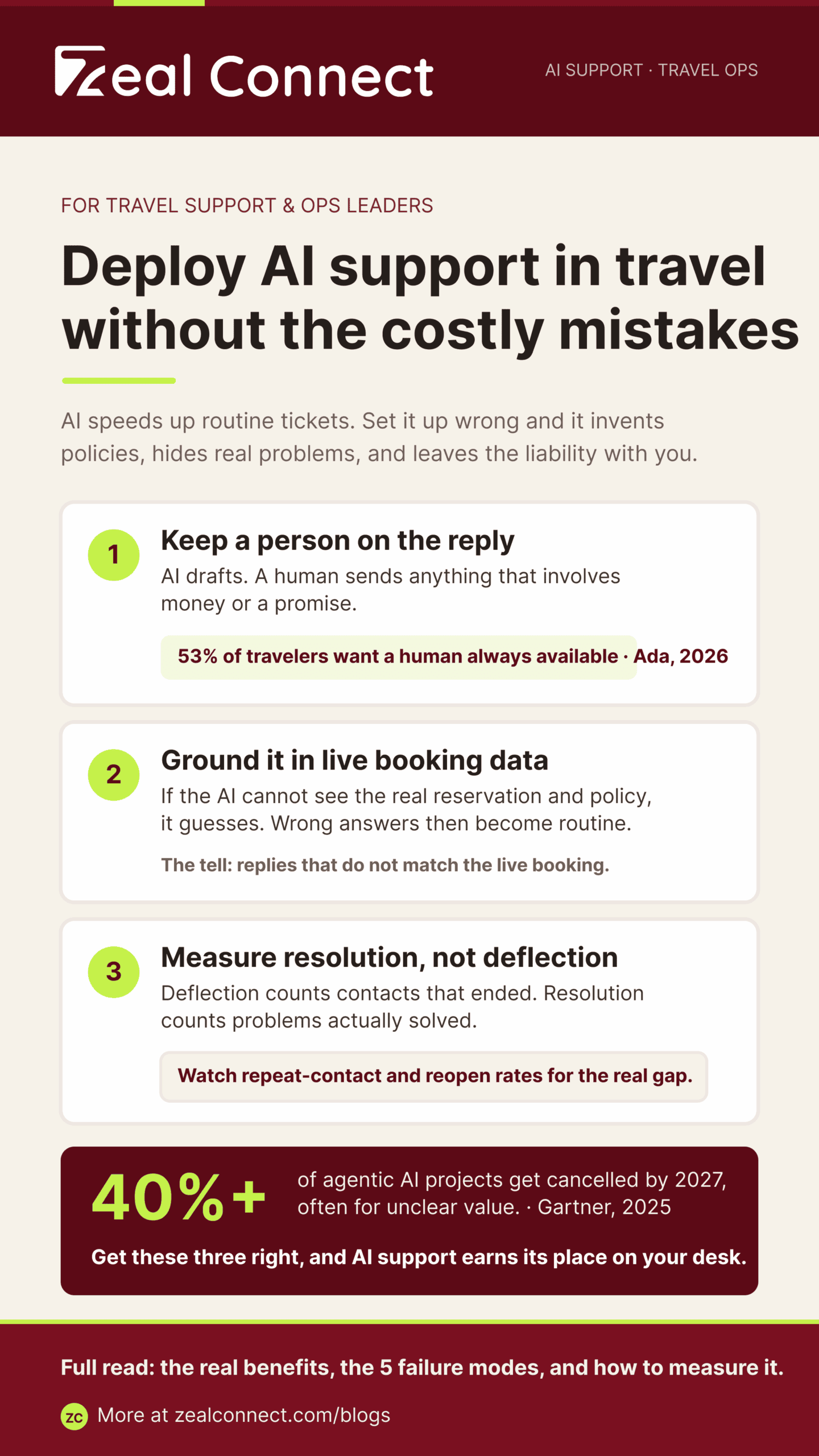
Knowing the benefits and the limits is only useful if it changes how you roll out. The goal is to capture the predictable work gains while keeping the failure modes contained, and that comes down to three decisions.
Ground it in live booking data, keep a person on the reply, and measure resolution, and most of the rest is tuning.
Keep a person sending the reply, and give travelers a human on demand
Design AI to draft and prepare, and keep a person on anything the customer sees that carries money or a promise. Travelers expect this: Ada (2026) found 53% say human support should always be available even when AI is used. A visible, easy path to a person is not a fallback you bolt on. Instead, it is the trust signal that makes travelers comfortable using the AI for everything else.
What has to be true about your data before AI based customer support pays off?
The accuracy of AI based customer support is capped by the data it can reach. If the AI cannot see the live reservation, the current fare rule, and your real policy, it will guess, and the first two failure modes in the table become routine. So before you judge a tool by its answers, check the integration and data quality it is grounded in. An AI connected to live booking data behaves very differently from one working off a static help center article.
Start narrow, measure resolution, and expand what earns it
Pick one high volume, low risk ticket type, deploy there, and measure real resolution before you widen the scope. This discipline is what separates the projects that stick from the ones that stall. According to Gartner (2025), more than 40% of agentic AI projects will be cancelled by the end of 2027, often for unclear value and weak controls. A narrow start with an honest resolution metric is how you stay out of that number.
Conclusion
AI based customer support for travel is neither the miracle the demo promises nor the menace the skeptics warn about. It is a set of real, measurable gains on predictable work, paired with a short list of nameable failures that travel surfaces harder than most industries. The teams that get value from it do four things. They map each benefit to a metric they already own. They keep a person on the reply. They ground the AI in live booking and policy data. And they measure resolution rather than deflection, so a diverted contact never gets mistaken for a solved problem. Do those four, and the 2am refund answer becomes one a traveler can actually trust.
Frequently Asked Questions
What is AI based customer support for travel?
It is the use of AI across the support workflow, classifying and routing messages, extracting booking details, drafting replies, and answering routine questions through self service, inside the tools a travel team already uses. A person still owns the decision and sends the customer facing reply.
Does AI based customer support replace travel agents?
No. It handles routine questions through self service and prepares the rest, drafts, summaries, extracted fields, while an agent makes the judgment call and sends the reply. In practice it changes what agents spend time on, moving them off repetitive lookups toward complex, high stakes cases.
Is deflection the same as resolution?
No. Deflection means a contact ended without reaching an agent; resolution means the traveler's problem was actually fixed. A contact can deflect because the traveler gave up. Watch repeat contact and reopen rates alongside deflection to see which is really happening.
Who is responsible when AI based customer support gives a wrong answer?
The operator, not the AI vendor. A Canadian tribunal held an airline liable for its chatbot's incorrect fare advice, rejecting the claim that the bot was a separate entity. Treat any money or policy related answer as something a person should send.