


This article explains what in house, outsourced, and hybrid travel customer support services actually mean, and gives you a way to decide which support work belongs in which model. You'll get plain definitions, a Support Work Placement Map you can apply to your own queue, the two travel specific factors most guides skip, and the operational steps to run a split without breaking SLA or brand voice.
Search this topic and you meet a wall of the same advice: outsource, cut cost, scale for the season. It reads clean until you look at your own queue. The peak week disruption surge, the refund and chargeback tickets, the supplier chasing that never closes on your side, none of it fits one blanket model. So the more useful question is which support work belongs where, and why travel changes the math. Whether your whole desk sits in house or with a partner matters less than where each class of work lands. This article gives you a way to structure your travel customer support services around that decision.
Travel Customer Support Services Are Being Sourced on the Wrong Question
Most guides frame this as a cost fight: cheaper agents versus control. That framing is already out of date. The people who buy outsourcing have moved on from cost as the main reason, and the real expense of getting support wrong in travel shows up as lost bookings, not payroll. Before you pick a model, it helps to see what the decision is actually about.
Cost no longer drives the travel customer support services decision
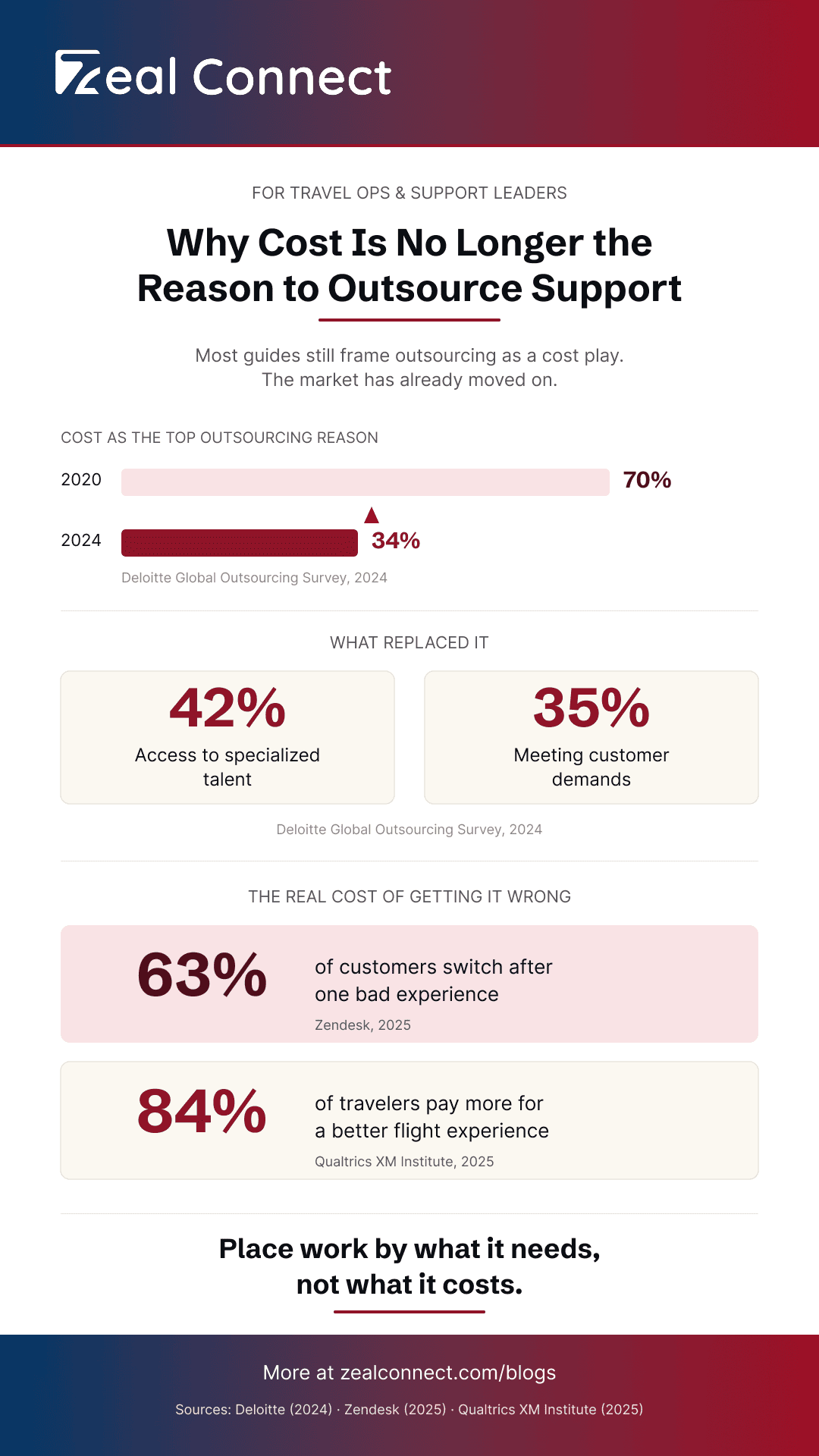
Cost still matters, but it stopped being the headline reason companies outsource. According to Deloitte's Global Outsourcing Survey 2024, cost reduction as the top objective fell to 34%, down from 70% in 2020, while access to specialized talent (42%) and meeting customer demands (35%) now rank higher. So if you are choosing your support model purely to shave the hourly rate, you are optimizing for a goal most of the market has already left behind. Talent and coverage decide more than price.
Choosing a support model on price alone optimizes for a goal most of the market has already left behind.
Why does poor support cost more than any salary line?
Because a bad experience walks with the customer. 63% of customers say they would switch to a competitor after a single bad experience, up nine points year over year (Zendesk, 2025). Travelers reward good service more than almost anyone: 84% are willing to pay more for a better experience when flying, the highest of any category (Qualtrics XM Institute, 2025). A saved wage on a mishandled refund is a false economy when the traveler never rebooks.
The stakes run higher in travel than the SERP admits
Three things make this decision heavier for a travel company than for a generic retailer. Demand is spike driven, not steady, so peak weeks can swamp a fixed roster. Many tickets carry money and compliance weight, from chargebacks to passport and card data. And resolution often waits on a supplier you do not control. Independent coverage from PhocusWire tracks how travel CX keeps shifting toward faster, AI assisted service, which raises the bar on every channel. Any sourcing model you choose has to survive what makes travel support hard in the first place.
What Do In House, Outsourced, and Hybrid Travel Customer Support Services Actually Mean?
Travel customer support services are the people, processes, and channels a travel company uses to help travelers and partners before, during, and after a trip. They can be delivered in house with your own team, outsourced to a provider as a managed service, or run as a hybrid of both. Each model changes who holds the knowledge, who carries the cost, and who answers at 3 a.m.
In house support: your team, your systems, your control
In house means your own employees handle support, on your tools, inside your booking systems. The advantage is depth and control. Your agents see live PNRs and supplier notes, learn your fare rules, and speak in your brand voice without a briefing. Data stays under your roof, which matters when a ticket touches card or passport details. The trade off is rigidity: you carry the salaries, the training, and the empty seats during a quiet Tuesday and the overtime during a storm.
Outsourced travel customer support services, or customer support as a service
Outsourcing hands some or all of support to a third party that runs it for you, often billed as customer support as a service in travel. A good partner brings elastic capacity, multi time zone coverage, and languages you could not staff alone. You rent scale instead of building it, and a team can be live in weeks rather than months. A neutral read of the trade offs from Outsource Accelerator is useful here: you gain speed and reach, but you give up some direct control over how each conversation goes.
Hybrid customer support solutions in travel are now the default
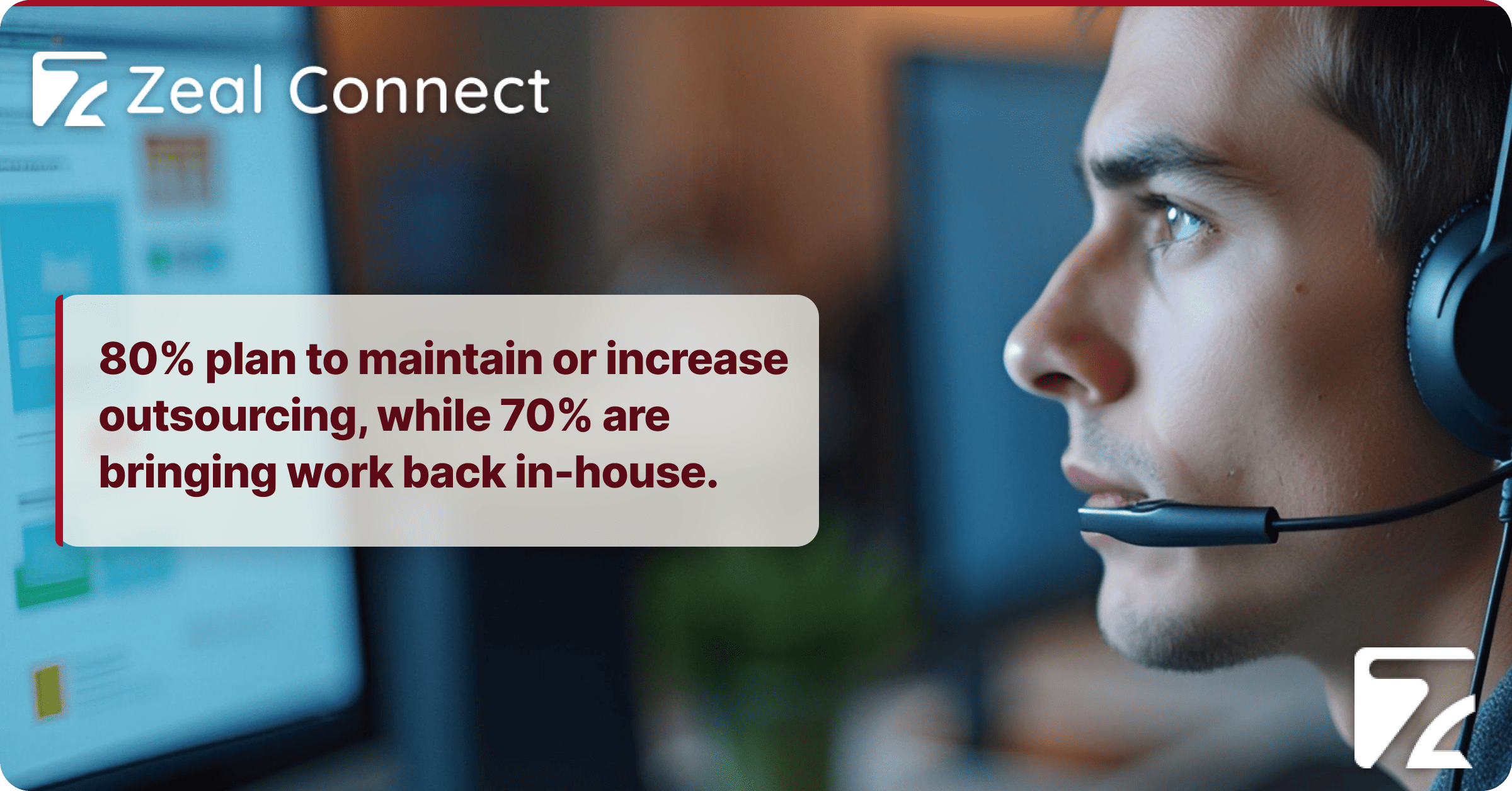
Most operations already run a mix, whether they planned it or not. 80% of executives plan to maintain or increase outsourcing, yet 70% have pulled some scope back in house over the past five years (1840 & Company, 2025). That is not indecision. It is teams learning that some work belongs outside and some belongs in, then adjusting the line. These hybrid setups keep judgment and sensitive work close while renting capacity for the predictable volume.
Most travel operations already run a hybrid. The only real question is whether the split is deliberate or accidental.
Key Terms Worth Knowing
A few terms used across this article, defined the way a travel operations team uses them.
- Customer support as a service (CSaaS): Outsourced support delivered as an ongoing managed service, where a provider runs your support function against agreed SLAs rather than as a one off project.
- BPO (Business Process Outsourcing): A third party company that runs a business function, such as customer support, on your behalf, using its own staff and often its own tools.
- IROPS (Irregular Operations): Disruption events like weather, strikes, and schedule changes that spike ticket volume far above normal and compress the time you have to respond.
- Fully loaded cost: An agent's true cost beyond salary, including benefits, payroll tax, software seats, facilities, training, and the cost of replacing turnover.
- Nearshore / offshore: Where an outsourced team physically sits, which sets the time zone overlap, language options, and cost you can expect from a partner.
Which Travel Customer Support Services Should You Keep In House, and Which Should You Outsource?
Stop deciding by model and start deciding by work. Sort your queue into classes of work, then place each class where it belongs. A ticket that is high volume, predictable, and low context is a poor use of an expensive in house seat. A ticket that moves money or leans on a supplier relationship is a poor thing to hand a partner. The map below sorts the common travel work types so you can copy the logic onto your own operation.
Stop choosing one model for the whole desk. Place each class of support work where control, predictability, and context send it.
Which three drivers decide where travel customer support work sits?
Three drivers settle almost every placement. First, control sensitivity: how much the outcome depends on your brand voice, your data, or your judgment. Second, volume predictability: whether the work arrives in a steady, forecastable stream or in unplanned spikes. Third, context depth: how much booking history, supplier detail, or policy knowledge an agent needs to answer well. Score a class of work on those three, and its model is usually obvious. High control, deep context, and money on the line point in house. Predictable, low context volume points out.
A placement map for travel customer support services
Read the table as a starting template, not a verdict. Your ticket mix and your compliance exposure move a few rows, and that is expected.
Table: Where each travel customer support job belongs, in house, outsourced, or hybrid
| Travel support work | Best fit model | The travel driver | The risk if you place it wrong |
|---|---|---|---|
| Tier 1 FAQs and booking confirmations | Outsourced | High volume, predictable, low context | Overspending in house on scriptable work |
| Disruption and IROPS reaccommodation | Hybrid | Spike driven, high stakes | Fixed roster cannot absorb the peak |
| Refunds, chargebacks, PCI tickets | In house | Compliance and money movement | Wider PCI and GDPR scope, audit risk |
| Supplier chasing and escalations | In house | Relationship and system depth | Partner cannot hold your supplier ties |
| After hours and overflow tier 1 | Outsourced | Coverage gap, predictable | 24/7 in house is the costliest cover |
Why do disruption spikes and supplier waits reshape the model?
Two travel realities break the tidy version of this decision. Disruption is constant and spiky: in 2024, 1.4% of U.S. flights were cancelled and about one in five arrived late (U.S. DOT, 2024), and a single event, like the July 2024 global IT outage that grounded thousands of flights for days, can push volume five to ten times over normal. A fixed in house roster cannot flex that fast, which is why surge work suits a partner.
Outsourcing the traveler facing reply never shortens a supplier's response, so supplier dependent work stays in house.
That is the second reality: a hotel or airline still sets the clock, no matter who answers the traveler. So supplier dependent work stays in house even when handling support at scale tempts you to push everything out.
How to Run Blended Travel Customer Support Services Without Breaking SLA or Brand Voice
A placement decision is only as good as the operation behind it. Once you know what sits in house and what sits with a partner, three things decide whether the split holds: what the law lets you move, what the in house work truly costs, and how cleanly tickets pass between teams. Get these right and the reader on the other end never feels the seam.
Can compliance and data control veto where travel customer support work goes?
Yes, and it should be your first filter, not an afterthought. PCI DSS scope, GDPR, and data residency rules can rule out sending card, passport, or booking data to an offshore partner before cost even enters the conversation. For a payments company or a TMC, that constraint decides the whole plan. Map which ticket types touch regulated data, mark them, and treat them as in house or tightly governed by default. This is also the evidence your security lead or CTO will ask for before signing off, so gather it early.
The fully loaded cost of an in house support agent
Salary is the base, not the cost. The U.S. median wage for a customer service representative was $42,830 in May 2024 (U.S. BLS), but the fully loaded number adds benefits, payroll tax, tools, a software seat, facilities, and the churn of replacing agents who leave. Together those can lift the real figure well above the wage line. Knowing your loaded cost matters because it tells you what you are truly paying to keep a class of work in house, and whether that premium buys control you actually need.
Routing, escalation, and QA across your travel customer support teams
The seam fails when two teams work off two systems. So give both the same booking aware view, one routing map, and one QA standard. Tickets should escalate on defined triggers, from partner to in house, with the booking record attached so nothing has to be typed twice. Score both teams against the same SLA, not two scorecards. When you first move work out, start with after hours and tier 1 overflow, since 77% of customers expect to reach someone immediately (Salesforce, 2024) and night coverage is where in house is weakest. Consistent multilingual coverage follows the same rule.
Conclusion
The decision comes down to placement: putting each class of travel customer support work where control sensitivity, volume predictability, and context depth send it. Map your own queue against the placement table. Keep the compliance gated and supplier dependent work in house, where judgment and data control earn their premium. Rent capacity for the predictable, high volume, and after hours tickets, where a partner's scale beats your fixed roster. Then run the seam with shared booking access, one routing map, and a single QA standard so travelers never feel the handoff. Do that, and you stop answering a cost question the market has moved past, and start building support that fits how travel actually behaves.
Frequently Asked Questions
Which travel support tasks should never be outsourced?
Keep anything that moves money or leans on your relationships in house: refunds, chargebacks, and PCI or payment tickets, supplier chasing and escalations, and VIP or loyalty cases. These need your data, your judgment, or a supplier tie a partner cannot hold, so outsourcing them adds risk without saving much.
Does outsourcing help when resolution waits on a supplier, not my agent?
Only partly. Outsourcing can absorb the traveler facing volume, but it does not shorten a hotel's or airline's response time, so the ticket still waits on the supplier. That is why supplier dependent work usually stays in house, where your team already holds the relationship and can push for a faster answer.
How do I keep SLA and brand voice consistent across in house and outsourced teams?
Run both teams off one booking aware system, one routing map, and one QA standard. Score them against the same SLA, share your knowledge base and tone guide, and set clear escalation triggers so tickets pass cleanly with the booking record attached. Consistency comes from shared tooling, not from hoping.
What is the right first thing to outsource in travel customer support?
Start with after hours coverage and tier 1 overflow. That work is predictable, low context, and high volume, so a partner handles it well, and it fills the night and weekend gaps where an in house team is thinnest and most expensive to staff. Keep judgment heavy and regulated work in house.