



- This article explains what live chat tools for travel are, how a live agent chat differs from a chatbot, and when live chat is the right channel for travel support operations.
- It is written for support and operations leaders at travel companies, OTAs, TMCs, DMCs, and tour operators, who run chat alongside email and phone.
- You will get a working definition, a decision table for what a live chat can finish in the session versus what has to become a ticket, and a staffing model for running chat under normal load and during disruption.
A traveler opens a chat window mid trip and expects an answer in seconds. Some of those requests a live agent can close on the spot. Others cannot be closed at all until an airline or a supplier replies. That gap is the whole story of live chat tools for travel. The channel is fast and popular, but it only finishes the work when the answer already exists and someone in the chat can act on it. This guide covers what live chat tools for travel are, how they differ from a bot, what a live chat can actually finish, and how to staff it.
Why Live Chat Became a Core Support Channel for Travel Companies
Live chat earned its place because travelers reach for it first and expect it to move fast. It sits on the website, in the app, and inside messaging apps, right where a traveler already is. For a support leader, that convenience is also a commitment: once the window is open, the clock is visible and the traveler is watching it.
Travelers reach for live chat first, and they expect it to be fast
Chat wins on speed and low effort. According to Tidio (2026), over 41% of customers prefer using live chat compared with email or phone. Travelers rarely want to sit on hold or wait a day for an email, especially mid trip when a decision cannot wait. The pull toward chat also reflects a wider shift in guest communication, which coverage from HiJiffy tracks across hotels and messaging apps. For most travel brands, chat is no longer optional.
Live chat runs in real time, so the bar is seconds, not hours
The channel is synchronous, so the response bar is unforgiving. Across more than 1.67 billion chats, the average first response time was 35 seconds (LiveChat, 2024). Email buys you hours, while a chat window buys you seconds before the traveler feels ignored. A slow queue on email is invisible to the customer, but a slow live chat is visible while it happens, and travelers judge you on it.
On live chat, delay shows in real time, so travelers treat a fast first response as the baseline.
Is sales chat the same as support chat in travel?
No. The chat on your marketing site that helps someone book behaves very differently from the chat that helps someone after they have paid. Sales chat handles short, self contained questions and pushes toward a booking. Support chat inherits amendments, refunds, and disruptions, which often depend on a supplier or an airline. Travel teams get into trouble when they staff and measure post booking support with a pre booking playbook, because the resolution paths are not the same.
What Are Live Chat Tools for Travel, and How Do They Differ From a Chatbot?
Live chat tools for travel are the software a travel company uses to run real time, text based conversations with travelers, usually through a website or app widget or a messaging app. A live agent handles the conversation while the traveler waits, with the booking record and support history on the same screen. It is the human, synchronous channel, separate from an automated chatbot, even when the two share one window.
A live agent chat and an AI chatbot are not the same channel
A chatbot answers common questions and collects details before a person steps in, while a live agent handles judgment, edge cases, and anything the bot cannot. The two increasingly share the same window, and bots now carry most of the routine load. AI agents handle 75.3% of chat sessions in one large data set of over 220 million interactions (Comm100, 2026). That leaves live agents with the harder residue, so the handoff between them matters as much as either part alone.
The warm handoff is where most travel chats succeed or fail
When a bot passes a conversation to a person, it should carry everything with it. A warm handoff means the agent inherits the full chat, the traveler's identity, and the booking in question, so nobody has to repeat themselves. Cold handoffs are where travelers get angry: they have already typed their booking reference twice, and now a third party is asking again.
In travel, the bot to agent handoff quality decides the chat: a cold handoff turns a fast answer into an escalation.
A travel live chat is only as useful as the booking context beside it
A chat window on its own is just a text box. What makes it work for travel is the booking, the passenger record, and the supplier status sitting next to it. Without that context, the agent is guessing, and the traveler feels it. The strongest live chat tools for travel pull the reservation onto the same screen, so the agent can see the itinerary, the fare rules, and the amendment history before they answer, instead of switching between four tabs while the clock runs.
Key Terms Worth Knowing
A few terms come up throughout this article on live chat tools for travel. Here is what each one means.
- Live agent chat: a human handling a real time text conversation with a traveler, as opposed to an automated bot reply.
- Concurrency: how many chats one agent holds at the same time, the number that most directly drives chat staffing.
- First response time (FRT): the seconds between a traveler's message and the first human reply in the chat.
- Warm handoff: passing a chat from bot to agent, or agent to agent, with the full context and booking attached.
- Chat to ticket conversion: turning a chat that cannot close in the session into a tracked case that continues after the chat ends.
- Proactive chat: a chat the site or app triggers based on behavior, such as a traveler stuck on a checkout or a changed flight page.
What Can a Live Chat Actually Finish in a Travel Support Session?
Live chat finishes an interaction when the answer already exists and the agent can act on it right there. It struggles the moment a case depends on someone who is not in the chat. Sorting your travel interactions by that test is the single most useful thing you can do before you decide what belongs on chat. The table below shows how common requests split.
What a live chat can and cannot finish, request by request
Simple, documented questions close in the chat, while anything waiting on a supplier does not. That pattern holds across travel. It also matches how travelers already use automation: 70% of guests find chatbots helpful for simple inquiries in a survey of 402 recent hotel guests (Hotel Tech Report, 2026). The simple end resolves fast, whether a bot or a person answers. The complex end is where live chat has to hand the case onward.
Table: What a live chat can and cannot finish in a travel support session
| Traveler's live chat request | Can a live agent finish it in the session? | What decides it | Where it goes if it cannot |
|---|---|---|---|
| Where is my confirmation or itinerary? | Yes | Answer is in the booking record | Resolved in chat |
| Change my seat or add a bag | Usually | Agent has access and authority | Resolved in chat |
| My flight was cancelled, rebook me | Partly | Depends on airline reaccommodation | Assist live, then convert |
| Where is my refund? | No | Answer sits with a supplier | Convert to a ticket |
| Dispute this charge or chargeback | No | Needs review, finance, and time | Convert to a ticket |
What decides whether a live chat can close a travel case?
Three things decide it. First, is the answer already known, documented in your knowledge base or retrievable from the booking record right now? Second, can the agent act on it, with the authority and system access to make the change? Third, is anyone outside the chat needed, such as an airline, a supplier, or finance? When all three line up, the chat closes the case. When any one fails, the chat can only start the case, not finish it.
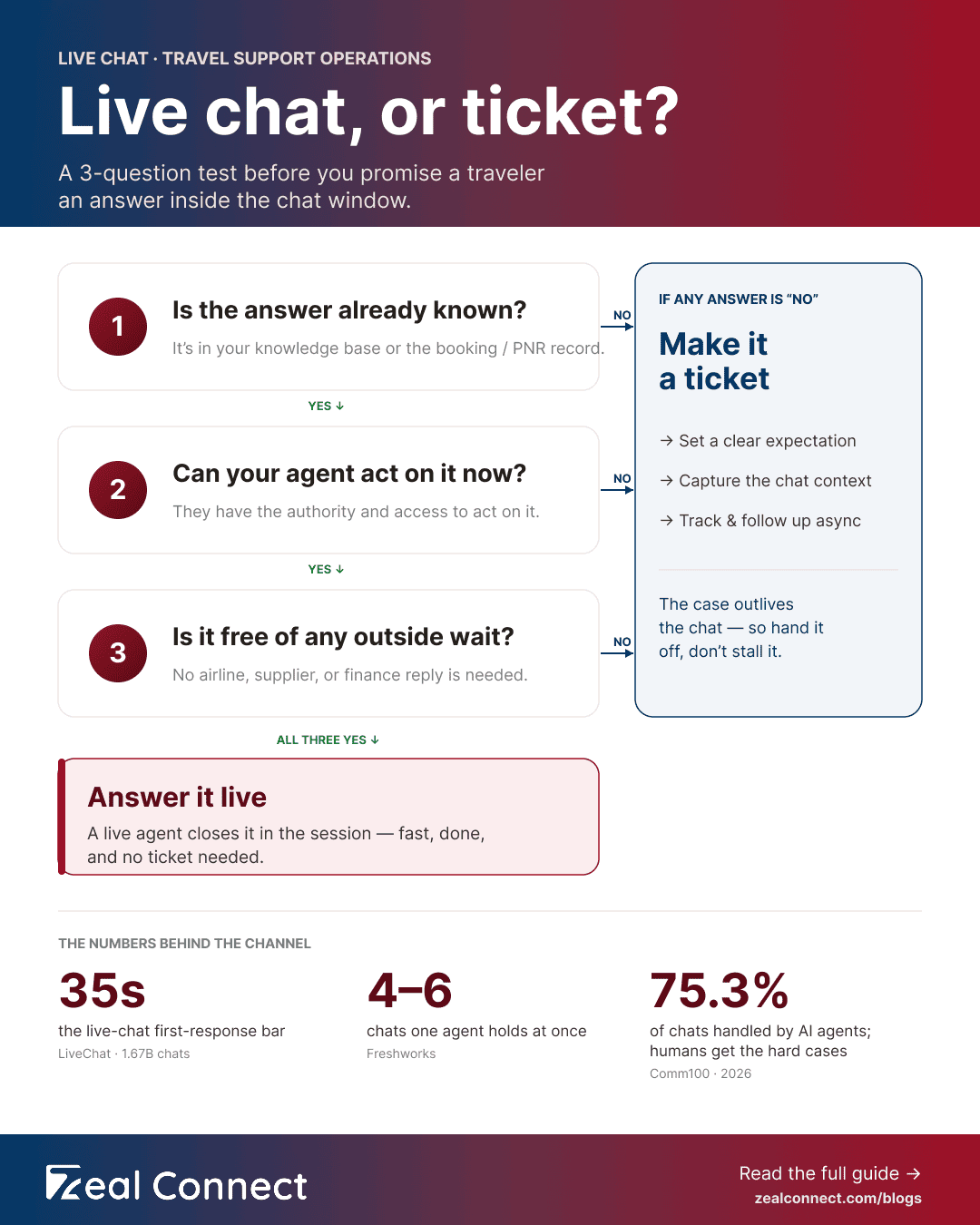
Live chat closes a travel case only when the answer already exists and someone in the chat can act on it.
When a live chat cannot close, convert it to a ticket cleanly
A chat that cannot close on the spot should become a tracked ticket, not a longer chat. Keeping the traveler in a stalled conversation while you wait on a supplier helps nobody. The clean move is quick: tell the traveler what happens next, capture the chat and the booking into a case, set an expectation, and follow up asynchronously. The case outlives the chat, so continuity into a ticket is the real requirement, and a longer chat is never the fix.
How to Staff and Run Live Chat Tools for Travel Without the Channel Breaking
Running live chat well is a staffing and continuity problem, not a software purchase problem. Once you know which interactions chat should own, the operating decisions follow: how many agents, how many chats each holds, and what happens when volume spikes. Get those wrong and the channel that felt fast on a quiet day fails on a bad one.
Concurrency is the number that sets live chat staffing
Plan headcount from how many chats one agent can really hold at once. An experienced live chat agent can handle four to six chats at a single time (Freshworks, 2024). In travel, treat the lower end as your planning number, because each chat often needs a booking lookup or a supplier check that a retail chat does not. Multiply realistic concurrency by staffed agents and availability, and you have your true chat capacity.
Live chat capacity is realistic concurrency times staffed agents. Plan above it and the queue backs up where the traveler can see it.
What happens to live chat during a disruption spike?
Disruption breaks a synchronous channel first. Picture a mid size OTA that handles about 300 chats a day with eight agents and a 40 second first response. A schedule change morning, an IROPS event, triples volume to roughly 900 chats before lunch, first response slips to several minutes, and most of those requests cannot close in the chat because they wait on airline reaccommodation. The plan is to let the bot triage the known questions, trigger proactive chat on the changed flight page, and convert supplier dependent cases to tickets fast, so the live queue stays for what a person can actually finish.
Measure live chat on more than CSAT
Satisfaction alone hides the operational picture. Track first response time, concurrency, chat to ticket conversion rate, and how many chats resolve in the session, alongside CSAT. Rising expectations make this sharper: 61% of consumers expect AI driven interactions to feel tailored to them, from a survey of nearly 5,100 consumers (Zendesk, 2025). Language belongs in the picture too, and reference benchmarks on chat satisfaction help set targets. Machine translation is fine for simple questions, while a native or human checked reply should carry any high stakes case such as a refund or a safety issue.
Conclusion
Live chat is the right channel for travel interactions whose answer already exists and can be given now, and a poor container for anything waiting on a supplier. Define it against the bot: the bot fields the simple, known questions, and a live agent takes the judgment calls and edge cases through a clean warm handoff. Use the three question test: is the answer known, can the agent act, and is anyone outside the chat needed? That tells you what stays a chat and what becomes a ticket. Then staff for realistic concurrency and plan for the disruption spike, because that is when a synchronous channel fails first. Pick the interactions live chat should own, set a conversion path for the rest, and measure response time and conversion, not just satisfaction.
Frequently Asked Questions
Is live chat better than email or phone for travel support?
It depends on the interaction. Live chat is best for answerable now requests like itinerary questions or in policy changes. Email or a ticket suits supplier dependent cases such as refunds, because those cannot close in real time no matter how fast the chat is.
How many live chats can one travel agent handle at once?
Plan for the lower end of four to six concurrent chats (Freshworks, 2024). Travel chats often need a booking lookup or a supplier check, which slows each conversation, so a realistic travel concurrency number sits below a retail one.
Should a chatbot or a live agent answer first?
Let the bot answer first for simple, known questions, then warm hand off to a live agent for judgment calls and edge cases. The handoff must carry the full chat, the traveler's identity, and the booking, so nobody repeats themselves.
What happens to a live chat that cannot be resolved on the spot?
Convert it to a tracked ticket. Tell the traveler what happens next, capture the chat and booking into a case, set an expectation, and follow up asynchronously. A longer chat is never the fix when the answer waits on a supplier.