



This article explains what a customer support app for travel operations is, how it differs from a generic help desk app, and why a single traveler request usually moves across several teams before it is resolved.
You will get a plain definition, a Request Relay map showing what the app must do at each internal handoff, a walked disruption example, and a checklist for buying one.
It is written for operations and support leaders at DMCs, tour operators, OTAs, and TMCs.
You buy a customer support app, the demo looks fast, and the first week goes fine. Then a refund lands that waits on a supplier, or a schedule change floods the queue overnight, and the request stalls the moment it leaves the support agent. That is the real test of a customer support app for travel operations. In travel, a hard request rarely belongs to one person, so the app's job is carrying it across teams without losing it.
A Customer Support App for Travel Operations Runs a Team, Not an Inbox
Page 1 tools sell you a fast agent inbox. What you actually run is a multi team operation, and most of a hard ticket's life is spent inside your own company, not in the reply box. A refund needs finance. Reservations owns a rebooking. A room change waits on a supplier confirmation. The agent who took the request often cannot finish it alone, so the app has to move it to whoever can.
In Travel Operations, the Support App Serves Reservations, Suppliers, and Finance Too
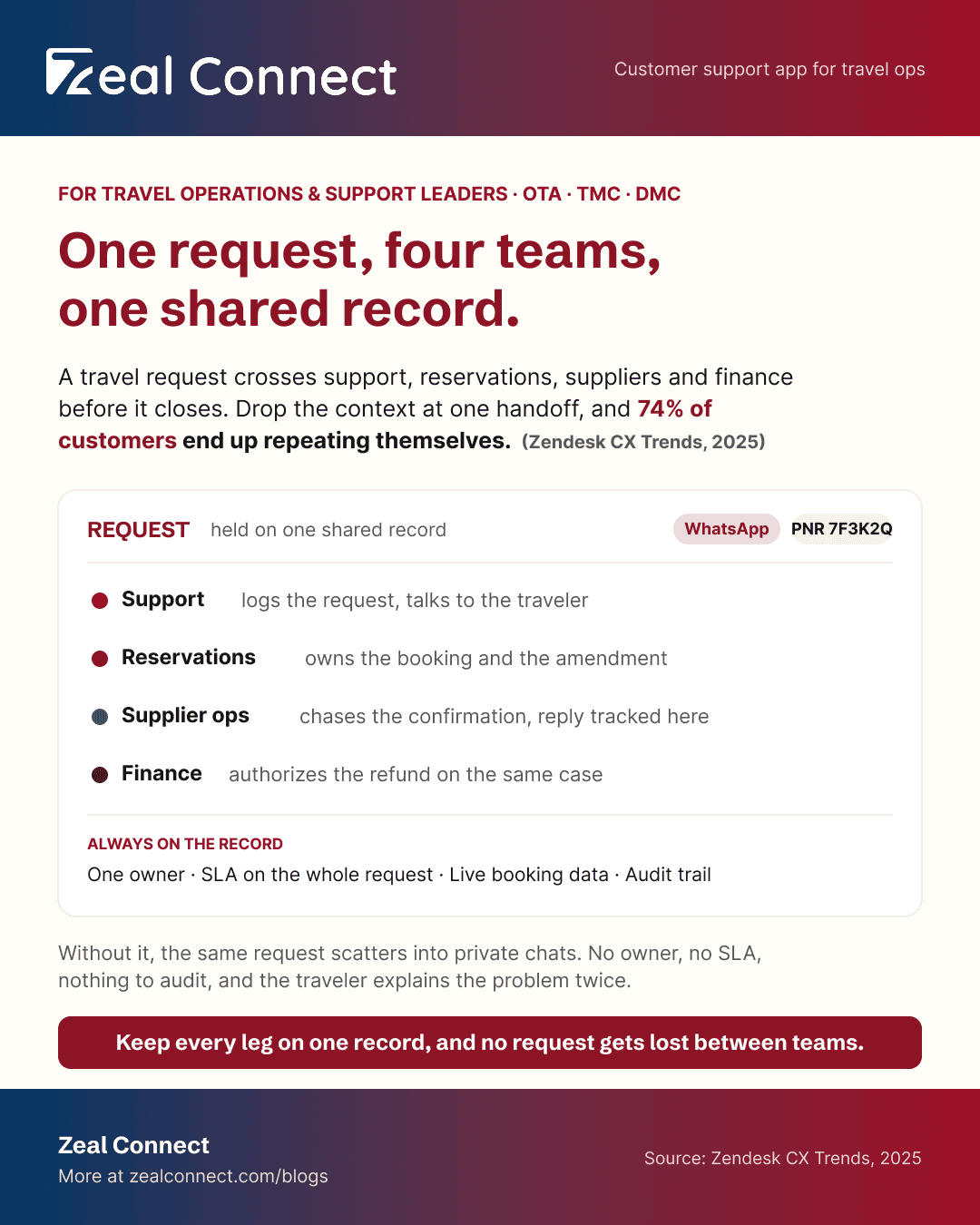
One traveler request usually touches four teams before it closes. Frontline support takes it in and talks to the traveler. Reservations or ticketing owns the booking and any amendment. Supplier and ground ops chase the hotel, airline, or DMC for a confirmation. Finance owns the refund or the chargeback. A support app built only for the first team leaves the other three working in email.
Why Is a Customer Support App Judged on the Work Between Intake and the Reply?
Because the reply is the last step, not the work. Vendors compete on response speed and channel count, which measure how quickly an agent can type back. In travel, the slow part sits before that: waiting on a supplier, confirming fare rules, moving money. If the app cannot hold that middle work, a fast reply just tells the traveler you have received a problem you cannot yet solve.
In travel operations, the reply is the last step of a request. The work is everything that happens between your teams before it.
A Stalled Request Quietly Costs Revenue, Not Just CSAT
A request stuck between teams does more than lower a satisfaction score. It puts money at risk. Qualtrics XM Institute estimates that $3.7 trillion of 2024 global sales are at risk from bad customer experiences, and much of that comes from people who quietly reduce or stop spending after one poor interaction. A traveler who waits three days for a refund because it sat in a colleague's inbox is unlikely to rebook with you.
What Is a Customer Support App for Travel Operations, and What Does It Hold Together?
A customer support app for travel operations is the shared application a travel team uses to receive, coordinate, and resolve traveler and partner requests across channels. It ties each request to its booking and carries it between the teams that must act on it, while a person owns the reply. The app coordinates the work, but people make the decisions and send the messages.
A Customer Support App for Travel Operations, Defined
A customer support app for travel operations is the shared application a travel company runs its support on, where requests from every channel land against the matching booking, move between the teams that resolve them, and stay on one record until a person closes them. It combines omnichannel intake, booking aware records, routing, and AI assistance in a single place, so no request depends on a private chat.
The Request Relay: What the App Must Do at Each Handoff
Think of one request as a baton passed down a relay. Each team runs a leg, then hands the baton on. The baton is the context: what the traveler asked, which booking it concerns, what the supplier said. Every time that context gets dropped, the traveler has to repeat themselves. According to Zendesk (2025), 74% of customers get frustrated when they have to repeat information.
Every internal handoff that drops the context forces the traveler to explain the problem again.
The table below maps what the app must do at each leg.
Table: How a customer support app carries one travel request across the operations team
| Operational function | What it owns on the request | Where the relay breaks | What the app must do here |
|---|---|---|---|
| Frontline support | intake and traveler comms | context stays in the agent's head | log the request against the booking |
| Reservations or ticketing | the booking and amendments | booking details typed again | show live booking data on the record |
| Supplier or ground ops | hotel, airline, DMC confirmation | chased over personal email | track the supplier reply on the ticket |
| Finance or refunds | chargebacks and refund authority | refund sits in a separate system | link the payment action to the case |
| On call or duty manager | overnight disruption escalations | no visibility after hours | surface status on any device |
Where Does a Customer Support App for Travel Operations Lose the Request?
It loses the request the moment a colleague answers on private WhatsApp or forwards an email off the record. Side channels feel faster, but they carry no SLA, no owner, and no audit trail. When the person who moved to a personal chat goes off shift, the thread disappears with them. The app's core job is to make the shared record the easiest place to work, so the relay never leaves it.
Key Terms Worth Knowing
PNR or booking reference: the record that identifies a booking. Every travel request should attach to one, so a handoff never types the same details twice.
IROPS or reaccommodation: irregular operations, such as a cancellation or schedule change, and the work of rebooking affected travelers. This is the work that floods the queue.
Internal warm handoff: passing a request between teams with its full context attached, rather than a cold reassign that forces the next person to rebuild the story.
Omnichannel intake: email, WhatsApp, chat, and web forms landing in one queue as a single thread, instead of four separate places to check.
Audit trail: the timestamped record of who did what on a request. Private chats have none, which is why work done there cannot be tracked.
Inside a Customer Support App for Travel Operations During a Disruption Surge
A disruption is where the relay is tested hardest. Volume climbs, several teams work at once, and the request that needed one confirmation now needs three. This is not a rare event, either. European air traffic flow management delays rose 114% between 2015 and 2024, against only a 6.7% rise in flight numbers, so the surges that break staffing models are becoming more common, not less.
During a disruption, the app has to keep one request whole while four teams work it at once.
A Schedule Change Hits: One Request, Four Teams, Ninety Minutes
A traveler messages on WhatsApp that their flight is cancelled. Support logs it against the booking. Reservations checks alternatives and needs the airline to confirm a reprotection. Supplier ops chases that confirmation while finance prepares a partial refund for the missed hotel night. In an app that holds the relay, each team adds to the same record. In a generic inbox, the request splits into four threads, and the traveler explains the cancellation twice. Coverage from PhocusWire describes exactly this pressure to rethink disruption servicing at scale.
The App as an App Reducer: Closing the Swivel Chair Tabs
A good travel support app is measured by how many other apps it lets your team stop opening. During a surge, agents lose real minutes toggling between the desk, the booking system, a supplier inbox, and a spreadsheet. That switching cost is not small: Salesforce's State of Service research found that 58% of agents at underperforming service teams toggle between multiple screens to find what they need, compared with 36% at high performers. An app that surfaces booking and supplier data on the record removes most of those tabs.
How Does the App Keep One Messaging Channel From Becoming the Whole Operation?
It keeps the channel in its place by pulling every message onto the shared record. WhatsApp is now a primary support channel in travel, not a side one. Air France alone exchanged more than 33 million WhatsApp messages with customers in a year, with 85% of its social customer care conversations happening there. If those messages live only in a messaging app, a surge fragments instantly. The support app has to make WhatsApp one input to the record, not a separate operation.
What to Require of a Customer Support App So It Holds the Whole Operation
Take these requirements into your next demo and make the app prove each one on a real, hard request. The goal is simple: reservations, supplier ops, finance, and on call should all be able to work the same request in the same place, without dropping to email. A tool that only serves the front line will push the rest of your operation back into the inbox you were trying to leave.
Buy the app that keeps the booking on the record and holds the relay across your teams, not the one with the fastest reply.
Require a Booking Aware Record, Not a Flat Ticket
Every request should attach to its PNR, travel dates, and supplier reference the moment it arrives. A generic desk treats a ticket as self contained text, so each handoff types the booking again and risks an error. When the booking sits on the record, the next team reads it instead of asking for it again. This is the single change that removes the most repeat yourself moments, so make the app tie tickets to bookings first.
Require Shared Ownership and Routing, So No Request Lives in a Private Chat
Each request needs one clear owner, a visible status, and a route to the next team that carries its full context. Without that, work slides into personal inboxes and the operation loses sight of it. Ask the app how it does an internal warm handoff, how it applies an SLA to the whole request rather than one reply, and what the audit trail looks like. If the honest answer is a reassign that strips context, the relay will keep breaking.
Does a Customer Support App for Travel Operations Need to Work From a Phone at 2am?
Yes, because travel disruption does not wait for office hours. The on call manager who can authorize a reprotection is rarely at a desk when a storm hits overnight, so the app has to be usable from a phone. Automation and AI help here by drafting replies, summarizing long supplier threads, and routing by ticket type. But a person still reviews and sends. McKinsey's view of agentic AI in travel puts AI in the same place, assisting the team rather than owning the decision. For a disrupted trip, a 2026 Ada survey found 44% of travelers prefer a human agent even if it takes longer, and 53% say human support should always be available even when AI is used.
Conclusion
A customer support app for travel operations is a coordination surface, not an inbox. The real work of a hard request happens between your teams, and the internal handoff is where it stalls or leaks into a private chat. When you evaluate one, look past the reply speed and the channel count. Take one genuinely hard request from your last peak, the kind that waited on a supplier and a refund, and make the app carry it from intake to close across every team that has to touch it. The app that keeps the booking on the record, holds the relay, and works from a phone at 2am is the one built for how your operation actually runs.
Frequently Asked Questions
What makes a customer support app for travel operations different from a generic help desk app?
A generic help desk treats each ticket as self contained text. A customer support app for travel operations ties every request to its booking and coordinates it across support, reservations, suppliers, and finance. The difference is booking aware records and cross team handoffs, not just channels and faster replies.
Which teams besides support use the app to resolve one request?
Reservations or ticketing owns the booking and amendments, supplier and ground ops chases the hotel or airline confirmation, and finance handles refunds and chargebacks. An on call manager escalates overnight disruptions. One hard request typically passes through all of them before it closes.
Why do agents still switch between apps after buying a unified support app?
Because the app does not hold the data they need. If booking details and supplier replies live in other systems, agents toggle out to find them. Salesforce found most agents at underperforming teams switch between multiple screens, which a booking aware app is meant to remove.
Can a customer support app for travel operations resolve requests without a human?
No. The app assists by drafting replies, summarizing supplier threads, routing by ticket type, and surfacing booking data. But a person reviews and sends the reply and authorizes any money movement. Travelers strongly prefer a human on disrupted trips, so AI supports the team rather than replacing it.