


This article explains how to pick the best alternative to Zendesk for travel companies by travel fit, not by price or feature counts. You'll get a plain definition of what "travel native" means, a 5 check decision tool called the Travel Fit Test, a side by side comparison, and a switching checklist that protects your SLAs. It's written for operations and support leaders at OTAs, TMCs, DMCs, tour operators, and travel payment companies.
Most "best Zendesk alternative" lists rank tools by price and channel count. None of that tells you whether a tool can handle a refund dispute, a long supplier thread, or a disruption surge that doubles your queue overnight. For a travel company, those are the tickets that decide whether support holds up. So, the right question isn't which alternative is cheapest or most popular. It's which one fits how travel tickets actually behave. This guide gives you a simple way to test for that fit before you switch.
Why Are More Travel Companies Looking for an Alternative to Zendesk?
The move off Zendesk usually isn't about Zendesk being a poor product. It's about fit. A general purpose help desk does a lot well, but travel teams keep hitting the same wall: the tool doesn't understand a booking, so every travel detail becomes setup work. That shows up as cost, and it shows up as agents spending their day on manual steps instead of travelers.
What Does the "Zendesk Is Expensive" Complaint Really Come Down to for a Travel Team?
The cost complaint is real, but the cause is volume, not the sticker price. Travel demand is seasonal, and disruption events create sharp spikes. When a storm grounds flights, a few hundred tickets a day can become more than a thousand. Per agent pricing then scales with the headcount you add for peak season, and your cost per ticket climbs right when margins are thin. The price isn't the problem on a normal week. It's what the price does during a surge.
Why Doesn't a General Purpose Help Desk Match How Travel Work Actually Flows?
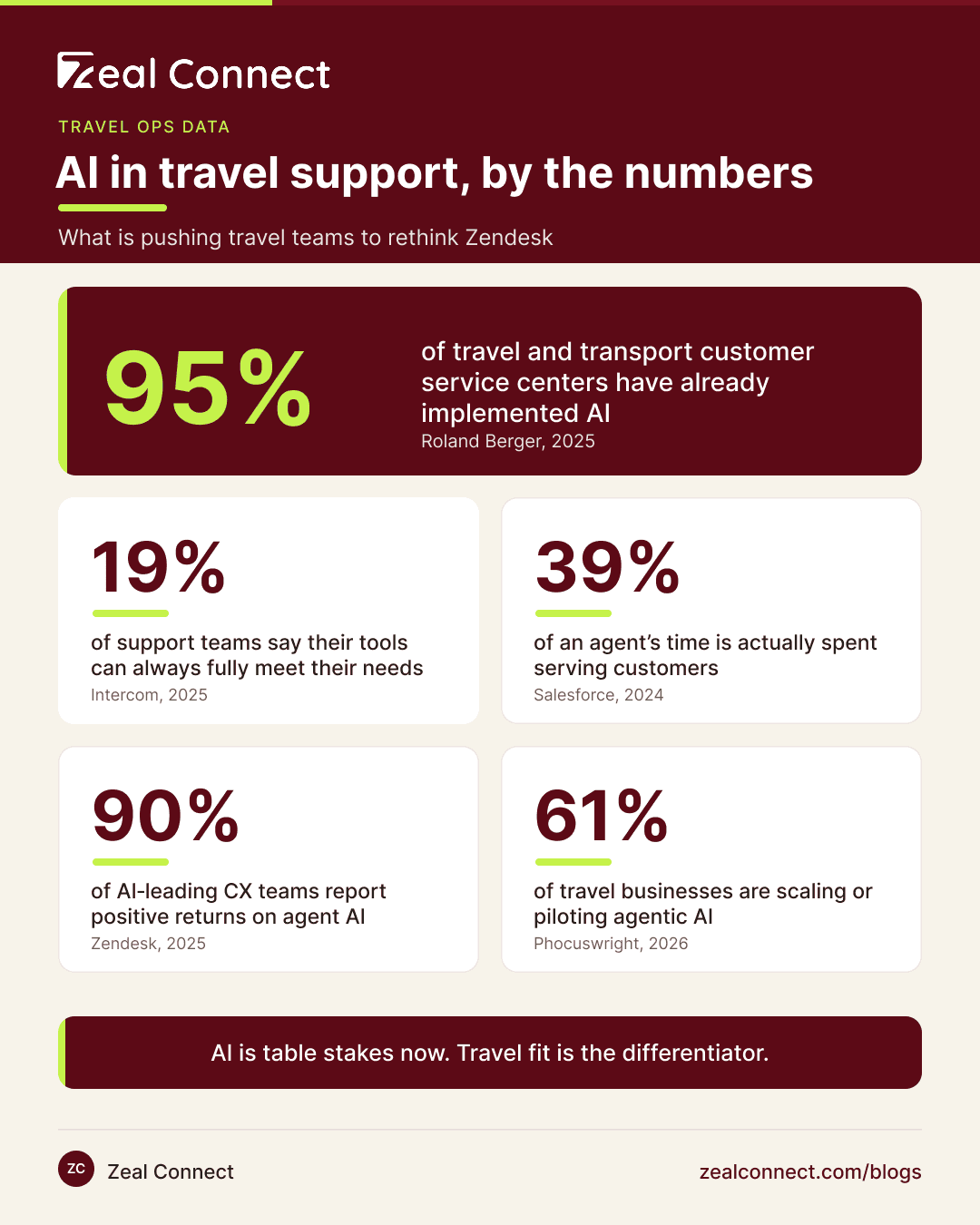
A horizontal help desk is built for any industry, so it has no built in idea of a booking. Because of that, fields like PNR, check in date, and supplier reference become custom fields you create and maintain. Routing by ticket type means writing and updating rules by hand. According to Intercom (2025), only 19% of support teams say the tools they use can always fully support their needs. For travel ops, much of that gap is travel logic the tool was never designed to hold.
Is Moving Off Zendesk Really About AI, or About Fit?
Both matter, but AI alone won't fix a fit problem. Most desks now ship AI features, so AI is table stakes rather than a differentiator. What separates options is whether the AI understands travel work. There's plenty of room to improve here: according to Salesforce (2024), agents spend just 39% of their time actually serving customers, with the rest lost to admin and manual logging. A good alternative cuts that manual load specifically for travel.
What Makes a Zendesk Alternative Genuinely Built for Travel Companies?
A travel native help desk treats travel work as the default, not as configuration. The booking fields, ticket categories, and supplier steps are part of the product, so your team isn't rebuilding them. This is the real line between options, and it's easy to miss because so many tools market a travel page without changing what's underneath.
What Does "Travel Native" Actually Mean in a Help Desk?
Travel native means the system already knows what a booking is. Fields like check in and check out dates, PNR, and supplier reference are read from the ticket automatically. Ticket categories match travel work, such as amendments, refunds, and supplier chasing. Routing understands those categories without rules built by hand. The result is that an agent opens a ticket and sees the travel context immediately, instead of hunting for it across a generic layout.
How Is a Horizontal Zendesk Alternative Different Under the Hood?
A horizontal alternative like Freshdesk, Zoho Desk, or Zendesk itself is general purpose by design. That design serves any industry well, which is exactly why travel logic sits on top as custom work rather than inside the product. You can configure these tools to handle travel, and many teams do. However, the configuration is yours to build, test, and maintain as your suppliers and ticket types change. The capability exists; the travel fit is something you assemble.
Why Does This Difference Decide the Best Alternative to Zendesk for Travel Companies?
Because fit compounds over every ticket and every peak. A small gap on one ticket becomes a daily tax across thousands. Travel teams aren't fringe adopters either: according to Phocuswright (2026), 61% of travel businesses are already experimenting with or scaling agentic AI. So the practical question becomes how to measure travel fit consistently, which is what the next section gives you.
Key Terms Worth Knowing
A few terms come up throughout this comparison. Here's a quick reference before we get into the test.
- Horizontal / general purpose help desk: A desk built for any industry. Travel fields and workflows are custom setups you create and maintain yourself.
- Travel native help desk: A desk where booking fields, travel categories, and supplier aware routing are built in rather than configured.
- Deflection: A ticket resolved by customer self service, where the traveler finds the answer themselves. It does not mean an AI replying on its own.
- FRT / AHT: First Response Time and Average Handle Time. The two speed metrics support and ops leaders manage against, especially during surges.
- PNR / supplier ref: The booking identifiers a travel ticket hangs on. A travel native desk reads them straight from the ticket.
- ADM / BSP: Agency Debit Memo and Billing Settlement Plan. The financial back office flows behind refunds, disputes, and airline settlement.
How Do You Score Zendesk Alternatives With the Travel Fit Test?
The Travel Fit Test is a five check rubric you run against any Zendesk alternative to see whether it's travel native or a general desk with a travel landing page. Each check maps to a way travel tickets actually behave. Score a tool out of five, and you get a clear, repeatable read instead of a feature by feature guess.
Which Five Checks Make Up the Travel Fit Test for a Zendesk Alternative?
The five checks are simple, and each one targets a specific failure point. First, booking fields: does it read PNR, dates, and supplier ref natively? Second, surge handling: does classification hold in a 5 to 10x spike? Third, supplier threads: can it compress a long supplier chain into a brief? Fourth, back office: does it handle refunds, chargebacks, and ADM/BSP tickets? Fifth, human in the loop: does AI draft for an agent to send, never auto reply?
Table: The Travel Fit Test, five checks for any Zendesk alternative
| Check | What it tests | General purpose help desk | Travel native help desk |
|---|---|---|---|
| Booking fields | Reads PNR, dates, supplier ref | Custom fields you build | Native |
| Surge handling | Classification holds in 5 to 10x spike | Manual rules to maintain | Travel trained routing |
| Supplier threads | Compresses long supplier chains | Generic thread view | AI summary to a brief |
| Back office tickets | Refunds, chargebacks, ADM/BSP | Generic ticket type | Travel financial flows |
| Human in the loop | AI drafts, agent sends | Add on bots | Draft and send by design |
How Do the Checks Play Out for an OTA Versus a TMC or DMC?
The checks matter to everyone, but the weighting shifts by sub vertical. An OTA lives on surge handling and back office, because cancellations drive volume and refunds carry money. A TMC leans on response speed and reaccommodation under SLA, since corporate travelers expect fast disruption support. A DMC weighs the supplier thread check most, given how much of its work is chasing ground suppliers. So, the same five checks produce a different priority order for each business.
Where Does AI Genuinely Help a Travel Queue, and Where Does It Stop?
AI helps with the predictable input, not the final resolution. It can classify a ticket, pull the booking fields, summarize a supplier thread, and draft a reply. What it can't do is decide the outcome, because that depends on what the supplier or traveler sends back. According to Zendesk (2024), 90% of CX leaders who lead on AI report positive returns on AI tools for agents. The gains come from assisting the agent, not from replacing the judgment a travel resolution still needs.
Which Zendesk Alternative Should Your Travel Company Pick, and How Do You Switch Without Breaking SLAs?
Once you've scored your shortlist with the Travel Fit Test, the decision gets concrete. The help desk field is crowded, with the help desk software market estimated at $11.24 billion in 2024, so a clear test saves you from demos that all blur together. The goal now is to turn scores into a choice, then move without disrupting the SLAs your team is measured on.
How Do You Turn the Travel Fit Test Score Into a Shortlist?
Weight the five checks by your ticket mix before you compare totals. A raw score out of five treats every check as equal, but your business doesn't. If refunds and chargebacks are most of your volume, the back office check should carry more weight than the others. Rank your top two checks, then drop any tool that fails them, even if its overall score looks fine. That keeps the shortlist honest.
What Should You Map, Preserve, and Rebuild When You Migrate Off Zendesk?
Treat migration as a mapping job, not a fresh start. List your booking related custom fields, SLA rules, macros, and routing logic first, then decide what carries over. Preserve the SLA rules exactly, because those define how your team is judged. Rebuild supplier routing in the new tool's native categories rather than copying old workarounds. Most importantly, pilot one queue first, such as refunds, and confirm it holds before moving the rest.
How Do You Know the New Zendesk Alternative Is Actually Working?
Measure it on travel metrics, not generic CSAT alone. Watch First Response Time and Average Handle Time during your next surge, since that's when fit either holds or breaks. Track deflection through self service, where travelers resolve simple questions themselves. Check back office cycle time on refunds and disputes. If those move in the right direction during a busy week, the switch is working. A quiet week improvement tells you far less.
How Does Zeal Desk Pass the Travel Fit Test That Horizontal Zendesk Alternatives Can't?
Zeal Desk is built only for travel operations, so the Travel Fit checks are native rather than configured. A general purpose alternative can meet many of the same needs, but it meets them through custom setup you own. The difference below is architecture, not effort: Zeal Desk starts with travel built in.
Does Zeal Desk Read Booking Fields and Classify Travel Tickets Natively?
Yes, and this covers the first two checks. Zeal Desk automatically classifies each ticket into categories that are custom created per business and trained by AI, so routing matches your travel work without rules built by hand. It also extracts structured fields like check in and check out dates, PNR, and supplier reference straight from the ticket. Because that classification is travel aware, it holds up better when a disruption drives a sharp spike in volume.
How Does Zeal Desk Handle Supplier Threads and Operational Workflows?
This covers the supplier thread and workflow checks. Zeal Desk uses the original query context to summarize a long supplier email chain into a short brief, so an agent reads one line instead of forty messages. It also supports custom workflows for repetitive operational tasks, such as routine amendments or preparing reconciliation details. A horizontal desk can show the thread, but turning it into a usable summary and a travel workflow is setup you'd build and maintain yourself.
Does Zeal Desk Keep a Human in Control of Every Customer Reply?
Always. This is the human in the loop check, and it matters for trust. Zeal Desk drafts a reply from the ticket's context, then the agent reviews, edits, and sends it. No AI generated reply is ever sent to a customer automatically. Deflection here means self service, where the traveler finds the answer themselves, not an AI answering on its own. That keeps judgment with your team while still removing the manual drafting load.
Conclusion
The best alternative to Zendesk for a travel company is the one that fits how travel tickets behave, and fit beats both price and feature counts. Run any option through the Travel Fit Test: booking fields, surge handling, supplier threads, back office tickets, and a human in control of every reply. Weight those five checks by your own ticket mix, since an OTA and a DMC won't prioritize them the same way. Then switch carefully, preserving SLA rules and piloting one queue before the full move. Do that, and you replace a tool that needed constant travel setup with one that understood travel from the start, measured on the metrics your team actually lives by.
Frequently Asked Questions
How Can I Tell if a Zendesk Alternative Is Genuinely Built for Travel and Not Just Marketed That Way?
Check the architecture, not the landing page. Ask whether it reads booking fields like PNR and check in dates natively, routes by travel categories without custom rules, and handles back office tickets. If those need custom setup, it's a horizontal desk with travel marketing.
Which Zendesk Alternative Fits My Sub Vertical: OTA vs TMC vs DMC vs Travel Payments?
There's no single winner for all of them. Weight the Travel Fit checks by your ticket mix. OTAs prioritize surge and back office handling, TMCs prioritize SLA speed and reaccommodation, and DMCs prioritize supplier thread compression. Score each tool against your top two checks first.
Does an AI Travel Help Desk Reply to My Customers Automatically?
In a well designed system, no. AI drafts a reply and assists the agent, but the agent reviews, edits, and sends every customer message. Deflection means the traveler self serves and finds the answer themselves. A human stays in control of the outbound reply.
How Long Does It Take to Migrate a Travel Support Operation Off Zendesk?
It varies by team size and how much custom logic you carry. The safest path isn't a big bang cutover. Map your fields, SLA rules, and routing first, then pilot one queue such as refunds. Confirm it holds before moving the rest, which lowers risk.
Will a Zendesk Alternative Handle Back Office Tickets Like Chargebacks and ADMs, or Only Traveler Chat?
Only if it's built for travel financial flows. Many general purpose tools treat a chargeback or an ADM as a generic ticket type. A travel native desk recognizes refunds, settlement disputes, and ADM/BSP work as distinct flows, which is exactly what the back office check tests for.