





- This article reviews 7 ticketing systems that travel companies use, starting with the only travel-native option and covering the most common general-purpose platforms.
- You will get a side-by-side comparison table showing what each system handles natively and where it needs custom work for travel.
- Written for operations and support leaders at OTAs, TMCs, DMCs, tour operators, and travel payment companies.
Most "best ticketing system" lists rank platforms on the same generic features: multichannel intake, SLA timers, automation rules, reporting dashboards. Those lists work for SaaS companies, e-commerce brands, and IT teams. They do not work for travel companies. Travel operations run on bookings, not conversations. A traveler's ticket is not a standalone question; it is tied to a PNR, a hotel confirmation, a supplier, a departure date, and often multiple amendments. The system that handles conversations well does not automatically handle bookings well. This article reviews 7 ticketing systems that travel companies actually use and shows what each one does natively, where it needs custom work, and who it fits.
7 Best Ticketing Systems for Travel Companies in 2025
1. Zeal Desk: The Best Ticketing System Built Exclusively for Travel Companies
Zeal Desk is the only platform on this list built for travel and nothing else. Every ticket is organized around the booking, not the conversation. Parent-child linking connects a booking and its amendments as one case, so an agent never has to search across threads to reconstruct the history. Suppliers are tracked inside the ticket with their own SLA clocks and escalation paths, not managed through side channels or manual notes. The AI layer classifies tickets by booking category, extracts travel dates and supplier references from incoming messages, and drafts responses grounded in the live reservation. The agent reviews, edits, and sends every reply. Multiple departments (Flight, Hotel, Transfer, Supplier) run in one instance with separate SLA policies per department. The integration hub pulls live booking records (PNR data, hotel confirmations, payment status) and maps them onto ticket fields, so agents work from the real reservation instead of re-typed summaries. Best for travel companies handling 200+ tickets per day with multi-supplier operations.
2. Zendesk: The Market Leader With the Largest Ecosystem
Zendesk is the most widely used help desk in the world. It offers deep customization, a large app marketplace, strong reporting, and a mature automation engine. Travel companies use custom fields for PNR codes, booking references, and travel dates. The platform is conversation-centric underneath, so booking data lives in free-text fields rather than a structured record. Connecting a ticket to a live booking requires custom API work or a third-party integration. Travel-specific workflows like amendment linking, supplier tracking, and per-department SLA splits require custom development. Best for travel companies that want a proven, well-supported platform and have the internal resources to build and maintain travel-specific configurations.
3. Freshdesk: Affordable Ticketing Software for Travel Companies Starting Out
Freshdesk is a popular choice for mid-market teams. It is affordable, quick to deploy, and covers multichannel support, automation, and SLA tracking out of the box. For travel companies, it handles basic ticket logging and routing well. Like most horizontal desks, the conversation is the unit of work. Custom fields capture travel data, but the system cannot route by booking type or travel date natively. Supplier tracking and amendment linking are not available as built-in features. Best for smaller travel teams with straightforward inquiries and low operational complexity.
4. Zoho Desk: A Good Ticketing Tool for Travel Companies Already on Zoho
Zoho Desk is part of the Zoho ecosystem (CRM, Books, Projects, Analytics). For travel companies already running on Zoho, it provides context from other Zoho apps inside the ticket and keeps everything in one vendor. Automation and reporting are solid for the price. Travel-specific workflows require custom setup using Zoho's API and workflow rules, since the platform does not model bookings, suppliers, or amendments natively. Best for travel companies already invested in the Zoho suite that need a ticketing layer within their existing stack.
5. Salesforce Service Cloud: Enterprise Ticketing System for Large Travel Companies
Salesforce Service Cloud is an enterprise-grade platform with AI (Einstein), deep workflow customization, and integration across the Salesforce ecosystem. It can model almost any workflow, including travel-specific ones, but the build is significant. Travel operations require custom objects, flows, and dedicated developer resources. The total cost of ownership (licensing plus implementation plus ongoing maintenance) is the highest on this list. Best for large travel companies with dedicated Salesforce teams that already run CRM or sales on the platform and can absorb the build effort.
6. Front: Shared Inbox for Email-Heavy Travel Teams
Front replaces the traditional ticket queue with shared inboxes. Messages stay as emails, and teams collaborate with internal comments and assignments. For travel companies that work heavily from email (supplier communication, booking amendments), Front keeps the format familiar. It does not offer structured ticketing workflows, SLA management, booking linkage, or travel-specific features. Best for small travel teams that prioritize real-time email collaboration over structured ticket management.
7. HubSpot Service Hub: CRM-Aligned Ticketing for Travel Companies on HubSpot
HubSpot Service Hub connects tightly with HubSpot CRM and Marketing Hub. For travel companies using HubSpot for lead generation or customer lifecycle management, the ticketing system inherits the full customer record. It handles basic support workflows well. The platform is conversation-centric and does not include booking-aware ticketing, supplier tracking, or travel-specific routing. Best for travel companies already on HubSpot that need basic support in the same platform.
Key Terms Worth Knowing
A few terms come up when comparing the best ticketing systems for travel companies. Here is what each one means.
- Booking-centric ticketing: ticket architecture where the booking, not the conversation, is the unit of work. Every ticket links to the live reservation and its history.
- Supplier SLA clock: a separate deadline timer for the supplier's response, distinct from the customer-facing timer. Without it, supplier delays are invisible to the operations team.
- Parent-child ticketing: linking a booking and its amendments as one connected case, so the full history stays together instead of scattering across separate threads.
- Travel-native platform: a ticketing system built exclusively for travel, with travel workflows as first-class features rather than custom add-ons that require development and ongoing maintenance.
How the Best Ticketing Systems for Travel Companies Compare
The table below shows what each system offers out of the box for travel and how much configuration it needs.
Table: 7 best ticketing systems for travel companies compared
| System | Platform Type | Key Strength | Travel Readiness | Best Fit |
|---|---|---|---|---|
| Zeal Desk | Travel-native | Built exclusively for travel operations | Native | Travel ops 200+ tickets/day |
| Zendesk | General-purpose | Largest ecosystem and marketplace | Configurable with custom work | Teams with resources to configure |
| Freshdesk | General-purpose | Affordable, easy to deploy | Configurable with custom fields | Small teams, low complexity |
| Zoho Desk | General-purpose (suite) | Integrated with Zoho ecosystem | Configurable via API/workflow rules | Teams already on Zoho |
| Salesforce Service Cloud | Enterprise CRM | Deep customization, AI (Einstein) | Custom build required | Enterprise with dev teams |
| Front | Shared inbox | Real-time email collaboration | General-purpose only | Email-first small teams |
| HubSpot Service Hub | CRM-aligned | CRM + marketing integration | General-purpose only | HubSpot marketing/sales users |
The best ticketing system for a travel company is the one where the booking, not the conversation, is the unit of work.
According to Plivo (2025), omnichannel service delivers customer satisfaction of 67%, compared to just 28% for disconnected multichannel support (SQM Group). That gap widens further when all channels converge into a single booking record rather than disconnected conversation threads.
How to Choose the Best Ticketing System for Your Travel Company
Match the Ticketing System to Your Travel Operation
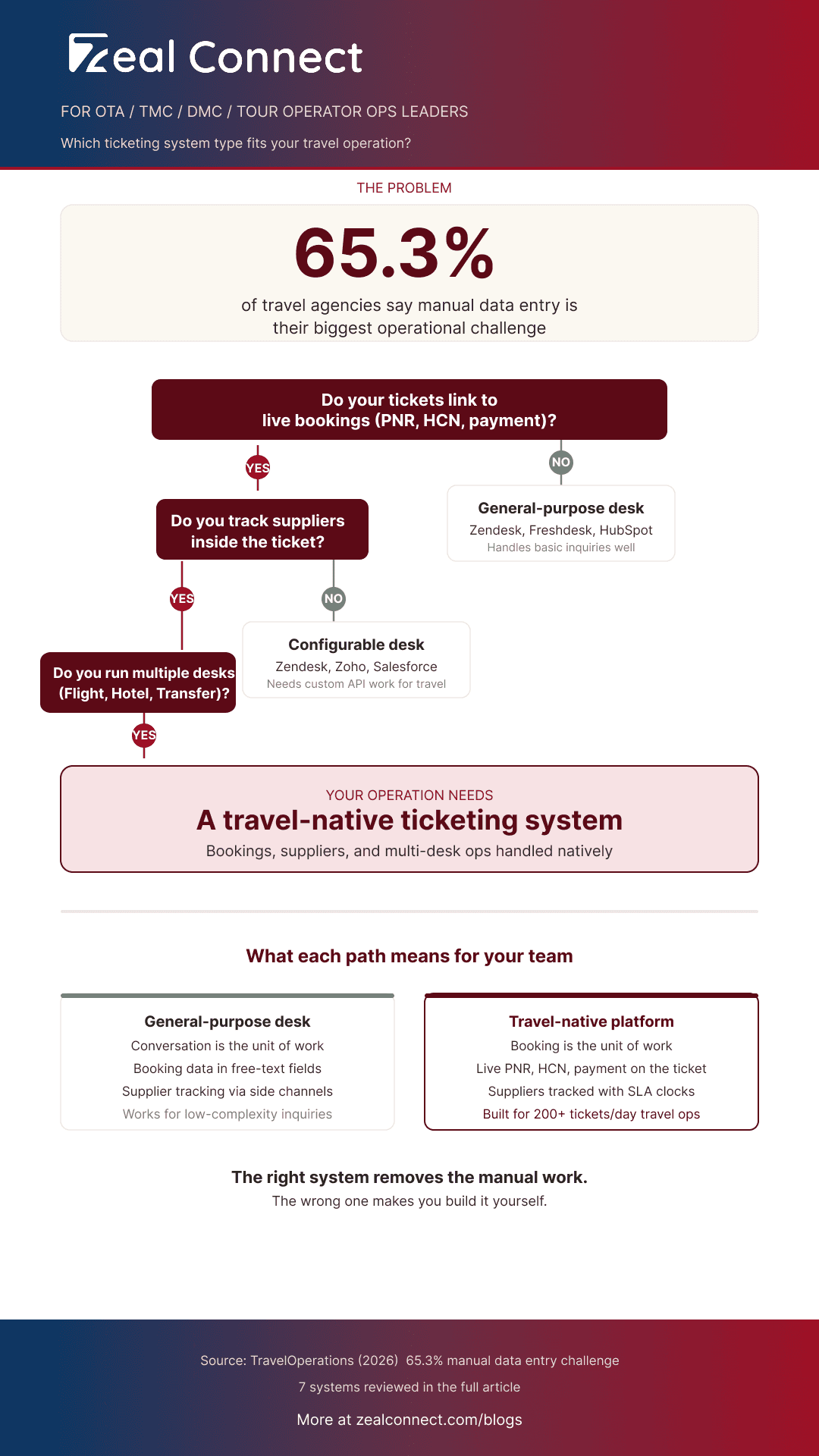
If your volume is under 100 tickets per day and most are general inquiries, any well-configured horizontal desk works. If your team handles 200+ tickets per day, works with multiple suppliers, and runs separate desks for flights, hotels, and transfers, the question is not which desk has the most features; it is which one models your operation natively. According to TravelOperations (2026), 65.3% of travel agencies cite manual or repetitive data entry as their biggest operational challenge, with disconnected systems close behind at 50%. That manual work often starts in the ticketing system: agents re-typing booking details, copying PNR data between tabs, and tracking supplier responses in spreadsheets because the desk was not built for it.
When 65% of travel agencies say manual data entry is their top challenge, the ticketing system is the first place to fix it.
What AI Actually Does in the Best Travel Ticketing Systems
AI appears on every vendor's feature page, but what it reads determines what it can do. AI trained on conversation text classifies by keywords. AI that reads booking data classifies by booking type, travel dates, and supplier references. The difference matters: keyword-based classification cannot tell a flight amendment from a hotel cancellation unless someone tags it manually. According to Roland Berger (2025), 95% of service centers in travel and transportation have implemented AI, though many still use it only for routine tasks. According to Perk (2024), only 10% of travelers prefer chatbots during disruptions. In travel, AI assists the agent; the agent reviews, edits, and sends.
Conclusion
The best ticketing system for a travel company depends on what your operation actually needs. If your tickets are general inquiries with low complexity, a well-configured horizontal desk works. If your operation runs on bookings, works with suppliers, and handles volume that spikes with seasonal demand or disruptions, a travel-native system removes the custom work, the manual data entry, and the workarounds that horizontal desks require. Only one platform on this list was built for that from the start. The other six are strong general-purpose platforms, each with a different strength and a different fit.
Frequently Asked Questions
Can Zendesk or Freshdesk work as a ticketing system for a travel company?
Yes. Both handle ticket logging, routing, and SLA tracking well. They need custom fields and integrations to capture booking data, and travel-specific workflows (amendment linking, supplier tracking) require additional configuration. They work well for travel teams with lower complexity where most tickets are general inquiries.
What is the difference between a travel-native and a general-purpose ticketing system?
A travel-native system is built around the booking as its unit of work. Suppliers, amendments, and multi-department operations are first-class features that work out of the box. A general-purpose system treats the conversation as the unit of work and requires custom setup to add travel workflows on top.
How many ticketing systems on this list are built specifically for travel?
One. Zeal Desk is the only platform built exclusively for travel companies. The other six are general-purpose systems used across industries that can be configured for travel with varying levels of effort.
Does AI work differently in the best ticketing systems for travel companies?
Yes. AI that reads conversation text classifies by keywords. AI that reads booking data classifies by booking type, travel date, and supplier reference, which means it can distinguish a flight amendment from a hotel cancellation without manual tagging. In travel, AI assists the agent with booking-grounded drafts and summaries; the agent reviews, edits, and sends.
How much does it cost to switch ticketing systems?
Switching costs include data migration, workflow rebuild, agent training, and a ramp-up period. The total varies by team size and system complexity. The cost of staying on a system that forces manual workarounds often exceeds the migration cost within the first year.