




- This article breaks down which ticketing system features actually matter for travel operations and, more importantly, how those features behave differently when they operate on bookings instead of generic conversations.
- You'll get a feature by feature comparison showing what routing, SLA management, automation, AI, and reporting do on a travel ticket versus a generic one, plus a reference table you can use to evaluate any ticketing system against your operation's real requirements.
Your ticketing system for travel operations has routing. It has SLA timers. It has automation rules and an AI layer. Every box on the vendor's checklist is ticked. Yet your team still copies booking references by hand, chases suppliers in a separate inbox, and loses track of amendment cascades across disconnected tickets. The features exist. They just don't work the way travel needs them to. Because a feature built for generic conversations behaves differently from one built for bookings, suppliers, and travel deadlines. This article shows where those differences sit, feature by feature, and how to evaluate what your system actually does versus what it claims.
Why Ticketing System Features Look the Same Until You Run Travel Through Them
Travel operations leaders evaluate ticketing systems by comparing feature lists. Routing, SLA management, automation, AI, reporting: every vendor offers them. The comparison looks like a tie. But the comparison is between labels, not behaviors. Two systems can both say "routing" while one routes by keyword and the other routes by booking type, supplier, and travel date. The difference only surfaces once live travel tickets flow through, and by then the contract is signed.
Why Every Ticketing System for Travel Operations Passes the Feature Checklist
Every modern help desk ships with the same feature categories. Routing exists. SLA timers exist. Automation exists. AI classification exists. The checklist comparison always ends in a draw because it asks "does this feature exist?" instead of "what can this feature see and act on?" According to Sabre (2025), 91% of travel agencies operate with four or more booking systems, and over half manage seven or more. Each of those systems holds data the ticketing features need to reach. A feature that can't see booking data can't act on it, regardless of what the checklist says.
Where Ticketing System Features for Travel Start Behaving Differently From the Demo
The gap opens the moment a ticket involves one of four conditions: a booking reference, a supplier dependency, a travel date deadline, or a financial consequence. Generic features handle these as text in a conversation thread. Travel native features handle them as structured data the system can read, route on, and automate against. According to HubSpot (2025), 75% of customer service reps saw the highest ever volume in customer service tickets in 2024. Volume amplifies whatever a feature can or can't do. At 50 tickets a day, manual workarounds are annoying. At 500, they break the operation.
What a Feature Checklist Cannot Tell a Travel Operations Leader
A checklist tells you whether a system has routing. It doesn't tell you whether that routing can distinguish a pre departure amendment from a post trip refund claim and send each to the right desk. It tells you the system has SLA timers. It doesn't tell you whether those timers can run separate clocks for the customer response and the supplier response. The rest of this article replaces the checklist with a behavioral comparison: what each feature does on a generic ticket versus what it does on a booking aware travel ticket.
How Core Ticketing System Features Behave on a Booking Aware Travel Ticket
A ticketing system for travel operations is a support platform where every feature operates on a booking aware record (PNR, supplier references, travel dates, fare rules, payment status) rather than a flat conversation thread, so that routing, SLA timers, automation, AI, and reporting can all act on the booking data, not just on the text of the message.
The ticket's data model determines what every feature can do. In a conversation centric system, the ticket holds a subject line, a status, and a message thread. In a booking centric system, it holds a live reservation: PNR, supplier references, check in dates, fare rules, payment status, and linked amendments. Every feature built on top of that model inherits what the model can see. So the same feature, sitting on two different data models, produces two different operational outcomes.
Routing, SLA, and Automation: Three Ticketing Features That Change on a Travel Ticket
Routing on a generic system assigns tickets by keyword, priority tag, or round robin. Routing on a booking aware system assigns by booking type, supplier, travel date urgency, and financial weight. SLA timers on a generic system run one clock from first contact. On a travel ticket, you need two: one for the customer response and a separate one for the supplier, because the supplier wait is usually the longest segment of resolution time. Automation on a generic system means auto assign, auto tag, and canned replies. On a travel ticket, it means supplier follow up triggers, amendment cascade updates across linked tickets, and parent child status sync.
The same feature label on a vendor's checklist can mean two entirely different things depending on whether the ticket underneath carries a booking or a conversation.
Table: How ticketing system features behave on a generic ticket versus a travel operations ticket
| Feature | On a generic conversation ticket | On a booking aware travel ticket | What the gap costs |
|---|---|---|---|
| Routing | By keyword, tag, or round robin | By booking type, supplier, travel date urgency | Misrouted tickets; agents handling unfamiliar suppliers |
| SLA timers | One customer response clock | Separate customer + supplier clocks | SLA breaches blamed on agents when the supplier is late |
| Automation | Auto assign, auto tag, canned reply | Supplier follow up, amendment cascade, linked ticket sync | Manual chasing; amendments lost between tickets |
| AI triage | Text classification by keywords | PNR, fare rule, supplier ref extraction + booking linking | Agents re key data the system should have read |
| Reporting | FRT, CSAT, ticket volume | Cost per ticket, supplier chase time, amendment accuracy | No visibility into where travel operations actually lose time |
How AI and Reporting Differ in a Ticketing System for Travel Operations
AI in a generic system classifies tickets by scanning text for keywords. AI in a booking aware system extracts structured fields: PNR codes, check in dates, supplier references, fare rule clauses, and amounts. It links the ticket to the live booking record so the agent and the system both work from actual reservation data instead of a re typed summary. According to Salesforce (2025), by 2027, 50% of service cases are expected to be handled by AI, up from 30% in 2025. But that projection depends on the AI reading the right data. When the data model is a flat conversation thread, AI triage hits a ceiling: it can classify the topic but can't act on the booking.
Reporting follows the same pattern. Generic systems report on first response time, CSAT, and ticket volume. Those metrics tell you how fast you replied and whether the customer was satisfied. They don't tell you how long the supplier took, how much each ticket cost, or whether amendments were processed accurately. A ticketing system for travel operations needs metrics that track what the operation actually cares about: supplier chase time, SLA compliance split by customer and supplier clock, cost per ticket by ticket type, and amendment accuracy rates.
Key Terms Worth Knowing
A few terms come up throughout this article on ticketing systems for travel operations. Here is what each one means.
- Booking centric ticketing: ticket architecture where the booking, not the conversation, is the unit of work; every ticket links to a live reservation with PNR, supplier refs, and payment status.
- Supplier SLA clock: a separate deadline timer for the supplier's response, distinct from the customer facing first reply timer, so SLA compliance reflects who actually caused the delay.
- Parent child ticketing: linking a booking to its amendments or a group's travelers as one connected case, so changes cascade without losing context across a multi component itinerary.
- PNR (Passenger Name Record): the booking reference that identifies a trip across airlines, GDS platforms like Amadeus and Sabre, and booking systems; often the key used to match a request to the right record.
- ADM (Agency Debit Memo): an airline issued financial charge for agency booking errors, creating tickets with BSP filing deadlines that generic desks don't distinguish from standard inquiries.
Which Ticketing System Features Matter Most for Supplier Coordination and Disruption Handling
The feature behavior gap is sharpest in two areas that generic ticketing systems barely acknowledge: supplier coordination and disruption event handling. These are not edge cases. Supplier dependent tickets are the majority of travel support volume for OTAs, TMCs, and tour operators. Disruption events are the stress test that breaks any system designed for steady state operations. The features each workflow demands are specific, and they don't appear on standard vendor checklists.
Supplier Coordination Features a Ticketing System for Travel Operations Must Have
In most travel tickets, the agent can't close the customer's request alone. A date change needs the hotel to confirm. A cancellation refund needs the airline to process. The supplier's response time, not the agent's, determines resolution speed. A ticketing system for travel operations needs the supplier modeled as a tracked ticket participant with their own communication thread, their own SLA clock, and automated follow up when they go silent. Without this, agents chase suppliers in personal email, and the ticketing system shows a ticket "in progress" with no visibility into what's actually stalled. According to Chargeflow (2025), travel and hospitality carry the highest average chargeback value of any industry at $120, with total merchant costs reaching $450 per dispute. When supplier coordination fails on refund and chargeback tickets, the financial cost multiplies fast.
Disruption Event Features in a Ticketing System for Travel Operations: When Volume Spikes 5x
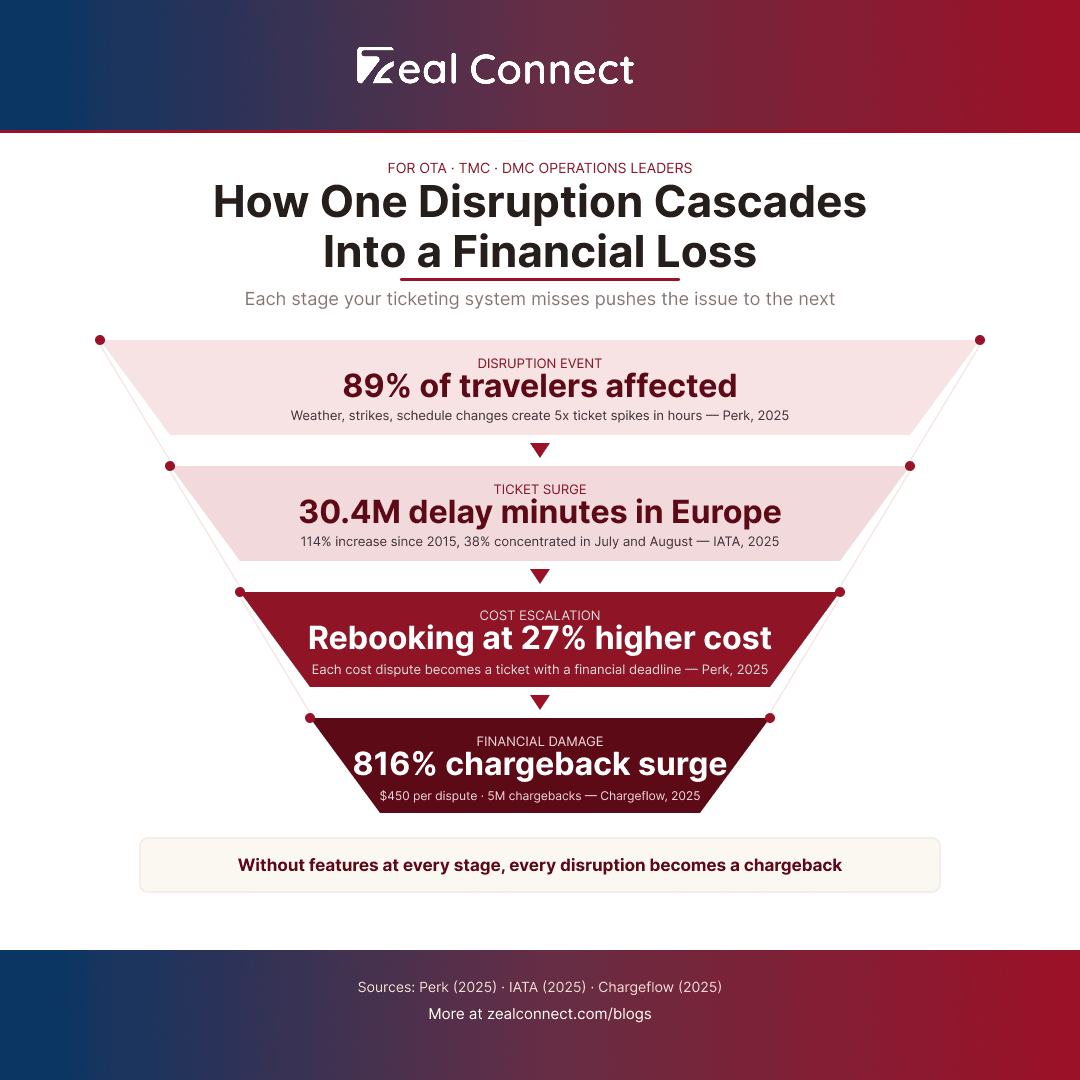
A weather event, a schedule change, or a strike can push a travel team's queue from 300 tickets to 1,500 in a few hours. Generic ticketing systems apply the same routing rules at 1,500 that they applied at 300. Travel native disruption features include bulk ticket creation from API and system events (a cancellation feed creates tickets before travelers contact you), priority override by travel date (tomorrow's departures jump the queue), mass update actions, surge routing to available agents, and proactive outreach to affected bookings. According to IATA (2025), ATFM delays in Europe reached 30.4 million minutes in 2024, a 114% increase over 2015, with 38% of delays concentrated in July and August. Those delays generate ticket surges every summer. According to Perk (2025), 89% of business travelers were affected by travel disruptions in 2025, and those who rebooked did so at an average 27% higher cost. The rebooking cost becomes a dispute. The dispute becomes a ticket. The system needs to absorb the volume before agents drown in it.
A ticketing system that works at 300 tickets a day but collapses at 1,500 is not built for travel operations.
Financial and Settlement Tickets: Ticketing Features Beyond Standard Support
Not every travel ticket is a customer service request. Refund tracking across the customer, agency, OTA, and supplier chain. Chargeback disputes with regulatory response deadlines. ADM handling with BSP filing windows. Commission reconciliation and invoice discrepancies. These are financial tickets that carry regulatory and contractual weight. They need features generic support desks don't offer: deadline aware SLAs (a chargeback response window overrides a standard response time target), compliance aware routing (PCI sensitive tickets go to authorized agents), financial field extraction (amounts, transaction IDs, dispute codes), and audit trails that hold up under review. According to Chargeflow (2025), chargeback rates in travel surged 816% from 0.1% in 2023 to 0.916% in 2024, with 5 million chargebacks processed. A missed deadline on any one of those costs real money.
How to Evaluate Ticketing System Features for Your Travel Operation
The feature behavior comparison gives you the framework. But which features matter most depends on your operation. A 200 agent OTA processing high volume amendments and refunds needs different feature priorities than a 15 person DMC managing on trip incidents and supplier reconciliation. Instead of ranking features generically, evaluate them against your own ticket mix.
Four Questions That Reveal Which Ticketing System Features Your Operation Needs First
Start with four numbers from your own queue. First: what percentage of your tickets involve a booking reference? If it's above 60%, booking centric architecture is not optional. Second: how many tickets depend on a supplier response before you can close them? If it's more than a third, supplier tracking features are a top priority. Third: how often does your volume spike 3x or more in a single day? If it happens seasonally or during disruption events, you need surge handling features. Fourth: what percentage of your tickets carry a financial deadline (chargeback, refund, ADM)? If it's above 10%, you need compliance aware routing and deadline driven SLAs. The answers sort your feature priorities by what your operation actually runs.
Evaluate ticketing system features by what they do on your tickets, not by whether they appear on the vendor's list.
Why "Comfortable With AI" Is Not the Same as "Ready for AI on Travel Tickets"
AI features are the loudest line on every vendor's pitch. But readiness for AI in travel operations depends on what the AI can read, not just that it exists. According to GBTA (2026), 89% of corporate travel managers are focused on automated disruption management and rebooking, but only 57% are comfortable with fully autonomous booking changes. That 32 point gap exists because travel decisions carry financial and logistical consequences that generic AI triage is not grounded in. Evaluate AI features by whether they can extract booking data (PNR, fare rules, supplier refs), ground their suggestions in live reservation details, and keep a human in the loop for the final action. According to Gartner (2026), 91% of customer service leaders reported pressure from executive leadership to implement AI. The pressure is real, but "implement AI" means different things on a generic ticket and a booking aware travel ticket. Evaluate accordingly.
How Does a Ticketing System for Travel Operations Handle These Features Differently?
Zeal Desk is built only for travel, so the features described throughout this article operate on booking aware records by architecture, not by customization. Where horizontal competitors like Zendesk, Freshdesk, and Zoho Desk offer generic feature labels and leave the travel logic to your team, Zeal Desk ships it as standard.
How Does Zeal Desk Route, Track SLAs, and Automate on a Booking?
Zeal Desk's integration hub pulls live booking records from external APIs and maps them onto ticket fields. Routing uses that data: booking type, supplier, travel date urgency, and financial weight all drive assignment. SLA policies run dual clocks, one for the customer and one for the supplier, so a late hotel confirmation doesn't count as an agent breach. Automation triggers supplier follow ups, cascades status updates across parent child linked tickets, and syncs amendments. On a general purpose help desk, building this requires custom fields, manual tagging, and workaround workflows that break at scale.
How Does Zeal Desk's AI Work on a Travel Ticket Instead of a Generic Conversation?
Zeal Desk's AI layer reads every inbound request and extracts structured booking data: PNR, dates, supplier references, amounts, and fare rule clauses. It classifies using the operation's own categories (trained per business, not generic labels) and links the ticket to the live booking. For routine cases, support AI agents handle the work end to end within configured playbooks. For cases that need a human, auto next action suggests the next step grounded in the knowledge base and the live reservation. The agent reviews, edits, and sends. AI drafts; the human decides.
How Does Zeal Desk Report on Travel Operations, Not Just Ticket Counts?
Zeal Desk's reporting is built on travel operations data, not just support metrics. Dashboards track SLA compliance split by customer and supplier clock, workforce productivity across shifts, supplier response times by vendor, and operational anomalies (issue spikes, a supplier slowing down). Because the system holds booking level data, reports can break down cost per ticket by booking type, amendment accuracy, and resolution paths. On a generic system, these reports require manual exports and spreadsheet analysis because the ticket data model doesn't carry the fields.
Conclusion
A feature checklist is the wrong tool for evaluating a ticketing system for travel operations. Every modern help desk has routing, SLA timers, automation, AI, and reporting. The question is what those features do when the ticket involves a booking, a supplier, a travel date deadline, or a financial consequence. Start with the four diagnostic questions from this article: how many of your tickets carry a booking reference, depend on a supplier, spike during disruptions, or carry a financial deadline? The answers tell you which features to evaluate first, and the behavioral comparison tells you what to look for. Evaluate what the features do on your tickets, not whether they appear on the vendor's list.
Frequently Asked Questions
What is the difference between a ticketing system for travel operations and a generic help desk?
A generic help desk models every request as a conversation: subject, status, thread. A ticketing system for travel operations models it as a booking: PNR, supplier references, travel dates, fare rules, and payment status. That data model determines what every feature on top of it can see and act on. The difference is structural, not cosmetic.
Which ticketing system features matter most for supplier coordination in travel?
Supplier coordination requires the supplier modeled as a tracked participant inside the ticket, with their own communication thread, their own SLA clock (separate from the customer's), automated follow up and escalation rules, and visibility on the agent's screen showing exactly where the supplier response stands. Without these, agents chase suppliers outside the system.
Can a generic ticketing system be customized for travel operations?
To a point. You can add custom fields for booking references, create tags for supplier names, and build manual routing rules. But custom fields don't pull live booking data, track supplier responses with a separate SLA clock, or cascade amendment updates across linked tickets. The gap is architectural: the data model underneath determines what features can do.
How should a travel company evaluate AI features in a ticketing system?
Evaluate by what the AI can read, not just what it can do. Can it extract PNR codes, fare rules, and supplier references from an inbound message? Can it ground its suggestions in a live booking record? Does it keep a human in the loop for the final reply? Only 57% of travel managers are comfortable with fully autonomous booking changes, so human in the loop design is a practical requirement.
What ticketing system features does a travel company need during a disruption event?
Disruption handling needs bulk ticket creation from API and system events (a cancellation feed creates tickets before travelers call), priority override by travel date, mass update actions across affected bookings, surge routing to available agents, and proactive outreach to travelers whose trips are impacted. These are a distinct feature category that generic checklists don't cover.