


This article explains what a customer support knowledge base for a travel company actually contains, why travel knowledge behaves differently from other industries, and how to build and maintain one.
You get a working definition, a classification of travel support knowledge by how fast it changes and who owns it, a four step build order, and the health metrics that keep the knowledge base from going stale.
It is written for support and operations leaders at OTAs, tour operators, DMCs, and TMCs.
Most travelers try to answer their own question before they contact you. In travel, that answer can change from one week to the next: a supplier's cancellation window, a fare rule, an entry requirement. A knowledge base built the generic way, where you write articles once and review them quarterly, serves those out of date answers with total confidence. Confident but wrong is the expensive failure in customer support in travel, because it becomes a wrong refund promise or a second contact. This guide shows how to build the knowledge base by sorting knowledge by how fast it changes and who owns it, then serving travelers, agents, and AI from one source of truth.
Customer Support in Travel Lives or Dies on the Answer Behind Each Ticket
Support quality in travel is really a question about the answer behind the ticket. Does the right, current answer exist, and can the person who needs it find it? When it does, most contacts never reach an agent. When it doesn't, a simple question becomes a queue. So the knowledge base, not headcount, is the first place to look when contact volume climbs.
Why Customer Support in Travel Is Under More Pressure Than Its Volume Explains
Complaints are growing faster than trips. Complaints against the 10 largest U.S. airlines reached a record 66,675 in 2024, up nearly 9 percent from the prior year even though passenger volume rose only about 4 percent, according to the U.S. PIRG Education Fund (2025). The top drivers were refunds, cancellations and delays, and baggage. Those are exactly the topics whose answers change most often, so the pressure lands hardest on the knowledge that is hardest to keep current.
Travelers Self Serve First, So the Knowledge Base Is the Front Line
Your knowledge base handles the first attempt at every question, whether you designed it that way or not. According to Zendesk (2024), 69 percent of customers want to resolve as many issues as possible on their own. In travel that instinct is strong, so the help center is where customer support in travel actually begins. A good answer there ends the contact. A missing or stale one routes the traveler to a channel that costs you more.
Why Does Self Service in Travel Fail So Often?
Because people can't find the answer, or the answer isn't really there. Only 14 percent of customer service issues are fully resolved in self service, and the most common failure is that customers can't find content relevant to their problem, per a Gartner (2024) survey of more than 5,700 customers, as a CX Dive (2024) breakdown lays out. Travel adds a second failure on top, since even findable answers go out of date fast.
In travel, findability is the first problem to solve, and freshness is the second.
What a Customer Support Knowledge Base for a Travel Company Actually Holds
A customer support knowledge base is your answer layer, but two things about travel make it different from a generic help center. First, the knowledge inside it does not all behave the same way. Some is stable for a year, and some changes every week. Second, the same fact has to reach three different readers. Get those two ideas right and the rest of the build follows.
What Counts as Customer Support Knowledge in Travel?
A customer support knowledge base for a travel company is the governed, single source of truth for the answers your travelers, agents, and AI need. It ranges from how to basics and your own policies to supplier terms, entry rules, and disruption playbooks. It is not just a public help center, and it is not a folder of documents that happens to exist. It is the maintained set of answers your whole support operation reads from.
Why Isn't a Travel Knowledge Base Just One Library of Articles?
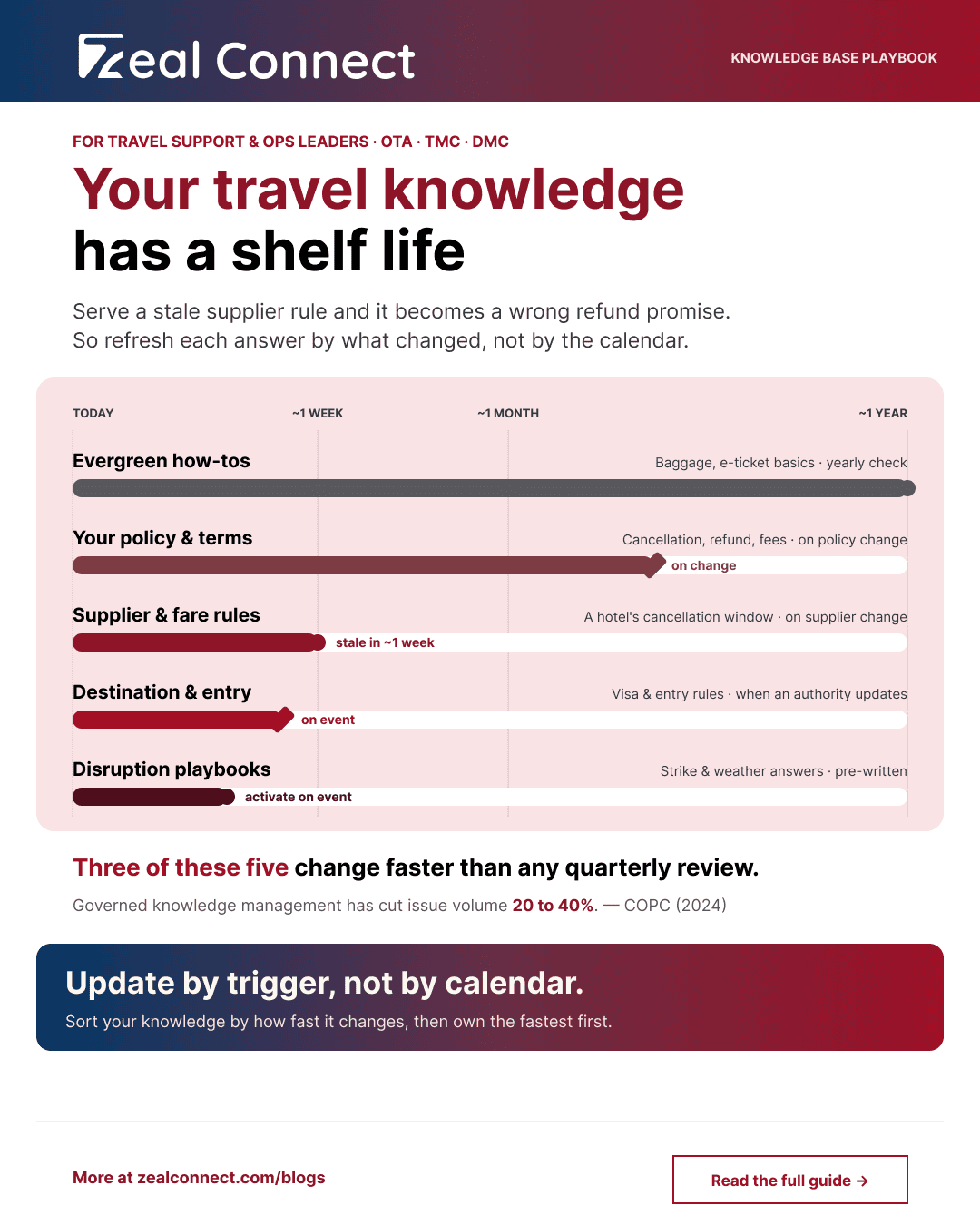
Because travel knowledge has different shelf lives and different owners, and treating it as one flat pile is how it rots. A baggage how to is stable. A hotel's cancellation window can change with a season, and you don't even own that fact, the supplier does. Sort your knowledge by how fast it changes and who owns the truth, and you can see where staleness will strike before it does. The table below is the sorting you can copy.
Table: What a travel customer support knowledge base holds, by how fast it changes and who owns it
| Knowledge type | Example in travel | Who owns the truth | How fast it goes stale | Which layer it serves |
|---|---|---|---|---|
| Evergreen how to | Reading an electronic ticket, baggage basics | You (support) | Low, yearly | Traveler, agent, AI |
| Your policy and terms | Cancellation, refund, and fee rules | You (ops, legal) | Medium, on change | Traveler, agent |
| Supplier and fare rules | A hotel's cancellation window | Supplier (you mirror) | High, weekly | Agent, AI |
| Destination and entry | Visa and entry requirements | External authority | High, event driven | Traveler, agent |
| Disruption playbooks | What to tell travelers in a strike | You (ops) | Spiky, pre written | Traveler, agent, AI |
One Travel Knowledge Base, Three Audiences: Travelers, Agents, and AI
The same fact needs three forms. A traveler wants a short, plain answer in the help center. An agent wants the policy plus the edge cases and the exact wording to send. An AI assistant needs a clean, grounded version it can quote without inventing. All three should trace back to one source of truth, an approach Zendesk (2025) frames as keeping agents and any bot drawing from the same knowledge. Travelers already expect this depth, since 70 percent of American travelers say they're likely to check themselves in by app or kiosk, per Mews (2025).
One policy update should change every surface at once: the traveler's answer, the agent's answer, and the AI's answer.
Key Terms Worth Knowing
Ticket deflection: a customer question answered through self service, so no agent ticket is ever created.
Single source of truth: one authoritative place each answer lives, so the help center, agents, and AI all agree.
Taxonomy: how knowledge base content is categorized and labeled, which decides whether people can find an answer.
Content decay (staleness): knowledge going out of date, most often supplier terms, fare rules, and entry requirements.
AI grounding: an AI assistant answering only from your approved knowledge base rather than inventing a policy.
How to Build a Customer Support Knowledge Base for Travel, Step by Step
You build a travel knowledge base in a deliberate order, because the order decides whether it cuts contacts or just fills a folder. Start with real data about what travelers ask. Structure it around how they ask. Then write, and write the answers that matter most first. The classification above tells you which those are.
Step 1: Mine Your Real Customer Support Tickets Before You Write Anything
Start with the contacts you already have, not a blank content plan. Pull the last quarter of tickets and rank the reasons by two numbers: how often each one comes in, and how much each one costs to handle. The top of that list is your first backlog of articles. Say a mid size tour operator pulls 4,000 tickets and finds five reasons drive about 60 percent of them: refund status, meeting point confusion, date changes, visa questions, and supplier no shows. Those five become the first five articles, written before anyone touches a low volume topic.
Step 2: Structure the Knowledge Base Around How Travelers Ask, Not How You're Organized
Organize by the traveler's question, not your internal departments. Findability is the top reason self service fails, appearing in more than 43 percent of failed attempts in that same Gartner (2024) survey, so your categories and titles have to match the words travelers use. Someone types "change my flight," not "post booking amendment." Use their language in titles, keep one idea per article, and the same help article fundamentals that work anywhere will carry travel content too.
Step 3: Write the Volatile, High Volume Answers First, in Three Forms
Write the fast changing, high traffic answers before the easy evergreen ones. Supplier terms, refund rules, and entry requirements drive contacts and go stale quickly, so they earn the first effort. As you write each one, produce its three forms at once: the short traveler version, the agent version with edge cases and send ready wording, and the grounded version an AI assistant can quote. Pre write your disruption playbooks here too, so the answer for a strike or weather event is ready before the day it's needed.
Write the answers that change fastest and get asked most first, not the easy evergreen ones.
How Do You Keep a Travel Customer Support Knowledge Base From Going Stale?
You keep it current with a maintenance system, not good intentions. A knowledge base is a live operation, and the travel content that helps travelers most is the content that decays fastest. Three habits keep it honest: update by trigger rather than calendar, give every answer an owner, and measure more than deflection. Do those, and the knowledge base keeps cutting contacts instead of quietly generating them.
How Often Should You Update Travel Knowledge Base Content?
As often as the content itself changes, which is not the same rhythm for every article. A blanket quarterly review is too slow for a supplier rule and a waste of time for a baggage how to. Tie the cadence to the volatility tiers from the table: evergreen content gets a yearly check, your own policies update on change, and volatile supplier and entry content needs a trigger. When a supplier changes a term, that event, not the calendar, drives the update.
Assign an Owner to Every Answer, Especially the Ones You Don't Control
Every article needs a named owner, and the riskiest ones are those whose truth lives outside your company. You can't stop a hotel from changing its cancellation policy, but you can assign someone to watch that source and update your mirror of it. Without an owner, external truth drifts silently until a traveler or an agent hits the gap. As travel companies test agentic AI for servicing, that ownership matters more, because an ungoverned source is what makes an assistant confidently wrong.
Measure More Than Deflection to Catch Confident but Wrong Content
Deflection alone will lie to you. Track the self service success rate, coverage gaps, content age, and how often agents reuse an answer, so you catch decay before customers do. Governed knowledge management pays off here: organizations that run it with governance have seen 20 percent to 40 percent reductions in issue volume, according to COPC Inc. (2024). The gain comes from maintenance, not just publishing.
A knowledge base can post a healthy deflection rate while serving a stale answer to everyone who reads it.
Conclusion
Support quality in travel comes down to the answer behind the ticket, and the knowledge base is where that answer lives or fails. Treat it as one flat library and the fast changing content, supplier terms, entry rules, disruption answers, goes stale while the deflection number still looks fine. Sort your knowledge by how fast it changes and who owns it. Build from your real contact data, writing the volatile, high volume answers first and in three forms, so travelers, agents, and any AI assistant read from one source of truth. Then govern by trigger and metric, not by calendar. The first move is small: pull last quarter's top contact reasons and classify each one against the table above.
Frequently Asked Questions
How do I stop supplier specific content from going out of date in my knowledge base?
Assign an internal owner to each supplier source and update on a trigger, not a calendar. When the supplier changes a term, the owner updates your mirror of it. Tag that content as high volatility so reviews are event driven and agents know it is the fastest changing part of the base.
Should my travel knowledge base be one thing customers read, or separate content for agents and AI?
One source of truth, in three forms. Travelers get a short public answer, agents get the same answer with edge cases and send ready wording, and an AI assistant gets a grounded version it can quote. All three trace back to one record, so a single policy update changes every surface at once.
What should I put in a customer support knowledge base for travel first?
The answers with the highest volume and cost, which in travel are usually the volatile ones. Mine last quarter's tickets, rank reasons by frequency and handling cost, and write those first. Supplier terms, refund rules, and entry requirements earn priority because they drive contacts and go stale quickly.
How do I measure whether my knowledge base is working beyond a deflection rate?
Track self service success, coverage gaps, content age, and agent reuse. Deflection can look healthy while stale answers quietly cause repeat contacts. Self service success shows whether travelers actually resolved their issue, and content age flags the supplier and entry articles most likely to be wrong.
How does a travel knowledge base handle a disruption spike?
With disruption playbooks written before the event. During a strike or weather event, the same question arrives thousands of times, so the answer must already exist in all three forms. Pre writing lets you activate a ready answer across the help center, agents, and any assistant the moment the disruption starts.